
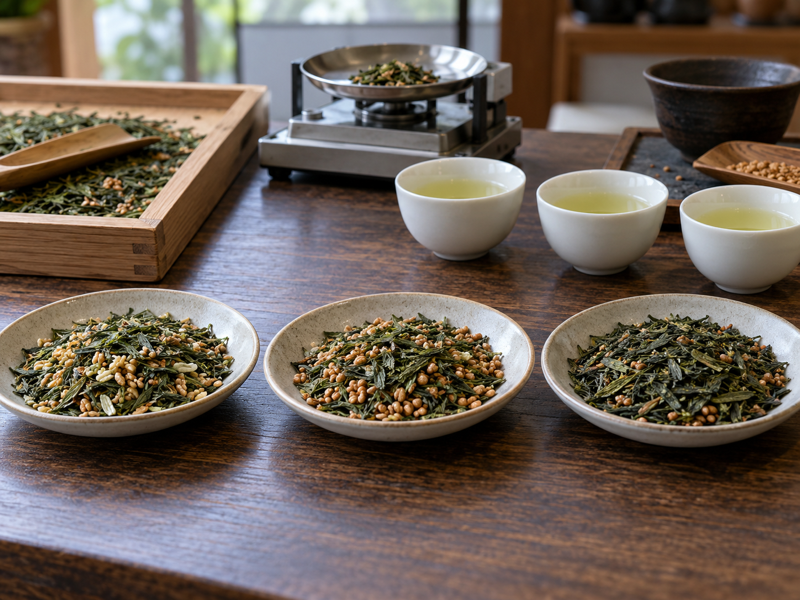
“Premium genmaicha” is a sales phrase, not a complete purchase specification. Two blends can differ in leaf base, rice roast, ratio, cut size, and intended use while both carry that label. A buyer needs to translate grade language into attributes that can be sampled, tested, and repeated. This guide explains how to compare genmaicha tea grades for loose-leaf retail, tea bags, and foodservice. It does not declare one grade universally best; the right material depends on the cup and channel the business wants to deliver.
Contents
- 1. What does a genmaicha grade describe?
- 2. How does the tea leaf base change the blend?
- 3. What should be specified about roasted rice?
- 4. Why does the tea-to-rice ratio matter?
- 5. How do cut size and fines affect use?
- 6. What is the role of matcha in a grade?
- 7. How should buyers taste grade samples?
- 8. Which grade fits each sales channel?
- 9. What documentation should a supplier provide?
- 10. How should a grade be approved and controlled?
1. What does a genmaicha grade describe?
A useful grade describes the material and its expected performance, not only a price tier. Japan’s MAFF tea reference names bancha, sencha, and gyokuro as possible green-tea bases mixed with roasted brown rice. Each can produce a different cup when combined with rice. Commercial grades may also vary in leaf cut, rice roast, ratio, matcha addition, and pack form. Ask suppliers to define their own grade terms before comparing quotes.
A buyer should begin with an application brief: brewed specialty cup, everyday café tea, retail sachet, or ingredient for a dessert. The same visual grade may perform differently in those uses. A finely cut leaf could be useful in a tea bag and less attractive in a transparent loose-leaf pouch. A rice-forward blend might smell appealing but feel thin if the tea portion is too low. The grade is only meaningful when linked to a finished-product target.
| Grade dimension | What to ask | Finished effect |
|---|---|---|
| Tea base | Bancha, sencha, gyokuro? | Body and cost |
| Rice roast | Light or dark? | Aroma |
| Ratio | Tea vs rice? | Strength |
| Cut size | Whole or broken? | Brew and appearance |
2. How does the tea leaf base change the blend?
Bancha, sencha, and gyokuro are different tea inputs with different price and sensory expectations. A sencha base may give a familiar green-tea profile; a gyokuro component may offer a deeper, more umami-forward note; a bancha base can support an everyday blend. These are starting hypotheses, not guarantees of quality. Poorly handled premium leaf can make a worse cup than a well-made standard blend. Taste the final genmaicha, not the leaf alone.
Ask for the tea-base specification and whether more than one leaf grade is used. A supplier may change the mix to manage availability unless the buyer controls it in the purchase agreement. If the brand uses a named premium leaf in marketing, keep documentary support and test whether customers can perceive the difference. The gyokuro genmaicha guide goes deeper on that particular blend. For a general grade comparison, leaf base is one variable among several that must be held or recorded during tasting.
3. What should be specified about roasted rice?
Roasted rice contributes the aroma that separates genmaicha from plain green tea. Specify rice type or supplier where relevant, roast target, size range, and acceptable sensory profile. A darker roast may bring a strong cereal note but also a burnt edge. A light roast can seem delicate or weak depending on the tea base. Popped grains sometimes appear in the blend; they can affect appearance but do not by themselves prove a better cup. Taste and physical consistency matter more than a photograph.
Rice particle size affects mixing and packing. Very fine pieces can settle or create dust; large pieces may separate from leaf in a hopper. Request samples from a production-equivalent run, not only a hand-mixed bowl. Brew from several portions of a bag to see whether the ratio changes. Record the dry aroma and brewed cup. If a supplier changes roast equipment or rice source, the buyer should receive notice and reapprove the sensory target.
| Rice feature | Quality question | Process question |
|---|---|---|
| Roast level | Pleasant, not burnt? | Repeatable? |
| Size | Good mouthfeel? | Segregation? |
| Popped grains | Useful appearance? | Breakage? |
| Moisture | Stable storage? | Specified test? |
4. Why does the tea-to-rice ratio matter?
The ratio sets how much leaf and rice enter each gram of blend. More rice can emphasize toast and reduce the tea fraction; more leaf can strengthen green-tea body and astringency. Neither direction is automatically premium. A buyer should compare the ratio under a fixed brew, then assess whether the cup meets the intended style. If two quotes are priced per kilogram but one blend contains far less tea leaf, the apparent bargain may change when cost is calculated per enjoyable cup.
Ask the supplier for a target ratio and a reasonable manufacturing tolerance. Then sample across the packed lot to see whether distribution stays within the agreed range. Rice and leaf may settle differently in a bulk sack or filling hopper. A consistent average batch ratio does not guarantee consistent sachets. If the exact ratio is proprietary, the supplier should still offer an agreed physical and sensory acceptance standard that lets the buyer protect the finished product.
5. How do cut size and fines affect use?
Whole or larger leaf pieces can look attractive in a loose-leaf pouch and may brew differently from a fine tea-bag cut. Fines can make a cup cloudy or bitter if the brew method is not adjusted. Roasted-rice crumbs can add sediment or seal contamination during sachet filling. Specify the physical form needed for the sales channel and ask for a sieve profile or other appropriate measure if the application requires tight control. Inspect the actual filled pack.
Run the planned brewer in testing. A large-leaf blend may not fit a small flat tea bag well, while a fine cut may over-extract in a customer’s loose-leaf pot. The buyer should not treat bagged and loose versions as one interchangeable SKU. Package design, dose, and brew instruction belong in the grade decision. The genmaicha tea packaging guide details those format questions.
| Physical form | Suitable use | Watch point |
|---|---|---|
| Larger leaf | Loose retail | Uneven scoops |
| Fine cut | Tea bag | Fast bitterness |
| Powder | Food application | Grit |
| High fines | Low-cost blend | Cloudiness/seals |
6. What is the role of matcha in a grade?
Matcha-iri genmaicha adds powdered tea to the blend. It can make the first cup greener and give more tea body, but it changes the product rather than merely raising its grade. A standard genmaicha and a matcha-added genmaicha should be compared as distinct styles. The powder can settle in bulk handling or move into the first infusion, affecting consistency. Ask for the matcha share and whether the buyer’s brewing and pack format can control it.
Avoid treating matcha as a shortcut to a premium claim. A poorly balanced matcha coating can cover a weak rice roast or create a cloudy cup the customer did not expect. Test flavor, color, sediment, and cup-to-cup variation. If the brand sells both styles, name them clearly on menus and pack artwork. The matcha-iri guide explains the blend in more detail; the purchasing question is whether the addition supports the planned use at a repeatable cost.
7. How should buyers taste grade samples?
Write one common brew protocol with dose, water, temperature, time, vessel, and serving temperature. Brew all samples blind under that method. Then, if suppliers provide different recommended brews, test those as a second round. Score roasted-rice aroma, green-tea body, astringency, aftertaste, appearance, and sediment. A grade should win because it meets the target, not because a salesperson called it “ceremonial” or because one sample was brewed more carefully.
Taste from at least two lots when supply allows. Request a production-equivalent sample, since small hand-packed bags may look better than a line-filled order. Check top and bottom portions of a bulk pack for segregation. Use a reference cup and retain records so a future buyer can compare new lots. If the winning grade is intended for milk tea or dessert, run a finished-product trial too. The best plain cup may not be the best ingredient in a sweet matrix.
| Tasting item | Fixed method | Score |
|---|---|---|
| Dry aroma | Same sample mass | Roast |
| Brewed cup | Same protocol | Leaf/rice balance |
| Appearance | Same vessel | Fines/sediment |
| Later sip | Same temperature | Finish |
8. Which grade fits each sales channel?
Specialty retail may reward visible leaf quality and a nuanced cup. A busy café may need a blend that remains clear and consistent under a simple brew card. Individual sachets need reliable fill and extraction in a customer’s cup. Food manufacturers may care more about powder fineness and flavor survival than leaf appearance. Write a separate target for each channel rather than stretching one “premium” grade across all of them. Shared ingredients can still be used when trials support them.
Cost the finished serving. A higher-priced tea may need fewer grams for the desired cup, while a lower-priced blend may need a stronger dose. Include packaging, waste, and staff time. If a café’s staff cannot identify the sensory difference between two grades after normal service, the expensive option may not support the menu price. If retail customers are buying a visible loose-leaf experience, the same difference may be central. Channel fit is a test result.
| Channel | Priority | Grade check |
|---|---|---|
| Loose retail | Appearance and cup | Leaf/rice integrity |
| Café | Repeatability | Brew tolerance |
| Sachet | Fill consistency | Extraction |
| Baking | Particle/flavor | Heat survival |
9. What documentation should a supplier provide?
Request a current specification, ingredient statement, tea-base and rice information, physical form, relevant quality test results, origin documentation for any claim, pack details, storage guidance, lot coding, and change-control process. The exact document package depends on the market and use. A supplier should be able to explain what changes between its grades in operational terms. If the only difference is a vague adjective, the buyer has little basis for approving a price premium.
Link the spec to a retained sample and brew protocol. Ask which attributes are fixed and which may vary within a stated range. If the supplier substitutes a tea lot, changes rice roast, or moves milling, the brand may need a new sensory and label review. Documentation is not a substitute for tasting, and tasting is not a substitute for records. Both are needed to repeat a product across months and purchase orders.
10. How should a grade be approved and controlled?
Approve a named grade for a named use, with an accepted sensory range, physical limits, pack format, price basis, and change-notification terms. Run a production-equivalent trial and check samples across the lot. If it is for a café, confirm the staff brew; if for a tea bag, confirm the filled bag; if for a bakery, confirm the baked item. Do not let a sample cup carry a broader approval than the test supports.
Keep a small incoming inspection plan: verify lot, pack integrity, appearance, dry aroma, and a brewed reference where practical. Investigate changes before compensating with a higher dose. Review the grade when sales channel, package, or recipe changes. The purchase specification should let the next procurement colleague order the same material and let the next quality colleague decide whether a delivered lot matches it. That is what a useful grade means in business terms.
FAQ
Q1. Is gyokuro genmaicha always the highest grade? No. It is a distinct tea-base choice; quality depends on the full blend and use.
Q2. Do popped rice grains prove better genmaicha? No. They affect appearance, but the brewed cup and consistency matter more.
Q3. Can one grade serve both loose tea and tea bags? Sometimes, but each pack and brew format needs testing.
Q4. Does more matcha make a blend premium? Not automatically. Matcha changes color and taste; balance and consistency still decide quality.
Q5. What should a buyer request first? A clear specification, traceable sample, and recommended brew method.
A grade is approved when the supplier can repeat the cup and the buyer can verify it on arrival.