
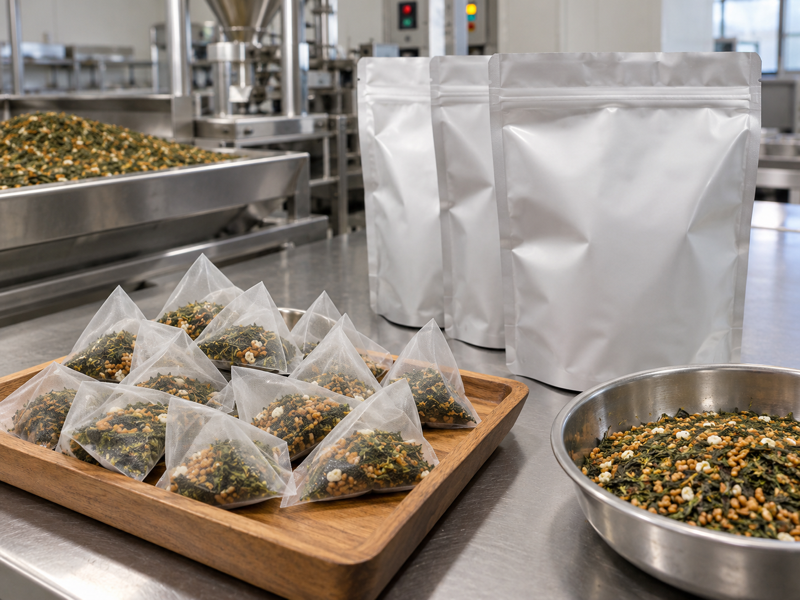
Genmaicha tea packaging has one job beyond looking good: keep the green-tea and roasted-rice cup recognizable until the buyer opens it. A beautiful pouch with a weak seal can lose the rice aroma; a tight barrier pack can still frustrate cafés if its bulk size leaves tea open for weeks. This guide helps brands and buyers choose between loose-leaf pouches, sachets, and foodservice packs. It links format to filling, distribution, shelf life, and the actual way customers brew the tea.
Contents
- 1. What must genmaicha packaging protect?
- 2. Which pack format fits the channel?
- 3. How should a tea bag be specified?
- 4. What matters in a loose-leaf pouch?
- 5. How can bulk packs work for cafés?
- 6. Which barrier and seal checks are needed?
- 7. How does filling affect blend consistency?
- 8. What should a shelf-life trial compare?
- 9. What belongs on the label?
- 10. How should a packaging supplier be approved?
1. What must genmaicha packaging protect?
The pack must protect aroma, physical quality, and the approved serving experience. Green tea can lose freshness; roasted-rice notes can fade or pick up odors. Moisture may cause clumping or change the dry blend. Rice and leaf pieces can also break or separate during handling. A shelf-life date should be supported by the actual filled package, not only by a loose tea sample. Write the desired brewed-cup standard before choosing a film because the customer buys the cup, not the barrier specification alone.
The existing genmaicha tea shelf-life guide explains how to study stability. Packaging selection starts with the distribution route: warehouse, container, retail shelf, café back room, or online parcel. Each route exposes the pack to different light, temperature, humidity, and handling. Define the route and expected opening pattern before comparing materials. A high-barrier film can be wasted if the user leaves a large bag open for a month.
The site's best genmaicha tea guide discusses the cup a buyer is trying to preserve. Packaging trials should use that approved cup as a reference.
| Protection target | Possible failure | Check |
|---|---|---|
| Roast aroma | Fades | Brewed sensory |
| Tea freshness | Flat/stale | Reference cup |
| Moisture | Clumps | Pack and material test |
| Blend integrity | Rice/leaf segregation | Portion samples |
2. Which pack format fits the channel?
A loose-leaf retail pouch lets customers see and dose the blend, but it needs an effective closure after opening. Individual sachets give consistent portioning and convenience, yet each has its own seal and may hide leaf quality. A café bulk bag can reduce unit packaging cost but may lose aroma during repeated daily opening. Choose the format from how the tea will be used, not from a competitor’s shelf photograph. Run a cup test in the intended brewer for every format.
Cost per pack is only one line. Sachets involve filling speed and material costs; loose pouches involve scoops and customer instructions; bulk packs involve open-use waste. A tea-bag guide for genmaicha provides a consumer angle, but a private-label buyer must specify the bag material, fill, seal, and finished cup. A supplier should be able to explain why a format fits the buyer’s volume and channel.
| Format | Best use | Main risk |
|---|---|---|
| Loose retail pouch | Tea enthusiasts | Open-pack aroma |
| Individual sachet | Convenience | Seal and fill |
| Café bulk pouch | High throughput | Repeated opening |
| Tin/jar | Premium shelf | Light/lid control |
3. How should a tea bag be specified?
Specify fill weight, bag shape, mesh or paper material, seal method, tag/string if used, and expected cup size. Genmaicha has both leaf and rice. A small bag with coarse pieces may not allow enough water movement, while a fine cut may brew quickly but change the cup’s clarity and texture. Trial the bag in the customer’s normal mug, not only in a laboratory beaker. The brew should reach the approved aroma and taste within the printed instructions.
Ask whether the bag material and any adhesives or inks meet food-contact requirements in the target market. Test bag integrity after shipping and in hot water. A pyramid bag may look premium, but the material and fill must be appropriate; a flat bag may perform well at a better cost. Sample from the beginning, middle, and end of a filling run to see whether rice and leaf remain proportionate. A bag that contains mostly rice is a blend-control failure, even if its weight is correct.
4. What matters in a loose-leaf pouch?
A loose-leaf pouch should preserve aroma before opening and be usable afterward. Compare opaque barrier structures, seal design, zipper reliability, and opening size. A narrow mouth can make a café scoop awkward; a wide mouth can expose more tea to air. For retail, the pouch should stand and close as intended without forcing customers to transfer tea to another container. Test the printed brew instruction with an average household spoon or, better, give grams for accuracy.
If a clear window is desired, evaluate light exposure and shelf presentation through the intended sales period. A visible blend can help sell genmaicha because rice and leaf are distinctive, but visibility should not shorten quality life beyond the planned date. Use a filled-pack test, not an empty-film claim. Check whether the pouch survives compression in a shipping carton and whether its bottom gusset traps rice fines. A beautiful pack that fails after online delivery is not a good pack.
| Pouch feature | Benefit | Test |
|---|---|---|
| Barrier film | Aroma protection | Shelf study |
| Zipper | Reclosure | Repeated-use test |
| Window | Ingredient visibility | Light exposure |
| Gusset | Shelf stability | Parcel compression |
5. How can bulk packs work for cafés?
Size the pack to actual store turnover. A high-volume site may use a large pouch quickly; a slow site may leave it open long enough for roast aroma to fade. The pack should have a reliable closure, practical opening, and clear lot and opening-date area. Staff need dry scoops and a storage place away from steam and strong odors. A printed best-before date usually describes unopened storage; the café should establish an open-use period for its routine.
Test the full routine. Open and close the pouch as staff would, dose tea several times daily, and brew a cup near the end of the proposed open period. If aroma weakens, smaller packs may save more product than they cost. Do not ask staff to “use a little extra” to rescue an ageing blend. That changes cost and caffeine exposure while failing to restore the right roast note. Keep bulk-pack and retail-pack shelf plans separate.
6. Which barrier and seal checks are needed?
Request material data relevant to oxygen, moisture, light, and food-contact compliance. Then verify the complete pack: heat seals, zipper, corners, any tear notch, and transport performance. A film with good barrier numbers can still fail if the line seals it poorly. Set inspection criteria for seal appearance and integrity. Check a sample after normal shipping, not only at the filler. If the package includes an inner sachet and outer pouch, assess both layers as a system.
The choice of tests depends on material and product risk, so the quality team should set the method and acceptance limit. Keep the result linked to the exact film structure and machine settings. A supplier change to a “similar” film may alter seal behavior. Require a change notification and validation before switching it under existing artwork and date coding. Packaging protects a sensory promise; it deserves the same revision control as the tea formula.
| Package part | Failure | Verification |
|---|---|---|
| Heat seal | Leak | Integrity test |
| Zipper | Incomplete closure | Use simulation |
| Film | Aroma/moisture ingress | Stability study |
| Carton | Crushing | Route trial |
7. How does filling affect blend consistency?
Rice and tea leaf differ in shape and density. Vibration and hopper design can make a blended batch separate during filling. Check samples from early, middle, and late production, and from top and bottom of bulk bags. Measure total fill weight and, where useful, the visible rice-to-leaf distribution. A sachet with the right total grams can still taste wrong if the blend has segregated. The pack line must maintain the formula that the buyer approved.
Powder and fines can create dust, seal contamination, or inconsistent bag flow. Keep equipment settings and cleaning rules in the production record. If a new tea grade or rice size is introduced, recheck filling before claiming it is a minor ingredient substitution. The customer experiences each bag or scoop, not the average of an entire batch. A good pack specification includes portion consistency, not only a material code and artwork file.
8. What should a shelf-life trial compare?
Trial the actual blend in competing final packs under expected storage and any justified challenge conditions. At planned intervals, inspect pack integrity, dry aroma, brewed flavor, moisture-related measures, and relevant safety attributes. Blind tasting against a retained reference helps identify when the roasted-rice note fades. A film can perform well for plain green tea and poorly for a more aroma-sensitive genmaicha blend. Do not extend a date from another SKU without evidence.
Also test opened packs according to the channel. A retail customer may open a pouch weekly; a café may open it dozens of times. A sachet is usually used once but has many seals to inspect. The study should answer whether the last normal serving tastes like the approved cup. If one format fails earlier, set a different date or improve the pack. A single universal date across all formats is convenient only if the data support it.
| Study sample | Question | Outcome |
|---|---|---|
| Unopened pouch | Pre-sale life | Date basis |
| Opened retail pouch | Home use | Reclosure advice |
| Café bulk pack | Daily exposure | Open-use period |
| Individual sachet | Unit integrity | Seal acceptance |
9. What belongs on the label?
The pack should identify the product, ingredients, net content, lot, date, storage instructions, and other information required by the destination market. If the tea contains matcha or flavoring, the description should reflect it. Standard genmaicha contains green tea and caffeine; avoid an unsupported caffeine-free statement. An organic or origin claim requires documentation for the actual product. The regulatory team should approve wording and layout before a large print run.
Instructions matter to quality. Give a practical brew method matched to the packed form and intended cup. A sachet instruction written for a loose-leaf pot can disappoint customers. A bulk foodservice pack may need an operator sheet rather than only consumer copy. Tie artwork to the formula and pack revision. If the fill weight, bag material, or brew recipe changes, review the label again. Good packaging helps the customer make the cup the brand tested.
10. How should a packaging supplier be approved?
Ask for food-contact documentation, material specification, barrier data where relevant, seal recommendations, traceability, and change-control terms. Run a line trial with filled packs and the actual genmaicha blend. Check throughput, seal integrity, print quality, dosing consistency, and shipping performance. Taste cups from multiple points in the run. A supplier’s empty sample pouch can show appearance, but it cannot prove that the finished system protects aroma or fills evenly.
Approval should include a shelf-life plan and a retained filled-pack reference. Cost the format using material, filling waste, rejected packs, shipping cube, and product loss from poor open-use performance. A cheaper pouch can be expensive if it weakens the last cup or fails on a parcel route. Choose the format that preserves the approved tea and works for the way customers actually use it.
FAQ
Q1. Are tea bags worse than loose-leaf genmaicha? Not automatically. Bag fill, material, size, and brew method determine performance.
Q2. Does a zipper preserve aroma by itself? It helps reclose a pack, but the full barrier and use routine need testing.
Q3. Why do sachets taste inconsistent? Rice and leaf may segregate during filling even when bag weights match.
Q4. Can retail and café packs share one shelf-life date? Only if the actual pack and storage data support it; open-use rules are usually separate.
Q5. What should a buyer test first? A finished cup from a filled production pack after realistic storage and transport.
The winning package is the one that delivers the approved genmaicha cup at the end of the planned selling period.