
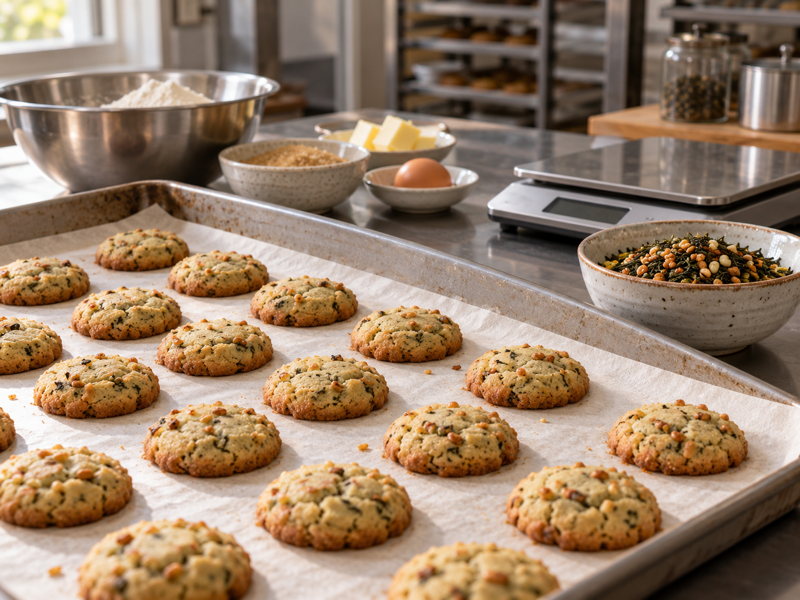
Genmaicha cookies can taste like a specific tea, or like an ordinary butter cookie with faint green specks. The difference appears in ingredient form, baking loss, sweetness, and how much roasted-rice aroma survives the oven. A home recipe can tolerate variation; a bakery selling the same item across stores needs a controlled formula and a repeatable sensory target. This guide gives product developers a way to test the tea, build the cookie, and check it after packaging. It does not prescribe a universal dose for every flour or fat system.
Contents
- 1. What should genmaicha cookies taste like?
- 2. Which tea form works in cookie dough?
- 3. How can toasted-rice aroma survive baking?
- 4. What should a first dose trial compare?
- 5. How does tea affect color and texture?
- 6. Which add-ins help or hide the tea?
- 7. How should a bakery judge the baked cookie?
- 8. What changes during packing and shelf life?
- 9. What should the ingredient label say?
- 10. How can a chain repeat the product?
1. What should genmaicha cookies taste like?
Write a target before testing ingredients. A genmaicha cookie should offer a recognizable toasted-rice note and enough green-tea character to support the name. The cookie still needs to taste good as a cookie: browned edges, pleasant sweetness, and a clean finish. Decide whether the tea should lead or sit behind butter and sugar. That choice affects dose, tea form, and whether chocolate or citrus belongs in the formula. A sample that smells of genmaicha in raw dough may lose that identity after baking.
Use a plain control cookie from the same base recipe. Compare it with tea variants at the same bake and cooling conditions. Ask tasters to describe the first aroma, middle of the bite, and aftertaste without being told which sample contains tea. If nobody identifies toasted rice, the product may need a different tea ingredient or less masking sweetness. If everyone notices bitterness or grit, adding more sugar is a weak fix. The existing genmaicha tea recipe describes the brew; the cookie requires its own flavor target.
| Sensory point | Desired result | Common failure |
|---|---|---|
| First aroma | Toasted rice | Generic butter |
| Mid-bite | Tea and cereal balance | Sugar dominates |
| Finish | Clean and short | Dry bitterness |
| Texture | Planned crumb | Grit from coarse tea |
2. Which tea form works in cookie dough?
A finely milled genmaicha powder can distribute through dough, but rice and leaf particles may differ in size and flavor. A brewed infusion brings tea notes with added water, which can change cookie spread and crispness. A concentrated extract may be easier to dose yet may not provide the same rounded roast character. A bakery should request the ingredient composition and particle-size information where available, then test each form in the actual dough. “Tea powder” is not a complete specification.
Try one form at a time while holding flour, fat, sugar, and bake constant. If whole roasted-rice grains are used as visible inclusions, check whether they stay pleasant after baking and storage. A hard grain that looks attractive in a close-up can feel like a defect in a thin cookie. Sifted powder may provide a smoother bite, while an infusion may suit a softer dough. The winner is the form that meets flavor and texture targets after the cookie has cooled and sat in its intended package.
3. How can toasted-rice aroma survive baking?
Baking drives off volatile aromas while creating new browned notes. A strong oven roast can make the cookie itself smell toasted, which may hide the distinct rice-tea note. Trial the bake profile along with ingredient choice. A lower or shorter bake may protect aroma but change food safety, moisture, or texture; any change must be validated in the bakery’s process. The aim is not to stop browning, but to make the tea recognizable in the finished cookie.
Taste at three moments: after full cooling, after a day in the proposed pack, and near the planned end of shelf life. Warm cookies can flatter an aroma that disappears in retail. A filling, glaze, or post-bake dusting might add tea character, but it also adds handling and label complexity. Compare the whole cost and sensory result against a simpler dough-only solution. A supplier sample should be evaluated under the same bake, not by sniffing the dry bag.
| Trial change | Expected effect | Check |
|---|---|---|
| Tea powder grade | Different flavor release | Finished bite |
| Bake endpoint | Browning vs aroma | Color and moisture |
| Post-bake finish | Stronger top note | Stability and mess |
| Pack barrier | Aroma retention | Shelf study |
4. What should a first dose trial compare?
Build a small matrix with a plain control and several tea levels within a range recommended by the ingredient supplier and bakery team. Keep dough temperature, piece weight, tray position, oven program, and cooling time consistent. Record how the tea changes dough handling before discussing flavor. A powder can absorb moisture, alter spread, and create specks. If the base dough changes significantly, reformulate deliberately rather than comparing cookies with different shapes and doneness as though only the tea dose changed.
Blind taste the cooled samples. Score roasted-rice aroma, green-tea note, sweetness balance, bitterness, texture, and appearance. Repeat the preferred dose with a second ingredient lot before approving it. Lot variation in roast can make a narrow winning formula unstable. Document the actual grams in each batch and the percent in the final dough; “one spoonful” is not a commercial measure. The final formula should be reproducible by a shift team that did not design it.
5. How does tea affect color and texture?
Genmaicha does not necessarily make a bright green cookie. Roasted rice can add tan flecks, and tea leaf may turn duller during baking. A muted color can be honest and appealing if the flavor is clear. Avoid trying to force a matcha-green appearance with a high tea dose that makes the cookie dry or bitter. If visual identity matters, use a controlled topping or package photograph that shows the real baked result. Do not let a digital image promise a color the line cannot repeat.
Powder fineness affects mouthfeel; coarse leaf pieces can feel papery, and roasted rice fragments can feel hard. Flour type and fat level change how noticeable those particles are. Test texture after storage, when crisp cookies may soften and soft cookies may dry. A supplier’s particle-size certificate can help screen candidates, but it cannot replace eating the actual cookie. Keep a retained reference sample and a simple defect vocabulary for the bakery’s quality panel.
| Observation | Likely cause | Next test |
|---|---|---|
| Grit | Coarse rice or tea | Finer form |
| Dry bite | Powder absorption | Adjust liquid/fat |
| Uneven specks | Poor dispersion | Mixing order |
| Pale tea flavor | Aroma loss | Different form |
6. Which add-ins help or hide the tea?
White chocolate, sesame, citrus, and nuts can complement a toasted tea profile, but each addition competes for attention. Start with the plain genmaicha cookie to prove the tea note. Then add one ingredient at a time. A sweet white-chocolate chunk may make the cookie more familiar to customers, yet it can overwhelm the green-tea finish. Black sesame can echo roast but may make the product read as sesame rather than genmaicha. Check allergens and declarations for every addition.
A café can use a paired drink or small garnish instead of loading all flavor into the cookie. Serve a plain cookie beside brewed genmaicha to let customers discover the link. For a packaged retail product, the cookie must stand alone after shipping and storage. Use the name “genmaicha cookie” only if the tea and rice remain perceptible. The buyer should not solve a weak tea ingredient with an unrelated flavoring that leaves the front-label story unsupported.
7. How should a bakery judge the baked cookie?
Set objective checks for piece weight, spread, thickness, moisture or water activity where appropriate, break, color, and packaging damage. Add a short blind sensory scorecard with the specific flavor target. Evaluate samples from different tray positions and production times. Ovens have hot spots, and a thin cookie can move quickly from pleasant roast to burnt note. A single hero photograph from the first test batch does not represent the line.
Hold tasting conditions constant. Warm and chilled cookies will give different aroma, and a cookie tasted beside coffee may seem less tea-forward than one tasted alone. Use the same serving temperature and a neutral palate between samples. If the bakery is scaling from a pilot mixer to a production line, recheck dispersion and bake. A process that works for two kilograms of dough may distribute powder unevenly in a much larger batch. Approval should follow the production-equivalent trial.
| QA point | Pilot record | Release question |
|---|---|---|
| Piece weight | Target and spread | Same size? |
| Tea flavor | Blind score | Recognizable? |
| Texture | Break and bite | Consistent? |
| Appearance | Photo standard | Honest match? |
8. What changes during packing and shelf life?
A cookie can absorb moisture and lose crispness; the tea aroma can fade or pick up unwanted notes from surrounding products. Test the final package material and closure with the actual cookie. A clear window may help shoppers see the flecks, but the pack still needs to protect quality through shipping and storage. Review grease resistance, oxygen and moisture barrier where relevant, and whether cookies break in transit. A shelf-life claim should be built from finished-product testing, not tea powder shelf life.
Taste stored cookies beside a freshly packed reference at planned intervals. Record which attribute fails first: texture, tea aroma, rancid fat note, or visible damage. If chocolate is added, watch its own bloom and storage needs. A supplier may provide tea stability data, but the bakery is responsible for the cookie. Choose a pack size the customer can finish while the cookie still tastes like the approved sample, and provide storage instructions that match the tested conditions.
9. What should the ingredient label say?
The label should identify genmaicha in a way that matches the ingredient composition and local rules. If the tea ingredient is a blend of green tea and roasted rice, the regulatory team should decide how to declare its components. Do not imply the cookie is caffeine-free because the powder contains rice; tea leaves are still present. Review allergens from flour, dairy, nuts, sesame, chocolate, or shared lines. Claims such as “organic” need product-level evidence, not only one tea supplier’s certificate.
Check the final formula after any pilot adjustment. A bakery may add a flavoring or change chocolate without updating the package draft. Tie label artwork to a formula revision and require sign-off before production. The finished-product name should be understandable to customers who have never heard genmaicha: a short subline such as “green tea and roasted rice cookie” can help. It is more useful than a vague “Japanese-inspired” story that tells the buyer nothing about the taste.
| Label item | Source record | Review |
|---|---|---|
| Tea blend name | Supplier spec | Composition |
| Allergens | Full formula | Market rule |
| Caffeine wording | Tea content | No false absence |
| Date and storage | Shelf study | Tested pack |
10. How can a chain repeat the product?
Write the formula in weights, not cups and spoonfuls. Specify tea ingredient SKU, lot acceptance, mixing sequence, dough temperature, portion size, oven program, cooling endpoint, and pack timing. Include a photograph of an approved cookie and a retained sensory reference. Train the line to identify underbake, overbake, uneven tea distribution, and hard rice pieces. A recipe without release checks will drift once several shifts produce it.
For a café chain, decide whether the cookie is baked centrally or on-site. A central bakery can control the process and ship finished packs; on-site baking may add aroma but increases variation. Test the actual distribution model before committing menu copy. Track customer complaints by lot and store, so a weak tea note can be traced to an ingredient, bake, pack, or holding problem. The cookie should taste like genmaicha at the last store on the route, not only in the development kitchen.
FAQ
Q1. Can loose genmaicha go straight into cookie dough? It can be tested, but coarse leaf and rice may give an unpleasant bite. A suitable powder or controlled infusion may work better.
Q2. Why does the tea disappear after baking? Oven heat and the cookie’s own browned flavors can hide delicate tea notes. Test the ingredient form and bake profile.
Q3. Should a genmaicha cookie be bright green? No. A muted color can be normal, especially with roasted rice.
Q4. Does a tea powder make the cookie caffeine-free? No. Green tea leaves contain caffeine.
Q5. What should a bakery test first? A plain control and several tea doses in the actual base dough, tasted after cooling and storage.
The release sample should be a packaged cookie from a normal production run. That is the product customers buy.