
Matcha tea leaves affect the flavor, color, safety, and the story a brand can honestly tell. Buyers often receive a finished green sample and a country-of-origin line, but little detail about growing, processing, blending, and milling. A traceable supply chain connects those steps to each powder lot. That matters when a company promises a particular origin, tries to repeat a flavor profile, or investigates a quality change between shipments.
Contents
- 1. What does “matcha tea leaves” mean in a purchase file?
- 2. How can matcha tea leaves influence flavor?
- 3. What should a buyer ask about shade-grown matcha tea leaves?
- 4. Which steps turn matcha tea leaves into powder?
- 5. How can milling change the finished powder?
- 6. What documents connect a carton to a leaf lot?
- 7. How should origin claims be reviewed?
- 8. How do storage and transport affect traceability?
- 9. How should a new source be qualified?
- 10. What belongs in a leaf-to-powder buying standard?
1. What does “matcha tea leaves” mean in a purchase file?
Separate matcha tea leaves from powder identity
Matcha is sold as powder, but its characteristics begin with the tea leaves and their handling. Ask a supplier what leaf material is used, how it is processed before milling, and whether multiple sources are blended. Do not infer the growing site from the packing address. ISO’s technical report on matcha provides a useful reference for discussing cultivation, manufacture, and sensory characteristics; an individual purchase still needs supplier-specific evidence.
Record the powder’s product code, ingredient statement, and lot. A sweetened mix or flavored powder contains ingredients beyond tea and requires a different specification. If marketing intends to describe leaves as shade-grown, from a particular region, or from a particular harvest, identify the evidence supporting each phrase. Traceability is a chain of records, not a photograph of a field on a brochure.
| Claim or fact | Evidence to request | Common gap |
|---|---|---|
| Growing location | Farm or producer record | Only packing address |
| Leaf process | Process description | Vague “traditional” claim |
| Powder lot | Milling and batch code | Sample without lot |
| Blend identity | Composition control | Silent source changes |
2. How can matcha tea leaves influence flavor?
Compare documented lots blind
Cultivar, growing conditions, harvest timing, and post-harvest handling can influence the sensory profile. A buyer does not need to turn every difference into a romantic story; it needs a repeatable target. Ask the supplier how it controls variation and whether a product is single-source or blended to a consistent profile. Taste documented lots at equal powder mass, water volume, and temperature. Note aroma, sweetness, astringency, bitterness, texture, and aftertaste.
Test the lots in the final product too. A leaf source that makes a delicate straight tea may not remain noticeable in milk or baking. Keep a retained reference sample and color photographs under fixed light. If a new shipment differs, those records allow the team to ask whether leaf input, processing, age, or storage changed. “It tastes different” is more useful when paired with comparable lot data.
3. What should a buyer ask about shade-grown matcha tea leaves?
Seek specific, supportable information
Shading is often discussed in matcha marketing, but a claim should reflect the supplier’s actual growing practices and records. Ask who applies shade, at which growing site, and whether the practice applies to all leaf sources in a blend. The supplier may have practical records such as field plans, harvest dates, and product specifications. If the brand prints a specific method or duration, a qualified reviewer should check that the wording is supported and appropriate for the market.
For purchasing, the more immediate question is whether the leaf program produces the required sensory and color profile consistently. Compare samples from different lots and seasons. Avoid treating a single growing detail as a guarantee of quality. Milling, storage, and formulation can still change the finished powder. Keep the shade claim separate from the performance decision so marketing and quality teams can each review their evidence.
| Supplier question | Why ask | File to retain |
|---|---|---|
| Which fields supply this SKU? | Source trace | Supplier declaration |
| Is material blended? | Claim scope | Blend control record |
| What growing practice is claimed? | Marketing accuracy | Supporting record |
| How are changes notified? | Consistency | Supply agreement |
4. Which steps turn matcha tea leaves into powder?
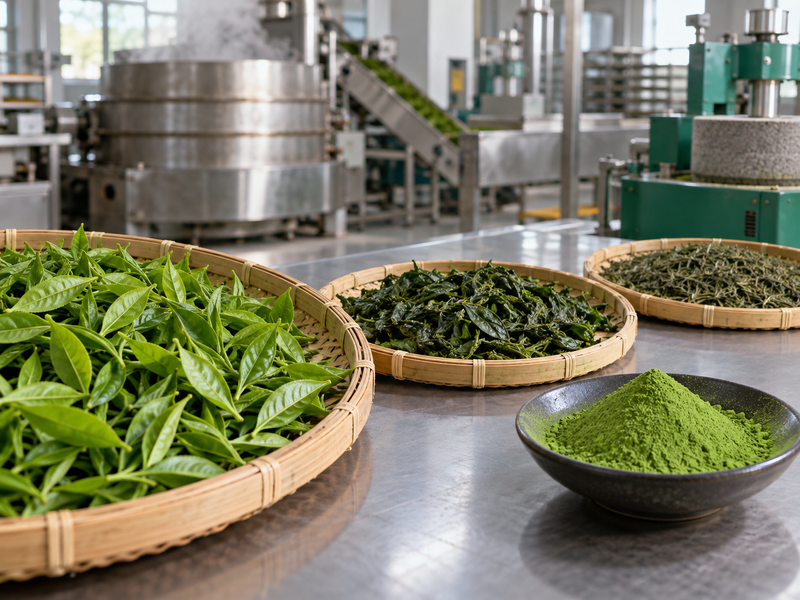
Follow matcha tea leaves between harvest and mill
Ask for a process flow at a useful level: harvest, steaming or other fixation, drying, sorting, removal of unwanted parts where applicable, storage of intermediate tea, milling, and packing. The exact route depends on the supplier. The goal is to understand where lots can be mixed, where quality is checked, and where contamination or identity errors could occur. A flow chart is more valuable when it names batch codes and responsible sites.
Match the finished powder lot to upstream records. If several leaf batches enter one powder lot, the supplier should be able to identify them and manage a recall or quality investigation. Buyers should request enough trace data to meet their own food-safety and customer obligations. Do not ask for decorative detail while ignoring the basic ability to trace one shipment backward and forward.
5. How can milling change the finished powder?
Treat the mill as part of the specification
Milling affects particle size, heat exposure, color, mouthfeel, and how the powder disperses. Ask where milling occurs, how lots are identified, and what controls keep the powder within the supplier’s physical specification. A new mill or grind profile can make a previously approved matcha settle differently in a beverage or leave flecks in a custard, even if the leaf source remains the same.
Test the powder with the same mixing method used by customers or production. Observe clumps, suspension, sediment, and texture. Keep the process and result with the lot record. A supplier’s milling story may be interesting, but the buyer needs reproducible properties and notification of material changes. If an origin statement refers to where powder was made, distinguish that from where leaves were grown.
| Powder attribute | Application impact | Test |
|---|---|---|
| Particle profile | Mouthfeel and sediment | Fixed mixing trial |
| Color | Product appearance | Standard light/photo |
| Aroma | Tea identity | Blind sensory test |
| Moisture | Handling and storage | Specification check |
6. What documents connect a carton to a leaf lot?
Build a traceable chain
Request the supplier product specification, ingredient statement, lot-linked certificate of analysis where appropriate, packing record, process or batch trace, origin evidence for claims, and shipping documents. Check that codes agree. A generic certificate without the shipped lot number is weak evidence for that delivery. The brand’s receiving process should record carton codes and retain samples so later complaints can be tied to a specific batch.
Set document requirements according to destination market and product risk with the technical team. Relevant safety checks may include contaminants and microbiological criteria under applicable rules, but the exact limits should not be copied from an unrelated website. Review how the supplier handles nonconforming lots and customer notification. A trace system should support action, not merely fill a folder with PDFs.
7. How should origin claims be reviewed?
Distinguish growing, processing, and packing
A pack may mention a country, region, farm, or processing tradition. Each statement should have a defined meaning and evidence. Leaves grown in one place can be processed or packed elsewhere. Ask legal and regulatory reviewers to assess the proposed wording for each sales market. A photograph or supplier presentation may help tell the story, but it does not replace shipment-linked records when a specific origin appears on a commercial label.
If the powder is blended across sources, the brand should understand how that affects claims and consistency. A supplier may blend to maintain a flavor target, which can be commercially valuable, but marketing should not imply a single field if the supply chain cannot support it. Keep approved wording attached to the product code and supplier agreement. Recheck it when an origin, process site, or blend changes.
| Wording type | Evidence question | Change trigger |
|---|---|---|
| Country-grown | Where were leaves grown? | New leaf source |
| Region-specific | Which lots qualify? | Blend change |
| Milled in location | Where was powder milled? | New mill |
| Packed in location | Where was final pack made? | New packer |
8. How do storage and transport affect traceability?
Keep lot identity and quality together
Tea powder can lose color and aroma when exposed to heat, moisture, oxygen, or light. Ask for packaging and storage specifications and record conditions at receipt. A powder may arrive with correct documents yet perform poorly if it has been stored badly. Keep cartons sealed and identify opened stock so a sample’s age is known. First-in, first-out rules should account for actual date and package condition.
During a quality investigation, compare the supplier’s retained lot sample with the buyer’s receipt sample and opened production stock. If only the opened bag differs, warehouse handling may be involved. If all samples differ from the approved reference, sourcing or processing may have changed. The same batch code should appear in purchase, receiving, storage, and production records. Traceability has little value if the code is lost when the bag enters the mixing room.
9. How should a new source be qualified?
Test evidence and product performance
Start with identity and documentation, then run a blind sensory comparison against the approved powder. Check color, aroma, taste, physical behavior, and the relevant application. For a café, make the normal latte; for a bakery, bake the saleable item; for a bottled drink, run a representative process. Request more than one lot if long-term supply matters. A single perfect sample does not show the range the supplier will deliver.
Compare landed cost, minimum order, lead time, change-notification terms, and the time needed to maintain trace records. A source with a low price but unclear lots can create expensive downstream work. Keep a written approval decision and a retained reference. If a second supplier is added, decide whether the finished product can use either powder unchanged or needs a controlled formula adjustment.
| Qualification gate | Evidence | Decision owner |
|---|---|---|
| Identity | Ingredient and source records | Quality |
| Safety | Relevant lot and system data | Food safety |
| Application | Finished-product trial | Product team |
| Supply | Quote and lead time | Purchasing |
10. What belongs in a leaf-to-powder buying standard?
Make matcha tea leaves traceability repeatable
The standard should name the product code, permitted leaf sources or blend rules, process and milling sites as needed, ingredient identity, sensory reference, physical attributes, safety criteria, packaging, storage, shelf life, lot coding, required shipment documents, and change-notification triggers. Include evidence requirements for every origin or growing claim the brand uses. A supplier should know which changes require approval before shipping.
At receipt, compare the shipment documents and a sample with the approved standard. If a lot fails, quarantine it and investigate rather than quietly changing the recipe to make it work. Trace records should lead from the finished customer unit back to the powder lot and, through the supplier, to the relevant leaf batches. That chain turns a broad “matcha tea leaves” story into a dependable sourcing program.
Rehearse a trace request
Choose one received powder lot and ask the supplier to identify the upstream leaf batches and the processing and milling records that connect them. At the buyer’s plant, identify the finished products made with that powder and the customers or warehouses that received them. Time the exercise and record any broken link. A supplier may have excellent field records, while a manufacturer loses the link when operators write only “matcha” on a batch sheet. Fix the weakest handoff and repeat the exercise.
The purpose is not to collect every detail in a beautiful presentation; it is to find the relevant material quickly when a claim is questioned or a quality issue appears. Store the trace result with the supplier approval file, and rerun it after changes in packing site, ERP workflow, or private-label partner. A credible leaf story starts with records that work under pressure.
FAQ
Q1. Are matcha leaves and matcha powder the same purchase item?
Usually buyers receive powder. Leaf sourcing and processing records explain the material behind that finished ingredient.
Q2. Does a packing address prove where tea leaves grew?
No. Growing, processing, milling, and packing may occur at different sites; request evidence for the exact claim.
Q3. Why does milling matter if the leaves are unchanged?
Particle properties can affect mouthfeel, dispersion, sediment, and color in the finished product.
Q4. Is one attractive supplier sample enough to approve a source?
No. Compare documented lots and test the powder in the intended application.
Q5. What is the minimum useful trace record?
The shipped powder lot should connect to supplier batch records and the finished units that used it, with clear origin evidence for any printed claim.