
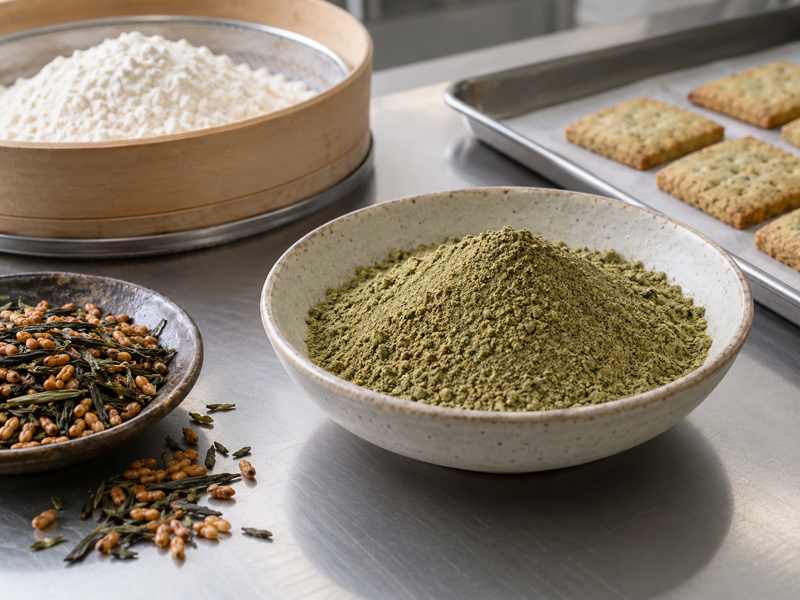
A bag labeled “genmaicha powder” can contain very different material: milled leaf and rice, a tea-heavy blend, or a flavored ingredient designed for drinks. Bakers need to know what it is before adding it to dough. Powder size affects mouthfeel, rice roast affects flavor after heat, and the formula may need water or fat adjustment. This guide is about selecting and qualifying the ingredient across bakery applications. It does not replace the separate genmaicha cookie or cake recipe development work.
Contents
- 1. What is genmaicha powder for baking?
- 2. Which composition details should a buyer request?
- 3. How fine should the powder be?
- 4. How does the rice roast behave in an oven?
- 5. How should a bakery run an application screen?
- 6. What changes in cookies, cakes, and crackers?
- 7. Can an infusion work better than powder?
- 8. Which quality documents matter?
- 9. How should the powder be stored and handled?
- 10. When should a powder be approved for production?
1. What is genmaicha powder for baking?
Genmaicha is a green-tea and roasted-rice blend; Japan’s MAFF definition allows several tea bases. A baking powder made from genmaicha should be described more precisely than its category name. It may contain both milled components, a different tea-to-rice ratio from loose leaf, or added flavor. The buyer needs an ingredient statement and physical specification. Powder intended for a latte may be too coarse, too soluble-looking, or too strongly flavored for a smooth cake.
The bakery should decide what function it is buying: green-tea color, roasted-rice aroma, visible flecks, or a balanced tea taste. One powder may not deliver all four. A genmaicha cracker recipe illustrates a baking use, but its result does not certify a powder for every factory. Start by tasting the ingredient brewed or dispersed at a standard concentration, then test it in the actual baked matrix.
The site's genmaicha ice cream development guide shows a different matrix where particle size and roasted-rice flavor need separate checks. A bakery should set its own limits for heat and crumb.
| Desired function | Ingredient question | Finished check |
|---|---|---|
| Roast aroma | Rice roast level? | After baking |
| Tea flavor | Leaf type and share? | Bitter finish |
| Color | Tea powder content? | Baked shade |
| Texture | Particle size? | Grit |
2. Which composition details should a buyer request?
Ask for the exact ingredient list, tea base, roasted-rice share or accepted range, any matcha addition, flavoring, carrier, and process description. If the supplier calls it “pure genmaicha powder,” ask whether that means no additives or whether it means both leaf and rice are milled. Those are different facts. A bakery also needs allergen and cross-contact information, origin claims where used, lot coding, and a change-notification process. The front-of-bag name does not cover those controls.
Compare samples by finished application rather than by color or dry aroma alone. A high-rice powder may give a lovely toasted smell but little green-tea finish. A tea-heavy powder may taste sharp after heat. Keep a small retained sample from the approved lot. If the supplier later changes rice roast or milling, the bakery should be able to detect it before several tons of dough are produced. Put the critical composition and sensory range in the purchase specification.
3. How fine should the powder be?
Fineness is a functional choice. A smooth sponge or cream filling may require a finer powder than a rustic cracker. Coarse rice particles can feel hard or sandy; coarse leaf can feel papery. Ask for particle-size data if available, but do not choose solely from a number. A distribution can include a small tail of large particles that tasters notice even when the average looks fine. Inspect the powder, sieve a sample if appropriate, and eat the finished product.
Fine milling can also change how the powder wets, clumps, and disperses. A very fine ingredient may create dust during handling or absorb more liquid in dough. Measure dough viscosity, spread, rise, and finished bite alongside flavor. If a bakery wants visible rice pieces, use a controlled inclusion rather than accepting random coarse particles in the powder. The ingredient specification should describe what the product is meant to do, not just a marketing adjective such as “ultrafine.”
| Application | Texture target | Powder screen |
|---|---|---|
| Smooth cake | No grit | Fine dispersion |
| Cookie | Pleasant bite | Particle check |
| Cracker | Some texture possible | Hardness |
| Filling | Smooth mouthfeel | Settling |
4. How does the rice roast behave in an oven?
The oven creates its own toasted notes. A rice roast that tastes clear in a drink may vanish in a browned cookie or become too dark in a cracker. Trial at the bakery’s actual bake temperature and endpoint. Taste the cooled product, not only the warm batch. A stronger rice roast may survive heat but can create a burnt finish when combined with crust browning. A lighter roast may let green tea show but have too little aroma in a rich dough.
Ask the supplier for several roast profiles if the application is large enough to justify customization. Keep all other recipe variables fixed during comparison. If the product will include chocolate, sesame, or caramel, test those later; they can mask the roast and confuse the first ingredient decision. Record the acceptable sensory range and color. A consistent roast is often more valuable than a dramatic sample that the supplier cannot reproduce across lots.
5. How should a bakery run an application screen?
Select two or three bakery matrices with different stresses, such as a short cookie, a light sponge, and a crisp cracker. Use a plain control for each and a small dose ladder of the candidate powder. Hold formula, mixing, bake, and cooling conditions constant within each matrix. Note how much ingredient is needed before tea and roasted rice become recognizable. A powder that works at a sensible dose in one matrix may be inefficient in another. Record cost per finished unit, not just cost per kilogram.
This screen is not final recipe optimization. It tells the buyer where the ingredient performs and where it fails. If a powder produces grit in sponge but an attractive cracker, buy it for the cracker and choose another form for cake. Taste after normal packaging hold. A fresh-out-of-oven aroma may fade quickly. Keep the screen small and well documented so the development team can explain why it advanced or rejected each material.
| Screen item | Hold constant | Measure |
|---|---|---|
| Dose | Base recipe | Flavor/cost |
| Bake | Oven program | Aroma survival |
| Mix | Sequence | Clumping |
| Storage | Pack/time | Flavor retention |
6. What changes in cookies, cakes, and crackers?
Cookies have fat and browned edges that can mask tea, but their small size can deliver a clear first aroma. Cakes have a softer crumb where coarse particles are easier to notice; their moisture balance can change when powder absorbs liquid. Crackers may amplify roast but risk a bitter, over-baked finish. A bakery should not copy one dose across all three. Build an application-specific formula and release standard for each product. The same powder can be useful in all three, but only after separate testing.
Serving context matters as well. A café cookie may be eaten beside tea, while a retail cake sits in a sealed box and a cracker travels with savory snacks. Check the actual package and hold. The ingredient buyer should share these use cases with the supplier. A supplier recommending one powder for “all bakery” without asking about texture, heat, or packaging has not answered the right question. A limited, evidence-based application list is more helpful than a universal claim.
7. Can an infusion work better than powder?
Yes, when smooth texture matters more than visible solids. A filtered genmaicha infusion can carry tea into a cake syrup, filling, or dairy-based component. It also adds water and may lose aroma in baking, so the formula needs rebalancing. Compare it with powder at a similar sensory target, not at the same raw ingredient mass. The total tea used, extraction yield, and wastewater or spent-tea cost belong in the calculation.
An extract is another route, but it may deliver a narrower flavor and different label wording. A hybrid approach can use a modest powder dose for body and a controlled infusion or extract for aroma. Test complexity against benefit. Every extra step creates a chance for process drift, especially at scale. If a simple powder works in the finished product, keep it. If it does not, change form rather than forcing a coarse ingredient into a delicate matrix.
| Form | Best reason to try | Trade-off |
|---|---|---|
| Powder | Direct tea solids | Texture |
| Infusion | Smoothness | Added water |
| Extract | Compact aroma | Label/flavor |
| Hybrid | Layered profile | Process complexity |
8. Which quality documents matter?
Request a current specification, ingredient statement, physical description, lot coding, relevant microbial and contaminant results, storage guidance, and allergen or cross-contact information. The exact tests depend on product, source, and buyer requirements. If the bakery plans an organic, gluten-free, or origin claim, obtain documentation that supports the finished product’s claim path. A supplier certificate for one ingredient does not automatically certify a cookie or cake made on a shared line.
Keep the approved sample linked to its lot and lab records. If the powder is made by milling a blend, ask how leaf and rice remain uniformly distributed. Check whether the supplier controls metal detection or sieving as appropriate to its process. Define critical changes requiring buyer approval: tea base, rice supplier, roast, ratio, milling site, particle profile, or packaging. A change can alter flavor and texture even if the product name stays the same.
9. How should the powder be stored and handled?
Tea and roasted-rice aromas can fade or absorb foreign odors. Store the powder in its approved sealed package under the supplier’s specified conditions. In a bakery, open bags may sit near flour dust, steam, spice, or cleaning chemicals; design a clean dosing station and close the bag promptly. Use dry scoops and prevent untracked rework. Mark opening date if the bakery has an approved open-use rule. The printed date on a sealed bag is not automatically an open-bag quality period.
Watch for clumping, color drift, and aroma loss during storage, but do not rely on appearance alone. Compare a working bag with a retained sealed reference using a simple application test. For high-volume production, size bags to normal usage so material is not repeatedly opened for weeks. A bulk price saving can disappear if stale powder weakens the finished product or forces higher dosing. Pack size should follow the bakery’s turnover and quality target.
10. When should a powder be approved for production?
Approve after a production-equivalent trial in the specific product, with a written formula, process settings, sensory reference, physical quality checks, label review, and shelf-life plan. Run at least a second ingredient lot when practical. Sample finished goods across the production run to find settling or dispersion changes. A pilot bowl can hide problems that appear in a full mixer or depositor. Taste the product after packaging and at the intended service age.
Document the cost and supply plan. If the powder needs a high dose to be noticed, compare it with another grade or infusion. If it tastes good but creates grit, reject it for smooth products and consider it for a suitable textured application. The buyer should approve a defined material for a defined use, with change controls. “Genmaicha powder” is a category; the approved production item is a specific lot-controlled ingredient that performs in a specific bakery formula.
| Approval gate | Evidence | Release owner |
|---|---|---|
| Composition | Current spec | Procurement |
| Bake performance | Production trial | Bakery R&D |
| Texture | Finished bite | Sensory panel |
| Shelf result | Final packed item | Quality |
FAQ
Q1. Is genmaicha powder the same as matcha? No. Genmaicha includes roasted rice with green tea; the composition needs checking.
Q2. Can one powder work in all baked goods? Possibly, but each matrix needs its own dose, texture, and bake test.
Q3. Why does powder make cake gritty? Tea or rice particles may be too coarse for a soft crumb.
Q4. Does a strong dry aroma guarantee flavor after baking? No. Test the cooled, stored product.
Q5. What should a buyer request first? Composition, physical specification, traceable sample, and change-control terms.
Choose the powder from the baked item customers will eat. The dry sample is only the starting material.