
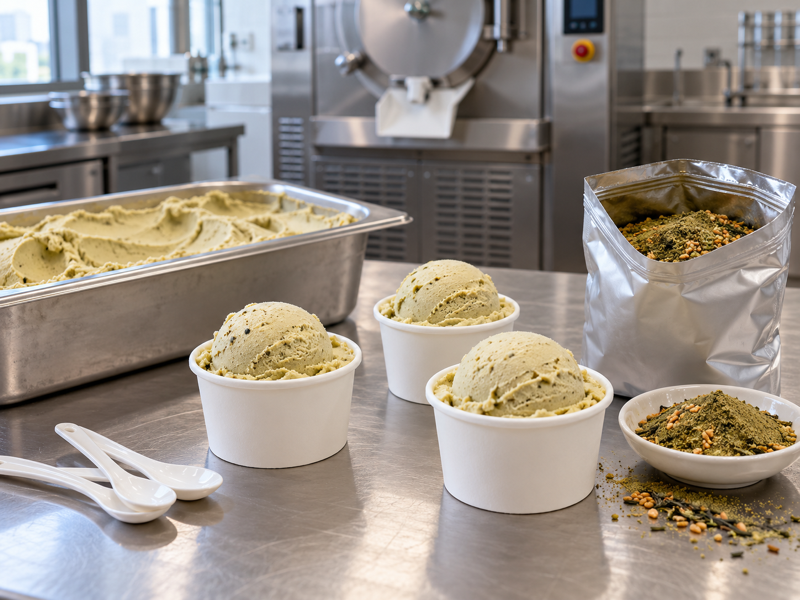
Genmaicha ice cream brings toasted-rice aroma and green-tea character into a frozen dairy or plant-based base. The commercial challenge is keeping those notes recognizable after fat, sugar, freezing, and storage change the way flavor is perceived. A sample that tastes strong in hot tea may feel faint in a cold scoop. Food developers need a measured ingredient, controlled pilot batches, and clear checks for texture, color, labeling, and cost. This guide is for brands, dessert chains, and ingredient buyers who want a repeatable product rather than a one-off kitchen recipe. Food-safety limits and shelf life must be set by qualified teams for the exact formula and process.
Contents
- 1. What gives genmaicha ice cream its flavor?
- 2. Which genmaicha ingredient form should a developer choose?
- 3. How should a dose trial be structured?
- 4. How can tea flavor survive dairy and cold temperature?
- 5. What texture problems can genmaicha powder create?
- 6. How should color and appearance be assessed?
- 7. Which processing and food-safety checks belong in the plan?
- 8. What labels and claims need review?
- 9. How do buyers compare cost and suppliers?
- 10. What should a commercial launch sequence look like?
1. What gives genmaicha ice cream its flavor?
Genmaicha combines tea leaves and roasted rice. Japan's MAFF tea reference describes roasted rice blended with bancha, sencha, or gyokuro. The tea contributes leafy, mildly vegetal, or brisk notes; rice contributes a toasted cereal aroma. In ice cream, those components enter a sweet, cold, often fatty matrix. The finished scoop can taste more like cereal cream than a brewed cup if the tea character is too weak. That may be acceptable for one brand and a failure for another.
Write a flavor target before selecting an ingredient. Should customers notice green tea immediately, or should roasted rice lead? Is a pale beige-green color desirable, or should the product remain cream-colored? A flavor brief lets a supplier recommend the right powder, infusion, or extract. It also keeps tasting panels from rewarding whichever pilot batch is simply sweetest. Use a plain base as a control, and ask panelists to describe aroma, first taste, finish, and aftertaste. The product name should match what those customers can actually perceive.
| Flavor component | Desired expression | Common development problem |
|---|---|---|
| Roasted rice | Clear cereal aroma | Lost during cold service |
| Green tea | Recognizable tea note | Covered by fat or sugar |
| Sweet base | Supports flavor | Makes roast taste generic |
| Finish | Clean and repeatable | Astringency at high dose |
2. Which genmaicha ingredient form should a developer choose?
Loose tea can be brewed into an infusion, then filtered before adding liquid to the mix. This offers a familiar tea flavor, but the added water and filtration yield must be accounted for. A powder can deliver tea and rice solids more directly; it may also affect texture, color, and sediment. An extract or flavor system may concentrate aroma, though its ingredient declaration and flavor balance can differ from a whole-tea approach. Ask exactly what the supplier is offering. “Genmaicha powder” alone does not describe its milling, composition, or additives.
The genmaicha versus matcha comparison can help a product team decide which tea profile it wants before formulation. Test each form against the same finished-product target. A powder with strong aroma in dry form may be grainy in a smooth premium scoop. A brewed tea might make a clean texture but dilute solids or lose aroma during heat processing. An extract can be easy to dose but may lack the rounded cereal finish the brand wants. Request a current specification, ingredient statement, storage guidance, sample lot, and any relevant allergen information. Choose the form through pilot performance, not a category assumption or a lower price per kilogram.
3. How should a dose trial be structured?
Start with a stable base formula and change only the genmaicha ingredient dose. Prepare several small batches spanning a sensible range based on supplier guidance and your own sensory target. Keep fat, sugar, stabilizer, overrun target, processing, and serving temperature constant. Record ingredient weights, mix viscosity, appearance before freezing, and flavor after freezing. If a powder is used, note how it is dispersed and whether lumps form. If an infusion is used, account for the water it adds to the recipe.
Taste blind after the product has equilibrated under normal storage conditions. An immediate taste from the freezer may differ from a scoop served after a few minutes in the display case. Ask whether the roasted-rice note is identifiable, whether green tea remains clear, and whether a high dose adds bitterness or grit. Keep a control from the same production session. Later, repeat the winning dose with another ingredient lot. A commercial formula should tolerate ordinary material variation while meeting the agreed flavor standard. Do not publish a fixed “best percentage” without validating it in the actual base.
| Trial variable | Keep constant | Measure or observe |
|---|---|---|
| Ingredient dose | Base recipe | Flavor strength and cost |
| Dispersion method | Mixing sequence | Lumps and grit |
| Freeze process | Equipment settings | Texture and overrun |
| Storage | Package and temperature | Flavor and color drift |
4. How can tea flavor survive dairy and cold temperature?
Cold service suppresses aroma relative to a hot drink. Fat and sugar can also mask delicate tea notes. A developer may respond by increasing dose, but that can raise cost and astringency. Compare a more roast-forward genmaicha with a more tea-forward option before pushing one material beyond its pleasant range. Consider whether the base itself is too sweet or heavily flavored. Vanilla, caramel, and other additions can make roasted rice harder to identify, even though each addition tastes good alone.
Build the formula around the intended claim and menu description. If the product is sold as genmaicha ice cream, panelists should find a tea-and-roasted-rice character without needing a prompt. If the product is a broader sundae element, a gentler note may be enough beside toppings. Taste with the actual cone, cookie, sauce, or mix-in because those elements change perception. Check flavor after your normal heat process and after frozen storage, not only in a mixed liquid base. A consistent finished scoop is the target.
5. What texture problems can genmaicha powder create?
Powder can add very small tea and rice particles. Depending on milling and dose, these may feel smooth, slightly sandy, or visibly speckled. Some particles can settle in the liquid mix before freezing, causing uneven flavor across the batch. Thorough dispersion and suitable mixing equipment help, but they do not turn a coarse ingredient into a fine one. Ask the supplier for particle-size information if available and verify mouthfeel in the actual ice cream. Do not invent a fineness requirement before the application trial reveals what the product needs.
Assess texture at multiple points: after mix preparation, after aging if used in your process, after freezing, and after the normal display period. Observe whether solids cluster or sink. A fine-looking scoop can still leave a dry or gritty afterfeel. If the ingredient is unsuitable, test a finer powder or an infusion rather than hiding texture with more sugar. Keep samples from several positions in a production batch to detect poor distribution. A dessert chain also needs the scoop to behave consistently from tub to tub and site to site.
| Texture issue | Possible source | Practical response |
|---|---|---|
| Grit | Coarse tea or rice particles | Trial finer material or infusion |
| Lumps | Poor wetting | Change dispersion sequence |
| Uneven color | Incomplete mixing | Sample across batch |
| Weak body | Formula diluted by tea infusion | Rebalance mix solids |
6. How should color and appearance be assessed?
Genmaicha ice cream does not need a bright matcha-green color. Its tea-and-rice blend may create a muted green, tan, or cream tone depending on the ingredient and formula. Set an appearance target that matches the brand's ingredients and photography. Avoid treating a bright color as proof of stronger tea flavor. A powder can deepen color but may also produce flecks. A filtered infusion may leave a smoother, lighter appearance. Both can be valid choices if the package and menu description are honest.
Examine samples under the lighting customers will see: a retail freezer, café display, or plated dessert setting. Record color after production and after the proposed shelf period. Ice crystals, surface drying, and packaging light exposure can change appearance independently of genmaicha quality. If consistent shade matters, keep a reference sample or approved photograph and evaluate new lots in the same base. A supplier's dry-powder photo is insufficient because fat, sugar, processing, and serving temperature alter the final visual impression.
7. Which processing and food-safety checks belong in the plan?
The ice cream base must follow a qualified food-safety process for its ingredients, equipment, and market. Tea powder can be added at different stages, but any stage change can alter microbial controls, dispersion, and flavor. Involve the plant's process and QA specialists before changing an approved sequence. The supplier's document package should support raw-material review; it does not validate the finished frozen dessert. Establish incoming checks for identity, packaging integrity, lot code, and required tests.
Pilot the process on equipment similar to commercial production. Record mixing order, hydration, heat treatment where applicable, cooling, freezing, filling, and storage. Taste the product after each step that may change flavor. Do not infer shelf life from a single taste test. A qualified study should address safety and quality over the intended distribution conditions. For a café using ready-made tubs, define storage and handling instructions that staff can follow. For a manufacturer, link each ingredient lot to finished lots so deviations can be investigated.
| Stage | Key question | Record |
|---|---|---|
| Ingredient receipt | Is this the approved lot and form? | Code and condition |
| Mix preparation | Did it disperse evenly? | Method and observation |
| Process | Does flavor survive? | Time and settings |
| Finished product | Does each pack meet standard? | QA and sensory release |
8. What labels and claims need review?
The ingredient list must reflect the actual formulation. A product made with genmaicha powder, brewed tea, extract, or added flavorings can need different wording under local rules. Check milk or plant-base ingredients, stabilizers, inclusions, and any allergens. Do not assume that a simple genmaicha ingredient description proves a product is gluten-free, organic, or suitable for a particular diet. Match every claim to the exact finished product, production controls, valid documents, and destination market.
Tea contains caffeine, and a frozen dessert may contain some depending on the tea ingredient and dose. Do not call the product caffeine-free without evidence. If a quantitative caffeine statement matters, test or validate the finished serving rather than borrowing a brewed-tea number. Japan's MAFF caffeine table concerns a specified infusion, not ice cream. Keep marketing language focused on flavor and ingredients unless the regulatory team has reviewed a nutrition or health claim. Clear wording prevents a creative menu description from becoming an unsupported product promise.
9. How do buyers compare cost and suppliers?
Compare cost per finished scoop, not cost per kilogram of ingredient. Powder dose, infusion yield, processing loss, labor, and rejected batches change the economics. Request quotations for the same pack size, delivery term, order volume, and document set. Ask about lead time and whether a supplier can supply the same formulation through the planned season. A low unit price offers little value if the product requires a high dose or creates grit that consumers reject.
Ask for production-representative samples from more than one lot when possible. Set a reference flavor and appearance standard, then agree on change notification for tea base, rice roast, milling, or any added ingredient. Matcha Village lists genmaicha powder among its food ingredient products; buyers should still request the current SKU specification and conduct a plant trial. If you need private-label finished dessert, distinguish ingredient supply from finished-product manufacturing in the agreement. Confirm who owns the recipe, artwork, testing plan, and release decision.
| Cost element | Why it belongs | Check |
|---|---|---|
| Ingredient | Dose drives unit economics | Cost per batch |
| Yield | Infusion and filtration lose material | Finished quantity |
| Process | Added mixing or filtering costs time | Labor and equipment |
| Waste | Trial rejects and expired stock | Realized cost |
| Logistics | Frozen distribution may dominate | Landed scoop cost |
10. What should a commercial launch sequence look like?
Approve the flavor target, compare ingredient forms, and screen candidates in a plain base. Move the best options into a controlled dose trial, then test the actual process, package, and serving conditions. Ask the qualified food-safety and labeling teams to review the exact formula. Check sensory quality across proposed storage checkpoints and another ingredient lot. Write a finished-product specification covering flavor, appearance, texture, portion, packaging, and release criteria.
Before launch, make a store or plant instruction sheet with measured actions rather than subjective language. Keep an approved control batch and a record of why the ingredient was chosen. If the product fails after scaling, compare the new batch with that control and review ingredient lot, dispersion, heat process, freezing, and storage separately. Genmaicha ice cream can give a distinctive tea-and-cereal flavor when the ingredient is matched to the base. Ask suppliers for samples suited to the actual formulation, then approve what survives the full production route.
FAQ
Q1: Can loose genmaicha tea be used in ice cream? Yes, through an infusion, but the added water, filtration yield, and flavor after processing need testing.
Q2: Does genmaicha ice cream need to be green? No. Color depends on ingredient form, dose, and base. Set a target that reflects the finished recipe.
Q3: Can powder cause a gritty texture? It can if particle size, dose, or dispersion is unsuitable. Test mouthfeel in the final frozen product.
Q4: Is genmaicha ice cream caffeine-free? Do not assume that. Tea ingredients can contribute caffeine; assess the finished serving before making a claim.
Q5: Which cost figure helps a buyer most? Compare cost per finished serving after dose, yield, labor, waste, and frozen distribution are included.