
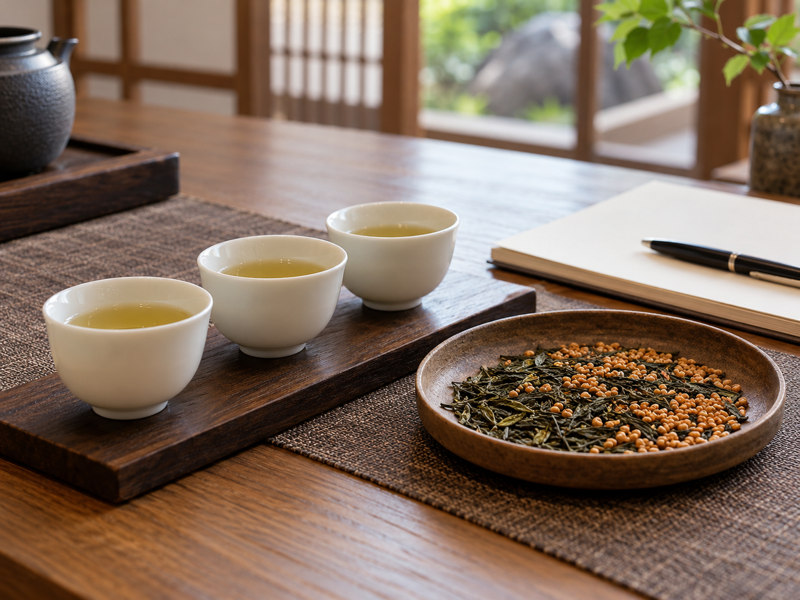
A tea buyer can know exactly what is in a blend and still hesitate over its name on a sales call. Genmaicha is one of those words. Clear pronunciation helps, but an accurate one-sentence description matters more when a café trains staff or a distributor introduces the product to new accounts. This guide gives an English-friendly way to say the Japanese name, explains its parts, and shows how to keep the description consistent across menus, samples, and supplier records. It does not claim there is only one acceptable English accent.
Contents
- 1. How do you pronounce genmaicha?
- 2. What do the parts of the word mean?
- 3. Where should an English speaker place the stress?
- 4. Why do English spellings and recordings differ?
- 5. How should café staff introduce the tea aloud?
- 6. What should a menu say after the name?
- 7. How can a buyer check that the product matches the name?
- 8. Which training mistakes create customer confusion?
- 9. How should the name appear on export documents?
- 10. What should a short staff training card include?
1. How do you pronounce genmaicha?
A practical English cue is gen-my-cha, with “gen” close to the start of “gentle,” “my” like the English word, and “cha” like the familiar word for tea. Japanese pronunciation is smoother than that three-block cue. The written form げんまいちゃ is normally heard as gen-mai-cha, without a hard pause between each part. If you work with Japanese speakers, listen to a native recording and mirror its pace rather than treating English syllable labels as a phonetic rule.
For a sales team, choose one pronunciation cue and use it consistently in onboarding. A customer will usually forgive an accent; a team that alternates between several product names creates uncertainty about whether it is selling the same blend. Put the cue in a staff-only guide, then let the menu carry the name and a plain description. Staff can answer a pronunciation question in a sentence and move to the flavor: green tea with a warm toasted-rice aroma.
| Training cue | What it does | Limit |
|---|---|---|
| “gen-my-cha” | Helps English speakers start | Approximation of Japanese sounds |
| Native audio | Shows pace and vowels | Requires a reliable recording |
| Plain product description | Explains the drink | Does not replace the name |
2. What do the parts of the word mean?
“Genmai” refers to brown rice; “cha” means tea. In the product, roasted rice is blended with green tea. Japan’s Ministry of Agriculture, Forestry and Fisheries describes genmaicha as roasted brown rice mixed with bancha, gyokuro, or sencha. That definition is a useful starting point because it names both components and allows for different tea bases. It does not promise that every supplier uses the same ratio, rice roast, or leaf grade.
The meaning also explains why “rice tea” alone can mislead an English-speaking buyer. A conventional genmaicha contains tea leaves, so it normally contains caffeine. Some products may use matcha or other additions; check the actual ingredient list before describing a particular SKU. For a concise consumer line, “Japanese green tea blended with roasted rice” is clearer than a story about “popcorn tea.” Popped grains can appear in some blends, but they are not a substitute for naming the tea and rice.
3. Where should an English speaker place the stress?
English speakers tend to accent one part of a borrowed word. Japanese does not use English-style word stress in quite the same way. A calm, even “gen-mai-cha” is a better training target than a dramatic “GEN-my-CHA.” A recording from a Japanese speaker gives the team a better reference than spelling alone. When filming a short product introduction, ask a Japanese-speaking colleague or language reviewer to check the audio before it is used across paid ads or customer training.
This is a practical quality check, not a demand for a perfect accent. A distributor with several sales regions may hear different English versions of the name. The aim is that customers recognize the word and connect it to the right product. Keep the vowel in “mai” clear, finish with “cha,” and avoid adding an extra “tea” as though it were part of the Japanese word. On a menu, “genmaicha tea” may still help search and understanding, but staff can say the shorter name aloud.
| Usage | Recommended treatment | Why |
|---|---|---|
| Staff pronunciation | Even “gen-mai-cha” | Easy to recognize |
| Menu title | Genmaicha | Keeps the product name clear |
| First description | Green tea with roasted rice | Answers the next question |
4. Why do English spellings and recordings differ?
Romanization turns Japanese sounds into Latin letters; it does not force every English speaker to read them the same way. The letters “mai” may become “may,” “my,” or a two-vowel sound in informal guides. Recordings also vary by speaker, microphone, and how slowly the word is pronounced. A phonetic hint is useful in a staff note, but it should never be the only source for a language-sensitive campaign. Use Japanese-language audio when the difference matters to the brand.
Product listings add another source of variation. “Genmai cha,” “genmai-cha,” and “genmaicha” often refer to the same tea category, but a label can also attach “matcha,” “organic,” or a regional claim. Those modifiers describe a specific product only if its composition and documentation support them. A buyer should separate spelling variants from formulation differences. The most reliable identifier for a purchasing team is the full specification and ingredient declaration, not a single catalog title.
5. How should café staff introduce the tea aloud?
A workable counter line is: “Genmaicha is a Japanese green tea blended with roasted rice. It tastes toasty and gently vegetal.” That sentence tells the customer what it is and what to expect without promising health effects. Staff can then ask whether the customer wants a hot brewed tea, an iced drink, or a milk-based menu item. If the café’s SKU contains matcha, the description should mention it because matcha changes color, mouthfeel, and often perceived intensity.
Train with the actual brewed product rather than a script alone. Have staff smell dry leaves, taste the standard recipe, and compare it with an over-steeped cup. A menu claim such as “nutty” should reflect a sensory description, not an undeclared tree-nut ingredient. Keep a written recipe and serving size beside the pronunciation card. A customer who hears the name correctly but receives a weak or inconsistent cup will remember the service problem, not the language lesson.
| Customer question | Short staff answer | Verify locally |
|---|---|---|
| What is it? | Green tea with roasted rice | Product ingredients |
| Is it like matcha? | It is brewed unless the blend contains matcha | SKU specification |
| Does it have caffeine? | Usually yes; amount varies | Serving and assay if claimed |
6. What should a menu say after the name?
The menu needs a plain product description, not a dictionary entry. “Genmaicha — Japanese green tea with roasted rice” is enough for a basic brewed cup. A café might add “toasty, light green-tea finish” if that is true in the served recipe. Avoid “caffeine-free,” “detox,” or a fixed caffeine number without evidence for the precise serving. The existing genmaicha caffeine guide can help staff frame the question, but a product-specific claim still needs product-specific data.
A menu line should also distinguish related items. A “genmaicha latte” includes milk or an alternative and may be sweetened. “Matcha-iri genmaicha” contains matcha. A cold brew has a different method from a hot-brewed tea poured over ice. Use the same name across the point-of-sale system, delivery listing, allergen sheet, and recipe card. If one system shortens the name to “brown rice tea,” add the full product name in a field staff can see, so reorders and customer questions trace back to the correct SKU.
7. How can a buyer check that the product matches the name?
Ask for the ingredient statement and a sample from the lot proposed for purchase. Look for tea leaves and roasted rice, then ask whether the tea base is sencha, bancha, gyokuro, or another documented material. Check for matcha, flavoring, or sweetener if the product name suggests a standard loose-leaf blend. The dry appearance should make sense: recognizable leaves and rice, with particle size appropriate to the planned brewing equipment. A photo alone cannot establish composition.
Brew competing samples at the same dose, water temperature, and contact time. Compare roasted-rice aroma, green-tea character, aftertaste, and visible sediment. Record the lot code and reference sample. If the supplier will also offer a powder or tea bag, treat those as separate specifications, even when the front-label name is identical. The buyer’s task is to turn a broad tea name into a repeatable material that purchasing, quality, and café teams can all identify.
| Purchase check | Evidence to request | Decision it supports |
|---|---|---|
| Composition | Ingredient statement | Accurate product name |
| Tea base | Specification | Flavor and price comparison |
| Sensory sample | Coded lot | Approval target |
| Pack format | Packaging spec | Brewing and shelf plan |
8. Which training mistakes create customer confusion?
One common mistake is teaching pronunciation without teaching composition. A staff member may say “genmaicha” confidently, then describe it as caffeine-free rice water. Another is treating all genmaicha products as interchangeable. A matcha-coated blend, a coarse loose leaf, and a fine powder can all taste and handle differently. A third is using poetic tasting language that does not match the actual cup. “Popcorn” may be a helpful analogy, but it can sound like an ingredient claim on a menu.
Run a short role-play using the top customer questions and the actual SKU. Ask one employee to describe the tea without looking at the packet. If the answer changes between employees, simplify the script and show the ingredients. Keep tasting notes tied to approved batches. When the blend changes, revise the card and point-of-sale description before it reaches stores. A two-minute update can prevent months of inconsistent customer explanations.
9. How should the name appear on export documents?
Use the product’s exact legal or commercial designation consistently across invoices, labels, specifications, and shipping records. “Genmaicha” alone may be too broad for customs or ingredient review; a fuller description such as “green tea blend with roasted brown rice” can clarify composition. The exact wording depends on market rules and the product form, so have the importer or regulatory team approve final labels. Do not assume that an English phonetic cue belongs on commercial paperwork.
For a private-label program, lock the spelling and SKU code in the approval record. Store the approved ingredient statement, country-of-origin documentation, lot traceability, and artwork version with that code. If a buyer requests “genmai cha” in emails but the approved label reads “genmaicha,” map the alias in the order system rather than silently making a new product. This is a mundane control, but it avoids wrong-pack shipments and mismatched certificates when several tea blends look similar.
| Document | Name field | Review owner |
|---|---|---|
| Specification | Approved SKU and composition | Supplier QA |
| Label artwork | Consumer-facing name | Brand/regulatory |
| Invoice | Commercial description | Export team |
| Staff card | Pronunciation and serving | Café operations |
10. What should a short staff training card include?
Keep the card short enough to use during service: the name, a pronunciation cue, one-line composition, two or three sensory notes from the approved cup, standard brew recipe, caffeine wording, and the SKU’s ingredient or allergen reference. Add a photo of the correct dry blend if several teas share the station. A long cultural history belongs in optional training material. The counter card should help staff answer real customer questions and make the same drink twice.
Before rollout, test the card with a staff member who did not write it. Ask them to pronounce the name, describe the product, and brew a cup from the instructions. If they hesitate, revise the line that caused the pause. If the cup differs from the reference sample, fix the recipe or equipment details. The final card should fit the actual operation. Pronunciation creates a good first impression; repeatable tea quality keeps the customer’s trust.
FAQ
Q1. Is “gen-my-cha” an exact Japanese pronunciation? No. It is an English-friendly cue. A native Japanese recording is a better model for sound and rhythm.
Q2. What does genmaicha mean? “Genmai” means brown rice and “cha” means tea. In practice, the drink is green tea blended with roasted rice.
Q3. Is genmaicha the same as matcha? No. Standard genmaicha is usually brewed from leaves and rice. Some blends add matcha, which should appear in the ingredient description.
Q4. Should a menu say “genmaicha tea”? The extra English word can help customers understand the category, but “genmaicha” with a plain description is often cleaner.
Q5. Can pronunciation vary by region? English accents vary. Train staff to use a recognizable version and to describe the actual blend accurately.
For the next supplier sample, put the approved name, composition, and brew recipe on one sheet. That sheet will settle more customer questions than a phonetic spelling alone.