
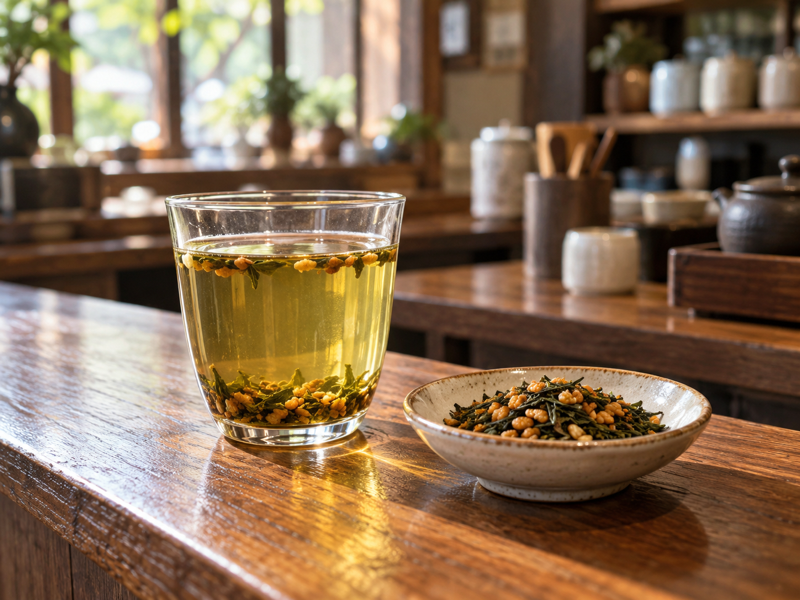
Genmaicha fits more than one moment: a warm cup with lunch, an afternoon break, or a light tasting flight. The useful timing question is less romantic. It contains green tea, so it normally contains caffeine, and the amount in a cup depends on the blend and brew. A customer who wants to sleep soon or who limits caffeine needs that information more than a claim that toasted rice makes the drink “gentle.” This guide helps cafés, retail brands, and tea buyers explain timing honestly and design service around the actual product.
Contents
- 1. When is genmaicha usually served?
- 2. Does genmaicha contain caffeine?
- 3. Is morning a good time for genmaicha?
- 4. How does genmaicha work with a meal?
- 5. Should it be served in the afternoon?
- 6. Can a customer drink genmaicha at night?
- 7. Does hot or iced service change the timing?
- 8. How should cafés describe caffeine?
- 9. What should buyers test before making a claim?
- 10. How can a menu make the choice easier?
1. When is genmaicha usually served?
There is no single correct hour for genmaicha. Its roasted-rice aroma and green-tea character make it plausible with food or on its own. A café might offer it as a brewed cup at lunch, while a retailer might position it as a routine afternoon tea. Those are serving choices, not physiological rules. The buyer should decide what the product actually tastes like at the planned cup size and whether that profile makes sense with the menu.
Taste the tea at the temperature at which customers will drink it. A hot cup may show more roast aroma; a cooled cup may emphasize other notes. If it accompanies a meal, taste it with the real food. If it is a take-away drink, check how it holds after ten or twenty minutes. Avoid claiming it is suitable for everyone at every hour. The practical service message can be simpler: it is a green-tea blend with roasted rice, so customers who watch caffeine should treat it as a caffeinated tea.
| Service moment | Why it may fit | Check |
|---|---|---|
| Breakfast | Toasted cereal note | Portion and caffeine |
| Lunch | Pairs with savory food | Brew strength |
| Afternoon | Warm, aromatic break | Customer sensitivity |
| Evening | Some may enjoy it | Sleep and caffeine choice |
2. Does genmaicha contain caffeine?
Standard genmaicha contains green tea leaves, and green tea contains caffeine. Roasted rice does not make the leaf caffeine disappear. The amount per serving varies with the leaf base, tea-to-rice ratio, matcha addition, gram dose, water, and brew method. The FDA's caffeine overview reminds readers to count tea alongside other caffeine sources. A generic internet number cannot stand in for a finished product assay. The existing genmaicha caffeine article explains the wider topic; a café still needs a product-specific method if it wants to publish milligrams per cup.
Some brands sell decaffeinated genmaicha or rice-only drinks. Those are different products and should be named accurately. A customer may infer “low caffeine” from the soft taste of a standard blend, but flavor intensity is not a reliable measure. Staff should answer “yes, it contains caffeine” unless the particular SKU has documented evidence for another statement. If a customer has a medical reason to limit caffeine, direct them to the product information and their clinician rather than estimating their personal safe dose at the counter.
3. Is morning a good time for genmaicha?
Many people enjoy a caffeinated tea in the morning, and genmaicha can provide a different flavor from coffee or plain sencha. The roasted-rice note may be pleasant beside toast, rice dishes, or a lightly sweet pastry. That is a sensory observation, not a promise of energy or focus. A café should test whether its normal brew stands up to breakfast food without becoming bitter or disappearing under butter and sugar. A stronger cup is not automatically a better cup.
For retail education, describe a repeatable brew and the expected taste. If the brand wants to compare genmaicha with coffee, avoid a fixed caffeine comparison unless both servings are measured and defined. Cup sizes vary sharply. A 120 ml tasting cup and a 450 ml take-away drink should not share one unqualified caffeine line. Morning positioning is straightforward when the product description is honest and the serving information is visible.
| Morning use | Sensory target | Operational check |
|---|---|---|
| Plain cup | Clear roast and leaf | Brew recipe |
| With breakfast | No harsh finish | Food tasting |
| To-go cup | Flavor after travel | Hold test |
4. How does genmaicha work with a meal?
Roasted rice can connect naturally with rice dishes, toasted bread, sesame, or lightly savory snacks. The green tea helps prevent the pairing from tasting only like cereal. A buyer designing a café menu should taste combinations, not rely on a generic pairing list. Salty food may make the tea seem sweeter; a rich dessert can make it seem thin. Run a small panel with the actual food portions and note which pairing improves the cup and which buries it.
The serving vessel and temperature matter. A strongly brewed tea in a large cup may dominate a delicate lunch; a light brew may vanish beside a spicy meal. If the brand sells a food pairing, train staff on the same cup size and steep time used in the tasting. The genmaicha tea recipe provides a starting method, but the menu should be tested with its own blend. A good pairing is one the kitchen and tea station can repeat during busy service.
5. Should it be served in the afternoon?
An afternoon service can highlight genmaicha’s toasted aroma without the sweetness of a latte. A café may offer a small hot cup with a pastry or an iced version in warm weather. Caffeine sensitivity becomes more relevant later in the day, especially for customers who sleep early. Staff need not make personal health judgments. They can state that the tea contains caffeine, offer the serving size, and point to a verified decaf alternative if one is available.
For a packaged tea brand, avoid “perfect before bed” copy unless the product is designed and supported for that claim. “Good with an afternoon snack” is a flavor and occasion suggestion. It leaves the timing choice with the customer. If the business tests a decaf line, compare its roast aroma and green-tea character with the standard SKU; the word “decaf” should not be used for a weak brew of the original blend. The product itself must meet the claim.
| Afternoon option | Benefit | Watch point |
|---|---|---|
| Small hot cup | Roast aroma | Dose consistency |
| Iced tea | Refreshing service | Dilution |
| Decaf SKU | Lower caffeine choice | Documentation |
| Sweetened latte | Dessert-like menu | Sugar and tea clarity |
6. Can a customer drink genmaicha at night?
Some customers can drink caffeinated tea late without noticing sleep changes; others cannot. A café cannot predict that response from the product category. Standard genmaicha still contains tea-leaf caffeine, so night-time marketing should avoid treating it as a sleep aid. A customer who asks for a caffeine-free evening drink should be offered a genuinely caffeine-free alternative or a documented decaf product, rather than reassured that roasted rice cancels caffeine.
The distinction between “less caffeine than a strong coffee” and “safe for bedtime” matters. Even a measured lower-caffeine cup can disturb a sensitive person if it is consumed close to sleep. For customer service, a short honest answer is best: “This blend contains green tea, so it has caffeine; the amount depends on our serving.” If a brand has a lab-tested value, state the cup size and brew method beside the number. Do not turn a product description into individual medical advice.
7. Does hot or iced service change the timing?
Hot and iced service change the cup customers perceive and may change extraction if different methods are used. Hot-brewed tea poured over ice can become diluted; cold-brewed tea uses different time and temperature. Neither method automatically removes caffeine. A brand selling both should develop separate recipes and, if making caffeine claims, assess the actual finished servings. Calling a drink “iced genmaicha” says how it is served, not how much caffeine it contains.
The timing choice may also be driven by the meal or weather. An iced cup at lunch can be useful for a quick-service menu; a small hot cup after food may suit a tasting program. Test aroma after the drink sits in its real cup. Roasted rice can smell vivid in a hot cup and muted in a cold one. If staff compensate with a higher tea dose, they may also change caffeine exposure. Record those changes rather than treating both drinks as interchangeable versions of one recipe.
| Format | Recipe variable | Customer information |
|---|---|---|
| Hot brewed | Dose and contact time | Caffeinated tea |
| Hot brew over ice | Ice dilution | Final serving size |
| Cold brew | Time and ratio | Method-specific amount |
8. How should cafés describe caffeine?
Begin with the reliable fact: the standard blend contains green tea, so it contains caffeine. If the café has not measured the finished drink, do not print a precise milligram range borrowed from another brand. If it has measured a product, keep the sample plan, method, serving size, and formulation on file. The menu line can be plain: “Contains caffeine.” Staff should know whether a matcha-added variant has a separate ingredient and caffeine profile.
Training should also cover the usual questions. “Is it herbal?” No, if it contains green tea. “Is it decaf?” Only if the SKU is decaffeinated and documented. “Can I drink it at night?” That depends on the customer’s sensitivity and total caffeine intake. This answer respects the customer’s choice without making a medical claim. Update the line when the blend, tea ratio, or recipe changes. A caffeine statement attached to an old formula can mislead even if it was once measured correctly.
9. What should buyers test before making a claim?
Start with the exact SKU and finished-serving recipe. Document leaf base, tea-to-rice ratio, any matcha addition, grams used per cup, water volume, steep time, and dilution. If a numeric caffeine claim is important, use a qualified laboratory and a sampling plan that accounts for normal lot variation. One hand-made cup from one bag may not represent a year of commercial sales. Review the result with regulatory staff for the market where the product will be sold.
The same discipline applies to “low caffeine” or “gentle” statements. “Gentle” can describe taste, but customers may read it as a health or caffeine promise. Make the wording specific: “toasted rice aroma and a mild green-tea taste” is sensory language. If the brand wants to say “low caffeine,” it needs to define and substantiate that claim under the applicable rules. Test what is measurable, and keep personal health recommendations off the label.
| Proposed claim | Evidence needed | Common problem |
|---|---|---|
| Contains caffeine | Ingredient verification | Usually straightforward |
| Milligrams per cup | Finished-serving test | Recipe changes |
| Low caffeine | Claim review and test | Undefined comparison |
| Caffeine-free | Strong product evidence | Standard tea is not free |
10. How can a menu make the choice easier?
Put a clear descriptor under the name: “Genmaicha — green tea with roasted rice; contains caffeine.” Add the served size and choose a flavor note from the actual cup. If the café offers a decaf or caffeine-free alternative, place it where the customer can find it, rather than forcing staff to improvise. Separate the brewed tea from latte and bubble-tea versions because milk, syrup, pearls, and cup size change the drink and its nutrition.
The menu should also help staff execute the promise. Tie each item to a recipe card and SKU code. Taste the drink during training and after ingredient changes. Keep a simple escalation path for customers asking about pregnancy, medication, or a medical condition: provide ingredient and caffeine information that the brand has verified, then recommend medical advice for the personal decision. A good menu gives customers enough facts to choose without pretending that one hour suits everyone.
FAQ
Q1. Is genmaicha only a morning tea? No. It can be served at several times, but its caffeine matters for people who are sensitive or close to bedtime.
Q2. Does roasted rice make genmaicha caffeine-free? No. Standard genmaicha contains green tea leaves and therefore contains caffeine.
Q3. Is iced genmaicha lower in caffeine? Not necessarily. The result depends on the recipe and serving size, not the presence of ice alone.
Q4. Can a café call genmaicha a sleep tea? That would be misleading for a standard caffeinated blend without specific evidence.
Q5. What should staff say if a customer asks about evening use? State that the tea contains caffeine, give verified serving information, and let the customer decide.
The useful timing label is a clear serving description and a truthful caffeine statement. Customers can take it from there.