
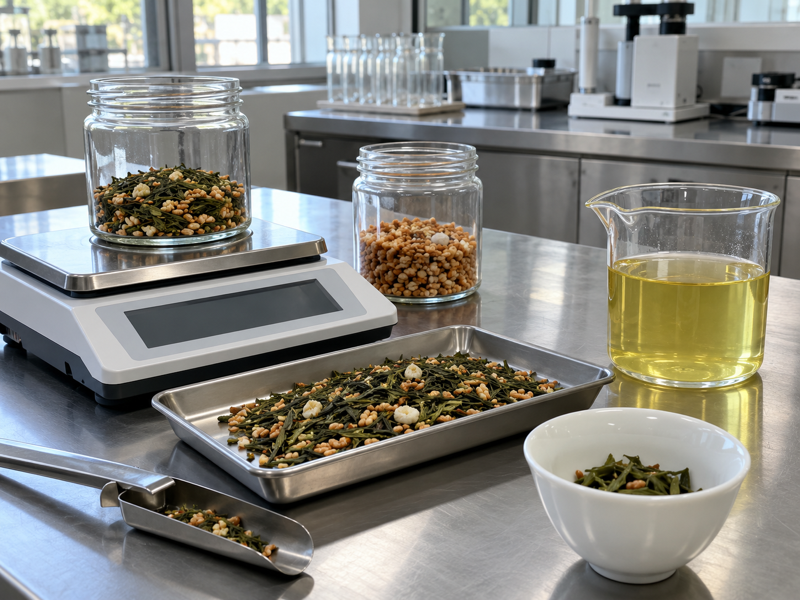
Genmaicha tea caffeine comes from green tea leaves in a blend with roasted rice. There is no single caffeine number that fits every blend, recipe, and serving size. That matters to beverage brands writing labels and to café operators answering customer questions. A useful caffeine statement starts with a precise product and a defined preparation method. This guide explains what can be inferred from ingredients, what requires a measurement, and how to make supplier and finished-drink testing comparable.
Contents
- 1. Does genmaicha contain caffeine?
- 2. Why do genmaicha tea caffeine figures differ?
- 3. Is genmaicha lower in caffeine than other green tea?
- 4. Does brewing temperature change caffeine exposure?
- 5. How do steep time and dose affect a caffeine claim?
- 6. What does adding matcha do to genmaicha caffeine?
- 7. What information should a supplier provide about caffeine?
- 8. How should caffeine be communicated to customers?
- 9. How can a buyer set up a defensible caffeine test?
- 10. What is the practical purchasing decision on genmaicha caffeine?
1. Does genmaicha contain caffeine?
Yes. Conventional genmaicha blends roasted rice with green tea. The Japanese Ministry of Agriculture, Forestry and Fisheries describes genmaicha as roasted rice combined with tea such as bancha, sencha, or gyokuro. Rice does not supply the tea caffeine, but it does not remove caffeine from the leaves. If a supplier adds matcha, that powder is also green tea and becomes part of the caffeine calculation.
For a buyer, the ingredient list answers whether caffeine is expected. It does not answer how many milligrams a customer drinks. A dry blend's tea-to-rice ratio, tea material, brewing dose, water volume, temperature, and extraction time all affect the result. A concentrated brew used for milk tea differs from a lightly steeped cup. Even identical dry tea can yield different caffeine per serving if one shop pours 180 mL and another pours 450 mL. Treat “contains caffeine” as the starting statement and reserve numerical claims for tested products.
| Question | What the ingredient list tells you | What still needs testing |
|---|---|---|
| Is there caffeine? | Green tea means caffeine is expected | Exact amount |
| Does rice dilute tea leaf? | Ratio may suggest direction | Brewed value at serving size |
| Does matcha change it? | Added tea powder adds a source | Finished-drink amount |
2. Why do genmaicha tea caffeine figures differ?
Many published values refer to a specific infusion. A figure per 100 mL differs from one per cup, and a cup is not a standardized volume. The agriculture ministry's caffeine table lists a genmaicha infusion at 10 mg per 100 mL under a stated preparation method. It is a useful example of a measured brew, not a specification for all genmaicha. Copying it onto a different brand's label would discard the conditions that give the value meaning.
Tea leaf grade, crop, blend ratio, and particle size can vary. So can the proportion of powdered matcha in matcha-iri genmaicha. Brewing adds another layer: a hotter, longer, or heavier extraction may yield a different value. A comparison should normalize units and record the recipe. If the number came from dry leaf analysis, it cannot be presented as a brewed-cup number without an extraction model that has been validated for that product. Ask what was sampled before comparing two figures.
3. Is genmaicha lower in caffeine than other green tea?
It may be lower than a comparable all-leaf tea by dry weight when rice replaces some tea leaf, but that is a conditional comparison. It does not guarantee a lower-caffeine finished serving. A shop could brew more blend per cup or add matcha. A supplier could use a different leaf type. A consumer could drink a larger portion. To advertise “lower caffeine,” define the comparator, prepare both products by a repeatable method, and test the finished drinks.
The US Food and Drug Administration's caffeine guidance notes that caffeine values vary among specific beverages and serving sizes. It gives 37 mg as a typical green tea amount for a 12-fluid-ounce drink, but that category number is not a genmaicha benchmark. Procurement teams should resist comparing a 100 mL genmaicha reference with a 12-ounce green tea value as if the methods were matched. A claim can be technically true under one recipe and misleading under another. Use matched samples and units.
| Comparison | Required controls | Useful output |
|---|---|---|
| Two dry blends | Same mass and analytical method | Caffeine per gram of blend |
| Two brewed teas | Same dose, volume, temperature, time | Caffeine per 100 mL |
| Two menu drinks | Real recipes and final sizes | Caffeine per sold serving |
4. Does brewing temperature change caffeine exposure?
Temperature can affect extraction, but it acts with time, dose, leaf structure, and agitation. It is not a reliable stand-alone caffeine control. Cooling the water may change flavor and extraction; it does not make a caffeinated tea decaffeinated. A café recipe that cools water for a softer taste still needs a measured result if the menu promises a numerical caffeine level.
For a study, record water temperature at the point of contact with the tea, not merely the kettle setting. A preheated pot, room-temperature vessel, or large batch changes what leaves actually experience. Weigh the blend and note the ratio of tea leaf to rice if the supplier discloses it. Measure final beverage volume after straining, because leaves retain some water. If you investigate temperature as one variable, hold all other steps fixed. Otherwise a difference in a laboratory result might reflect a changed dose or final yield. For routine service, choose temperature for the target flavor and confirm the caffeine level of that service recipe rather than attempting to infer it.
5. How do steep time and dose affect a caffeine claim?
Both should be written into the test protocol. A short steep and a long steep do not describe the same beverage. Doubling tea mass while keeping water fixed changes the amount of caffeine available for extraction and often changes bitterness. Multiple infusions complicate a per-cup claim because the total caffeine is spread across servings. A café might blend a strong first infusion with milk; a tea room might serve successive light infusions. Each is a different exposure question.
Create a recipe sheet with dry blend mass, water input, temperature, steep time, number of infusions, filtered liquid volume, and final serving composition. For a bottled drink, include the manufacturing extraction and dilution steps. Sample the product as a customer receives it. If testing a new supplier's sample, repeat the same recipe with the approved control. A result that looks different on paper may disappear once methods match, while a real difference can remain even when dry tea looks alike. Method details make test data useful for future batches.
| Recipe field | Why it matters | Example record format |
|---|---|---|
| Blend mass | Sets material available | Grams per batch |
| Water input | Sets extraction ratio | Milliliters per batch |
| Temperature and time | Define extraction | Measured °C and seconds |
| Final beverage volume | Sets concentration | Milliliters after straining |
| Served portion | Sets customer intake | Milliliters per sale |
6. What does adding matcha do to genmaicha caffeine?
Matcha is powdered tea leaf. For a broader ingredient comparison, see genmaicha versus matcha. In matcha-iri genmaicha, some of that powder may disperse into the cup and be consumed rather than removed with strained leaves. The amount varies with formulation, settling, filtering, and serving practice. A vivid green appearance does not tell you how much matcha was added, nor does it establish a caffeine value. Two suppliers can use the same product name for visibly different blends.
Ask the supplier for a composition range and application guidance. If the exact ratio is confidential, request a caffeine specification or test report for the offered SKU and then measure your own finished beverage. Agitate a sample according to your service process before testing if powder settles in a batch vessel. Test the drink after the same hold time used in stores. If a brand switches between plain genmaicha and matcha-added genmaicha, the caffeine statement must be reconsidered rather than carried over from the earlier item. Maintain separate product codes and label approvals for the two variants.
7. What information should a supplier provide about caffeine?
At minimum, a supplier should identify the exact SKU and lot, full ingredient statement, recommended preparation, and whether any caffeine value refers to dry blend or brewed beverage. A test report should state units, analytical method, laboratory, sample identity, and date. Buyers should also request the specification revision and change-notification process. Without those, a test result can be accurate yet belong to a different blend or an obsolete recipe.
Do not assume a broad company capability statement proves a particular product's caffeine content. Matcha Village supplies tea and tea powder categories, including genmaicha powder in its stated portfolio, but an individual SKU's caffeine requires SKU-specific documents. A retail brand may need an independent laboratory result for its local label rules. A foodservice operator may instead need a recipe-specific figure to answer customer inquiries. The evidence should fit the claim. When a supplier cannot provide it, keep copy qualitative and avoid “low,” “very low,” or “safe for children” language.
| Supplier item | What to verify | Why it matters |
|---|---|---|
| Specification | Current SKU and revision | Prevents mixing different blends |
| Caffeine report | Sample, method, units, date | Makes value interpretable |
| Ingredient statement | Tea and rice components | Identifies caffeine sources |
| Change notice | Trigger and lead time | Protects label validity |
8. How should caffeine be communicated to customers?
Use plain wording that matches the evidence. “Contains caffeine from green tea” describes a conventional blend without implying a fixed amount. If you give milligrams, state the serving size and keep the recipe controlled. A ready-to-drink label may have market-specific rules about nutrition and caffeine disclosures, so route it through local regulatory review. Do not describe genmaicha as an herbal tea or caffeine-free rice tea when it includes green tea leaves.
Customers differ in sensitivity. The FDA says 400 mg per day is an amount not generally associated with negative effects for most adults, while noting that individual factors matter. That is general guidance, not a recommendation for every person or a license to market genmaicha as medically safe. Pregnant customers, people taking certain medicines, and people who are sensitive to caffeine may need advice from their clinician. A staff training card can identify the tea as caffeinated and direct precise questions to the verified product data. It should not turn a server into a medical adviser.
9. How can a buyer set up a defensible caffeine test?
Start with a question narrow enough to answer: caffeine per sold 300 mL bottle, caffeine per standard café drink, or caffeine per gram of dry blend. Write a sampling plan, choose representative lots, and prepare according to the actual production recipe. Ask an appropriate laboratory to report the result with units and method. Retain the sample and result with the lot record. If the product changes, decide whether the test still represents it.
For a supplier comparison, test at least the proposed blend and current control under matched conditions. If your target is a “lower caffeine” positioning, test the comparator using the same method and define the comparison basis before seeing the results. The report should support a decision, not a search for a favorable number after the fact. A formulation change, new matcha addition, or larger serving requires reassessment. Set an internal review interval for recurring products, especially if leaf source or blend ratio can change seasonally.
| Test objective | Sample to send | Result to request |
|---|---|---|
| Ingredient screening | Representative dry blend | mg per g of blend |
| Menu disclosure | Finished service drink | mg per sold serving |
| RTD label | Production-equivalent beverage | mg per declared container |
| Comparative claim | Product and named comparator | Matched method and units |
10. What is the practical purchasing decision on genmaicha caffeine?
Choose a blend for taste and application first, then measure caffeine if it affects positioning or compliance. A rice-heavy visual appearance is not an analytical result. A published category figure is useful background but cannot replace an exact SKU or finished-drink test. Procurement and product development should agree on the standard recipe before sending samples to a laboratory; otherwise the number may not describe what customers receive.
Request the ingredient specification, representative lot samples, and any available caffeine report from the candidate supplier. Run a controlled sensory trial and commission finished-product testing when the label or menu needs a number. Keep a record of the recipe used for both tasting and analysis. That gives marketing a statement it can defend and operations a drink it can reproduce.
Frequently asked questions
Q1: Is genmaicha caffeine free? No. Conventional genmaicha contains green tea, which naturally contains caffeine.
Q2: Is genmaicha always lower in caffeine than green tea? No universal ranking applies. Blend, dose, brew, and serving size must be matched for comparison.
Q3: Can a published caffeine figure go on my label? Use a value measured for your exact product and serving, then obtain local label review.
Q4: Does matcha-iri genmaicha have more caffeine? Added matcha adds a tea caffeine source, but the finished amount depends on formulation and serving.
Q5: What should a café tell a caffeine-sensitive customer? Say the drink contains caffeine and provide a verified serving value if available; avoid medical advice.