
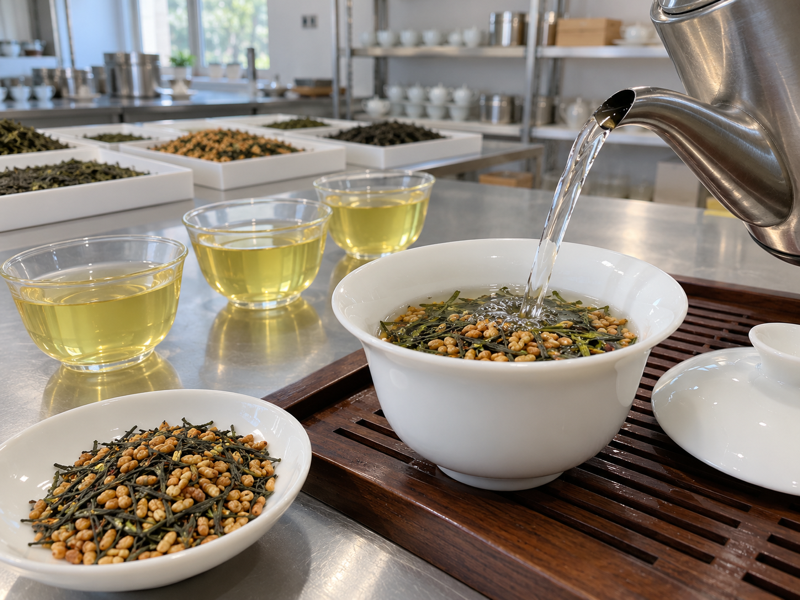
A genmaicha tea recipe should deliver the same toasted-rice aroma and green-tea balance across operators, batches, and serving formats. A vague direction such as “steep until ready” leaves too much to chance. This guide gives café, hospitality, and beverage teams a measured starting method and a way to adapt it for hot tea, iced tea, and concentrate. The times and temperatures are starting points, not guarantees; validate them with the particular blend, water, equipment, and customer preference you will use.
Contents
- 1. What ingredients belong in a genmaicha tea recipe?
- 2. What is a sensible hot-brew starting point?
- 3. How should water affect the recipe?
- 4. How can an iced version be developed?
- 5. When is a concentrate useful?
- 6. How should flavor additions be handled?
- 7. What should a batch recipe record?
- 8. How can teams diagnose a weak cup?
- 9. What safety and holding rules matter?
- 10. How can the recipe be approved for rollout?
1. What ingredients belong in a genmaicha tea recipe?
The basic recipe needs genmaicha, potable water, and a measured brewing vessel. Traditional genmaicha combines green tea with roasted rice; the tea type and rice preparation can vary. Japan's Ministry of Agriculture, Forestry and Fisheries identifies bancha, gyokuro, and sencha as possible tea bases. That means a supplier sample is the real ingredient, not an abstract category. Its blend ratio, leaf size, and roasting level will influence the cup.
Choose a weighed dose rather than a spoonful. Rice grains and tea leaves differ in density and can segregate inside a bag, so a volume scoop may deliver a changing blend. Mix the dry batch gently according to supplier instructions and sample from a representative part of the pack. Use a mesh that retains leaves and rice but allows normal extraction. Keep a plain reference brew before adding sweetener or citrus; it tells the team whether any later flavor problem began in the tea.
| Input | What to specify | Why it changes the cup |
|---|---|---|
| Genmaicha | Supplier SKU and lot | Blend and roast variation |
| Water | Potable source and treatment | Taste and extraction |
| Dose | Grams per brew | Strength and consistency |
| Vessel | Capacity and filter type | Contact and retention |
2. What is a sensible hot-brew starting point?
For a hot service trial, start near 2–3 g of loose tea per 100 mL water. Japan's agriculture ministry gives a genmaicha starting range of roughly 90–100°C and 30 seconds to one minute in its tea preparation guidance. These are useful reference points, yet a commercial team should taste several time and temperature combinations because the exact blend, vessel, and serving size differ. A highly toasted blend may give aroma quickly; a leaf-forward one may need another balance.
Warm the vessel if the equipment standard calls for it, weigh tea, add measured water at the target temperature, start a timer, then strain completely at the chosen endpoint. Taste promptly. Record aroma, roasted note, tea bitterness, and aftertaste. Repeat with another operator before writing the method on a recipe card. A time range without an extraction endpoint can still produce variation if one employee pours immediately and another leaves leaves in the pot during service.
| Trial | Dry tea | Water | Brew condition to test |
|---|---|---|---|
| A | 2 g | 100 mL | 90°C, 30 seconds |
| B | 2 g | 100 mL | 95°C, 45 seconds |
| C | 3 g | 100 mL | 95°C, 45 seconds |
| D | 2 g | 100 mL | 100°C, 60 seconds |
These are exploratory comparisons, not an approved formula or a claim about any supplier's ideal method. Stop a trial if flavor becomes harsh or the service method cannot be reproduced.
3. How should water affect the recipe?
Water is most of the drink, so use the same source for development and service whenever possible. Strong mineral taste, chlorine odor, or a filtration change can shift the perceived tea balance. Record water treatment and temperature at the point of contact with the leaves, not only the kettle setpoint. A small teapot may cool rapidly; a large insulated brewer may not. The recipe must describe the real vessel in which extraction happens.
If stores operate in several cities, test the recipe with their actual water supplies or a defined filtered-water standard. A single laboratory cup may not predict performance across the network. For an international brand, local water adjustments can be easier than changing tea dosage in every region. Keep water testing within your food-safety system and avoid treating this tasting guidance as a water-quality specification. The practical goal is reproducible flavor using safe water and a method the operation can maintain.
4. How can an iced version be developed?
An iced genmaicha tea recipe needs a dilution plan. If hot tea is poured over ice, some ice melts and lowers concentration. Brew a stronger tea base or use less initial water, then specify ice weight and final cup fill. A drink that tastes balanced at the moment of pour may become weak after ten minutes. Taste both points. If the product is prepared in advance and chilled, evaluate aroma after refrigeration as well as immediately after brewing.
Do not assume cold brew and hot brew followed by chilling taste alike. Cold extraction changes the flavor balance and requires its own food-safety controls. For a fast café service, a measured hot-brew concentrate may be simpler, but a cooling and holding plan is required. Test the actual cup, lid, ice type, and time before delivery. If citrus or sweetener is added, measure those separately so the tea strength can be judged on its own.
| Iced method | Advantage | Trial risk |
|---|---|---|
| Hot brew over ice | Fast aromatic release | Variable melt and dilution |
| Brew then chill | Consistent batch preparation | Aroma change during hold |
| Cold extraction | Different flavor profile | Time and safety controls |
| Concentrate plus ice | Faster store assembly | Over- or under-dosing |
5. When is a concentrate useful?
A concentrate can reduce service steps for a café or beverage line. Develop it by increasing tea dose, reducing water, or adjusting time while protecting the desired roast and leaf balance. Do not simply steep much longer: bitterness may rise while the toasted aroma does not. Specify a dilution ratio in grams or milliliters, then verify the finished cup. A concentrate should be judged after dilution with the same water, milk, or ice that customers will receive.
Record extraction yield and filtration loss. If 1 L water does not produce 1 L usable tea after leaf absorption and filtration, a batch recipe based only on input water will misstate cost and serving count. Include prepared-at time and a validated hold rule from your quality team. If several stores make concentrate locally, consider whether a weighed sachet or preportioned ingredient could reduce error. That is an operational option, not a substitute for tasting or food-safety approval.
6. How should flavor additions be handled?
Sweetener, yuzu, milk, and other additions can support a genmaicha drink, but each can hide or alter the tea. Lock the basic brew before testing flavors. For a citrus version, add yuzu in measured increments and check whether its acidity dominates the roasted-rice note. For a latte, test the exact milk or plant drink SKU because sweetness and body differ by product. A powder topping may create sediment or a different tea identity from the liquid base.
Keep one change per trial where feasible. A test that alters tea dose, syrup, ice, and milk at once cannot tell the team which variable fixed the drink. If a retail product will use a premix, request its full composition; the premix may already contain sugar or flavor. Document ingredient declarations and allergen implications through the appropriate review. The customer-facing recipe should describe the finished taste honestly, while the internal formula should show every measured input.
| Addition | What it can do | What to verify |
|---|---|---|
| Sugar or syrup | Softens bitterness | Finished sweetness and calories |
| Yuzu | Adds citrus top note | Tea visibility and acidity |
| Milk | Adds body | Masking and separation |
| Matcha | Adds green color and tea intensity | Correct naming and sediment |
7. What should a batch recipe record?
A service card should contain the supplier item, dose, water amount and temperature, brew time, filtration method, final yield, cup size, additions, and holding rule. Include a photograph or sensory reference if the team has one, but do not rely on color alone. A batch log should also record date, operator, ingredient lot, and deviations. Those fields let a manager investigate a weak or bitter day without guessing whether the supplier changed.
Use units that staff can measure. “One scoop” is acceptable only if the scoop has been validated with the ingredient and a tolerance; even then, periodic weighing helps. For a multi-store rollout, trial the card with people who did not help develop it. Their questions reveal missing instructions. Keep the revision date visible. A recipe amended on a whiteboard at one outlet can spread by word of mouth while the approved master remains unchanged.
8. How can teams diagnose a weak cup?
Work backward from the symptom. If roast aroma is weak but tea bitterness is high, longer steeping may make the cup worse. Check blend composition and storage, then consider a different ingredient or dose. If both aroma and body are weak, check tea mass, water volume, filter loading, and dilution. If a cup varies through the day, examine hold time and whether leaves remain in the brewer. Tasting the dry ingredient beside the finished drink can help locate aroma loss.
Record observations before changing the recipe. A short troubleshooting sheet keeps staff from compensating with extra syrup, which can hide a problem while changing costs and nutrition. Escalate suspected off odor, contamination, or damaged packaging through quality procedures rather than trying to brew around it. A reproducible tea recipe depends on ingredient condition and process discipline, not a single magic temperature.
| Symptom | Check first | Possible next trial |
|---|---|---|
| Weak roast | Ingredient lot and storage | Alternate blend or dose |
| Bitter finish | Brew time and temperature | Shorter contact |
| Watery iced cup | Ice and concentrate ratio | Defined dilution |
| Uneven servings | Scooping and filtration | Weighed dosing |
9. What safety and holding rules matter?
Recipe guidance does not replace a food-safety plan. Use potable water, clean vessels, controlled ingredient storage, and established rules for brewed-tea holding. If adding milk, fruit, or sweetener, assess the finished drink under the site's applicable controls. A chilled batch requires a cooling method and time limit approved by the quality team. Do not publish a universal ambient hold time based on a tasting trial; equipment, temperature, and ingredients vary.
For packaged beverages, the challenge is larger: heat treatment, microbiological validation, packaging, and shelf-life study belong with qualified manufacturing staff. Tea aroma and appearance also need checks after processing and during storage. Keep sensory targets and safety release separate. A delicious sample is not evidence of a safe shelf-stable bottle. Procurement should obtain specifications and lot documents from suppliers, while the product owner validates the finished system.
10. How can the recipe be approved for rollout?
Approve the method against defined criteria: recognizable roasted-rice aroma, acceptable bitterness, target serving weight, preparation time, repeatability across operators, and cost per sold cup. Test on the equipment stores will actually use. Run a repeat brew with a second lot if the launch volume justifies it. Compare the optimized recipe with a plain reference cup so the team can tell whether a flavor addition improves or hides the tea.
Issue one controlled card for each format: hot, iced, and concentrate. Record who approved it and what change triggers retraining. A supplier brief can then specify the genmaicha profile, loose or powder format, expected volume, target market, and required documents. For source background, see Japan MAFF's genmaicha definition and its 2024 preparation guidance. The next action is a measured pilot in the real serving vessel, followed by a repeat test before menu release.
For a separate look at how roasted-rice tea differs from roasted-leaf tea, see our genmaicha vs hojicha guide.
FAQ
Q1: What is the simplest genmaicha tea recipe starting point? Test roughly 2–3 g loose tea per 100 mL water around 90–100°C for 30–60 seconds, then adjust by tasting the specific blend.
Q2: Can a tea bag replace loose genmaicha? Yes, if its fill weight and composition deliver the target cup. Test it using the intended vessel and time.
Q3: Should an iced recipe use the same strength as hot tea? Usually it needs a separate dilution trial because melting ice changes the finished cup.
Q4: Can a concentrate be held all day? Use a holding rule validated by your food-safety team for the actual process; tasting alone cannot establish a safe limit.
Q5: Is powder interchangeable with a loose-leaf recipe? No. Powder may be consumed rather than strained and can change flavor, sediment, and nutrition calculations.