
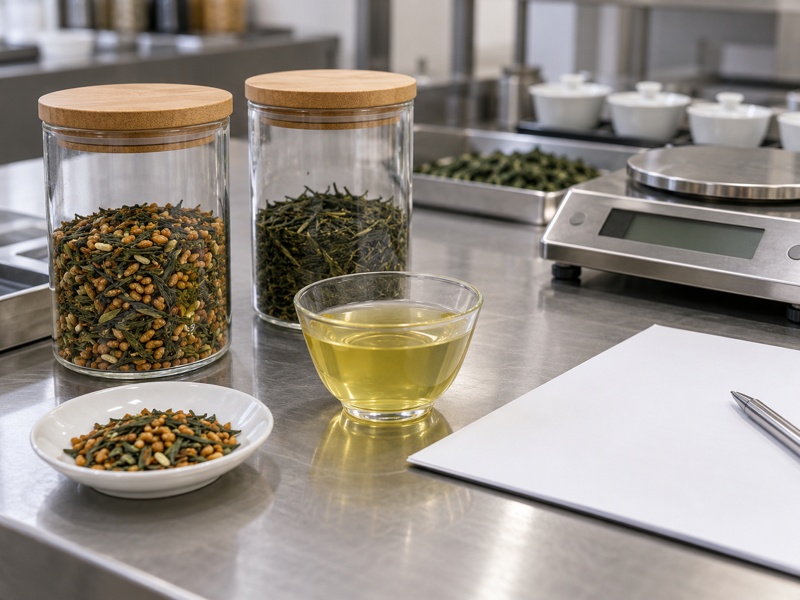
A pregnant customer may ask whether genmaicha is safe because it tastes softer than many green teas. The roasted rice changes flavor; it does not make the green tea caffeine-free. The sensible response is to give accurate product information, acknowledge that a brewed cup varies, and leave personal medical decisions to a clinician. This article is written for tea brands, café teams, and ingredient buyers building that response. It reviews the evidence a seller can verify and the claims it should avoid. It is not individual pregnancy advice.
Contents
- 1. Does genmaicha contain caffeine during pregnancy?
- 2. What does current pregnancy guidance say?
- 3. Can a brand quote milligrams per cup?
- 4. Does roasted rice reduce caffeine?
- 5. What changes if the blend contains matcha?
- 6. Is decaf genmaicha a separate product?
- 7. Which ingredients and allergens should staff check?
- 8. How should a café answer a personal question?
- 9. What should a buyer request from the supplier?
- 10. What belongs on a training and label review sheet?
1. Does genmaicha contain caffeine during pregnancy?
Standard genmaicha combines green tea leaves and roasted rice. The leaves contain caffeine. The customer’s pregnancy does not change the chemistry of the cup, but it changes how carefully the seller should speak about intake. A mild taste is not evidence of a low caffeine dose. Brew strength, leaf grade, rice ratio, cup size, and whether matcha is added all affect the amount consumed. Sellers should answer “yes, this tea contains caffeine” unless their specific product has documentation for another statement.
The existing genmaicha caffeine guide explains why general numbers vary. For a product label, a brand needs evidence for its own formula and intended brew, especially if it wants to give a milligram number. A staff member should not estimate a patient’s daily caffeine total from a single cup. Coffee, chocolate, soft drinks, medication, and other tea may contribute. If the customer asks what she personally should drink, the café can provide facts and suggest she speak with her pregnancy care professional.
| Product fact | What a seller can say | What needs testing |
|---|---|---|
| Green tea ingredient | Contains caffeine | Exact amount |
| Roasted rice | Adds toasted flavor | No caffeine-free inference |
| Cup size | Serving is defined | Dose per finished cup |
2. What does current pregnancy guidance say?
The American College of Obstetricians and Gynecologists states that moderate caffeine consumption, under 200 mg per day, does not appear to be a major contributor to miscarriage or preterm birth. Its guidance also notes that caffeine comes from tea and other foods. This is a population-level statement, not a certificate that any particular genmaicha cup is appropriate for a particular person. The customer’s clinician may give different advice based on individual circumstances.
A tea brand should quote the organization accurately and date-check the source during label review. It should not compress the guidance into “safe in pregnancy” on a package or menu. The former gives a total daily threshold; the latter turns a general guideline into a claim about one product and one person. If the brand has measured caffeine per finished serving, that information can help a customer count intake, but the final decision still belongs to the customer and clinician. Keep the claim limited to what the product evidence supports.
3. Can a brand quote milligrams per cup?
A brand can publish a measured value if it has an appropriate testing plan and the claim complies with its market’s labeling rules. The sample must represent the sold blend and the stated brew. A 2 g tea bag in 200 ml water is not the same product experience as a 5 g café dose in 450 ml. Lot-to-lot leaf changes, extraction time, water temperature, and matcha additions can change the result. The quality team should decide how many lots and replicates support the claim and how to express variation.
If no product-specific test exists, a seller can still say the blend contains caffeine and list its ingredients. Avoid lifting a number from a competitor’s website. That figure may come from a different tea-to-rice ratio or cup size. The buyer should keep the laboratory report, sampling record, method, recipe, and approved wording together. When the recipe changes, re-evaluate the number before reprinting menus. A precise-looking claim with no clear serving definition can mislead more than a plain qualitative statement.
| Claim | Minimum basis | Weak substitute |
|---|---|---|
| Contains caffeine | Verified tea ingredient | Taste |
| Milligrams per cup | Finished-serving analysis | Category average |
| Lower caffeine | Defined comparison and test | More rice by sight |
| Decaffeinated | Decaf process and specification | Short steep |
4. Does roasted rice reduce caffeine?
Roasted rice itself is not a tea leaf. Adding rice may reduce the fraction of tea in a fixed gram of blend, but that does not determine the caffeine in a served cup. A café might use more total blend to keep flavor strong, brew longer, or add matcha. Those changes can alter the finished drink. The reliable statement is that the rice contributes aroma and composition; a caffeine amount requires measurement under the actual recipe. This distinction matters when staff hear “rice tea” and assume no caffeine.
A buyer comparing blends should request the tea-to-rice composition and sample both under a common brew. If a brand wants a lower-caffeine option, it can investigate decaffeinated tea, a different formulation, or a rice-only beverage, then label the result accurately. It should not tell customers that a standard blend is a substitute for a caffeine-free infusion. For a pregnancy question, provide the documented serving facts and avoid solving the customer’s entire daily intake at the counter.
5. What changes if the blend contains matcha?
Matcha-iri genmaicha includes powdered green tea in addition to leaf and rice. The powder can cling to the dry blend, deepen color, and change the cup’s mouthfeel. Because matcha is consumed as suspended tea solids, it changes the caffeine question as well. A brand cannot assume that a caffeine value measured for a standard loose-leaf genmaicha applies to a matcha-added SKU. The ingredient statement, brew method, and test plan must match the sold product.
For staff, this is also a naming issue. A customer may ask for “genmaicha” and receive a matcha-coated version without realizing it. Put “with matcha” in the product description where it is true. The matcha-iri genmaicha guide covers the blend; the pregnancy discussion requires a separate response grounded in serving-specific caffeine information. Never imply that a green color proves a health benefit or a particular caffeine level.
| Blend type | Ingredient difference | Claim consequence |
|---|---|---|
| Standard genmaicha | Leaf and roasted rice | Caffeinated |
| Matcha-iri | Added matcha powder | Test separately |
| Decaf blend | Decaffeinated tea | Verify process |
| Rice-only drink | No tea leaf if truly so | Name separately |
6. Is decaf genmaicha a separate product?
Yes. A decaffeinated genmaicha uses tea that has undergone a decaffeination process or a documented low-caffeine formulation, depending on how the product is made and named. “Decaf” does not necessarily mean zero caffeine. Buyers should ask the supplier for a specification, residual caffeine information if claimed, ingredient statement, and process summary. Packaging and menu copy should distinguish decaf from the standard blend. Staff should not make a decaf version by steeping standard tea briefly or adding more rice.
A café with both SKUs needs separate bins, recipes, and order-system names to avoid substitution during busy service. The decaf cup should be tested for taste and consistency, not assumed to perform like the standard tea. If a customer needs strict caffeine avoidance, staff should point to the actual product information and advise medical guidance for the personal threshold. The business can offer choices and accurate facts; it cannot certify a person-specific safe intake from a menu description.
7. Which ingredients and allergens should staff check?
A simple blend may contain only green tea and roasted rice. Commercial products can include matcha, flavoring, sweeteners, or other materials. The café should use the exact ingredient statement for its SKU rather than a general description of the category. If it prepares a latte, dessert, or bottled drink, the finished product adds its own ingredients and allergen questions. A pregnancy response about a plain tea does not cover a milk-based or flavored menu item.
The quality team should also review supplier allergen controls and any cross-contact declarations relevant to the market. Roasted rice is not a blanket guarantee of a gluten-free finished product, because other ingredients and handling may matter. The seller should avoid making an allergen or pregnancy safety claim from the two-word name “brown rice.” Keep a current supplier spec and the café’s finished recipe available for staff. When either changes, update the answer sheet before the next sale.
| Information source | Question it answers | Owner |
|---|---|---|
| Supplier ingredient spec | What is in the tea? | Procurement/QA |
| Finished recipe | What is in the drink? | Café operations |
| Allergen review | What must be declared? | Regulatory |
| Caffeine test | How much in a serving? | Quality team |
8. How should a café answer a personal question?
A good response separates facts from advice: “This genmaicha contains green tea and therefore caffeine. We can show the ingredients and serving size. Your pregnancy care professional can advise you on your own intake.” If the business has a validated caffeine amount, staff can provide it with the defined cup and brew. If it does not, staff should say so. They should not invent a reassuring number or claim that the rice makes the drink harmless.
Train staff to respond without alarm or a lecture. A customer may be asking because she is tracking a daily total, not because she expects the café to practice medicine. Show the actual pack or product sheet if appropriate and offer a documented alternative. Escalate an ingredient or allergen question to the manager when the answer is unclear. The customer should leave with a clear choice and a truthful description, not a broad “safe” or “unsafe” verdict that the café cannot support.
9. What should a buyer request from the supplier?
Ask for the current ingredient statement, leaf base, tea-to-rice ratio or accepted range, matcha status, serving guidance, caffeine data if available, decaf documentation if applicable, allergen statements, and change-control process. If the product will be private-labeled, align the final package wording with those records. A buyer should also ask how a formulation change is communicated. A new tea base or different matcha dose can invalidate old consumer wording even when the front of the package looks the same.
Retain a sample and lot record. If caffeine is a central purchase criterion, commission a test of normal production lots rather than relying on a development sample. If the data are insufficient, simplify the claim instead of delaying the entire product or inventing certainty. “Contains caffeine” is more useful and defensible than a precise figure taken from an unrelated blend. The supplier’s role is to provide evidence about the material; the brand’s role is to approve what it says to consumers.
| Supplier item | Review purpose | Update trigger |
|---|---|---|
| Composition | Correct product description | Formula change |
| Caffeine data | Numeric claim | New lot or recipe |
| Allergen record | Consumer information | Site/process change |
| Change notice | Keep copy current | Any material change |
10. What belongs on a training and label review sheet?
Put the approved product name, ingredient list, standard serving, preparation method, verified caffeine wording, allergen response, and escalation contact on one controlled sheet. Link it to the exact SKU and revision date. If the business has a decaf alternative, list it by name rather than as a casual substitution. Include a short answer for pregnancy questions that provides facts and refers personal decisions to a clinician. This should be rehearsed with the actual staff who will face customers.
The label review needs a stronger record than the training card. Keep source documents, test reports, artwork approvals, and market-specific regulatory sign-off. Review public copy after a recipe or supplier change. A pregnancy-related query is a good stress test of the product-information system: if staff cannot find the ingredients or serving size quickly, the documentation is not ready for public use. Fix that gap before adding more reassuring language.
FAQ
Q1. Is genmaicha caffeine-free during pregnancy? No. Standard genmaicha contains green tea and therefore caffeine.
Q2. Is there one safe number of genmaicha cups? A cup’s caffeine varies, and personal advice belongs with a clinician. ACOG discusses total daily caffeine, not a universal number of cups of this tea.
Q3. Does more roasted rice guarantee less caffeine? No. The finished cup also depends on dose, brew, and other tea ingredients.
Q4. Is matcha-iri genmaicha the same for caffeine? No. Treat it as a separate formula and test it separately before giving a number.
Q5. What can café staff say confidently? State the verified ingredients, serving size, and whether the SKU contains caffeine. Refer personal medical decisions to a clinician.
A brand can answer the question well by making its product records easy to find and keeping the response within those records.