
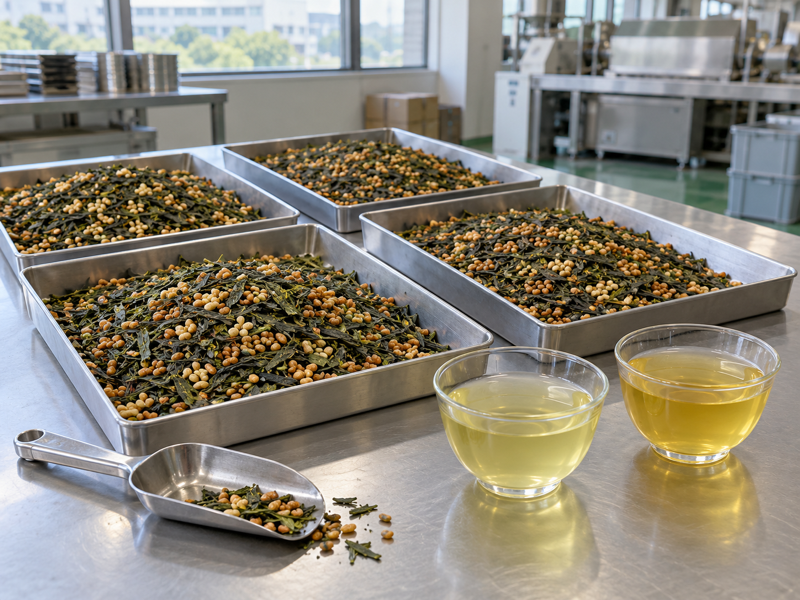
The best genmaicha tea for a retail tin may disappoint in a sweet bottled drink. Buyers need a blend that fits their application, repeats across batches, and arrives with useful documentation. Genmaicha combines tea leaves and roasted rice; Japan's Ministry of Agriculture, Forestry and Fisheries (MAFF) describes blends using bancha, sencha, or gyokuro. This guide turns that broad definition into a practical sampling and purchasing process. Ask suppliers for comparable samples, brew them under the same conditions, and judge their performance in the finished product rather than from dry-leaf appearance alone.
Contents
- 1. What does “best genmaicha tea” mean for a commercial buyer?
- 2. Which ingredients shape a genmaicha blend?
- 3. How should buyers run a fair tasting?
- 4. Which brewing variables reveal quality differences?
- 5. What should a supplier specification include?
- 6. How do loose leaf, tea bags, and powder compare?
- 7. How can buyers compare price without losing flavor?
- 8. How can consistency be checked across lots?
- 9. What should private-label and export buyers confirm?
- 10. How should a buyer make the final selection?
1. What does “best genmaicha tea” mean for a commercial buyer?
For a buyer, best means fit for a defined use. A specialty tea shop may prize a clean roasted aroma, attractive leaf, and several pleasant infusions. A café needs a dependable cup despite busy shifts and different staff. A bottled-tea developer has to consider extraction, clarity, filtration, and flavor after processing. Those priorities can point toward different blends without any sample being objectively inferior. Start with a one-page brief that names the sales channel, drink or food format, target flavor, serving method, desired price band, and expected order pattern.
Avoid a vague request for a “premium” sample. Premium can refer to the tea base, appearance, packing, or simply a supplier's marketing tier. Instead, describe how much roasted-rice character should remain after milk or sweetener enters the formula. State whether leaf appearance matters to the consumer. Request a reference sample when you already sell a product and need a close match. A written brief gives your team and the supplier the same target and makes the next tasting much more useful.
| Use | Main sensory target | Operational check |
|---|---|---|
| Loose-leaf retail | Clear tea and rice balance | Leaf appearance and repeat infusions |
| Café hot tea | Readable roast without harshness | Staff-friendly brewing window |
| Chilled beverage | Aroma after cooling | Clarity and filtration |
| Dairy application | Roast that survives milk | Flavor in the full recipe |
2. Which ingredients shape a genmaicha blend?
Genmaicha is a blend, so examine its components separately. The tea base contributes green, vegetal, sweet, or astringent notes. Roasted rice adds a toasted cereal aroma and can soften how a brisk tea tastes. The ratio, leaf cut, rice roast level, and freshness all alter the cup. MAFF's Japanese tea reference describes roasted rice blended with bancha, sencha, or gyokuro. That definition helps with category language; it does not imply that every commercial blend uses the same proportions.
Look at a representative sample rather than one attractive handful. Are the rice grains evenly distributed through the bag? Does the bottom contain excessive fines? Do the leaves look consistent with the agreed grade? Roasted rice may include puffed grains in some products, but their presence alone does not establish quality. Ask for an ingredient statement, the material specifications, and a current lot sample. If a powder is offered instead of loose tea, treat it as a separate ingredient with its own dispersibility and flavor requirements.
3. How should buyers run a fair tasting?
Use one recipe for every sample, including the same water, vessel, leaf weight, temperature, steep time, and serving temperature. Prepare coded cups if possible so the team does not favor a familiar supplier. Evaluate dry aroma, hot aroma, liquor color, first sip, finish, and a second infusion when relevant. Write down what happens after a cup cools. A blend that smells appealing hot can lose its roasted note at room temperature, which matters for takeaway and packaged products.
Taste at least twice on different days if the decision carries volume. One session can be distorted by a recently opened bag, an uneven rice distribution, or a brewer's mistake. Keep notes in plain language: “rice aroma fades under milk” is more useful than “good quality.” Include a known control from your existing range. If your project is a dessert or bottled drink, test each candidate in that actual matrix; neat tea is only a screening step. Retain the sample code, lot, and brew record so a winning cup can be traced back to a specific material.
| Score item | What to record | Reason for the check |
|---|---|---|
| Dry mix | Leaf and rice distribution | Screens blend consistency |
| Aroma | Tea, toast, off-notes | Tests desired flavor profile |
| Liquor | Color and visible sediment | Matters in clear drinks |
| Finish | Sweetness, bitterness, persistence | Predicts repeat drinking |
| Recipe fit | Flavor in final format | Prevents neat-cup bias |
4. Which brewing variables reveal quality differences?
Change one variable at a time after the baseline tasting. Slightly hotter water may draw more tea bitterness, while a longer steep can increase both body and astringency. Cooler water can favor a gentler cup, but it may also make a roast note seem faint. These are sensory tendencies, not fixed numbers for every blend. Record the range that produces an acceptable cup rather than chasing one perfect laboratory preparation. A café blend needs tolerance for ordinary service variation.
For retail, test the instructions you plan to print on the pack. If the recommended steep yields a weak or harsh cup, revise the instructions or select another blend. For food manufacturing, compare infusion strength and filtration under a process your plant can repeat. Do not assume tea brewed on a bench will behave the same after pasteurization or a long chilled hold. Run a pilot with the actual water and equipment. A purchasing decision made from a cup alone misses the operational failures that later become customer complaints.
5. What should a supplier specification include?
A useful specification describes the product the factory will actually ship. Ask for the ingredient list, tea-base description, rice ingredient description, particle or leaf form, sensory standard, packaging format, shelf-life basis, storage conditions, batch coding, and available test documents. Where relevant, ask which allergen information the supplier provides and how its facility controls cross-contact. The buyer's market and product format determine which tests and labels are required, so a generic certificate bundle is not enough.
Set acceptance criteria that can be checked at receiving. For example, define an approved reference sample and a defect list covering stale aroma, unusual odor, severe segregation, visible foreign material, or damaged packaging. A numerical limit should come from your applicable law, product risk assessment, or an agreed validated method. Do not copy a limit from another ingredient. Clarify what happens when a lot differs from the approved sample, who pays for retesting, and how replacement stock is handled. Those details turn “consistent quality” into a workable purchase agreement.
| Document or sample | Buyer question | Practical use |
|---|---|---|
| Current specification | What exactly is supplied? | Aligns purchasing and QA |
| Lot sample | Does shipped material match approval? | Incoming comparison |
| Test report | Which lot and methods does it cover? | Risk-based verification |
| Packing details | How is freshness protected? | Warehouse planning |
| Batch code format | Can a lot be traced? | Recall readiness |
6. How do loose leaf, tea bags, and powder compare?
Loose leaf gives buyers a visible product and flexibility to change dose. It also needs a brewer, filter, and staff time. Tea bags simplify portion control and service, but the leaf cut and bag material can affect extraction. Powder may suit a dessert or instant-style blend, yet it can settle, change color, or bring a different mouthfeel. A product described as genmaicha powder might be finely milled blended tea and rice, or an extract-based premix. Request the exact ingredient definition before treating powders as interchangeable.
If the shortlist also includes roasted tea, the genmaicha versus hojicha comparison clarifies which ingredient supplies the roast note. Choose form around use, not prestige. A foodservice distributor may want both a display-ready retail pack and a larger back-of-house pack. A chain might prefer a measured sachet for training and waste control. An ice-cream maker needs a powder that can be dosed and dispersed consistently. For each form, calculate cost per prepared serving at a realistic dose, not simply price per kilogram. Include filtration losses, labor, and any rejected product during trials. A cheap raw material can cost more after these practical losses are counted.
7. How can buyers compare price without losing flavor?
Request quotations against the same specification and pack size. If one quote includes private-label packing, freight, and testing while another is bulk material only, the unit prices do not describe equivalent offers. Ask each supplier to show the price basis, minimum order quantity, lead time, sample fee, available pack formats, and validity period. For imported goods, align the delivery term and destination before comparing landed cost. Check the currency and any seasonal adjustment method.
Then run a recipe-cost calculation. A stronger-tasting blend may allow a lower dose; a cheaper blend may need more product or additional flavor support. Test the lowest cost that still meets your sensory standard. Keep a reserve supplier in mind if uninterrupted menu availability matters. For a new brand, a smaller first order may have more value than the lowest tier price because it reduces inventory exposure while sales data develops. Price should be judged alongside repeatability, documentation, and realistic replenishment speed.
| Cost line | Include in comparison | Common oversight |
|---|---|---|
| Ingredient | Price at agreed order size | Different tea forms |
| Shipping | Delivery term and destination | Unclear freight basis |
| Preparation | Dose, labor, filters | Comparing only kg price |
| Loss | Sediment or trial rejects | Pilot yield ignored |
| Inventory | Lead time and shelf life | Overbuying launch stock |
8. How can consistency be checked across lots?
Ask for samples from more than one production lot if the supplier has them. Brew each against the approved control using the same method. Check aroma, roast intensity, liquor color, sediment, and finished-product performance. A blended product can segregate during packing and transport, so take a mixed representative sample from a bag rather than scooping only the top. Agree on how the factory homogenizes a lot and how it collects retain samples.
Consistency also depends on communication. A new tea harvest, altered rice roast, changed leaf grade, or packaging change may affect flavor even when the product name remains the same. Ask the supplier to notify you before material or process changes and to provide a sample for reapproval. Keep a signed version of the specification and log exceptions. If your product is a chain beverage, make one site prepare the control cup and another site prepare it from ordinary instructions. That comparison reveals whether the product or the operating method drives variation.
9. What should private-label and export buyers confirm?
Separate ingredient approval from artwork approval. The tea may pass tasting while a retail pack still needs a local-language ingredient statement, net quantity, responsible business details, date code, and market-specific label review. The destination market decides exact requirements. Ask who owns artwork, who signs off proofs, and how production records link printed packaging to the filled lot. For private label, also verify the minimum run by pack size and the fate of unused printed material.
Export buyers should request a packing list format, invoice details, country-of-origin documentation where applicable, and the test reports their importer needs. Confirm pallet dimensions, case count, and the storage conditions expected in transit. Do not assume an organic, halal, kosher, or food-safety claim applies to every SKU because a supplier offers such support elsewhere. Match each claim to the exact product, facility, destination, and valid document. A short document review before purchase is cheaper than reworking cartons after they are printed.
| Launch step | Owner | Proof to retain |
|---|---|---|
| Recipe approval | Product team | Coded tasting and trial record |
| Specification approval | QA and supplier | Signed current revision |
| Artwork approval | Brand and importer | Final proof |
| Shipment approval | Purchasing and QA | Lot and document match |
10. How should a buyer make the final selection?
Shortlist two or three blends that meet your basic requirements. Run a blind tasting, then test each in its intended recipe and operating conditions. Compare the finished result with a simple weighted scorecard covering flavor, process fit, documents, supply reliability, and landed cost. Weighting depends on your business: a premium loose-leaf brand might prioritize sensory quality while a chain beverage also needs a forgiving brew and stable stock. Record why the selected blend won and what would cause a requalification later.
Before placing a large order, approve a production-representative sample and a written specification. Ask for the expected lead time, replacement process, and first-shipment inspection plan. If your team needs a genmaicha ingredient for desserts or blended drinks, describe the recipe and ask suppliers for a sample suited to that application. Matcha Village lists genmaicha powder among its tea ingredients, but any offer should still be checked against your formulation and required documents. The best genmaicha tea is the one your team can prepare, sell, and reorder with confidence.
FAQ
Q1: Is expensive genmaicha always better? No. A higher price can reflect a different tea base or pack format. Judge samples in the intended use and compare cost per serving.
Q2: Can a loose-leaf sample qualify a powder product? No. Powder needs its own checks for ingredient definition, dispersibility, sediment, taste, and process behavior.
Q3: How many supplier samples should we compare? Compare enough distinct candidates to establish a useful benchmark; two or three qualified options often support a practical shortlist. Keep a control sample.
Q4: Does genmaicha always contain puffed rice? No. The product category centers on tea and roasted rice. The visible form of rice can vary by blend.
Q5: What should a first purchase order reference? Reference the approved specification, sample or lot, pack format, agreed price basis, delivery terms, and required documents.