
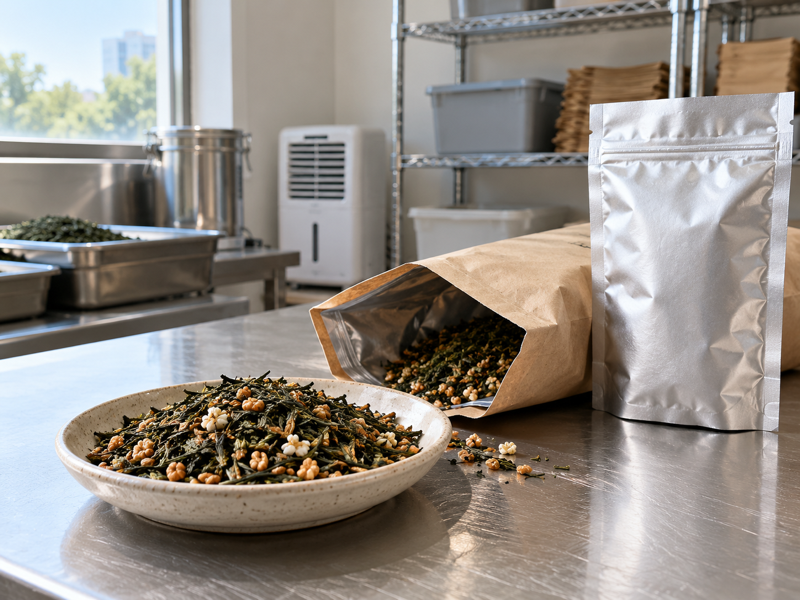
Genmaicha has two aromas to protect: green tea and roasted rice. A pack can still look dry and clean after months on a shelf while its toast note has faded and the tea tastes flat. Buyers often ask for one universal expiry period, but the answer depends on the actual blend, moisture, package barrier, sealing, and storage route. This guide explains how to set a defensible shelf-life plan for a commercial SKU. It is a quality and testing framework, not an unverified promise that every genmaicha remains good for a fixed number of months.
Contents
- 1. What limits genmaicha tea shelf life?
- 2. Why does roasted rice change the storage question?
- 3. Which package protects aroma in distribution?
- 4. How should a shelf-life study be designed?
- 5. What should a buyer check on arrival?
- 6. Can a stale-looking blend be judged by sight alone?
- 7. How do heat and humidity affect the plan?
- 8. What changes after a pouch is opened?
- 9. How should expiry and best-before dates be set?
- 10. What records should a supplier provide?
1. What limits genmaicha tea shelf life?
A shelf-life date is a claim about a specific product in a specific package under stated conditions. Green tea can lose its fresh, leafy aroma as oxygen, light, heat, and moisture exposure accumulate. Roasted rice brings volatile toasted notes that may fade on a different curve. The blend also needs to remain within the company’s microbiological and contaminant specifications. No single visual sign covers all these dimensions. The practical endpoint is the earliest failure of safety, legal, sensory, or physical acceptance criteria.
Define those criteria before the clock starts. For example, a tasting panel may agree that a reference cup must retain a recognizable roasted-rice aroma and clean green-tea finish, without stale or foreign notes. A laboratory may monitor moisture or water activity where suitable. The quality team should specify sampling methods and methods relevant to the product. Use a lot from normal production, not a hand-selected sample that will never represent commercial variation.
| Shelf-life dimension | Possible failure | Evidence |
|---|---|---|
| Aroma | Toast note fades | Blind sensory panel |
| Physical state | Clumping or excess fines | Pack and sieve check |
| Safety | Out-of-spec result | Qualified test |
| Pack | Seal leak | Integrity test |
2. Why does roasted rice change the storage question?
Roasted rice is not merely a visual garnish. It contributes much of the cereal aroma customers use to recognize genmaicha. Roast degree, rice particle size, and the ratio of rice to leaf affect how the dry blend smells and how the brewed cup tastes. A blend can pass a green-tea color check yet fail its intended flavor profile when the roasted note weakens. Compare the whole brew against an approved reference, rather than checking tea leaves and rice in isolation.
Rice and leaf can also segregate during transport if their sizes and densities differ. If the first retail sachets contain more rice than the last, flavor complaints may look like ageing even when the true problem is blend distribution. Sample from different positions in a bag or filling run. The existing guide to making genmaicha tea explains the brew itself; a shelf-life program must also prove that packages across the lot deliver comparable cups after storage.
3. Which package protects aroma in distribution?
Choose packaging against the distribution route, not the product photograph. A thin paper pouch may look attractive on a café shelf but may offer little barrier against oxygen or humidity unless it contains a suitable inner layer. An opaque, properly sealed barrier pouch often gives the quality team a more controlled starting point. Sachets add convenience but increase total seal area and may expose more material during filling. The final choice requires supplier data and a test with the exact pack construction.
Ask the converter for relevant barrier properties, seal requirements, and food-contact documentation for the target market. The tea packer should verify fill weights and seal integrity on the chosen line. A “high-barrier” marketing label is not enough if the seals fail in distribution. Test the complete filled pack, including any valve, zipper, label adhesive, carton, and shipper configuration. The unopened pack and the open-use plan are separate questions.
| Pack format | Main benefit | Main check |
|---|---|---|
| Bulk barrier pouch | Efficient for foodservice | Reseal and handling |
| Retail pouch | Shelf presentation | Seal and light barrier |
| Individual sachet | Portion control | Many small seals |
| Clear jar | Visibility | Light and lid control |
4. How should a shelf-life study be designed?
Start with the production blend, the intended package, and a written sampling schedule. Store packs under normal expected conditions and any justified challenge conditions. Pull samples at planned intervals, then evaluate dry aroma, brewed aroma, taste, appearance, moisture-related measures, pack integrity, and required safety attributes. Keep an unopened day-zero reference where the team can compare it fairly. Blind coding helps prevent testers from favoring a date because they know which sample is newest.
A single accelerated test can help screen pack options, but it cannot automatically convert to a real-world expiry date. Heat may change roasted-rice notes differently from ordinary room storage. If shipping includes warm containers or humid warehouses, model those exposures explicitly and then confirm under normal conditions. Record every lot, test method, acceptance limit, and deviation. The study should answer the commercial question: will a customer opening a normal pack near the end of its labeled life still get the cup the brand approved?
5. What should a buyer check on arrival?
Inspect the outer shipper for water damage, crushed cartons, broken inner packs, and inconsistent lot codes. Open a representative number of units from different cartons and compare seal quality, fill, dry aroma, and appearance. Brew a coded sample beside the approved reference under the same method. If the lot is large or the supplier is new, use a risk-based sampling plan designed by the buyer’s quality team. A quick sniff at the top of one bag is too weak to release a commercial shipment.
Request the specification, certificate of analysis where relevant, packing date, best-before basis, and storage instructions. Check that the product name and ingredient statement match the order. A sensory complaint after receipt can originate in shipping conditions, packaging, or the blend itself; receiving records help locate the cause. Reject or quarantine packs with evidence of moisture ingress or broken seals until the quality team decides their disposition.
| Receiving item | What to record | Why |
|---|---|---|
| Lot and pack date | Traceable identifier | Complaint investigation |
| Seal condition | Sample count and defect | Barrier confidence |
| Reference cup | Coded score | Flavor continuity |
| Storage instructions | Accepted condition | Warehouse control |
6. Can a stale-looking blend be judged by sight alone?
Appearance is a useful warning, but it does not establish shelf life by itself. Browned tea leaves, clumping, or visible moisture damage demand investigation. Yet a blend can lose its fresh roast aroma before obvious visual change. Conversely, naturally variable rice color may look “older” to an untrained viewer while the cup still meets the approved standard. Use a reference photograph only as one piece of evidence, with a brewed sensory check and the relevant test results.
The question is also whether the pack is safe and correctly labeled. A product with an acceptable cup but a compromised seal has not passed. A product with a sound seal but a flat, stale taste has failed a quality target. Keep those outcomes separate in the release record. If a customer returns a product, collect the lot, storage history, unopened control if available, and a photograph of the package before drawing a conclusion from one cup.
7. How do heat and humidity affect the plan?
Heat speeds many quality changes, and humidity can enter a weak package or an opened bulk bag. A sealed pouch held in a cool, dry warehouse is a different case from a bag kept beside a steamy café dishwasher. Define realistic conditions for import, domestic storage, last-mile delivery, and in-store handling. If a route passes through a hot container, sample that route or design a justified transport simulation. Do not write a storage instruction that the actual distribution chain cannot follow.
For a café chain, train staff to close the bulk pack immediately after dosing and to use clean, dry scoops. Condensation from a cold room to warm air can wet the pack mouth. For a manufacturer, monitor warehouse conditions and rotate stock by approved dates. A written instruction such as “store cool and dry” should have a practical interpretation for operators. If no one knows the temperature or humidity limits behind that phrase, the instruction is too vague to guide a quality decision.
| Exposure | Where it occurs | Control |
|---|---|---|
| Heat | Container or back room | Route review |
| Humidity | Open café pack | Dry tools and closure |
| Light | Clear retail display | Opaque barrier or test |
| Oxygen | Repeated opening | Smaller working pack |
8. What changes after a pouch is opened?
An opened pack no longer has the same barrier system as the sealed sample used for its printed shelf-life date. Oxygen and humid air enter each time the pouch is opened, and the exposed headspace changes as tea is used. A zipper helps, but staff may leave it partly open or scoop with damp tools. Establish an open-use period through the actual foodservice routine: pack size, daily openings, storage place, and desired cup quality. Then put the instruction on the operator card.
Smaller packs may cost more per kilogram but reduce the time a blend spends open at a low-volume site. High-volume sites may be able to use a larger pack without loss. Test both rather than assuming the largest pouch is cheapest after waste. Record opening date on the pack or in the inventory system. If aroma weakens, check stock rotation and the pack size before changing the blend or increasing the tea dose. More leaf will not recover a stale roasted-rice note.
9. How should expiry and best-before dates be set?
A quality date should come from documented testing and the target market’s labeling requirements. “Best before” typically communicates quality, while “use by” or expiry can have different legal meanings by market. The regulatory team should choose the term and date format, and the quality team should support the duration with the actual formulation and pack. Changing the rice roast, tea grade, barrier film, or filling method may require a new assessment because each can change the tested system.
Do not copy a competitor’s twelve- or twenty-four-month label. The competitor may use another package, leaf base, or storage route. Keep a conservative margin around the last passing time point if your policy requires one. When a lot approaches its date, follow the documented disposition process; do not silently relabel unsold stock. The date is part of a controlled promise to the buyer and the drinker, not a marketing estimate.
| Change | Review needed | Typical evidence |
|---|---|---|
| New barrier film | Pack performance | Integrity and shelf study |
| New tea base | Sensory profile | Reference comparison |
| New rice roast | Aroma stability | Sensory time points |
| New market | Label term | Regulatory review |
10. What records should a supplier provide?
At minimum, request a current specification, ingredient statement, batch code format, packing date, storage guidance, packaging description, and quality test package appropriate to the order. A supplier should also state how it handles deviations and retains samples. For a private-label product, connect approved artwork, pack structure, and the tested formula to a revision number. An unsigned spreadsheet with a shelf-life number alone is not strong evidence.
The best supplier discussion starts with the buyer’s distribution conditions and flavor target. Tell the supplier whether the tea will go into individual sachets, retail pouches, or a café bulk pack, and how long it will sit in warehouses and stores. Ask for the study behind the proposed date and any gaps. If the data do not cover the final pack, plan a joint validation before large production. A short, documented trial is cheaper than retrieving a retail lot after a preventable aroma complaint.
FAQ
Q1. How long does genmaicha last unopened? There is no universal period. The validated date depends on the blend, pack, process, and storage conditions.
Q2. Does roasted rice go stale faster than tea? Roasted aroma can fade, but the rate depends on the ingredient and package. Test the finished blend rather than guessing from either component.
Q3. Can a café use a bulk bag until its printed date after opening? The printed date usually relates to unopened storage. Set a separate open-use period for the café’s routine.
Q4. Is a flat cup unsafe? Not necessarily. Flat flavor is a quality failure; safety needs its own evidence and release rules.
Q5. What is the first test to request? Ask for the supplier’s shelf-life protocol and results for the actual blend in the actual package.
Before signing off on an expiry date, brew a near-end-of-life sample from the final package. If it no longer tastes like the approved reference, the date or pack needs work.