
Matcha tea origin has two connected parts: powdered-tea practices traveled from China to Japan, and Japanese growers and tea practitioners developed the shaded-leaf, tencha-based tea associated with matcha today. A brand needs both parts of the story. Saying “matcha was invented in one year” loses the process, while saying every modern matcha is Japanese confuses history with a product’s actual origin. This timeline uses the Japanese Ministry of Agriculture, Forestry and Fisheries account of Uji tea for the Japanese development and separates historical context from the documents a buyer needs for a current lot.
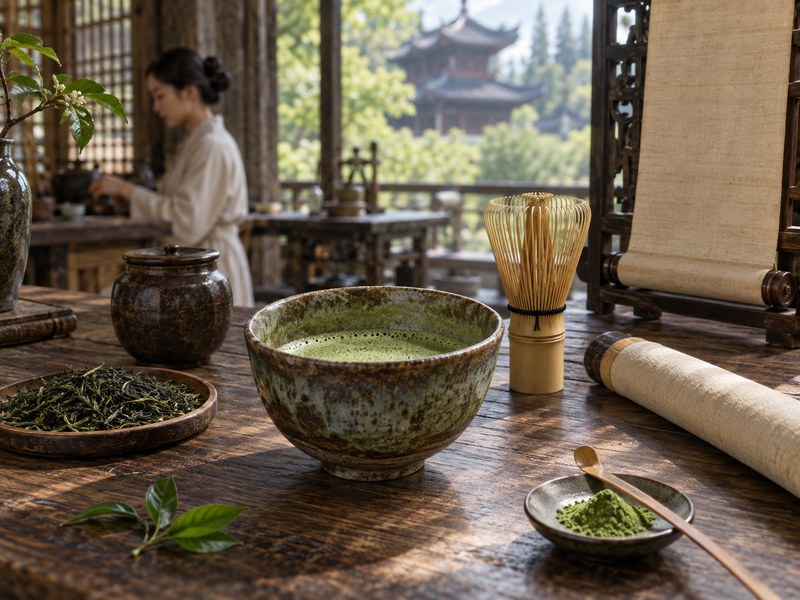
1. Where does the matcha tea origin story begin?
Powdered tea has roots in Chinese tea culture before it became closely associated with Japan. Tea and preparation knowledge moved through religious, trade, and cultural exchange. That history gives a sensible starting point: the idea of preparing tea from finely processed leaf traveled, then Japanese producers and hosts made distinct choices about cultivation, processing, and service.
How precise should a brand’s timeline be?
Use dates with sources. Broad statements are safer than a dramatic “first ever” claim. MAFF places the beginning of Uji tea’s history in 1191, linking the monk Eisai with tea brought from Song China and the later planting associated with Myoe. That is a documented account of Uji’s tradition, not proof that nobody elsewhere had prepared powdered tea earlier. For a short brand history, say that powdered-tea practices came from China and developed further in Japan. If packaging names an exact date, person, temple, or region, keep the source in the claim file so a distributor can check it.
| Historical statement | What it supports | What it does not prove |
|---|---|---|
| Powdered tea has Chinese roots | Cross-cultural origin of a method | Every current powder follows one old recipe |
| Eisai is linked to tea brought from Song China | A Japanese historical account | He invented powdered tea |
| Uji developed a tea-growing tradition | Regional Japanese history | All matcha comes from Uji |
2. How did tea become established in Japan?
The story involves several periods, not one arrival. Japan had earlier contacts with tea, while accounts of the tea culture that fed today’s matcha commonly emphasize the medieval exchange with Song China. MAFF describes Eisai bringing tea back in 1191 and says Myoe planted tea in the Kyoto area before cultivation spread to Uji. Over time, growers, patrons, and tea practitioners shaped a regional industry. A buyer should distinguish these historical accounts from a modern supply-chain statement. A powder grown and milled in another country may still belong to the category of matcha; its package must state its own provenance accurately.
Why is Uji mentioned so often?
Uji became closely tied to tea production and the development of tea culture. Its name has value because it refers to a real region and production tradition, so it should be used carefully. A tea sold as “Uji matcha” needs evidence that the particular product meets the applicable regional claim, not a green package and a Kyoto photograph. MAFF’s Uji tea account describes a regional definition involving leaf from several prefectures and finishing in Kyoto. A brand selling tea from Zhejiang, Kagoshima, or elsewhere should state the actual sourcing and processing locations.
3. When did tea gatherings shape matcha culture?
Japanese tea gatherings developed into formal practices with their own settings, tools, aesthetics, and roles for host and guest. MAFF links the refinement of matcha from tencha with tea-ceremony culture established during the Sengoku period. This is a longer cultural development, not a simple recipe launch. A café that whisks powder in front of customers may borrow a useful preparation method, but it should not describe an ordinary counter transaction as a traditional ceremony. For a more careful distinction between preparation and practice, read our matcha tea ceremony guide.
What wording respects that history?
Describe what happens. “Whisked matcha prepared to order” is accurate when staff really do that. “Guided tasting of two matcha lots” describes a commercial event. “Tea ceremony” suggests a formal practice and should be reserved for an appropriately trained presentation. The distinction matters for international marketing because a short phrase on a menu may be read as a cultural claim. If a business collaborates with a practitioner, name the role, scope, and permission accurately.
4. How did cultivation change the tea used for matcha?
Shading tea plants before harvest became a defining part of many Japanese tencha production methods. Reduced light changes the leaf’s development and contributes to the color and flavor sought in matcha. MAFF describes the development of covered cultivation in Uji in response to tea practitioners’ demand for a less astringent tea. Growing conditions, cultivar, shade method, and harvest timing all influence the result, so no single number of shaded days guarantees a particular grade. A modern buyer should ask for cultivation information where it is relevant to a product claim, then test the powder in the intended recipe.
What does shading tell a purchaser?
It tells the purchaser something about the production method, not everything about taste or safety. Two shaded teas may differ because of leaf maturity, processing, storage, or blending. Ask what was shaded, for how long, and how the supplier records the claim. If a package says “shade-grown,” the batch file should support it. If the product is intended for a vivid green latte, also test it in the actual milk and serving temperature. Historical production context is useful; a finished-product trial still decides commercial suitability.
5. What is tencha, and why is it part of this timeline?
Tencha is the processed leaf used for conventional matcha production. The leaf is steamed, dried without the rolling used for some other green teas, then refined before grinding. MAFF describes matcha as tencha ground into powder. This distinction matters because “ground green tea” can describe products made from other leaf styles. They may serve a valid culinary purpose, but the material, flavor, and marketing claim are different. Buyers should ask what raw leaf was milled and whether “matcha” is defined by the supplier’s specification or the destination market’s rules.
Which processing questions reveal the actual product?
Follow the leaf. Ask for the growing origin, harvest period, leaf style, steaming and drying approach, removal of stems and veins, grinding method, and lot traceability. Fine particle size alone does not turn any green-tea powder into high-quality matcha. It affects texture but cannot replace good leaf and sound storage. A clear specification distinguishes pure matcha from a matcha latte blend containing sugar, milk powder, or other ingredients. For more on the plant itself, see our matcha plant guide.
| Stage | Question for a supplier | Why a buyer asks |
|---|---|---|
| Cultivation | Where and how was leaf grown? | Provenance and flavor |
| Tencha processing | Was leaf steamed and dried without rolling? | Product identity |
| Refining | Were stems and veins removed? | Texture and taste |
| Milling | What controls heat and consistency? | Color and mouthfeel |
6. Did stone milling define every historical and modern powder?
Stone mills are strongly associated with matcha and remain a meaningful production method. They are not a license to claim that every powder is hand-milled. Modern producers also use other milling technology, and the relevant buyer question is how the finished powder performs and how the method is described. Grinding generates heat and exposes fresh surface area; both can affect a sensitive tea powder. Ask the supplier how milling conditions, packaging, and storage are controlled. Then taste a current lot, rather than assuming that a machine type guarantees flavor.
How should milling appear in marketing copy?
Only state a method that is true for the product offered. “Stone-milled” requires evidence tied to that product; “finely milled” may be enough when the exact equipment is not a sales point. Avoid using a photograph of a stone mill next to a product processed entirely on another line if it implies a false production claim. Buyers of bulk matcha may care more about particle-size distribution, dispersibility, and batch variation. A powder for a clear bowl faces different tests from a powder destined for a cookie.
7. When did matcha move beyond formal tea settings?
Contemporary matcha appears in cafés, desserts, packaged beverages, ice cream, and retail powders. These applications widened the range of flavor, color, particle-size, and price targets. A strong powder for a dairy drink may be too astringent in water. A delicate powder for a plain bowl may vanish in a chocolate coating. The category’s historical link to Japanese tea culture does not mean every modern format follows ceremonial practice. Brands can respect that history while treating recipes as product development: choose the tea for the application and describe the application plainly.
What does this mean for international buyers?
Develop an application brief before requesting samples. State the country of sale, product format, serving dose, target color, flavor, sweetness, packaging, shelf life, and price range. Ask for pure powder versus formulated blend explicitly. A supplier can then send useful candidates, and the buyer can compare them with a consistent test. Keep historical copy separate from origin and compliance copy. The answer should come from its lot documents, not from the category’s cultural history.
| Application | Main tea test | Claim to check |
|---|---|---|
| Plain cup | Aroma, texture, finish | Origin and leaf style |
| Latte | Flavor through milk | Pure powder or premix |
| Cake | Color after baking | Ingredient statement |
| Retail tin | Freshness through shelf life | Lot and storage details |
8. Can matcha produced outside Japan have an honest origin story?
Yes. Tea is grown and processed in several countries, including China, and a modern brand can describe its own growing region, production approach, and quality controls. The Japanese development of tencha-based matcha is part of category history; it does not transfer Japanese geographic origin to a lot made elsewhere. A Chinese-origin powder should say so when origin is stated or required. Buyers may value a particular origin for taste, price, supply, or customer expectations. Those are commercial choices. The misleading step is presenting a non-Japanese product as Japanese through wording, imagery, or an unsupported regional name.
Which claims deserve a document check?
Check country of cultivation, country of milling, organic status, specific region, cultivar, shade method, and any “stone-milled” or single-estate statement. Requirements vary by market and claim, so obtain local labeling advice before final packaging. A certificate is useful only if it covers the product, facility, scope, and validity period at issue. The same principle applies to test reports: match the sample and lot numbers. Keep a simple claim register linking each phrase on the pack to its supporting evidence.
9. How should a brand write a short matcha history?
Use a few accurate sentences. For example: “Powdered-tea practices traveled from China to Japan. Japanese growers and tea practitioners developed shaded tencha and the tea culture closely associated with matcha. Our powder is grown and milled in [documented locations].” The last sentence must be completed from the actual lot file. This format gives readers a useful historical sequence and immediately identifies the current product. It avoids claims that one region invented every step or that a present-day industrial powder is identical to a medieval tea.
What should be removed from a draft?
Watch absolute language. “The world’s first,” “unchanged for 1,000 years,” and “authentic Japanese matcha” all need unusually strong evidence. A more modest statement often says more. Name the source of a historical fact, specify the modern product’s origin, and avoid medical or spiritual outcomes that the copy cannot substantiate. A product story can discuss sensory traits, preparation, and the people who make it without promising a consumer a particular state of mind. Read the final copy as a distributor would: can each factual sentence be traced to a document or credible historical source?
| Draft claim | Better evidence-led approach |
|---|---|
| “Invented in Japan in 1191” | Explain the China-to-Japan exchange and later development |
| “All matcha is from Uji” | State this lot’s documented growing and milling locations |
| “Traditional stone-milled” | Verify the actual milling method |
| “Ceremonial grade proves authenticity” | Describe sensory and production specifications |
10. What should a wholesale buyer verify before repeating the story?
Request the lot specification, origin declaration, ingredient statement, available safety tests, and documents supporting any certification or production-method claim. Compare the powder with its own sample under the intended use. For an importer, confirm the destination country’s labeling and customs requirements; a historical page is no substitute for current trade documents. If a supplier offers several grades, ask how the distinctions are defined and whether a substitute lot will meet the approved sensory target. Put approved copy and product evidence in the same file so sales teams do not work from an outdated brochure.
What is a practical next step?
Write one historical paragraph and one product-provenance paragraph. Cite a source such as MAFF’s Uji tea history for the former. Use the specific purchase order and lot file for the latter. Then have the team responsible for the destination market review the pack and product page. Matcha Village can discuss a Chinese-origin bulk matcha or formulated blend for a defined application; the buyer should request the current documentation and sample before making origin or quality claims. A precise story gives the customer enough information to judge the tea in front of them.
| File item | Decision it supports |
|---|---|
| Historical source | Category background |
| Origin declaration | Product provenance |
| Ingredient specification | Pure matcha versus blend |
| Lot-linked tests | Purchase and import review |
| Approved copy | Consistent sales and packaging claims |
FAQs
Q1. Did matcha originate in China or Japan? Powdered-tea practices have Chinese roots. Japanese producers and tea practitioners developed the tencha-based matcha culture known today.
Q2. Is all matcha grown in Japan? No. Check the actual growing and processing origin of each product lot.
Q3. Is Uji a synonym for matcha? No. Uji is a tea region and tradition; a Uji claim needs appropriate product evidence.
Q4. Does “stone-milled” describe every matcha? No. Verify the milling method used for the offered product.
Q5. What is tencha? Tencha is processed tea leaf conventionally ground to make matcha.