
A buyer looking for a matcha supplier Indonesia cafés can rely on is making two decisions at once: which powder works in the cup, and which supply route can deliver that same powder repeatedly. A sample may pass a tasting, yet the first commercial shipment can stall over the importer role, product category, artwork or missing lot records. The ten checks below put those questions in purchase order, before a buyer commits to cartons of an untested blend.
The current top-ten search result Matcha Supplier Indonesia: Wholesale, OEM & Halal Guide shows that wholesale, private label and halal questions meet in this market. Treat a market guide as a starting point. Indonesian food registration and halal requirements depend on the actual product and sales channel; your Indonesian importer should verify the applicable route with the relevant authorities.
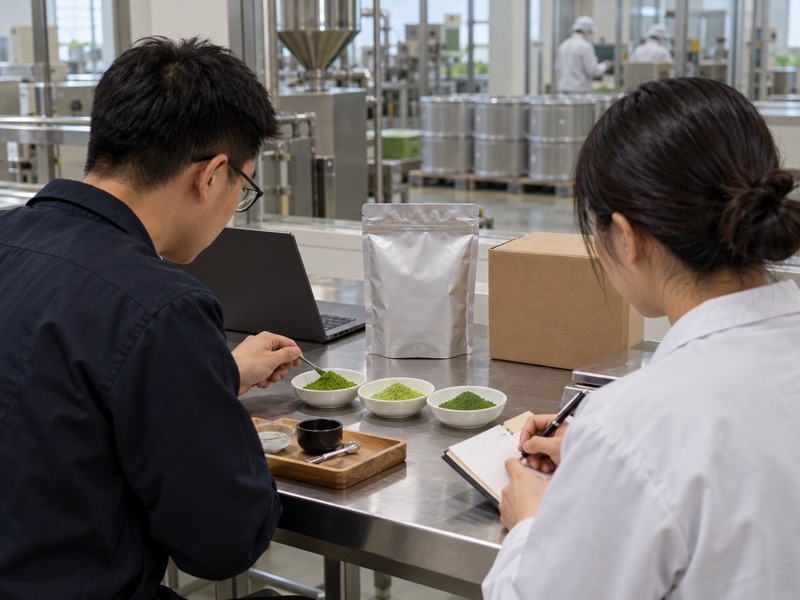
1. What product and sales channel are you actually buying for?
Write the product brief before asking for a wholesale price
“Matcha” can mean unsweetened green-tea powder, a latte blend containing sugar, a foodservice ingredient, a finished retail pouch or a private-label product. These are different purchasing and compliance projects. State the ingredient list, intended use, pack size, customer channel and whether anyone will repack the product after it arrives. A café serving drinks from a back-of-house pouch needs a different operating plan from a distributor placing branded pouches on retail shelves.
Put the actual recipe beside the brief: cup size, matcha dose, milk, sweetener and target selling price. If the product will go to several outlets, add monthly forecast by site and the person who can approve a recipe change. Suppliers often quote the cheapest broad grade when the buyer says only “premium matcha.” A clear brief lets them offer a sample that can be judged against a real drink. It also gives the importer a specific product to classify, rather than a vague description that may change after a label is printed.
| Buying route | Product to specify | First question |
|---|---|---|
| Café drinks | Foodservice pouch | Does the dose work in the menu? |
| Retail | Finished consumer pack | Is the approved artwork ready? |
| Manufacturer | Ingredient for further processing | How is the ingredient classified? |
| Private label | Finished product under buyer brand | Who owns each approval step? |
2. Who will be the Indonesian importer and receiver?
Name every party that touches the order
Identify the contracting buyer, exporter, importer of record, customs or logistics agent, receiving warehouse and final user. A foreign seller may prepare product and export paperwork, but it cannot replace the Indonesian party that checks the local entry requirements for the proposed shipment. If a local distributor already handles import and stores product in Indonesia, the café’s purchase may be much simpler; the distributor’s price should be compared with the full cost and work of direct import.
Ask each proposed supplier to state the delivery term, point of handover, shipping route and who pays for a delay caused by incomplete documents. Do not let “delivered to Indonesia” stand in for a named port, warehouse and responsibility split. Have the importer review the sample pack and draft invoice before placing the order. The product name, ingredient statement, net weight and origin should match across the quote, specification, artwork and documents. A mismatch found before dispatch is a correction; the same mismatch at arrival can become a costly interruption.
3. Does the planned product need BPOM registration?
Check the category rather than applying a blanket rule
Indonesia’s food and drug authority, BPOM, describes registration services for processed foods and also lists categories of products that may be exempt under the applicable conditions. Its official processed-food registration service page distinguishes products sold to consumers from some ingredients or bulk products used for further processing. That distinction matters for a retail matcha pouch, a foodservice pack and an industrial ingredient. It does not mean a supplier can label any large bag “bulk” and skip the relevant assessment.
Give the Indonesian importer the exact formulation, packaging, label, quantity, origin and intended channel. Ask the importer to document whether registration is required for that SKU, who applies, what evidence is needed and when approval must be obtained. If the product changes from plain tea powder to a sweetened blend, or from an ingredient to a consumer pack, repeat the review. Do not promise a launch date based only on the supplier’s earlier shipment of a different product. Keep the importer’s written determination with the approved artwork and purchase order.
| SKU question | Evidence for importer | Decision to record |
|---|---|---|
| Plain or blended? | Full ingredient statement | Product classification |
| Consumer or further use? | Sales channel and pack | Registration route |
| Who applies? | Importer and brand details | Named applicant |
| What changed? | Revised formula or artwork | Need for a new review |
4. How should halal status and claims be checked?
Separate a supplier statement from an accepted claim
Ask what the supplier actually has: an ingredient list, a facility statement, a certificate for the exact product and production site, or an Indonesian certification pathway. A phrase such as “halal friendly” is not the same as a document that the Indonesian buyer can use for a label or sale. Indonesia’s Halal Product Assurance Organizing Agency (BPJPH) publishes the official certification service. The importer or local brand owner should confirm whether the specific SKU and channel fall under the current obligations and how any foreign certificate is treated.
Review the complete formulation and processing aids, not just the green tea component. This is especially important for a sweetened latte mix or flavoured product with other ingredients. Match the certificate’s name, scope, site and dates to the item being bought. If the supplier changes a blend component or manufacturing site, require notice before another shipment. Keep label claims on hold until the responsible Indonesian party approves the exact wording and mark. The buyer can still compare taste and price while that review runs, but should not print an unsupported claim on thousands of pouches.
5. Which matcha actually works in your Indonesian menu?
Test a cup, not a colour swatch
Request two or three coded samples with an identified lot and grade. Test them at the same dose in the main menu drink, then adjust the dose to find a cup the café would sell. Record aroma, bitterness, sweetness balance, colour in milk, dispersal and the taste after a normal handoff delay. A very bright dry powder can disappear in a sweet iced latte; a cheaper powder that needs twice the dose may not be cheap per cup. If the buyer sells unsweetened tea as well as milk drinks, use a separate test for that product rather than asking one grade to satisfy every use.
Ask the supplier whether the sales sample represents the production lot for the first order. Keep one sealed reference pouch and a written recipe. Run the leading sample through a busy service shift with ordinary staff and tools. Record clumps, prep time and customer feedback, not just a tasting score from the buyer. The site’s café matcha selection guide covers cup testing more broadly; here the important extra step is matching the accepted powder to the exact import SKU and shipment lot.
| Cup test | Keep constant | Record |
|---|---|---|
| Plain tea | Water and dose | Aroma and finish |
| Signature latte | Milk, ice and cup size | Accepted dose |
| Service shift | Normal bar tools | Time and clumps |
| Held cup | Normal delivery delay | Settling and taste |
6. Which supplier and lot records should be checked?
Connect every document to the powder in the carton
Request a current product specification, full ingredient statement, origin information, pack specification, shelf-life and storage guidance, lot code system and relevant quality test results. For a certificate of analysis, compare the product code and lot number with the proposed shipment. A polished PDF from a different grade or an old lot does not answer the buyer’s question. Ask what tests the supplier performs routinely, which are performed by an outside laboratory and how often they are repeated.
Discuss the standard for acceptance before the first order. What happens if packaging is damaged, a lot differs from the approved sample or a document cannot be matched to the goods? Name the person who will hold stock, the time allowed for reporting and how the supplier will investigate. If the supplier advertises a certification, verify its scope and validity for the actual facility; a logo alone is not evidence. Keep the sample approval, purchase order, production record and receiving check together so a later quality issue can be traced without reconstructing a month of chat messages.
7. How should packaging and Indonesian label artwork be approved?
Approve the final pouch before ordering a full print run
For matcha, moisture, air, light and repeated opening can all undermine a cup that tasted good at sampling. Ask for the inner-pouch material, seal method, case packing and storage instructions. Choose pouch sizes against real turnover. A café that uses a modest amount each week may prefer smaller sealed units even if the packaging cost per kilogram is higher. Have the receiver inspect seals and cartons on arrival and move the powder promptly into the supplier’s stated storage conditions.
Send the final artwork and product information to the Indonesian importer or responsible brand owner for review. Language, mandatory particulars and permitted claims should be checked for the exact channel and pack under current rules. The matcha supplier should provide accurate ingredient, origin, net-weight, lot and storage details, but the local party should approve how they appear. Avoid printing an origin, grade or halal claim simply because it appeared on a sample label. If the buyer will repack or relabel locally, record who becomes responsible for the new pack’s traceability and claims.
| Pack decision | Supplier evidence | Buyer approval |
|---|---|---|
| Inner pouch | Material and seal details | Turnover and opening test |
| Outer carton | Case count and lot mark | Warehouse receiving check |
| Artwork | Accurate product facts | Importer or brand review |
| Storage | Written guidance | Local handling plan |
8. What is the landed cost per drink or retail pack?
Price the route that can actually be used
Compare quotes on the same pack size, currency, delivery term and quantity. Add freight, local charges estimated by the importer, testing, warehousing, relabeling if applicable, financing and likely waste. Divide by the number of accepted drinks at the tested dose, or by the number of compliant retail units that can be sold. A low kilogram price is less useful if its minimum order leaves the café holding many months of stock. A local distributor may cost more on the invoice but win after direct-import tasks and small-order freight are included.
Ask for lead time from approved order to dispatch, not a vague “ships quickly.” Test the model against a slow month and a busy month. If volume rises, a direct order may become attractive later; if volume falls, a smaller local purchase may protect freshness and cash. The importer’s actual estimate should supply duties and clearance fees for the proposed product. Do not copy a tariff or tax number from a generic matcha article into a buying decision, because classification and route determine the real figure.
9. What should the first commercial shipment prove?
Use a pilot lot with acceptance criteria
Order enough for a meaningful trial across several days of service, but keep the first commitment proportionate to demand. Agree before dispatch on the exact product code, lot, pack, documents, destination and promised date. On arrival, check carton count, seals, lot marks and the paperwork against the purchase order. Make the approved sample and recipe available to the café team, then compare the production lot in a real drink. A commercial pilot should test the whole route, not merely repeat a supplier’s office tasting.
Write a short exception process. If a seal is damaged or a document is missing, who quarantines the goods and who contacts the supplier? How quickly must the claim be raised, and what evidence is needed? For an outlet with a standing matcha menu, keep a practical backup stock level while the new supply route is proved. After the pilot, record actual delivery time, usable yield, cup dose and staff feedback. These facts are more valuable for the next purchase than a supplier’s general promise of reliability.
| Pilot measure | Evidence | Decision |
|---|---|---|
| Arrival | Count and condition | Accept or hold |
| Documents | SKU and lot match | Approve or clarify |
| Cup | Reference recipe | Keep or retest |
| Cost | Actual landed spend | Set reorder quantity |
10. How should a buyer control reorders and supplier changes?
Make the approved specification the reorder language
Place repeat orders against a product code and specification, not a photograph of an attractive sample. Ask the supplier to notify the buyer before changing the growing origin, blend, processing site, pouch, label or test method. A change may be perfectly acceptable, but the importer and café need time to reassess documentation, claims, cost and flavour. Compare early shipments with the retained reference sample and investigate a meaningful drift rather than quietly changing the café recipe to compensate.
Review actual grams used each month and set a reorder point that includes lead time and a realistic buffer. Record unopened shelf life separately from the period a pouch performs well after opening under your service conditions. Keep lot numbers traceable to the outlets that received them. Revisit the supplier scorecard quarterly: cup consistency, document accuracy, delivery reliability, response to issues and landed cost. The best matcha supplier for an Indonesian buyer is the one that can repeat the approved product and support the route the business actually uses.
Frequently asked questions
Q1: Does every matcha shipment to Indonesia need BPOM registration?
Do not assume one rule covers every SKU. Ask the Indonesian importer to classify the exact product and channel using BPOM’s current guidance, then record the required route.
Q2: Can a supplier’s halal statement be printed on a retail pack?
A general statement is not the same as approval for a specific claim. Have the responsible Indonesian party verify the product, certificate or certification route and final artwork.
Q3: Is a local distributor always more expensive than direct import?
No. Compare delivered cost per accepted drink or retail unit, including small-order freight, clearance work, storage and waste.
Q4: Should cafés test ceremonial grade first?
Test powders against the actual drink and accepted dose. A marketing grade label cannot predict how a powder tastes in milk or performs during service.
Q5: What should be kept for a reorder?
Keep the approved specification, sealed reference sample, lot record, recipe, documents, landed-cost calculation and supplier change-notice agreement.