
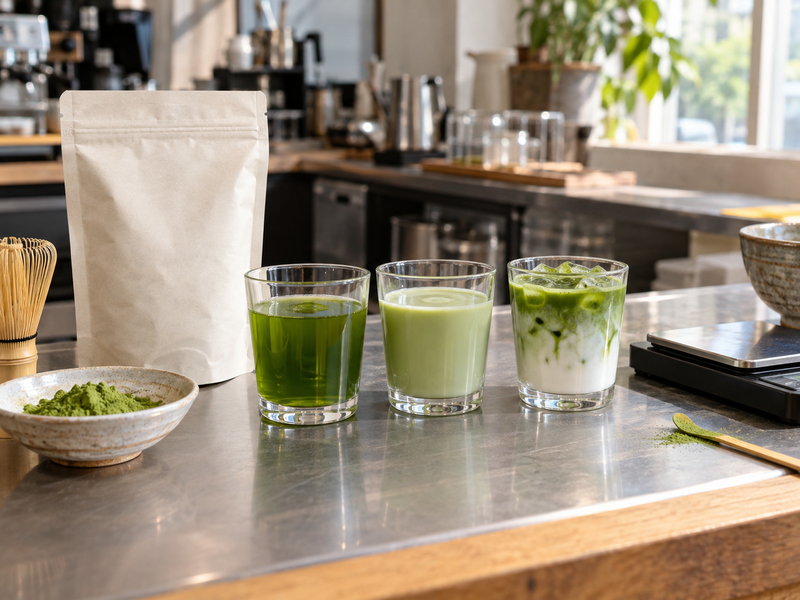
Matcha powder for cafes should be chosen in the cup, not from a grade name or a bright powder photograph. A tea that tastes good whisked with water may disappear under oat milk; one that holds color in an iced latte may taste too rough in an unsweetened drink. A café also needs staff to prepare it at speed, across shifts, without dry clumps or wildly different doses. This guide gives beverage developers and café buyers a controlled tasting plan for water, milk, iced drinks, and busy service. Our supplier perspective is application led: the useful matcha is the one that meets your menu’s sensory and preparation standard repeatedly.
1. What must matcha powder for cafes do on the menu?
Write a sensory brief for each drink family
List every menu item that will use the powder and estimate which ones matter most. A café with one iced sweet latte may value color and clean tea flavor after dilution. A tea-focused bar serving straight matcha may need more delicate aroma and a different bitterness profile. If one powder must serve both, define which performance is nonnegotiable and where compromise is acceptable. Avoid asking suppliers for an undefined “best café grade”; they cannot know whether your customer drinks it with water or vanilla syrup.
Specify cup size, powder dose range, milk options, sweetness, serving temperature, and target color. Include the existing reference drink if the café is replacing a supplier. A good brief also states what should not happen: visible clumps, harsh aftertaste, or a dull olive appearance after normal service. Keep the menu visible: the powder is an ingredient in a finished recipe. Its dry aroma and grade label are screening clues, not the purchase decision.
2. How should a water tasting be run?
Use water to hear the tea clearly
Prepare each candidate at the same powder weight, water volume, water source, and temperature. Use identical bowls and a consistent mixing tool. Taste blind if possible. Record aroma, vegetal or umami notes, bitterness, astringency, mouthfeel, and aftertaste in plain language. Do not let the team rank a stronger sample higher simply because someone added more powder. A water test is especially useful for identifying defects that milk and sugar might hide.
| Water test stage | Keep fixed | Record |
|---|---|---|
| Dry inspection | Same light and sample amount | Color and aroma |
| Prepared cup | Powder and water weights | Initial flavor |
| After short rest | Same standing time | Sediment and aftertaste |
| Blind retaste | Code samples | Panel agreement |
Rinse utensils between candidates and prepare fresh cups for retakes. If the café sells straight matcha, the water result may be decisive. If most sales are milk drinks, treat it as a baseline and continue to the finished recipe. A powder can win one test and lose the other without either result being wrong.
3. What changes when matcha meets dairy or plant milk?
Test in the milk customers actually choose
Milk changes sweetness, color, viscosity, and the way tea bitterness is perceived. Dairy and plant-based options can behave differently, and even two oat milks may not produce the same result. Use the café’s standard milk brands and measured recipe. Evaluate the finished cup at service temperature. Ask whether the tea remains identifiable after the first sip and whether the drink stays balanced as it cools or ice melts.
| Milk trial | Question | Decision |
|---|---|---|
| Dairy latte | Does tea survive the milk? | Base recipe fit |
| Oat or other plant milk | Does its flavor dominate? | Separate recipe needed? |
| Unsweetened version | Is bitterness acceptable? | Powder or dose change |
| After cooling | Does texture remain pleasant? | Service standard |
Keep sugar or syrup constant during the first comparison. Otherwise a sweeter candidate may seem smoother only because the recipe changed. If a powder performs well in one milk and poorly in another, the café may adjust the dose or carry a separate recipe card. A chain should choose that deliberately rather than let each barista improvise.
4. How should an iced matcha drink be tested?
Include dilution and preparation order
Iced matcha is not merely a hot latte poured over ice. Cold liquids can make dispersion harder, while melting ice changes concentration over the customer’s drinking time. Prepare candidates with the same ice weight, cup, liquid volume, and sequence. Compare a fresh cup with one after a realistic delay. Check whether dry specks cling to the lid, whether sediment collects, and whether the last third still tastes like matcha.
| Iced check | Method | Possible failure |
|---|---|---|
| Initial dispersion | Inspect base before ice | Dry clumps |
| At handoff | Taste complete drink | Weak tea note |
| After delay | Repeat under fixed time | Watery finish |
| Last sip | Inspect cup bottom | Heavy sediment |
Trial at least two preparation sequences if the first creates clumps. Many cafés make a small matcha base before adding milk and ice, but the method should be chosen with the intended powder and equipment. Do not solve poor dispersion by simply adding more powder. That raises cost and can make the last sip stronger while leaving the clump problem intact.
5. How do syrups and flavored creamers change selection?
Check whether matcha remains the reason for the drink
Strawberry syrup, vanilla foam, sweetened milk, and flavored creamer can make a menu drink appealing. They can also bury a delicate matcha and create a cup that tastes mainly of sugar and dairy. Run a tasting ladder: matcha base, base with milk, then the complete signature drink. Keep powder dose constant at each stage. If the tea disappears only after the final addition, adjust that addition before buying a more expensive powder.
Ask panelists to describe the drink without seeing its name. If they cannot identify tea in a product marketed as a matcha latte, the formula needs work. Color alone is not enough. For a seasonal special, a stronger culinary powder may fit better than a subtle straight-drinking option; test bitterness in the complete cup. Record the final recipe because a syrup supplier change can alter sweetness and the perceived matcha note. This is a formulation choice, not a debate about which grade name sounds more premium.
6. Can staff prepare the powder consistently during a rush?
Put a new barista in the trial
A developer may whisk a beautiful cup with patient technique. The café needs a method that works amid orders, steam, ice, and a crowded counter. Train a barista from a one-page card, then time several drinks. Weigh the powder they use and compare cup appearance. Note where the process stalls: sifting, measuring, mixing, transferring, or cleaning. A powder that disperses only after an elaborate procedure may be a poor fit for high-volume service.
| Service measure | How to collect it | What it reveals |
|---|---|---|
| Powder dose | Spot-weigh servings | Recipe consistency |
| Ticket time | Order to handoff | Station fit |
| Remakes | Record reason | Preparation failure |
| Cleaning | Observe reset step | Repeatability across orders |
Test both hot and iced service if both appear on the menu. A chosen powder and method should give a reasonable cup when an ordinary trained employee makes it, not only when the supplier demonstrates it. Keep the bar layout and tools consistent across stores during rollout.
Make the recipe card specific enough to survive a shift change. Show the measured powder dose, liquid volume, mixing tool, sequence, and visual target for the finished cup. During the pilot, watch whether staff take shortcuts when orders stack up. If they repeatedly skip a step, test a simpler method rather than writing a stronger instruction. Compare cups made by different baristas under the same conditions. The goal is a drink that stays recognizable when no developer is standing beside the station.
7. How can a café judge lot-to-lot consistency?
Keep an approved reference and test later deliveries
Ask for production-representative samples and product specifications. When a candidate is approved, retain a sealed sample and record the finished-drink recipe used for acceptance. On a later lot, compare color, aroma, taste, and dispersion under the same method. Agricultural inputs can vary, and a supplier may blend lots to maintain a target profile. The café needs an agreed acceptance range, not an assumption that every pouch will be identical.
Record lot codes in the trial and link customer complaints to them. If color drifts, check lighting, dose, and milk before assuming the powder changed. If the powder did change, ask the supplier for its investigation and whether a material or process change occurred. A multi-unit chain should communicate any approved adjustment through a revised recipe card, not informal messages between baristas. Consistency is a joint test of ingredient, preparation, and documentation.
8. What scorecard helps choose between samples?
Weight criteria by actual menu share
Use separate scores for water cup, dairy latte, plant-milk latte, iced drink, preparation ease, and lot documentation. Decide the weights before tasting. If iced milk drinks are most of the café’s matcha sales, they should have greater influence than a water cup the café never serves. Keep descriptive notes beside numbers. A score of seven means little without the reason, such as “good aroma, weak after ice melt.”
| Criterion | Sample question | Evidence |
|---|---|---|
| Tea flavor | Recognizable in main recipe? | Blind tasting notes |
| Visual quality | Within target range? | Fixed-light photos |
| Preparation | Clump-free at service speed? | Bar trial |
| Repeatability | Later lot similar? | Reference comparison |
Reject a sample for a true nonnegotiable failure even if its total score is high. A powder that tastes excellent but cannot be supplied in the required documented form may not be ready for a chain. Record the decision and next test so supplier feedback is actionable.
9. How should powder dose and cup economics be balanced?
Compare flavor at a workable cost per drink
Test each powder at the same starting dose, then adjust only if the finished drink needs it. The right dose is the lowest amount that reaches the approved sensory target consistently, not the lowest number on a costing sheet. A cheaper powder requiring a much heavier dose may cost more per cup. Conversely, a more expensive powder may not justify its price in a heavily flavored recipe where its subtle notes disappear.
Calculate powder cost per accepted drink using the actual grams dosed and landed cost per kilogram. Include remakes from clumps or training errors in the pilot result. Keep milk, syrup, cup, and labor constant when comparing candidates. This allows the buyer to see whether a powder changes margin because of price, dosage, or preparation loss. Do not chase a small ingredient saving that degrades the café’s signature drink. A clear cup target and cost ceiling give suppliers a more useful brief than “premium quality at the lowest price.”
10. What should the final café pilot prove?
Recreate a normal shift before signing supply terms
Run the chosen powder in at least one busy and one quieter service period. Use the standard bar tools, milk brands, ice, and cup sizes. Ask trained staff who were not part of development to make the drinks from the recipe card. Compare first and last cups, hot and iced versions, and different shifts. Record ticket time, customer feedback, remakes, and ingredient use. Keep a sample and photographs of the approved cup.
Matcha powder for cafes earns its place when tea flavor survives the menu recipe and staff can deliver that result at speed. Matcha Village can provide application samples and discuss grades or blends against a defined drink brief. Share your water, milk, and iced recipes with Matcha Village so the sample set fits what the café sells. After approval, retest commercial lots against the same recipe and sensory reference.
FAQ
Q1. Is the brightest powder always best for a café latte?
No. Color is one criterion; taste and dispersion in the finished latte matter as well.
Q2. Should matcha be tested only in water?
Use water as a baseline, then test every major menu recipe with the café’s own milk and sweeteners.
Q3. Why does iced matcha taste weaker later?
Ice melt changes concentration. Test the recipe after a realistic drinking delay.
Q4. Can one powder serve hot, iced, and straight matcha?
Sometimes. Compare all three applications and decide whether one powder meets the café’s required range.
Q5. What should a buyer send with a sample request?
Include cup size, dose range, milk options, sweetness, serving temperature, target flavor, and expected volume.