
A Dubai café can make a matcha sample taste good on Tuesday and still receive a shipment that is difficult to clear, too large to use fresh, or different from the approved lot. Buyers searching “matcha supplier dubai” need more than a green powder and a price per kilogram. They need a product that works in their menu, documents their importer can use and a reorder plan that survives heat and distance. These ten checks turn a promising sample into a purchase decision.
The top-ten result Matcha Supplier Dubai: Wholesale Guide for Cafés describes the local wholesale market. Use market articles to identify questions, then verify the exact powder, pack, shipping route and import requirements for your own business. A supplier’s origin, packaging and responsibilities should be stated on paper before money changes hands.
1. Who is buying the matcha and who will import it into Dubai?
Put the legal and operational roles on one page
A café with one store has a different path from a distributor supplying many outlets. Identify the buyer, the importer of record, the receiving warehouse and the person who will approve product information before requesting a quote. A foreign supplier may prepare export documents, but that does not make it the Dubai importer. The local business or its appointed importer should confirm what it needs for the specific product and route. If a seller says it will “handle customs,” ask exactly which party submits each document and pays each charge.
Write the destination and intended channel: foodservice powder for café drinks, retail pouches, an ingredient for manufacturing or a private-label product. The pack and label can change with the channel. For a small café, buying from a local distributor may make more sense than importing directly because its minimum purchase, clearance work and storage burden are lower. A larger chain can compare direct supply when volume is stable. Start with the role map, then price the feasible route.
| Role | Named party | Decision or document |
|---|---|---|
| Buyer | Café, chain or distributor | Menu and quantity |
| Exporter | Supplier | Product and export papers |
| Importer | Local entity or agent | Entry and local checks |
| Receiver | Warehouse or store | Lot acceptance |
2. What will the matcha be used for?
Choose powder against a real recipe
Send the supplier a short brief with your primary drink, serving size, matcha grams per cup, milk options and desired taste. If the powder is for a sweetened iced latte, a very delicate sample may disappear; if it is for straight tea, a strongly flavoured blend may be wrong. Ask for plain matcha and a sweetened mix as separate products, if both are under consideration. Do not compare their prices per kilogram without accounting for sugar or other ingredients. A lower powder price can still create a more expensive finished drink if the accepted dose is higher.
For retail, the buyer also needs pack size, shelf presentation, ingredient statement and batch identification. For food manufacturing, process behaviour may matter more than colour in a bowl. Give the supplier one accepted use case at a time. The matcha powder for cafés guide covers cup selection in more detail. A Dubai purchase brief should add expected monthly consumption and the number of receiving sites so the supplier can propose a practical pack and order rhythm.
3. How should a buyer check origin and grade claims?
Ask for traceable facts, not a grand label
“Japanese,” “ceremonial” and “premium” can appear in marketing, but the purchase record needs more precise information. Ask where the tea was grown, where it was milled, what the ingredients are and which lot is being sampled. If a blend combines origins, the supplier should say so. A Chinese-origin product should be sold honestly as Chinese-origin; a Japanese-origin claim should have supporting documentation. The buyer may prefer one origin for its menu story, or choose by flavour and cost. Either choice works only when the claim matches the product.
Request the supplier’s own grade description and compare it with the cup test. There is no single global grade scale that guarantees how a café latte will taste. Check colour, aroma, bitterness, dispersal and finish in the finished drink. A sample that looks bright in a dry bowl may turn dull in milk. Keep a sealed reference sample and the supplier’s lot code. Later shipments can then be judged against an approved standard instead of a memory of the sales call.
4. How should samples be tested before a bulk order?
Use coded cups and an ordinary service shift
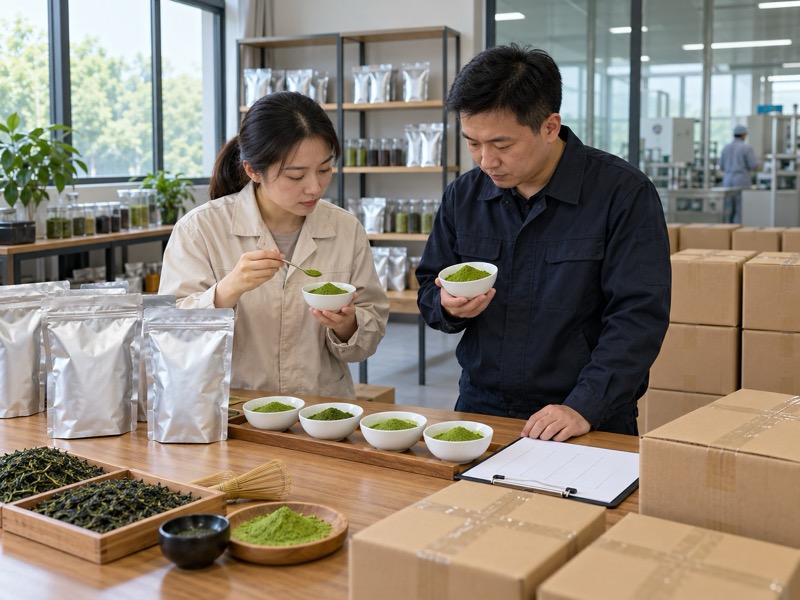
Ask two or three suppliers for samples in comparable formats. Code the pouches so the tasting team does not know which quote belongs to which cup. Use the same water, matcha dose, milk, ice and preparation method. Test a plain drink first, then the most important menu recipe. Record the acceptable dose for each sample rather than forcing every powder to win at one arbitrary weight. A powder that needs far more grams to taste present can lose its apparent price advantage.
Run the best sample through a busy service period. Watch clumping, colour after ten minutes, staff prep time and customer comments. Do not approve a supplier because a single carefully whisked sample looked good in a quiet office. If the supplier offers several grades, keep the sample codes linked to the exact grade and lot; similar names can lead to the wrong product being ordered. Ask for a production-lot sample before a large first shipment when the sales sample came from a different batch.
| Sample check | Method | Record |
|---|---|---|
| Plain tea | Fixed water and dose | Aroma and finish |
| Menu cup | Approved milk and size | Dose and colour |
| Service test | Normal bar tools | Time and clumps |
| Held cup | Normal handoff delay | Settling and taste |
5. Which quality records should accompany a matcha lot?
Request the records before discussing a container
Ask for a current product specification, ingredient statement, shelf-life and storage guidance, lot identification and a certificate of analysis or equivalent testing record relevant to the product. The buyer should identify which tests its business and local importer need; do not accept a generic PDF that cannot be matched to the shipment. Check dates, lot codes, unit of measure and the issuing laboratory where applicable. If a supplier cites a certification, request its scope and validity rather than relying on a logo in a brochure.
Define what happens when a lot falls outside the agreed specification. Who will hold the goods, how quickly can the supplier investigate, and what replacement or credit process applies? A practical agreement names the test method and tolerance for key attributes, not only a promise of “high quality.” The accepted cup may also need a sensory check on arrival because a paper result cannot describe every flavour change. Keep the purchase order, sample approval and test record tied to the same product code.
6. What should the importer confirm about documents and labels?
Check current local requirements before the shipment leaves
Have the Dubai importer review the exact commercial invoice, packing list, product description, country of origin, ingredient and label information required for its route. Requirements can depend on the product, pack and intended market. Dubai Municipality publishes food establishment and import service information; use that official source and the importer’s current guidance to check the proposed shipment. A buyer should not treat a supplier’s old clearance example as proof that a new pack is ready.
Review the artwork before printing retail pouches or large cartons. The importer may need particular product information in a particular language or format. The supplier should provide a clean source file or label proof with the correct lot, net weight and storage statement. For foodservice packs, confirm what must appear on the inner pouch and outer carton. If the product is repacked locally, document who has responsibility for that step and for traceability afterward. Resolve label questions before dispatch, when they are cheaper to fix.
| Pre-shipment item | Owner | Match to |
|---|---|---|
| Product description | Exporter and importer | Actual ingredients and pack |
| Lot documents | Supplier | Shipment lot code |
| Label proof | Importer approves | Local channel |
| Shipping papers | Forwarder and exporter | Order quantity and route |
7. How should matcha be packed for the route and stored on arrival?
Protect the powder from heat, light and damp handling
Ask for the pack material, seal method, inner pouch size and outer-carton protection. Matcha is sensitive to poor storage, and a journey through warm handling points can expose weak packaging. The supplier should state its storage guidance and expected shelf life in the proposed pack. The importer and receiver need a plan to inspect cartons promptly and move stock to appropriate storage. Do not leave newly arrived powder on a loading dock while the café decides where to put it.
Choose pouch sizes that fit actual turnover. A large open bag may be cheap per kilogram but lose quality before the bar uses it. Smaller sealed pouches can reduce repeated exposure, although they cost more in packaging. Test the chosen pack during a pilot order. Open one pouch, use it under normal service conditions and compare the last cup with the first. Keep cartons and pouches traceable by lot so an issue can be isolated without pulling every product from every store.
8. What is the true landed cost per accepted cup?
Compare quotes on the same delivery basis
Ask each supplier to state currency, pack size, minimum order, quoted delivery term, lead time and what the price includes. Add freight, local clearance, duties or taxes where applicable, storage, testing and unusable stock to estimate landed cost. Your importer or finance team should supply the actual charges for the chosen route; a blog post cannot give a reliable tariff for every pack. Divide by the number of accepted servings at the tested dose, not by the theoretical number of kilograms purchased.
Model a slow month as well as a busy one. If the MOQ is six months of demand, the lowest unit price may produce stale stock or tie up cash. If the order is tiny, freight can dominate. Compare a local distributor’s delivered price with the full direct-import calculation. Include the service cost of a late shipment or a rejected lot. A quote that looks expensive on powder alone can be the better buy when it arrives in the right pack at a manageable frequency.
| Cost line | Use in comparison | Ask who pays |
|---|---|---|
| Powder | Price at accepted dose | Buyer or distributor |
| Freight | Chosen route and volume | Per delivery term |
| Local charges | Importer estimate | Named party |
| Loss | Waste and rejected cups | Contract remedy |
9. What should the first commercial order prove?
Use a pilot lot with a written acceptance process
Order a quantity the business can use while still leaving room to learn. The pilot should test shipping time, document completeness, pack condition, lot consistency and cup performance across several shifts. Define who receives and opens the goods, which cartons are sampled, and how quickly a problem must be reported. Keep the production-lot sample and purchase order beside the incoming record. If the drink needs a different dose from the approved sample, calculate the new cup cost before accepting the lot as equivalent.
Write down what happens if the shipment is late or a seal is damaged. A supplier may have a reasonable investigation process, but the café needs a backup source or stock buffer for its menu. Agree on lead time from approved order to dispatch and on the point at which the buyer must reorder. A pilot is successful when the team can place the next order with fewer surprises, not merely when a carton arrives.
10. How should a Dubai buyer compare suppliers and plan reorders?
Score the evidence, then keep checking the next lot
Use a short scorecard with cup quality, document fit, traceability, pack suitability, landed cost and response time. Weight the fields for the business: a chain with a signature unsweetened latte may put more weight on stable flavour, while a distributor may need several grades and reliable case markings. Do not award points for claims that have not been verified. Ask the supplier to explain any change in origin, blend, packaging or production site before the next shipment, and put that notification requirement in the commercial agreement.
Review demand monthly against actual grams used, not only cups sold. A new menu campaign, summer iced drink or extra outlet can change the reorder point quickly. Keep enough buffer for the supplier’s stated lead time and the importer’s real clearance experience. Audit the first few lots more closely, then maintain a simple incoming check. The right supplier is the one whose product and paperwork remain dependable after the sample meeting ends.
| Scorecard field | Evidence | Review again when |
|---|---|---|
| Cup quality | Blind sample and pilot lot | Lot changes |
| Documents | Importer approval | Pack or route changes |
| Cost | Landed cost per cup | Freight or dose changes |
| Reliability | Pilot delivery record | Each reorder |
Frequently asked questions
Q1: Should a Dubai café import matcha directly?
Compare direct import with a local distributor using full landed cost, minimum order, storage capacity and the work the café can manage.
Q2: Does “ceremonial grade” guarantee a better latte?
No. Taste the exact powder in the finished drink and confirm the lot and specification.
Q3: Can a supplier prepare all Dubai import paperwork?
The supplier can provide export and product records, but the named importer should confirm current local requirements for the chosen shipment.
Q4: Is the cheapest kilogram the cheapest menu option?
Not necessarily. Dose, freight, waste and pack size can make a lower quoted kilogram price more expensive per accepted cup.
Q5: How often should a buyer retest matcha?
At each material product or lot change, and during incoming checks on early orders. Keep an approved reference sample.