
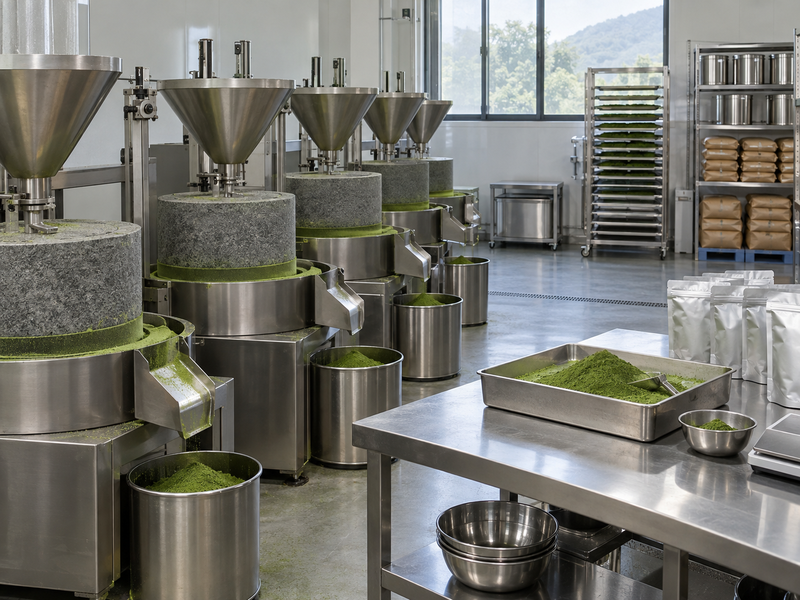
Matcha stone milling is often presented as a shorthand for quality. The process can influence powder properties, but a buyer still needs to know the raw material, mill controls, particle distribution, storage and performance in the intended product. A romantic image of a stone mill cannot guarantee that a bulk lot will taste good or run smoothly in a factory. Use the milling claim as a starting point for questions, then test production-representative powder against the finished item you sell.
Ask what the method achieves. A café may care about smooth mouthfeel and aroma, while a bakery may care more about color after heat and stable supply. Stone milling can be appropriate for some products; other milling methods may meet a particular commercial target. Compare measured results and application trials before paying a process premium. This guide helps procurement teams separate a useful process story from evidence they can actually approve.
1. What does matcha stone milling mean?
In traditional matcha production, prepared tea leaf material is ground with a stone mill into fine powder. The process is associated with careful control of feed and grinding conditions. A supplier may use “stone milled” to describe all its production, a particular grade, or a finishing step. Ask which exact product code and lots the claim covers. Also ask whether any blending occurs after milling. A lot can contain powder from several runs, which is not automatically a problem if the blend is controlled and traceable.
Do not infer quality solely from mill material. Leaf selection, shading, processing, moisture control, pack barrier and stock age can all influence the final cup. A poor raw material does not become excellent because it passes through stone. Conversely, an alternative milling process might produce a powder that works well in a sweetened beverage. The purchase decision should reflect a full specification and a trial under normal service conditions.
| Claim | Ask supplier | Keep as evidence |
|---|---|---|
| Stone milled | Which SKU and process stage? | Written process description |
| Fine powder | Which method and distribution? | Particle report |
| Low heat | How is process controlled? | Relevant production record |
| Single origin | How are lots traced? | Origin and lot record |
2. Which raw-material steps come before milling?
Milling cannot be assessed in isolation from the leaf material supplied to it. Ask about the tea material, processing to a suitable milling feed and removal of unwanted stems or veins where relevant to the product. Different suppliers may use different specifications and blends. A buyer does not need every proprietary process setting, but does need a clear product identity and a means of tracing production lots. Ask whether the sample and the later order use the same material plan.
For a branded product that makes origin or grade claims, get written evidence that supports those claims. For a functional ingredient used in bakery, a reliable flavor and color target may matter more than a detailed story about the mill. Keep priorities tied to the customer. If the supplier changes raw material while preserving the same milling process, the finished powder may still change. A change-control agreement should address both raw material and process.
3. Does stone milling always make finer matcha?
No single method guarantees one particle result. Mill condition, feed, settings and subsequent handling affect the distribution. Compare actual production-lot measurements using the same analytical method. Ask whether a quoted number is a median, a maximum or a sieve result. Fine powder may still agglomerate during storage. Run a cup or product trial to see whether the distribution produces acceptable texture and dispersion. Avoid buying an expensive claim when the application cannot perceive the difference.
Read the report carefully. A single “micron” figure hides the coarse tail that may be felt as grit. Ask about D10, D50 and D90 if those measures are appropriate and available. Use the same sample preparation for competing products. The matcha particle-size guide details how to connect measurement with a real drink or production line. Particle data should explain observed performance, not replace the observation.
| Data request | Why it matters | Trial link |
|---|---|---|
| Method | Comparable measurement | Use same protocol |
| Distribution | Shows fine and coarse portions | Check grit |
| Lot result | Shows actual shipment | Compare approved sample |
| Handling condition | Shows agglomeration risk | Check opened bag |
4. How should process temperature be discussed?
Grinding can generate heat, and suppliers may describe how they control it. Ask for a specific process explanation rather than accepting “cold milled” as an undefined label. What is monitored? Is the claim about mill temperature, powder temperature or production-room conditions? Does it apply to the product code being quoted? Temperature data can be useful, but its value lies in whether the powder retains the sensory and color performance your product needs.
Do not assume a temperature statement proves freshness, food safety or superior nutrition. Those are separate questions requiring their own evidence. Compare color and aroma with controlled samples, then test after your process. A tea that smells attractive from a fresh mill may change after months of storage. Packaging and stock rotation can preserve or undermine whatever advantage the milling step created.
5. How do throughput and lead time affect bulk buyers?
A method with slower throughput can influence capacity, lot size and reorder timing. Ask what volume the supplier can deliver under normal conditions and what notice it needs for demand spikes. A small pilot order does not prove it can fill a chain launch or a seasonal promotion. Request a realistic production plan, minimum order quantity and contingency for mill maintenance or raw-material shortage. Compare these with your stock policy and sales forecast.
A buyer might choose a higher-cost stone-milled product for a flagship unsweetened drink while using another approved powder in bakery. That split can protect sensory quality where customers notice it and supply resilience where volume is high. It also adds inventory complexity. Test the operational case, not only the cup. If only one SKU is possible, choose the powder that meets the whole portfolio’s minimum requirements at a sustainable cost.
| Supply item | Ask for | Buyer risk |
|---|---|---|
| Normal capacity | Monthly available volume | Launch shortage |
| Lead time | Production and transit plan | Emergency freight |
| Lot size | Typical batch range | Variation between runs |
| Backup plan | Approved alternative process | Uncontrolled substitution |
6. Which application tests reveal the value of milling?
Prepare each candidate in the sold product. For whisked tea, compare smoothness, aroma and sediment. For an iced latte, compare dispersion and flavor after milk and ice. For bakery, test color and flavor after heat. For a protein bar, check whether the powder distributes evenly and keeps a clean tea note. Hold dose, recipe and equipment constant. If a stone-milled candidate wins, write down which benefit won and whether customers can perceive it.
Blind-code samples where practical, and include more than one production lot for finalists. A supplier demonstration can be skilled at making one cup; your staff and equipment must reproduce it. Keep a retained reference and a scoring sheet. If the difference disappears in a sweetened matrix, do not carry a process premium into that item without another reason. If the difference persists in a premium tea service, the extra cost may be justified.
7. What should a supplier document about the milling claim?
Request a written description identifying where milling occurs, whether it is in-house or contracted, which SKU it covers and how changes are controlled. A buyer may not need proprietary mill specifications, but it should be able to verify that the commercial lot follows the claimed route. Ask for lot traceability and a specification with measurable output. If the supplier makes a geographical or organic claim as well, verify that separately. A milling method does not establish any other certification.
Link paper to powder. A process statement with no product code has little value. Match the approved sample, quotation, purchase order, COA and package label. If a distributor sells the matcha, ask how it keeps manufacturer lot identity through repacking. The matcha COA guide describes a practical document match at receiving. A complete chain gives marketing and quality teams confidence in the same claim.
| Record | Purpose | Match against |
|---|---|---|
| Process description | Defines claim | Quoted SKU |
| Lot record | Shows production route | Carton code |
| Specification | Defines output | Approved sample |
| Change notice | Flags new route | Supply agreement |
8. How should stone-milled and other powders be priced?
Compare delivered cost per accepted product unit. Use the tested dose and account for waste, pack size and process time. A higher price per kilogram may be reasonable if a powder achieves the target cup at a lower dose or reduces remakes. It may not be worthwhile in a strongly flavored cookie where the distinction disappears. Ask the supplier to explain what the milling method adds to its quote, but validate that benefit in your own product. Marketing value can matter too, provided claims are accurate and supported.
Do not compare a pure matcha powder with a sweetened latte blend by kilogram without normalizing composition. Compare similar grades, origin requirements, packaging and delivery terms. Include the cost of carrying extra stock if a slow production route requires longer lead time. The best purchase may be a dual-sourcing plan with defined applications, rather than one powder forced into every recipe.
9. What can go wrong after the powder is milled?
Exposure to moisture, oxygen, light and odors can change a powder’s performance. A carefully milled product can arrive in damaged packaging or sit too long in an opened bag. Check seals and lot codes at receipt. Store the powder under supplier instructions and rotate stock. If a cup changes, compare an unopened bag with the opened working pack before attributing the difference to milling. Document age and conditions; they are part of the investigation.
Ask the supplier how it packs bulk volumes and whether the smaller sample uses the same barrier. A foil sample pouch may protect a few hundred grams better than a poorly closed large bag at a café. Choose pack units according to usage rate. The bulk storage guide gives a receiving and opened-bag procedure that supports repeatable quality after milling.
| Problem | Check | Likely response |
|---|---|---|
| Clumps | Pack seal and humidity | Hold and investigate |
| Dull color | Lot age and light exposure | Compare sealed reference |
| Weak aroma | Stock rotation | Review pack and usage rate |
10. How should a buyer make the final decision?
Define the intended product, request production-representative samples and test candidates with a fixed recipe. Compare measurable powder attributes, sensory results, line performance, price and supply continuity. If stone milling gives a clear, repeatable benefit, put the relevant process claim and output specification into the agreement. If another route meets the product target, choose on evidence rather than a story. Retain the winning sample and plan a commercial-lot comparison.
Matcha Village can discuss milling and powder options for different B2B applications through its contact page. Share the recipe, target mouthfeel, expected volume and packaging needs. Matcha stone milling is a process choice worth examining, but the finished product and future supply decide whether it is the right choice for your business. Ask for a sample that represents normal output and schedule a repeat lot check before committing to a long purchase term. A process story is strongest when the next shipment delivers the same cup.
A published comparison of stone, ball and jet milling measured how matcha particle properties differed by method. Use those findings as context, then request current lot data and run an application test for the product you sell.
FAQ
Q1. Is all matcha stone milled?
No. Ask each supplier which product and production lots follow the stated milling method.
Q2. Does stone milling guarantee fine powder?
No. Request a defined particle measurement and test the powder in the intended product.
Q3. Is stone-milled matcha always best for bakery?
Not necessarily. Compare color and flavor after the actual bake, then calculate cost per accepted item.
Q4. Can a distributor support a stone-milled claim?
Yes, if it can trace its lot to the manufacturer’s process records and keep that identity through handling.
Q5. What should a buyer ask before paying more?
Ask which measurable or sensory benefit the process gives in the finished product and whether it can be repeated.