
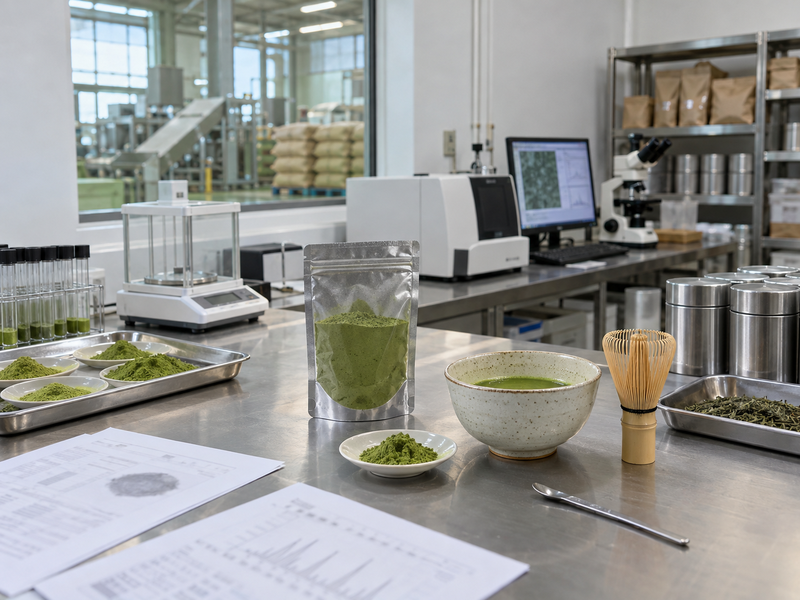
A matcha COA, or certificate of analysis, can help a buyer decide whether a production lot meets an agreed specification. Yet a neat PDF can cause false confidence when its lot code differs from the cartons, its test method is unclear, or a required result is missing. The practical solution is a receiving review that connects the document, purchase order, physical packs and risk-based quality plan. This guide shows how a foodservice or manufacturing buyer can perform that review without treating a single sheet as a complete supplier audit.
Start with the lot. A COA should answer a defined question about material you actually received. It should not be accepted merely because its logo looks official. The ten checks below can become a short receiving form. Keep the form and supporting records together so a later complaint, recall exercise or supplier discussion has a clear trail. U.S. importers should also assess their own applicable supplier-verification duties; the FDA’s FSVP overview describes risk-based verification activities, which may include testing, audits and record review.
1. Does the COA identify the exact matcha product?
Check the supplier’s legal name, product name or code, ingredient description and any grade or blend designation against the purchase order. A company may sell pure matcha, sweetened latte blends and powders for bakery use under similar names. A report for one formulation cannot approve another. If a distributor supplies the product, ask how its code maps to the manufacturer’s code. Keep that cross-reference in purchasing records. A generic “green tea powder” report is too ambiguous when the order specifies matcha with a defined origin or formulation.
Here is the useful test: could a new receiving employee match the COA to the order without phoning the buyer who arranged the sample? If not, ask the supplier to identify the relationship in writing. The document date alone does not solve the identity problem. Check the named pack size as well if the supplier sells the same powder in different packaging systems. Identity is the foundation for every later comparison of microbial, chemical or sensory results.
| Identity field | Compare with | Action on mismatch |
|---|---|---|
| Product code | Purchase order and approved specification | Hold and request code mapping |
| Formula or grade | Approved sample record | Confirm material has not changed |
| Pack configuration | Carton label and order | Check alternate pack approval |
2. Does its lot number match every received pack?
Find the lot number on the COA, outer cartons, inner bags and delivery note. Matcha shipments can include multiple manufacturing lots, particularly when a large order is filled from available stock. A report for one lot does not automatically cover the others. Record each lot’s quantity and pallet location. If a supplier uses a production code on its bags and a separate shipping code on its invoice, request the written conversion. That mapping should be controlled, not guessed from similar dates.
For partial deliveries, verify each arrival independently. A report sent before the shipment may describe the planned lot; substitutions can occur. Scan carton labels at receiving and compare them with the document actually supplied. If an inner bag lacks a readable code, isolate it until identification is resolved. Lot-level discipline is useful even when a test result later proves acceptable: it lets the team release unaffected stock while investigating a specific shipment.
3. Is the sample date consistent with production and dispatch?
Read manufacture date, sample collection date, analysis date and issue date as a timeline. A COA issued recently may contain results from an older retained sample. That may be appropriate for some stable parameters, but it should be explained. Ask whether the sample came from the final packed lot or an earlier process stage. The buyer’s specification should say which results must be lot-specific and when a periodic or supplier-level test is acceptable. Avoid inventing a universal recency cutoff; requirements depend on hazards, process and customer commitments.
What should raise a question? A sample date before the stated production date, an analysis completed before sampling, or a report copied across several lot codes with no explanation. Simple clerical errors happen, but release should wait for a corrected, traceable record. Keep the original and corrected versions so the audit trail remains clear. This approach is more useful than treating every date difference as proof of fraud.
| Date | What it tells you | Question if unclear |
|---|---|---|
| Manufacture | When the lot was made | Was it blended or repacked later? |
| Sampling | Which material could be represented | Was it final packed stock? |
| Analysis | When testing took place | Was the sample stored properly? |
| Issue | When the report was released | Was an earlier version superseded? |
4. Are the reported tests tied to your own specification?
Set the acceptance specification before reading a favorable COA. It might include identity, moisture, microbiological parameters, pesticide residues, heavy metals or other measures based on the product, destination market and hazard assessment. Do not copy another buyer’s panel without reviewing why each test is needed. A café using matcha in ready-to-drink service may have a different process risk from a manufacturer that bakes it into a bar. Food safety limits belong to applicable law and a documented risk assessment, not a marketing article.
Compare every specified parameter with the report. Mark a missing item as missing, even if all visible numbers pass. A supplier may use separate laboratory reports for different panels; ask for the linked records and the basis for testing frequency. A COA should not be used as a substitute for process controls, traceability or supplier performance history. The bulk matcha quality-control checklist describes a broader receiving plan.
| Check group | Typical buyer question | Record |
|---|---|---|
| Identity and composition | Does this match the approved ingredient? | Specification and lot result |
| Microbiology | Which hazards and methods apply? | Report and release rule |
| Chemical hazards | What destination-market criteria apply? | Risk assessment and result |
| Sensory performance | Will this work in the recipe? | Retained sample comparison |
5. Are methods, units and reporting limits clear?
A value is hard to interpret without its unit and method. “Less than 0.1” means little unless the analyte, unit, detection or quantification basis, and acceptance criterion are known. A laboratory may report a concentration per kilogram while the buyer’s limit uses another basis. Ask the quality team to convert units only when the conversion is valid. Results such as “not detected” also need a stated method sensitivity. A weak method cannot prove a sample meets a tighter customer criterion.
Check whether the report names the laboratory and whether accreditation or method scope matters for the customer’s program. Accreditation is not a magic pass for every test; the specific test and scope still matter. Retain the full report if the COA is only a summary. If a third-party lab report is referenced, match its sample number to the COA lot. This step often resolves apparent contradictions before any stock is released.
6. Who issued and reviewed the COA?
Identify whether the document came from the manufacturer, a contract laboratory or a distributor. All can be legitimate, but their roles differ. A manufacturer may compile a COA from internal and external testing. A distributor might forward the original with its own lot cross-reference. Ask who authorized release and how corrections are controlled. A signature image alone tells little; a named quality function and document revision history are more useful. Where supplier claims depend on certification, verify the relevant product and facility scope separately.
Keep the question practical: if a result changes tomorrow, who can issue a correction and notify affected buyers? Record that contact. For new suppliers, request a sample COA before approving the commercial order. Review the layout and fields while there is time to fix them. A rushed document chase on delivery day is an avoidable cause of warehouse holds and emergency substitutions.
| Issuer | Useful evidence | Remaining check |
|---|---|---|
| Manufacturer | Controlled COA, release authorization | Lot and test linkage |
| External laboratory | Full report and sample ID | Sample origin |
| Distributor | Original COA and code map | Repacking trace |
7. Can a COA replace incoming inspection?
No. Check seal condition, pack identity, visible damage, odor when a bag is opened under a controlled procedure, and transport conditions relevant to the material. A passing laboratory result cannot undo a torn liner or a wet carton. Nor can a green powder photo prove the correct lot arrived. The receiving team should record what it sees before material enters production. Keep suspect stock separated so an urgent production request does not turn a documentation question into a customer complaint.
Use a retained approved sample for color, aroma and application behavior where these affect the product. Perform the test in a fixed recipe and light, rather than comparing handfuls in an uncontrolled room. A food manufacturer may set a formal incoming sampling plan. A café may use a smaller but still documented cup check. The decision belongs to the business’s risk and process, with escalation rules agreed in advance.
8. What should happen when a result is out of specification?
Quarantine the affected lot and notify the appropriate quality lead. Confirm that the reported unit, limit and sample match the specification before deciding whether a true failure occurred. Do not average a failing result with a passing one or ask for repeat testing simply to obtain a favorable number. Investigate with the supplier and document the disposition. Depending on the issue, the result may require rejection, additional scientifically justified investigation or a different approved use where legally and contractually permitted.
Write a corrective-action record that names the lot, the deviation, affected quantity, supplier response and final authorization. If any stock was already used, trace the finished batches. Distinguish a formatting error from a food safety failure; both need resolution, but not the same response. For U.S. imports, supplier verification may include corrective action and review of supplier performance, as the FDA overview explains.
| Finding | Immediate action | Release evidence |
|---|---|---|
| Wrong lot code | Hold affected stock | Corrected traceable mapping |
| Missing required result | Hold or follow written policy | Valid result or approved decision |
| Out-of-spec result | Quarantine and investigate | Documented disposition |
| Damaged pack | Segregate and inspect | Quality decision on condition |
9. How should buyers file and retrieve COAs?
Index each COA by supplier, product code, lot and receipt date. Link it to the purchase order, goods-received record, any laboratory attachment, incoming inspection and finished-product use. A shared folder full of filenames such as “matcha final.pdf” is a weak system. Use controlled naming and access so an old report cannot be mistaken for the current lot. Keep original supplier files rather than only screenshots pasted into email. If a corrected version arrives, mark which one governed release.
Run a retrieval drill: choose a finished-product batch and see how quickly the team can identify the matcha lot and its COA. Then reverse the path from a matcha lot to affected finished products. Gaps found during a calm drill are cheaper than gaps found during a complaint. The FDA’s lot-code explanation illustrates why linking records to production codes improves source identification, while actual record duties depend on the food and applicable rules.
10. When should the COA review process change?
Revisit it when a supplier changes source, process, laboratory, blend or packaging; when a destination market changes; or when complaints reveal a new issue. Trend results across lots instead of reviewing each report in isolation. A parameter that drifts toward an agreed limit can justify an earlier supplier discussion. Review testing frequency with the quality team and supplier using evidence from the hazard assessment. A new certificate layout is also a good reason to make sure fields still map cleanly to your receiving form.
A matcha COA is most useful when it sits inside a controlled buying process. Matcha Village can provide product and lot documentation for evaluation of a specific order; send the proposed application, market, pack size and required specification through its B2B contact page. Ask for a representative sample and document set before the first bulk shipment. A few minutes of disciplined matching at receipt protects the value of every later production step.
FAQ
Q1. What does COA stand for in a matcha purchase?
Certificate of analysis: a document reporting defined test results for an identified material or lot.
Q2. Does a passing COA prove a supplier is safe?
No. Supplier approval also relies on appropriate hazard assessment, process evidence, traceability and verification activities.
Q3. Can one COA cover multiple matcha lots?
Only if the documented sampling and reporting basis supports that coverage and your agreed specification permits it. Never assume.
Q4. What if the bag’s lot number differs from the report?
Hold the stock and request a controlled code mapping or corrected document before release.
Q5. Should every buyer ask for the same test panel?
No. Select tests and limits from the product, process, destination market, customer requirements and documented hazard review.