
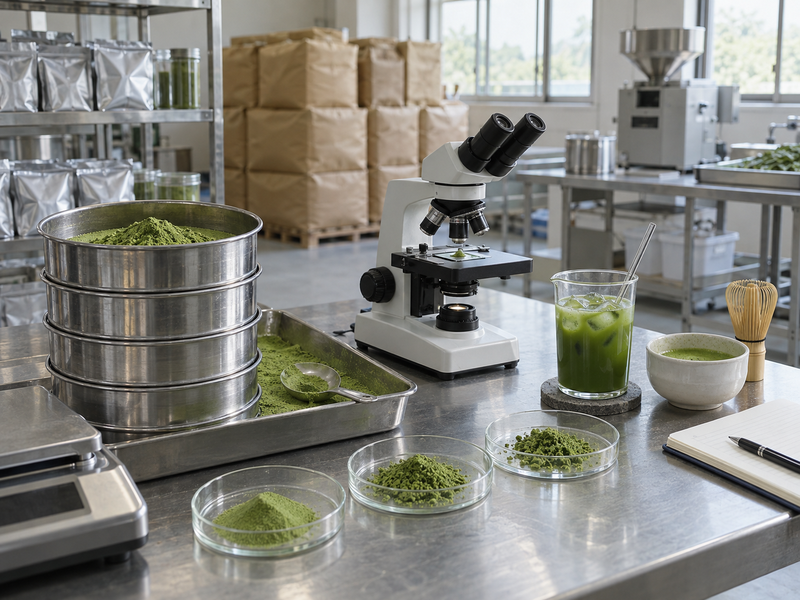
Matcha particle size affects how a powder disperses, feels in the mouth and behaves on a production line. Buyers often receive a single “micron” claim without a method, sample basis or distribution. That number cannot predict every iced latte, bakery dough or protein bar. Use a repeatable measurement and a controlled application trial together. This guide gives purchasing and product teams ten checks for comparing powder lots without turning a microscope result into a promise about the customer’s cup.
Look past one number. A bag contains a range of particles and sometimes clumps formed during storage. A distribution, the analytical method and the actual recipe provide a better picture. Your preferred result depends on the product: a whisked drink has different texture demands from a baked filling or a dry mix. Record the powder that works, then ask a supplier how it will keep future lots within the approved range.
1. What does matcha particle size describe?
It describes physical dimensions of ground matcha particles, often reported through a distribution rather than a single diameter. A report may use D10, D50 and D90 to show points in that distribution. Those labels mean little unless the test method, dispersion conditions and units are stated. Clumps can make a fine powder appear coarse if the sample was not prepared consistently. A supplier’s marketing phrase such as “ultrafine” is not a measurement. Ask what was actually measured and whether the sample represents commercial production.
Particle size is related to milling and handling, but it does not establish cultivar, origin, freshness or safety. Two powders can have similar distributions and different flavor. A color shift might arise from processing or storage without a major shift in particle size. Treat the measure as one line in a useful specification. Request a representative production sample, not only a hand-selected demonstration bag.
| Term | Plain meaning | Buyer question |
|---|---|---|
| D10 | Finer end of a measured distribution | How was the sample dispersed? |
| D50 | Median point | Is this a lot result or a catalog claim? |
| D90 | Coarser end | Does it predict grit or settling? |
| Clump size | Agglomerates during handling | Were clumps broken before testing? |
2. Which measurement method should a buyer ask about?
Laboratories may use laser diffraction, microscopy, sieving or another method suited to the expected range. Results from different methods are not automatically interchangeable. Ask for the method name, instrument settings where relevant, sample preparation, number of repeats and report basis. Wet dispersion might break agglomerates that remain troublesome in a dry mix. Dry dispersion may better reflect a dosing system but not a prepared drink. Choose a method for the decision you need to make, then keep it consistent across suppliers.
Request a full report for a short-listed powder. If the supplier only gives “below X microns,” ask whether that means every particle, a median, a percentile or a sieve pass. One claim can hide a coarse tail that customers feel as grit. When comparing quotes, note that a tighter size specification may add milling and quality cost. Test whether the extra control changes the finished item before paying for it.
3. How does particle size affect an unsweetened matcha drink?
In a water-based drink, a coarser portion can feel gritty and settle sooner. Very fine powder may disperse more readily under some conditions, but it can still form clumps if poured carelessly or exposed to moisture. Prepare each candidate with the same powder mass, water, temperature, vessel and whisking time. Taste immediately and after a realistic service delay. Check texture at the bottom of the cup. A smooth first sip followed by sediment is not a passing result for a drink served slowly.
Test the customer experience. Ask staff to use the normal workflow, not an ideal laboratory technique. If a powder needs an extra sifting step, include that labor in the decision. Compare color and aroma separately; a smooth powder is not necessarily flavorful. Record what an acceptable cup feels like using plain sensory terms. Those notes will help explain a future lot complaint better than “D50 changed” alone.
| Cup observation | Fixed condition | Possible implication |
|---|---|---|
| Grit | Same whisk and dose | Coarse tail or agglomerates |
| Clumps | Same addition order | Wetting or storage problem |
| Sediment | Same hold time | Dispersion differs |
| Foam | Same mixing energy | Surface behavior differs |
4. Does a finer powder always make a better latte?
No. Milk fat, protein, sweetener, temperature and mixing energy alter the result. A fine powder can look smooth in warm water but clump when sprinkled directly into cold milk. Another may disperse well after making a small slurry. Compare powders in your actual recipe, including plant-based milk if that is a major menu item. Review color and flavor after ice melts and after the expected pickup time. Some size differences that look dramatic in a lab report may be invisible in a sweetened latte.
Test at the intended matcha dose. A powder that disperses at a low trial dose may fail when the brand increases tea flavor. Note whether fine particles leave a powdery mouthfeel despite no obvious grit. Choose the powder and mixing instruction together. The matcha latte mix recipe guide develops that workflow for repeatable service.
5. What changes when matcha enters dry mixes or baked products?
Dry blending introduces a different concern: flow and distribution. Fine matcha can cling to equipment and form dust; damp agglomerates can create green spots in a finished product. A bakery might not need the same mouthfeel specification as a whisked tea, but it still needs uniform color and dose. Run a small batch with normal equipment. Sample from the beginning, middle and end of the run to see whether matcha remains evenly distributed. Baking can change color and flavor, so the raw powder test is only the start.
For a premix, review how the powder behaves after shipping vibration and storage. Does it segregate from sugar or dairy powder? Does a packet pour freely? These are process observations, not properties guaranteed by a median particle number. When a supplier recommends another grade for bakery use, ask for a matched trial rather than assuming a coarser powder must be acceptable.
| Application | Performance check | Where to sample |
|---|---|---|
| Whisked tea | Grit and sediment | First and last sip |
| Latte mix | Dispersion and clumps | Immediate cup and hold |
| Bakery batter | Uniform green distribution | Multiple batch points |
| Dry packet | Flow and segregation | After handling and storage |
6. How can storage change apparent particle behavior?
Moisture exposure can cause fine powder to agglomerate. A distribution measured on fresh production material may no longer describe a bag that was opened repeatedly in a humid workspace. Inspect pack integrity at receipt, keep bags sealed and follow the supplier’s storage instructions. If clumps appear, document the lot, storage conditions and opening date before blaming milling. Retest against an unopened control when possible. Do not break up suspect material and silently return it to production if the handling condition could affect quality or safety.
Packaging can therefore matter as much as a small change in measured size. A café chain with slow-moving large bags may perform better with smaller sealed units, even at a slightly higher packaging cost. The bulk matcha storage guide gives a practical stock-handling approach. Include pack format in any supplier comparison so the material that arrives can retain the behavior that was sampled.
7. What should a production-line trial measure?
Measure more than sensory quality. Record feeder flow, dust, bridging, line stops, cleaning time and rejected output. A fine powder may require a different hopper setting or addition order. In a liquid plant, note hydration time, wall deposits, filtration behavior and sediment after filling. Fix all other process settings for the first comparison. Only then decide whether a small adjustment can make a promising powder practical. A trial that changes the powder, mixer speed and recipe at once cannot identify which variable mattered.
Use real equipment when possible. A tabletop cup can screen candidates, but it cannot prove plant throughput. Write the run conditions and batch size on a one-page trial record. Photograph equipment behavior, not just the finished drink. Involve operators who see stoppages and cleanup costs. Their observations may change which powder has the lowest cost per accepted unit.
| Line measure | Why record it | Decision signal |
|---|---|---|
| Feeder rate | Shows flow consistency | Variation affects dose |
| Wall residue | Shows product loss | May raise cleanup cost |
| Clogging | Shows process fit | May cause stops |
| Finished texture | Shows customer result | Must meet target |
8. How should particle size appear in a specification?
State the test method, sample preparation, unit, reported percentiles and an agreed tolerance based on successful lots. Avoid imposing a number copied from a competitor without a trial. If the purchase specification only says “fine,” each party may picture a different powder. Attach an approved sample and a finished-product performance test where practical. Define who may approve a changed mill or blend. A consistent particle report helps track drift, while the application test tells you whether drift matters.
Ask whether the supplier can report results by lot or only as a product development average. A catalog range may be adequate for screening but too broad for an automated line. If a supplier cannot measure every lot, agree on a defensible monitoring plan and escalation point. A buyer with a low-volume café application might accept a different plan from a manufacturer running continuous filling. The specification should fit the operational risk.
9. Can particle size explain every quality complaint?
No. A gritty drink can arise from undispersed clumps, powder quantity, mixing technique or ingredients in the recipe. Sediment can reflect the whole formula. Dull color may be a storage issue. When a complaint appears, preserve an unopened bag from the same lot and recreate the customer recipe under controlled conditions. Compare with the approved reference and a current alternative lot. Use size testing if observations point there; do not order expensive analysis before ruling out basic preparation differences.
Log complaint frequency and conditions. If only one café reports clumps, review its storage and training. If many sites report the same change after a lot switch, escalate to the supplier with sample IDs and objective observations. This evidence supports a better corrective action than a message saying the matcha “feels wrong.” Keep decisions proportionate to risk and the number of affected customers.
| Complaint | Check before size testing | Useful comparison |
|---|---|---|
| Grit | Mixing and dose | Unopened lot versus reference |
| Clumps | Moisture and addition order | Opened versus sealed bag |
| Weak flavor | Recipe and stock age | Blind sensory cups |
| Line stops | Feeder settings | Recorded run conditions |
10. What is the best way to choose a powder?
Shortlist production-representative lots, obtain comparable particle reports and run controlled tests in the sold product. Score texture, flavor, color, process behavior and cost per accepted unit. Retain the winning sample. Then confirm that a later commercial lot performs similarly. A laboratory distribution can help explain and control performance, but it cannot choose the product for you. Keep supplier discussions specific: send the method, results, recipe and observed issue rather than asking for “finer matcha” without a target.
Matcha Village can discuss samples for tea service, latte blends and food manufacturing through its B2B contact page. Tell the team the product, mixing process, pack size and texture problem you need solved. The best matcha particle size is the range that delivers an acceptable finished product repeatedly, with a measurement your supplier and quality team can both reproduce.
FAQ
Q1. Is a lower micron number always better?
No. Compare the measured distribution and the finished-product result in the intended process.
Q2. Why can fine matcha still clump?
Moisture, addition order and mixing conditions can form or preserve agglomerates.
Q3. Should I compare D50 values from different labs?
Only after checking method and sample preparation; otherwise the values may not be directly comparable.
Q4. Does particle size prove matcha freshness?
No. Freshness needs separate storage, sensory and product-quality checks.
Q5. What trial matters most for a café?
A fixed recipe made by staff under normal service conditions, tasted immediately and after a realistic hold.