
Matcha stick packs wholesale should be purchased against a defined portion, product composition and user task. A slim packet can contain pure matcha, a sweetened blend or a more complex drink mix, and those products need different buying specifications.
For a brand or hospitality buyer, the project succeeds when the filled pack delivers the intended amount, opens cleanly and works in the customer’s actual cup or bottle. Start with that experience, then approve the powder, filling performance and carton configuration before committing to a printed production run.
Contents: 1. What product are you buying in matcha stick packs wholesale? | 2. How do you choose a portion that suits the application? | 3. What should the filling trial demonstrate? | 4. How should net contents be checked? | 5. What makes a stick pack practical to open and empty? | 6. Which barrier and sealing evidence should be requested? | 7. How should cartons and wholesale units be organized? | 8. How do printed materials affect order planning? | 9. What should the initial delivery acceptance check include? | 10. What should be confirmed before a repeat production run?
1. What product are you buying in matcha stick packs wholesale?
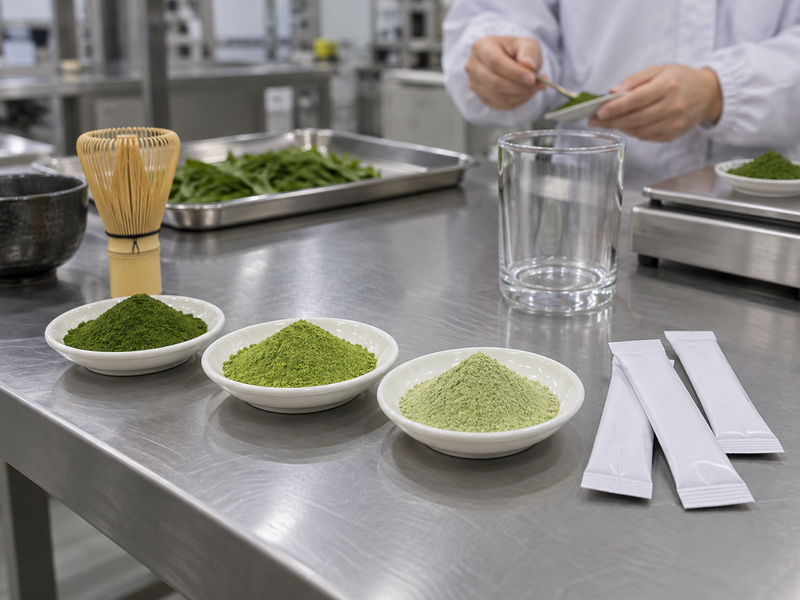
Define the contents before the format
Ask the supplier for an ingredient statement for the proposed product. The word matcha on the front of a packet does not establish its composition. Pure powder and a sweetened latte blend can have different portion sizes, application instructions and documents, even when the outer packs look similar.
Keicha’s stick-pack article describes single portions as a portable product format. Its health and market-growth claims are unnecessary for a procurement decision; assess the actual product you intend to buy.
| Product decision | Information needed |
|---|---|
| Pure matcha or blend | Full ingredient statement |
| Intended preparation | Cup, bottle or food application |
| Intended customer | Retail, hotel or workplace use |
| Sales destination | Label and document review scope |
Write one approved product description that purchasing, design and quality can share. If the supplier offers several blends, give each a distinct product code. This prevents a visually similar sample from becoming the basis for a quotation on different contents.
2. How do you choose a portion that suits the application?
Test the intended serving
Prepare the proposed product in the vessel the customer will use. Record the liquid type, amount, preparation method and expected serving conditions. Choose the powder portion through that application trial rather than copying the amount from another brand’s packet.
For a hotel guest, the available equipment might be a cup and spoon. For a cafe counter, staff may have a measured water source and mixing equipment. Those differences affect the trial. A portion that works with one preparation method does not automatically produce the same result with another.
Keep taste approval separate from the packer’s filling capability. Development can identify a desired amount, but the filling trial must establish whether the line can deliver the agreed product consistently. Have the packer explain the feasible target and operating tolerances for the actual powder.
Document the approved serving in a short instruction card. Include any limitation revealed by testing, such as the need for mixing equipment. Avoid promising that pure matcha will instantly dissolve because it comes in a convenient packet; packaging format alone cannot establish that performance.
3. What should the filling trial demonstrate?
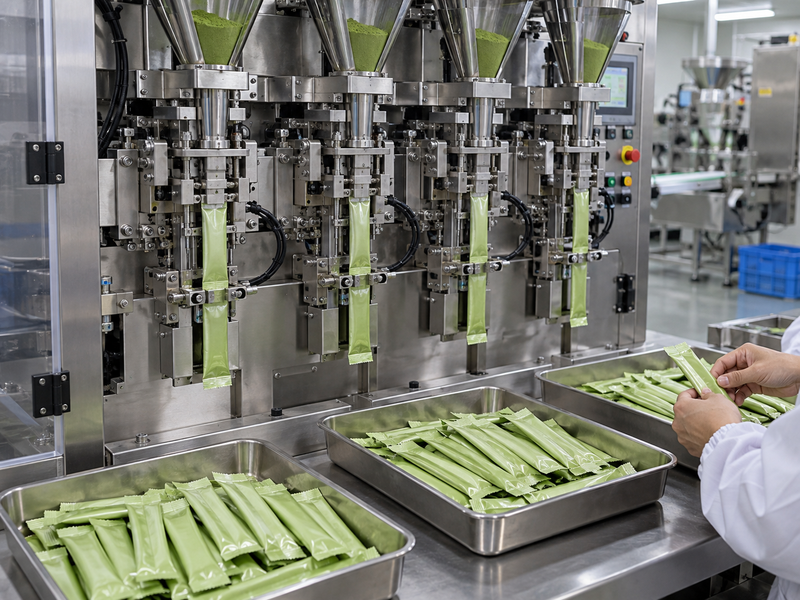
Evaluate the commercial powder on the proposed line
Request a trial on the intended line with representative powder and packaging material. Ask how the packer will measure fill performance, record rejected packs and assess conditions during startup, normal production and restarts. A few hand-filled samples cannot answer those production questions.
Syntegon’s powder stick-pack equipment description illustrates the separate operations of dosing, forming, filling, sealing and checking. It concerns that manufacturer’s equipment; it does not validate a matcha packer’s line or establish food-use approval.
| Trial observation | Buyer question |
|---|---|
| Filled weight records | Are individual results retained? |
| Powder at seal | How are affected packs detected? |
| Startup packs | Are they reviewed separately? |
| Line interruption | What happens at restart? |
Ask the quality team to agree the sampling approach before production. Preserve the actual distribution of results instead of a single average. If the line requires adjustments, record the approved settings and what evidence supports repeating them on the next order.
4. How should net contents be checked?
Agree the measurement and review method
Define the declared quantity and ask the supplier to document its filling-control method. The quality team should confirm applicable net-content requirements for the destination market. Avoid accepting a supplier’s general statement that the machine is accurate without reviewing how filled packs are actually checked.
Clarify how packaging tare is determined when checking net contents. Different film or printing revisions can affect the empty pack weight. Where a destructive measurement is used, identify how the contents are recovered and weighed without treating powder left in a seam or packet as successfully delivered to the user.
Keep commercial acceptance tolerances separate from statutory obligations. A negotiated specification cannot replace the destination’s rules. Buyers should obtain the relevant technical and regulatory review before signing a pack-weight specification or approving printed quantity statements.
Consider the customer’s usable portion as well. An acceptable filled weight can still leave an awkward amount trapped in a narrow or poorly opening packet. Record dispensing observations during the application trial so the buyer can distinguish filling variation from product that remains inside after opening.
5. What makes a stick pack practical to open and empty?

Test the opening with ordinary users
Give test packs to people who have not watched the development team open them. Observe whether they find the opening point, tear across the intended area and pour the contents into the chosen vessel. Use realistic conditions, including the surface and tools available in the intended channel.
Record failure modes rather than asking only whether the pack feels premium. A tear that travels lengthwise, powder caught in a corner or a packet too wide for a bottle opening creates a specific design question. Keep observations tied to the package revision.
| User action | Observation to record |
|---|---|
| Find the opening | Is the intended location clear? |
| Tear the packet | Does the tear follow the design? |
| Pour the powder | Does it enter the intended vessel? |
| Empty the packet | Is visible product retained? |
Run the test again after any change to dimensions, notch position or film. Do not approve the new version only from a flat artwork proof. The physical opening and dispensing task needs a filled sample.
6. Which barrier and sealing evidence should be requested?
Approve the complete filled package
Ask the supplier for the material identity and the checks used to confirm the finished seal. The long sides and narrow ends of a stick pack create a different construction from a large pouch. Do not assume that evidence from the supplier’s other pack sizes covers this format.
WITT’s package-testing explanation treats leak detection and headspace analysis as separate checks. If the proposed sticks use a modified atmosphere, ask the packer how each relevant characteristic is assessed for the small package.
Request product-specific evidence for the intended holding and distribution conditions. The report should identify the powder, film revision, filling line and observation period. Avoid adopting a fixed shelf life from a machinery brochure or another customer’s product.
Connect this evidence with the matcha packaging specification used by your purchasing team. Record which changes need review, including a different film supplier or sealing method. A printed stick pack should enter the order system as a controlled product, with a traceable revision and approval history.
7. How should cartons and wholesale units be organized?
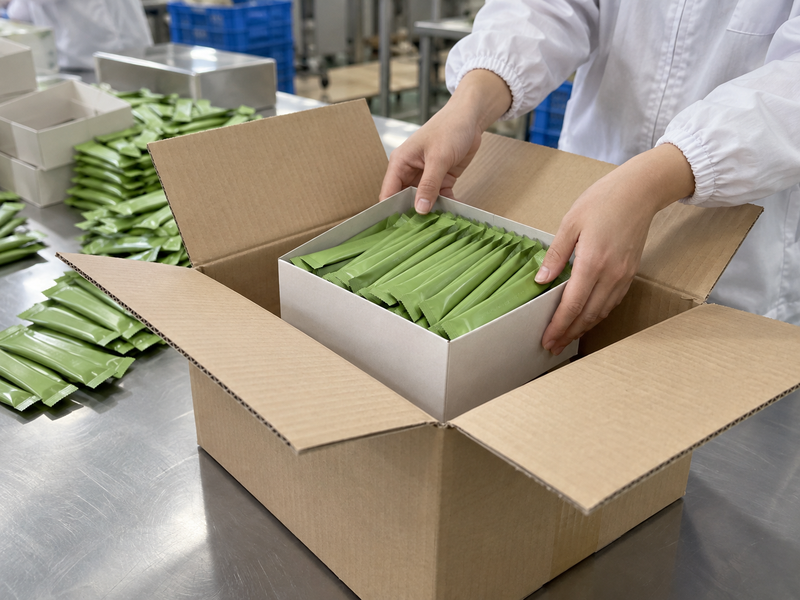
Separate portions from order quantities
Define the number of sticks in a retail unit, the number of retail units in a shipping case and the unit used on the purchase order. Suppliers may quote by filled stick, retail box, carton or powder weight. Those are different measures and must be reconciled before approving an order.
Ask the receiver to review the case design. Warehouse staff need to count and identify the goods without opening every retail box. A hotel buyer may prefer dispensing cartons, while a retail brand may require consumer-facing boxes and separate outer-case identification.
| Quantity field | Purpose |
|---|---|
| Net contents per stick | Defines the individual product |
| Sticks per sales unit | Supports the channel offer |
| Sales units per case | Defines receiving and dispatch |
| Cases per order | Connects quotation and delivery |
Check whether the proposed case configuration protects the packets during handling. Keep a packing photograph and drawing with the approved specification. If the supplier changes the case count, review handling, order conversion and downstream replenishment records together.
8. How do printed materials affect order planning?
Approve artwork after the product decisions
Resolve the product composition, net contents, destination and instructions before approving printed film. The artwork should match the actual product and the documents reviewed by the quality team. A late change to ingredients or serving instructions can make already purchased film unsuitable.
Ask the supplier to separate the minimum commercial filling run from the minimum printed-material purchase. Record who owns unused material, where it will be stored and how revisions will be withdrawn. These are project conditions to negotiate, not quantities that can be inferred from the word wholesale.
Establish an approval sequence involving brand, regulatory and operations staff. The person signing a visual proof may not be responsible for ingredient statements or carton codes. Keep each approval attached to the same revision so a later correction does not circulate as an isolated email.
The private-label project guide provides wider project context. For this format, request a physical filled proof after artwork and material approval. Confirm that the line can reproduce the intended opening, code placement and pack dimensions.
9. What should the initial delivery acceptance check include?

Use a written receiving decision
Give the receiver a short check linked to the approved product code and packaging revision. Include case counts, visible damage, lot identity and the documents needed for release. Decide which observations require the shipment to be held for the quality team.
Select any inspection samples according to the agreed procedure. Do not let an informal tasting replace document or packaging checks. Keep inspected units identifiable, particularly if opening the product means it cannot return to saleable stock.
| Receiving question | Decision record |
|---|---|
| Is this the ordered product? | Code and revision match |
| Is the quantity correct? | Cases and units checked |
| Are packs visibly damaged? | Affected quantity and photos |
| Are required records present? | Document references |
If a discrepancy appears, preserve the outer carton and relevant samples while the supplier investigates. Staff should know who may approve use, replacement or another agreed action. Avoid silently distributing part of a disputed lot to branches before its status has been decided.
10. What should be confirmed before a repeat production run?
Use feedback to update the specification
Collect feedback from the actual sales channel after the initial run. Ask about opening, pouring, portion suitability, instructions and case handling. Separate isolated handling incidents from repeated observations that suggest a product or packaging issue. Record the affected lot and revision with each report.
Review the consumption pattern before reordering. A single-serve format can make counting easier, but unused promotional stock and changes in menu use still affect demand. Count remaining approved units and confirm whether printed materials can support the next order without an artwork change.
Ask the supplier to declare changes to powder, formulation, film, line or packing location before accepting the repeat purchase. A previous approval is useful only when both sides know the conditions it covered. Request new samples where the responsible reviewers decide a change affects performance.
Send one consolidated repeat-order specification with the portion, composition, packaging revision, case configuration and release requirements. Confirm who will resolve any remaining issue before film is printed or powder is committed to the filling run.
Frequently asked questions
Q1: Are all matcha sticks pure matcha?
No. Request the complete ingredient statement. The format can hold pure tea powder or blends with different ingredients and portion requirements.
Q2: Can one stick serve every cup size?
Only if your application testing supports that instruction. Define the intended serving and preparation method before choosing the portion.
Q3: Does a stick pack make matcha instant?
No. Evaluate preparation performance using the actual contents and equipment; the shape of the package does not establish solubility.
Q4: Can a brand approve printed film from a digital proof?
A digital proof supports artwork review. A filled physical sample is still needed for opening, dispensing, coding and handling checks.
Q5: Should MOQ be expressed in kilograms or sticks?
Confirm both the powder requirement and finished-unit quantity, plus printed-material commitments. Keep the purchase-order unit explicit.