
Private label matcha looks simple when a supplier sends a powder sample and a mockup tin. The commercial work sits between those two objects: choosing a repeatable grade, agreeing on specifications, qualifying the pack and approving claims for each sales market. A buyer also needs a plan for the second order, when the first exciting sample is no longer available. These ten checks help a brand move from concept to a product it can reorder with confidence.
Contents: Brief · Customer · Supplier · Sample · Spec · Pack · Label · Terms · Pilot · Reorder
1. What Product Are You Actually Launching?
Write one product brief before asking for prices
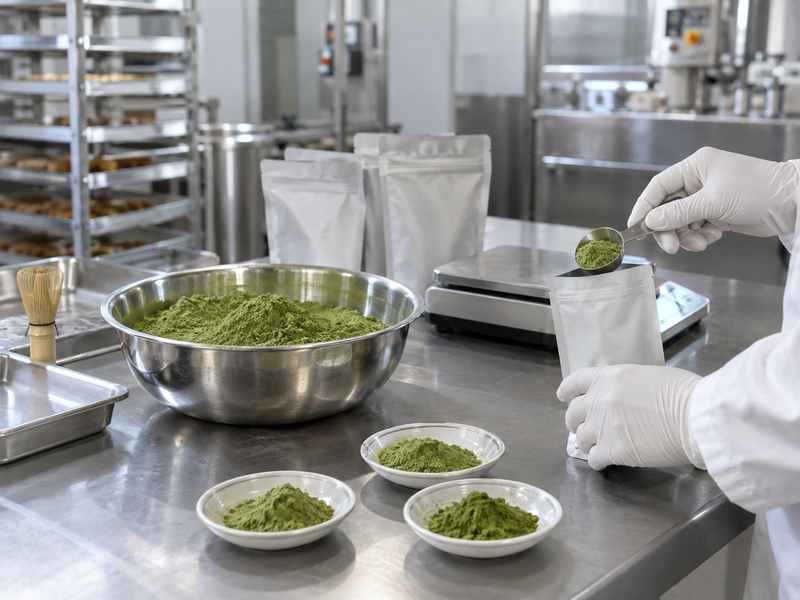
A matcha private label project could be a plain powder in a retail pouch, a sweetened latte blend, single-serve sachets or a gift kit. Those products need different ingredients, packs, testing and price models. Name the product form, serving size, target market, sales channel and the customer experience you want. If it is a powder for plain tea, flavor and mouthfeel will matter differently from a powder mixed into sweet drinks. A supplier cannot quote a useful commercial solution from “premium matcha, best price” alone.
Pick the first SKU. Brands often ask for several grades, flavors and packs before one has been tested. Begin with the product most likely to reach market, then consider extensions. Record a target cost range, forecast volume and expected launch date, but label forecasts honestly as estimates. A disciplined brief lets suppliers say what they can make and prevents the project from drifting each time a new sample arrives.
2. Who Will Buy the Private Label Matcha?
Let the use case set the grade
A consumer whisking matcha with water may pay for a clean, delicate tea. A cafe making sweet lattes may prioritize a stronger flavor at a reliable price. A bakery needs powder that survives its recipe. Decide which buyer and use will drive the first product. Test samples in that use. Avoid using a grade name as a proxy for quality; suppliers do not always define grade labels the same way. A product sold for several uses may need guidance on each rather than a claim that one powder is perfect for all.
Listen to a real buyer. Ask prospective customers what they currently use, what frustrates them and how much powder they consume. A retailer may care about shelf appeal and easy resealing; a food manufacturer may care more about lot documents and bulk handling. Translate that feedback into measurable requirements. A private-label brand that serves everyone in its first draft often ends up with a product no one specifically needed.
| Buyer | Primary test | Likely pack question |
|---|---|---|
| Home tea drinker | Taste in water | Can it reseal cleanly? |
| Cafe chain | Drink performance | Is service size practical? |
| Food manufacturer | Formula consistency | Can bulk packs be handled safely? |
3. What Should You Check About the Supplier?
Verify capability behind the sales page
Ask which steps the supplier performs, which it subcontracts and how it traces material from incoming tea to finished pack. Request relevant food-safety and certification records for the intended product and market. Review product range, production capacity, quality process, export experience and a realistic communication contact. A supplier that can mill powder may not be set up to print small retail runs; a packaging partner may not control the tea it fills. Map responsibilities before signing off on a label.
Look for usable answers. A clear explanation of lot codes, sample approval and how a complaint is investigated tells more than a collection of badges on a website. Ask for current documents and confirm they apply to the site and product in question. If a supplier promises multiple organic schemes or special tests, verify scope and timing. The right partner should be able to state what it can deliver, what needs outside approval and which questions remain open.
4. How Should You Compare Powder Samples?
Create the same test for every candidate
Request lot-linked samples with a specification and price basis. Taste them blind in plain water if the product will be sold for direct drinking. Then test them in the intended application, such as milk, a smoothie or a baked item. Record color, aroma, bitterness, mouthfeel and dose. Use the same water, temperature, recipe and portion each time. A powder that wins a water tasting may not be the economical choice for a sweet latte; another can look green in the bag and disappoint in the cup.
Keep the chosen sample. Seal and label a reference portion. Ask whether the quoted commercial material will match that lot, and how variation will be managed. If the supplier offers a blend designed for consistency, understand the permitted range. Compare cost per serving at the dose that tastes right, not merely price per kilogram. A low quote is weak evidence if a higher dose or high rejection rate erases the saving.
| Sample record | Why it belongs in the file |
|---|---|
| Lot identifier | Links tasting to sale material |
| Test recipe and dose | Makes comparison fair |
| Sensory notes | Records what customers will notice |
| Price basis | Enables cost per serving |
5. What Belongs in the Product Specification?
Turn a sample preference into an acceptance rule
The specification should identify product form, intended use, origin information where relevant, sensory target, color range, particle or handling needs, pack, labeling inputs and required quality documents. Qualified quality staff should determine test methods and limits appropriate to the product and markets. Do not copy numbers from another supplier’s sheet without understanding how they were measured. A specification needs to tell both parties when a future lot should be accepted and when it needs review.
Keep claims separate from preference. A buyer may prefer bright color, while “organic” is a documented status with a defined certification scope. A place name, food-safety claim or nutritional statement needs its own evidence. If the product is a blend, list its ingredients and what can vary. Agree on who approves any reformulation. A clear spec prevents a small cost-driven change from silently altering the product customers reorder.
6. Which Pack and Fill Size Fit the Channel?
Test the complete filled unit
Pouches, tins, sachets and bulk bags each serve a different use rate and price point. Choose size based on how quickly a customer will use the powder and how the channel handles stock. Ask for material and food-contact information for the destination market. Then fill the proposed pack with the actual powder and check seals, closures, scooping, shipping and appearance after storage. A premium tin can still need a qualified inner seal. A low-cost pouch can outperform a tin in some routes if it is well designed and filled correctly.
Do not approve an empty mockup. Fine powder can contaminate seal areas or collect in a zipper. A customer may struggle to scoop from a narrow opening. Run a pilot fill, send units through the planned shipping route and have someone use the pack for several days. The matcha storage guide can inform consumer instructions, but the private-label pack needs its own stability evidence.
| Pack choice | Useful for | Trial risk |
|---|---|---|
| Small pouch | Online retail | Closure and powder spills |
| Tin with inner seal | Gift or premium shelf | Extra cost and seal integrity |
| Sachet | Measured servings | Material and fill complexity |
| Bulk bag | Foodservice or factory | Opened-use handling |
7. Who Approves the Label and Claims?
Assign ownership before artwork is final
The brand owns the promise it makes to customers. The supplier may provide ingredient, origin and quality data; the brand’s regulatory team or qualified adviser should review the final label for every destination market. The pack may need ingredient, net quantity, business, nutrition, allergen and other required information. Organic, grade, origin and health statements need specific support. A design agency should not decide whether a claim is allowed from a marketing mood board.
Freeze a version. Keep the approved wording, barcode, pack dimensions and print proof together. If the formula or powder origin changes, review the label before another run. A supplier should not substitute an ingredient or pack material without telling the brand. A line that says “Japanese matcha” when the leaf origin is different can create a problem far more expensive than reprinting labels. Clear responsibility protects both parties.
8. What Commercial Terms Need to Be Written?
Price the real product at the real order size
Ask for a quote that specifies powder grade, pack, fill weight, minimum order quantity, lead time, sample charges, artwork costs, testing, shipping basis and payment terms. A unit price without those assumptions cannot be compared fairly. Decide who pays for unused printed packaging if a formula or design changes. Ask whether a small first order can scale into the forecast volume and how price may change at larger quantities. Keep estimates labeled as such until the buyer has data.
Plan a second order. The first launch often receives unusual attention. Later orders need the same quality without a project manager chasing every step. Agree on reorder lead time, approved alternatives, notice of material change and a complaint process. If a brand needs exclusivity or ownership of a custom formula, those terms should be reviewed and written explicitly rather than assumed from a friendly sample conversation.
| Quote field | Buyer question |
|---|---|
| MOQ | Can the launch absorb the inventory? |
| Lead time | Will stock cover the next order? |
| Testing | Which records are included? |
| Packaging | Who owns print stock and tooling? |
| Freight basis | What is included in the price? |
9. How Do You Approve the First Production Run?
Treat a pilot as a real customer order
Run the approved powder through the intended filling and packaging line. Pull units from early, middle and late production. Check fill weight, seal, lot code, artwork, powder appearance and documents. Send a case through the normal shipping route and open several units. Keep retained samples. A sample packed by hand at a sales desk does not prove the factory line can make the product repeatedly. Qualified quality staff should set the release and stability tests for the exact finished unit.
Have the brand use it. Make a drink or food product from the pilot pack exactly as a customer would. If the powder performs differently from the approved sample, stop and investigate before approving large-scale shipment. The packaging, formula and label all need sign-off on one version. A launch date is useful, but it cannot replace evidence that the unit in the carton is the unit the buyer approved.
10. What Keeps the Next Order Consistent?
Keep decisions in one versioned file
Store the approved specification, retained powder and pack samples, sensory results, artwork, commercial terms and release criteria together. Record lot numbers on every order. When a new tea lot, print stock or factory process is proposed, compare it with the approved reference and decide which tests need repeating. This makes change manageable without pretending natural agricultural material never varies. The goal is a consistent customer experience within a defined range.
Review the launch after sale. Track customer feedback, returns, actual usage and reorder timing. If buyers find the powder hard to scoop or the tea too mild in milk, test a controlled revision and update the product version. Do not quietly swap grade or packaging while keeping the same promise. A private-label matcha line becomes a durable business when purchasing, quality, packaging and marketing can all point to the same approved product.
| Reorder control | Evidence |
|---|---|
| Powder lot | Specification and sample comparison |
| Pack lot | Material and seal checks |
| Artwork | Approved print version |
| Release | Finished-unit inspection |
| Customer response | Complaints and reorder data |
FAQ
Q1: Is private label matcha the same as wholesale powder? Not always. Private label usually adds branded packaging, artwork and finished-product approval work.
Q2: Must a brand choose one grade for every use? No. Test the intended customer application and select a powder that performs at the target price.
Q3: Can a supplier design the label? It can help, but the brand should assign final claim and market compliance review clearly.
Q4: What should a first order include? An approved specification, samples, pack, artwork, release criteria and written commercial terms.
Q5: How can a brand avoid lot drift? Keep retained samples, define an acceptance range and review changes before the next production run.
The SERP reference private-label guide covers a related sourcing route. The practical decision remains the same: approve a reproducible powder and packed unit before placing the launch order.