
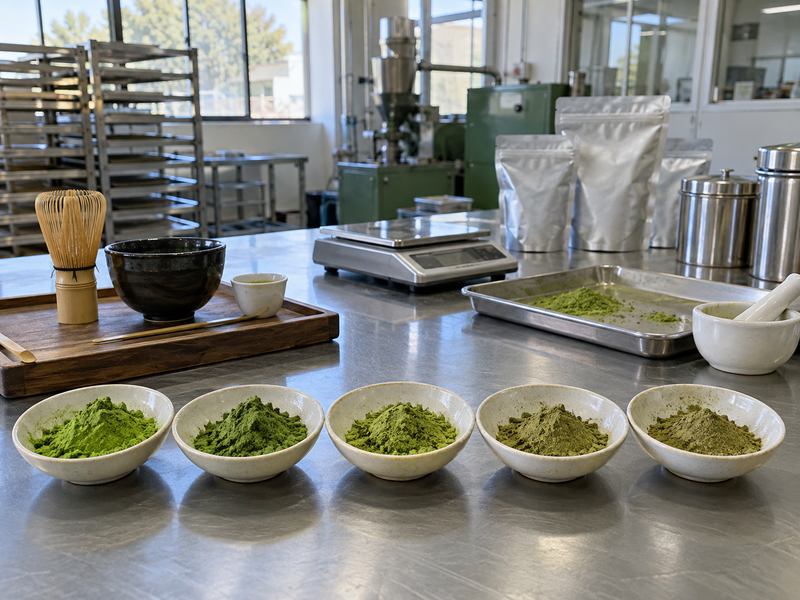
Matcha quality grades can help a buyer narrow a supplier’s catalog, but they are poor substitutes for a product specification. One seller’s “premium” may target unsweetened tea, while another uses the same word for a café latte powder. The label can also hide differences in blend, origin, harvest and processing. A food business needs to know what a powder does in its finished product and whether the next lot will do the same thing.
This guide is for purchasing teams, café chains and food developers buying commercial quantities. It does not rank ceremonial, premium and culinary as a simple ladder where the most expensive level always wins. Instead, it shows how to ask for comparable samples, evaluate them in use, document an approved reference and keep cost tied to accepted output. Matcha Village’s practical supplier role is to help match powder to an application, not to treat grade language as a laboratory result.
1. What do common matcha grade labels actually mean?
“Ceremonial,” “premium” and “culinary” are widely used commercial descriptions, but buyers should ask each supplier for its own definition. The terms may reflect leaf selection, sensory target, price tier or intended application. They do not by themselves state a measurable color, particle-size distribution or contaminant result. A quotation should name the exact product code and specification alongside any grade word. That lets a buyer compare what will arrive with what was sampled.
Ask the supplier whether the grade is pure matcha and whether it is a single lot, a planned blend or a formulated product. Some catalogs place sweetened latte powder next to pure tea powder; comparing their kilogram prices as if they were identical misleads. If a distributor relabels a powder, check the underlying manufacturer’s lot trace. A grade description is useful as a first conversation, then the written product identity must take over.
| Label on offer | Follow-up question | Evidence to keep |
|---|---|---|
| Ceremonial | For which cup and dose? | Approved sensory reference |
| Premium | Which attributes justify the tier? | Product specification |
| Culinary | Which heat or milk application? | Finished-product trial |
| Organic | Which certified product and scope? | Current relevant certificate |
2. Which use case should select the grade?
Begin with the product sold to the customer. For a lightly sweetened whisked tea, subtle aroma and a smooth finish may matter enough to justify a higher-cost powder. In a sweetened latte, the milk and sugar change what customers perceive. In a cookie, heat and a baked matrix can mute delicate notes. A bright premium powder that shines in water may not beat a more robust culinary powder in those foods. Test the dose and finished result before assigning any tier.
Write one target for each application, then ask for samples that could meet it. If a business sells both ceremonial service and bakery items, it may need two powders. Using one SKU everywhere simplifies inventory but can raise cost in a bakery or compromise a premium drink. Compare the cost of two controlled SKUs with the operational cost of one compromise. The bakery matcha guide shows how a heat application changes the evaluation.
| Application | Trial condition | Acceptable result |
|---|---|---|
| Whisked tea | Fixed powder and water | Balanced aroma, texture, finish |
| Iced latte | Actual milk, ice and pickup delay | Visible color, smooth cup |
| Cookie | Standard bake and storage | Useful color and flavor after heat |
| Ice cream | Frozen finished sample | Tea note through dairy or plant base |
3. How should a supplier sample be compared?
Request production-representative samples with product and lot IDs. Make the same recipe with each candidate. Keep powder dose, liquid, mixing equipment, temperature and serving time constant. Blind-code cups when practical, so assessors do not score the most expensive sample more generously. Separate notes on color, aroma, bitterness, mouthfeel and aftertaste. A single “favorite” vote gives little help when the next lot shifts. Use concrete descriptions that a supplier can recognize and act on.
Retain an approved sample under the supplier’s storage guidance. When the first commercial lot arrives, run the same comparison. It is reasonable for tea to vary somewhat, but the buyer must define which variation the menu can tolerate. Test more than one lot before a long contract if continuity matters. For a chain, include staff who will make drinks during normal service, not only the product developer who knows how to rescue a difficult powder with extra whisking.
4. Can green color prove a grade?
Color can reveal a useful difference, but it is not a grade certificate. Compare equal amounts under fixed neutral light and in the final recipe. Phone images, display settings and packaging graphics can make a powder appear greener than it is. Color also changes when matcha enters milk, batter or a frozen base. A buyer who approves only the dry powder may be disappointed by the sold item. Record color separately from flavor so a vivid but harsh powder does not win by appearance alone.
If the business uses an instrument, specify preparation, lighting and tolerance. If it uses visual comparison, train assessors against retained samples. Use words such as vivid green, yellow cast or dull brown rather than “good” and “bad.” Investigate a shift with the supplier; do not assume one cause from color alone. The real versus fake matcha article explains why visual cues cannot establish identity by themselves.
| Color check | Control | Common mistake |
|---|---|---|
| Dry powder | Same dish and light | Comparing supplier photos |
| Prepared tea | Same dose and water | Different whisking time |
| Milk drink | Same milk and cup | Changing sweetener or ice |
| Food product | Same process and hold time | Judging before heat or freezing |
5. What flavor differences matter to a commercial buyer?
Use the customer’s product as the judge. A tea may have a pleasant vegetal aroma in water but become too faint in milk. Another powder may offer strong color yet leave astringency that remains after sweetness is added. Ask a small panel to note when bitterness appears and how long it lasts. Compare aroma immediately after preparation and after the normal service delay. A strong smell from an opened bag does not guarantee flavor in a finished cup.
For food manufacturing, evaluate after the actual process. A flavor can change when powder is blended with protein, baked, pasteurized or frozen. Run a controlled side-by-side pilot and record the accepted dose. A higher-grade label is not a reason to skip an application trial. If the winning powder needs a much lower dose, the cost comparison may favor it despite a higher price per kilogram. If not, a less costly grade may be the rational choice without reducing customer experience.
6. How do texture and particle behavior affect grade choice?
Fineness can influence mouthfeel and dispersion, but a single particle-size number rarely captures a whole drink. Ask how the supplier measures it, then run a cup test. Look for clumps, sediment, powder on the vessel wall and grit after a normal hold. Test with the actual water, milk and mixer. A powder that performs in warm water may struggle in cold oat milk. A grade marketed for tea service may not flow cleanly through a particular factory dosing system.
Keep the machine and recipe fixed while comparing powders. If a candidate needs special mixing instructions, calculate that labor and training cost. Fine powders may also behave differently in humid handling environments. Do not overinterpret a photograph of powder on a spoon. The specification should include a practical acceptance test that reflects the product sold, with the particle method as supporting evidence where it is useful.
| Performance issue | Test | Buyer consequence |
|---|---|---|
| Dry clumps | First pour and vessel wall | Remakes and poor appearance |
| Grit | Blind taste after fixed hold | Customer texture complaint |
| Hopper bridging | Normal line trial | Slow production |
| Excess foam | Measure cup after service delay | Inconsistent fill |
7. Which documents should support the chosen grade?
Request a product specification, ingredient declaration, lot-specific quality record and the certificates relevant to the destination market and customer. Match the documents to the exact product code. A certification issued to a company or factory does not automatically cover every product or claim on the order. Ask for evidence of origin and traceability when those are part of the marketing proposition. If a supplier describes a single cultivar or a specific region, the purchase terms should identify how that claim will be controlled.
Do not treat a laboratory sheet as a sensory score. It may confirm specified safety or composition parameters but does not show how the powder tastes in a latte. Keep the document and the approved application trial together. When the supplier changes a blend or manufacturing site, decide whether to reapprove. The certification checklist offers a way to organize these requests without asking for every badge in the industry.
8. How should prices across grades be compared?
Compare cost per accepted finished unit, not only price per kilogram. Use the tested matcha dose, accepted yield, shipping basis, pack waste and any additional work the powder causes. A higher-priced grade can be economical if it gives the desired cup at a lower dose or reduces remakes. A less expensive grade can be entirely appropriate when the final product has strong flavors and the tea remains noticeable. The key is to calculate with the same recipe and quality target.
Do not pay a premium for a grade word alone. Ask which measurable or sensory difference justifies the price and whether it will persist in future lots. Review normal reorder pricing, not just a sample promotion. A chain should also consider whether stocking two grades adds training and inventory complexity. If the second SKU cuts ingredient cost in high-volume baking while protecting drink quality, that complexity may be worthwhile.
| Cost input | Measure | Comparison basis |
|---|---|---|
| Powder price | Delivered cost per usable kg | Same term and currency |
| Dose | Grams per accepted product | Fixed sensory target |
| Waste | Clumps, rejects and aging | Normal service or batch |
| SKU burden | Training and separate stock | Whole operation |
9. What should be written into the purchase specification?
Use the supplier’s product code, formulation and pack configuration. Attach or identify the approved reference sample. State application performance, color and sensory tolerances in terms your quality team can repeat. List required lot documents and the method for resolving a mismatch. If a grade label is commercially important, include it, but anchor it to the specification. A future purchasing employee should be able to order the same product without remembering a tasting conversation from months earlier.
Define change notification for material shifts in source, blend, milling or packaging. The exact threshold for notifying a buyer belongs in the supplier agreement, not in an unwritten expectation. Record who can approve a substitute during shortages. If an alternative grade is acceptable for one application but not another, state that clearly. This reduces the chance that a well-intentioned supplier or warehouse staff member sends the wrong powder to a premium menu.
10. When should a buyer revisit its grade decision?
Review it when the menu changes, production process changes, supplier lots drift or customer feedback points to flavor or color. A powder approved for a hot drink may need a new trial when the chain adds an iced oat-milk version. A bakery powder may work differently after a formula changes fat or bake time. Do not change the grade simply because a competitor advertises a more prestigious label. Test the proposed benefit in the sold product and calculate its cost.
Matcha quality grades are useful shorthand only when the buyer knows what stands behind them. Matcha Village can discuss samples for tea service, lattes and food applications through its B2B contact page. Share the recipe, pack need and expected volume so the sample set answers a real purchasing question. Retain the winner, the reasons it won and the tests the next lot must pass.
FAQ
Q1. Is ceremonial grade always best for a café?
No. Compare the finished drinks. A powder chosen for whisked tea may not justify its cost in a sweetened latte.
Q2. Can a culinary grade be good quality?
Yes, if it meets a defined food application and the buyer’s safety and consistency requirements.
Q3. Does bright green prove the highest grade?
No. Color is one controlled observation, not a complete identity, flavor or application test.
Q4. Should a brand use one grade across every product?
Only if controlled trials show it works economically in each product. Two SKUs may be sensible.
Q5. What should replace vague grade language in a contract?
Use a product code, approved sample, measurable specification, pack description and change-control terms.