
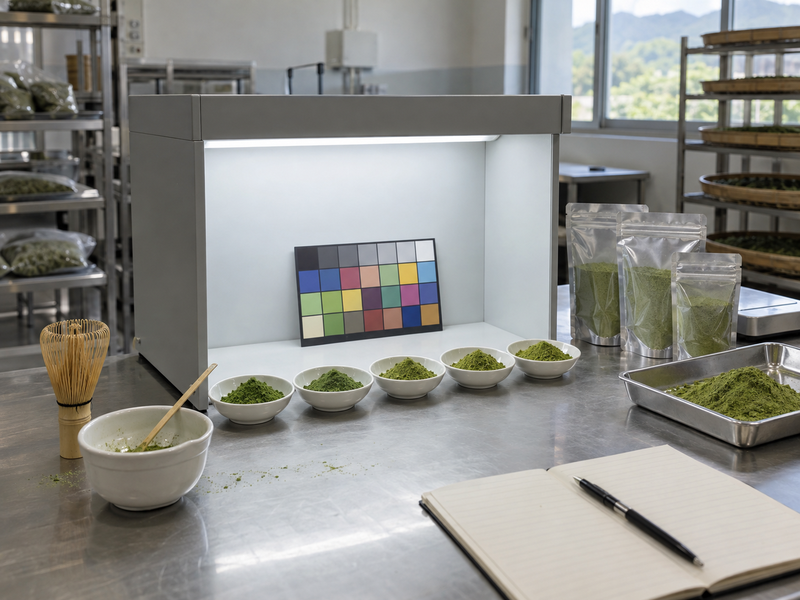
A supplier sends a photograph of vivid green powder. The bag that arrives looks duller under the café’s warm lights. Did the powder change, or did the viewing conditions? Matcha quality color is a useful buying signal, but it can be easily distorted by light, camera settings, recipe and storage. A buyer needs a repeatable observation before deciding that a lot is acceptable or defective. This guide gives food brands, café chains and distributors a practical way to compare powder and finished products without turning a shade of green into a promise it cannot support.
Color should sit beside identity, aroma, taste, texture and lot documents. It cannot prove origin or food safety, and the greenest dry powder is not automatically the best ingredient for a frozen dessert or sweetened latte. Matcha Village’s B2B perspective is to evaluate powder in the application it will enter and use the same test every time a new lot arrives.
1. What exactly should a color test answer?
Decide whether you are screening incoming lots for consistency, comparing suppliers, checking a finished drink or investigating a complaint. Each question needs a different sample. For incoming control, compare the production lot with an approved retained powder. For a new supplier, prepare each powder in the same recipe. For a customer complaint, compare the complained-about product with a retained sample from the same lot and a current control. Mixing these questions in one photograph leads to confused decisions.
Write a short acceptance statement in ordinary language before you see the new sample. “No obvious yellow or brown cast beside the approved lot under fixed light” is clearer than “premium green.” If the business uses an instrument, specify the preparation and acceptable difference through its quality process. Do not invent an instrument limit without first checking how the difference looks to customers in the sold product.
| Question | Reference | Useful output |
|---|---|---|
| Is this lot consistent? | Approved retained lot | Release or investigate |
| Which supplier fits the menu? | Fixed finished recipe | Rank application fit |
| Did storage change the powder? | Unopened same-lot sample | Find exposure cause |
| Why did customers complain? | Served product and control | Trace recipe or ingredient |
2. How should dry matcha samples be prepared?
Put equal masses of powder in identical, clean dishes. Level the surface the same way and avoid compacting one sample more than another. Use a neutral background and the same location for every comparison. A deep pile and a thin smear can look like different colors even when they come from the same bag. Label the underside or use an adjacent code card that will not cast a shadow. Keep the dishes covered until the viewing moment so one portion does not sit exposed while the other is prepared.
Compare promptly after opening, then record the time if repeated observations are part of the study. A production team may also look for specks, unevenness or clumps, but these should be separate notes rather than rolled into a single color score. Photograph the setup only as a supporting record; the physical retained samples and written conditions are more reliable than a phone image viewed on several screens.
3. Which light makes a visual comparison fair?
Choose a stable, neutral light source and use it every time. Mixed daylight and warm ceiling light can create a cast that changes from hour to hour. If a lightbox is available, document its lamp setting and placement. If not, use an interior area with controlled light and no strong reflections. Avoid direct sunlight, colored walls and a bright window behind one sample. Have assessors stand in the same position rather than passing the dishes around a room with different light.
Train the small group that makes release decisions. One person may call a powder “olive,” another “yellowish green.” Use retained examples and a short set of descriptors so the team agrees on what triggers investigation. Color perception varies, so a disputed sample should not be decided by whoever speaks first. An instrument can help when the business has the volume and method discipline to support it, but it still needs a preparation protocol and a sensory reality check.
| Lighting factor | Common distortion | Control |
|---|---|---|
| Warm bulb | Yellow cast | Fixed neutral source |
| Window sunlight | Changing intensity | Exclude during comparison |
| Colored background | Perceived hue shift | Neutral surface |
| Phone auto white balance | Different image per sample | Lock settings or rely on direct view |
4. Should a buyer measure color with an instrument?
An instrument can help a buyer track small changes across many lots, but only if the method is repeatable. Define the dish, powder depth, number of readings, calibration check and reporting format. If the instrument uses color coordinates, keep the raw values and the calculated difference with the lot record. Ask a trained quality person to connect an outlier with visible appearance and finished-product performance. A precise number that nobody can reproduce does not improve purchasing.
Instrument readings from different devices or settings should not be compared casually. Nor should a threshold be imported from a supplier brochure without testing whether it matters to your product. A café may tolerate a small powder shift that disappears in milk; a brand selling clear matcha drinks may notice it immediately. Use the instrument to make the decision more consistent, not to avoid looking at the cup.
5. Why test color in the finished recipe?
Milk type, water, sugar, pH, heat, ice and serving vessel can all change perceived color. Fix the recipe and preparation order, then compare samples in identical clear or standard service cups. Record the drink immediately and after a normal handoff delay. For bakery or ice cream, test after baking or freezing rather than judging the wet mix alone. A powder may look brilliant dry and become washed out in a dairy base. Another may start darker but retain a pleasing tea appearance in the sold food.
Keep flavor notes separate. If the greener cup tastes harsher, the buyer must decide whether customers will accept it or whether a different dose or formula is needed. Changing dose solely to hit a color target can alter bitterness and cost. Test the full product under ordinary service conditions, not only a carefully lit development photo. The café powder guide offers a broader trial checklist for drinks.
| Application | Color observation point | Keep constant |
|---|---|---|
| Hot tea | At service and short hold | Water, dose and bowl |
| Iced latte | After mixing and pickup delay | Milk, ice and cup |
| Baked good | After bake and cooling | Formula and oven process |
| Frozen dessert | After freeze and display | Base and overrun method |
6. Can color identify age or storage damage?
A color shift can justify an investigation, but it does not tell the whole cause. Compare the suspect bag with an unopened retained unit from the same supplier lot if possible. Review packing date, seal condition, storage location, light exposure and open-pack history. Smell and taste under controlled conditions as well. A different raw material or blend may also change color, so ask the supplier for production and change records rather than diagnosing the lot from one image.
If several bags from one pallet differ, isolate the affected stock and document positions. If only the working container changed, examine service handling. Do not mix a discolored powder into new stock to “even out” the shade. Quality staff should decide whether a product still meets its specification and customer commitments. The bulk shelf-life guide explains why a buyer needs actual stability evidence for storage claims.
7. How should photographs be used with suppliers?
Send photos with context: lot code, sample amount, light source, camera settings if known, and the approved reference beside the questioned sample. A picture of one green bowl on a café counter gives the supplier little to investigate. Add a short written description of the discrepancy and the finished-product result. Keep original images rather than heavily edited versions; filters and automatic enhancement can turn a modest difference into a dramatic one.
Ask the supplier to repeat the same comparison with a retained lot sample. If its result differs, compare preparation and lighting methods before arguing about which image is “real.” A shared reference sample is especially useful for long supply programs. It lets the team distinguish a production change from a screen or camera change. For a material issue, the supplier may need physical samples; photographs can start the conversation but rarely close it.
| Photo element | Include | Avoid |
|---|---|---|
| Reference | Approved sample in same frame | Old marketing image |
| Lot | Visible code in separate record | Unidentified powder |
| Light | Documented fixed setup | Mixed window and warm light |
| Editing | Original file retained | Color filters |
8. What belongs in a color acceptance rule?
State the approved reference, sample preparation, viewing or instrument method, allowable difference and decision owner. Include a route for borderline cases: repeat the test, use a second assessor, and check the finished product. If color is critical to a specific SKU, make that use explicit. A powder may be accepted for a dark chocolate bar but not for a clear bottled drink; the quality rule should not silently allow substitution across both.
Write the outcome in the lot record. An accepted deviation should say why the product remains fit for the named application and who approved it. A rejection should preserve enough evidence for the supplier to investigate. Avoid moving thresholds every time a new shipment arrives. Repeated exceptions signal that the specification or supplier process needs review, not that the team should become more creative with its camera.
9. How can color be balanced with flavor and cost?
Create a scorecard with separate lines for appearance, aroma, taste, texture, dose and cost per accepted unit. Do not let one vivid sample win automatically if it requires a higher dose or leaves an aftertaste. In a menu trial, ask customers or a trained panel to assess the drink without seeing the dry powder. Check whether a color difference remains visible under ordinary shop lighting. If it disappears, the business may be paying for an attribute that does not survive the recipe.
Conversely, color can carry real value in a product sold for its visual appearance. A brand should document that value through customer response or defined design requirements rather than assume every bright green powder is worth a premium. Compare delivered, usable cost for powders that meet the entire target. A vivid product photograph will not help a buyer if the cup is too bitter or the pack loses quality before it is used.
| Decision factor | Measure | Trade-off |
|---|---|---|
| Visual target | Finished product under normal light | Brand appearance |
| Flavor | Blind sensory panel | Customer acceptance |
| Dose | Grams per accepted serving | Ingredient cost |
| Handling | Waste and open-pack performance | Operational cost |
10. When should the color method be reviewed?
Review it when the menu, light source, camera workflow, product formula or supplier pack changes. A powder specification created for hot tea may not predict an oat-milk latte. A new store design with warm lighting can change how the same cup looks. Recheck retained samples and instrument calibration on the schedule set by the quality team. If assessors repeatedly disagree, simplify the descriptors or add a more controlled viewing setup.
Matcha quality color should help a buyer make a consistent decision, not become an argument over screenshots. Matcha Village can discuss matched samples and application tests through its B2B contact page. Send the intended recipe and a reference photo taken under documented light, then verify the production lot in the same setup when it arrives. Color is valuable when its method and purpose are clear.
A published Tencha storage study measured chlorophyll-related compounds and the surface color of powdered tea. Its conditions are specific; use it to frame questions, then compare your own lots under your own packing and storage conditions.
FAQ
Q1. Is the brightest green powder always the best matcha?
No. Evaluate identity, flavor, texture, application fit and documents alongside controlled color.
Q2. Can a phone photo be used for lot acceptance?
It can support a record, but automatic processing and different screens make it unreliable as the only test.
Q3. Should dry powder and a latte use the same color standard?
No. Compare each in a defined method; the finished latte is what the customer sees.
Q4. What if only one opened bag looks dull?
Hold it, review its seal and storage history, and compare with an unopened same-lot sample.
Q5. Does a color instrument remove the need for tasting?
No. It improves measurement consistency but cannot describe aroma, bitterness or mouthfeel.