
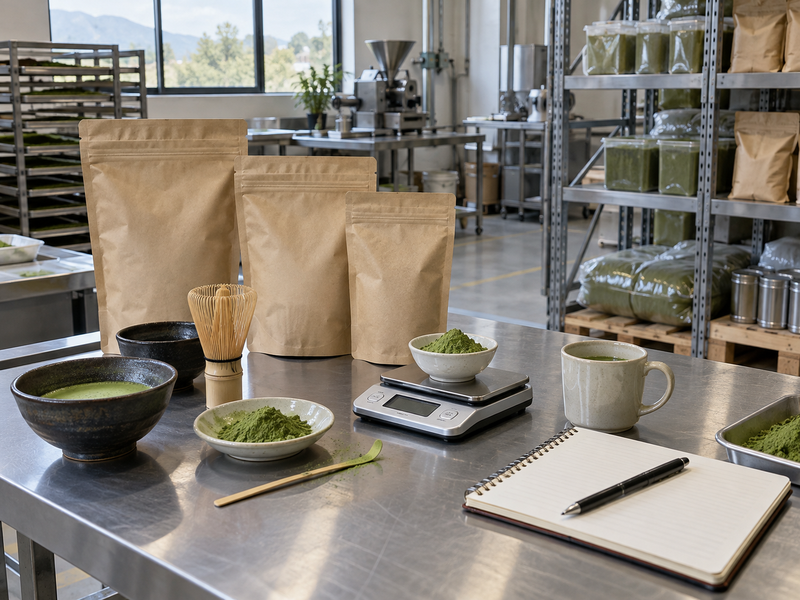
Buying bulk matcha for small business sounds like a simple way to lower ingredient cost. It can also tie up cash in powder that a new menu will not use quickly enough. A café, online brand or dessert shop needs a first order that proves the cup, the pack and the replenishment process before it chases a large price break. The right size is not the supplier’s most attractive tier. It is the smallest commercial order that lets the business serve customers consistently and learn what to reorder.
This guide focuses on a launch or early growth stage. It treats the wholesale quote as one part of a decision involving recipe, sales pace, shelf life, labor and customer response. Matcha Village’s B2B view is that a supplier should help a buyer test the actual application, not just send a visually impressive sample. Use the checks below to build a brief, compare offers and make the first commercial order measurable.
1. What menu or product will the first order support?
Pick one or two intended uses before requesting prices. A lightly sweetened latte, a matcha cookie and a retail tin put different demands on flavor, color, packaging and records. Write the recipe or product specification in enough detail that a sample can be tested fairly: matcha dose, liquid or base, sweetness, serving temperature and expected output. “Good matcha” is too broad. If the business has not yet sold the item, run a small menu trial and record how many customers choose it at the proposed price.
Do not build demand forecasts from the most enthusiastic tasting day. A launch promotion can create a short spike followed by ordinary sales. Use a conservative weekly estimate and ask how many grams of powder each accepted product actually needs. A high-dose powder may make a beautiful photo while ruining margin. Include remakes in the test, especially if staff are learning a new mixing method. This use-case brief will help suppliers offer a product that fits the business rather than their largest available bag.
| Launch product | First trial | Decision measure |
|---|---|---|
| Iced latte | Serve at normal pickup delay | Flavor, color and clumps |
| Hot drink | Use normal milk and cup | Texture and service time |
| Cookie or cake | Bake a standard small batch | Color and flavor after heat |
| Retail powder | Test pack and label concept | Customer use and handling |
2. How much matcha should a new business buy?
Estimate accepted units per week, multiply by powder dose and add a realistic allowance for test batches and waste. Then compare the result with supplier lead time and the after-opening use of each inner pack. A café expecting fifty 3 g drinks per week uses around 150 g before waste; a single large open bag may last too long for that operation. This is an example calculation, not a universal dose or sales forecast. Replace the numbers with your tested recipe and customer demand.
Keep the first order large enough to exercise normal supplier paperwork and shipping, but small enough that the business can change course if the drink fails. Ask whether a carton can contain several sealed inner packs. That option may cost more per kilogram yet reduce exposed powder. Compare the total cost of accepted cups, including storage and discard, with the discounted large-bag price. A lower invoice unit price is a weak win when the last half of the bag no longer meets the menu standard.
| Input | Owner | Use in order calculation |
|---|---|---|
| Tested grams per accepted unit | Recipe lead | Base consumption |
| Conservative weekly units | Store or sales lead | Demand forecast |
| Lead time and reserve | Buyer | Reorder point |
| Open-pack use period | Quality team | Inner-pack size |
3. Which samples are worth paying attention to?
Ask for production-representative samples with product and lot identification. Test them in the final recipe, not as dry powder alone. Blind-code the samples so staff do not reward the highest price or most familiar origin. Make the drink several times at the same dose and mixing time; a powder that looks good in one expertly made cup may give clumps during normal service. Record flavor, color, mouthfeel and how the drink looks after a realistic wait.
If the supplier offers several grades, define why each is being tested. A delicate powder might justify its cost in an unsweetened tea but add little value in a strongly sweetened drink. Ask for a second lot or a later production sample before scaling if consistency is important to the brand. A small business can keep the comparison simple: one recipe sheet, one tasting form and a few photos under fixed light. Detailed notes prevent the purchasing choice from turning into “we liked the green one.”
4. How should a small buyer compare wholesale quotes?
Place the offers on the same basis. Note product composition, net weight, number of sealed units, minimum order, delivery term, currency, freight, required tests and lead time. If one quote is ex-factory and another is delivered to your door, the kilogram prices are not comparable. A sample offer may omit the documentation or pack used for commercial orders. Ask whether those items are included in the quoted price. Do not treat a promotional first-order rate as the normal reorder cost.
Convert ingredient price into cost per accepted drink or food unit. Use the tested powder dose, not the manufacturer’s ideal serving suggestion. Add syrup, milk and labor if the menu decision depends on total margin. A price difference that looks large per kilogram may be small per cup; conversely, a weaker powder may require more dosage and erase the discount. Keep one table for the full comparison so the decision can be explained to a partner or store manager.
| Quote line | Supplier A | Supplier B |
|---|---|---|
| Pure powder or blend | Confirm formula | Confirm formula |
| Sealed inner units | Count and mass | Count and mass |
| Delivered cost | Include freight and tests | Include freight and tests |
| Accepted-cup dose | From trial | From trial |
| Normal reorder price | Written term | Written term |
5. What paperwork is reasonable for a small order?
A small buyer still needs product identity, a lot code, ingredient information and the documents required for its destination and use. The exact set depends on whether the business buys domestically, imports directly, repacks or makes a finished food. Ask for a product specification and lot-specific quality record before paying for a large shipment. If a certification claim matters to the menu or label, ask for current evidence that covers the offered product. A screenshot of a badge from a website is not a substitute.
Keep the records together with the purchase order and invoices. If a customer later asks about allergens, origin or a test result, staff should be able to identify the lot sold that week. Do not put a claim on a menu or pack merely because a supplier used it in an email. For more detail on documentation, see the supplier certification checklist. A simple folder with named files is enough at first if it is complete and easy to retrieve.
6. How should the shop store its first bulk order?
Choose a clean, stable place away from sunlight, steam and strong odors. Follow the supplier’s unopened and after-opening instructions. Write the open date and lot code on the working pack and keep it sealed between uses. A clear jar on a bright bar may help staff see stock but expose powder to light and air. If the bar needs a small working quantity, transfer only what the team can use under its written practice and keep the original lot traceable.
Plan who checks storage conditions when the owner is absent. A new café can be careful in the first week and casual by week six. Keep a retained unopened unit from the first order so later complaints can be compared with what arrived. If the business has no room for the minimum order in suitable conditions, that is a reason to negotiate a smaller pack or more frequent delivery. The storage container guide covers service-level choices, while the bulk storage article covers warehouse handling.
| Location | Control | Check frequency |
|---|---|---|
| Back-room sealed cartons | Dry, shaded and identified by lot | At receiving and stock count |
| Open working bag | Closed and dated | Each service shift |
| Service container | Clean and lot-linked | At refill |
| Reserve sample | Sealed and labeled | When quality is questioned |
7. When should the business reorder?
Set a reorder point using normal weekly use plus the supplier’s actual delivery and quality-release time. Do not wait until the last bag is nearly empty if international freight or seasonal demand can add weeks. On the other hand, a tiny store should not stack months of powder solely because the unit price falls at the next tier. Keep a modest reserve for an unexpected busy week or delayed truck, then review the reserve after a few normal sales cycles.
Record stock by lot and open date. When the reorder point is reached, look at sales and the remaining shelf life before placing the same quantity again. A new menu can gain or lose traction quickly. Ask the supplier whether sample approval and commercial production use the same formula and pack; a new lot may deserve a short confirmation cup before the store switches. The simplest reorder system is one staff will actually use, even if it starts as a shared sheet rather than software.
8. What should the first commercial delivery prove?
Check that it matches the approved sample and quote. Inspect seals, net weight, lot labels and documents; make the standard drink from the received lot. Record the time from order placement to stock ready for sale, not just the promised dispatch date. If the shipment arrives late or with damaged bags, note how quickly the supplier responds and whether a replacement is practical. Supplier service matters especially to a small business with little buffer stock.
Run the powder during an ordinary shift. Have someone other than the owner prepare a drink using the written recipe. Observe clumps, cup time, waste and customer reaction. A tasting with friends can confirm whether a flavor is appealing; a normal service trial shows whether the team can repeat it. Keep the packaging and lot record until the order has been used and reviewed. The second purchase should reflect what the first one actually taught.
| First-order result | Evidence | Next move |
|---|---|---|
| Good cup, slow service | Timed shift test | Improve method or equipment |
| Good sample, weak lot | Retained sample comparison | Ask supplier for investigation |
| Too much open-pack waste | Use and discard log | Choose smaller inner units |
| Late replenishment | Order-to-ready timeline | Adjust reserve or supplier terms |
9. When is private label or custom blending worth considering?
A new business should usually establish the product and sales pace before paying for custom artwork, packaging or a unique blend. Custom work can make sense when the brand has a clear sensory target, channel requirements and enough repeat volume to support setup and inventory. Ask for separate quotes for ingredient powder, formulation development, packaging and finished-product testing. That makes it easier to understand what the business is buying.
If the menu needs a sweetened latte powder, compare a house-made mix with a supplier-made blend in a controlled trial. Consider allergen handling, label responsibility and recipe consistency. A custom formula should have an approved reference and change-control terms. A tiny launch order may be better served by a standard powder and an in-store recipe; a growing multi-site brand may value a premix that reduces staff variation. The decision depends on operation, not merely on a supplier’s ability to print a logo.
10. How can a small buyer build a lasting supplier relationship?
Share honest forecasts, payment expectations and quality feedback. A supplier can plan better when it knows that the first order is a test and the next three months are uncertain. Agree on the sample that represents acceptable quality and on how a different lot will be communicated. Keep one contact path for product questions and another for urgent shipment problems. Review accepted cups, waste, stockouts and customer complaints after each order, then update the brief.
Bulk matcha for small business works when the business can use the pack, repeat the recipe and reorder before customers notice a gap. Matcha Village can discuss suitable commercial packs and application samples with cafés and brands through its buyer contact page. Bring a tested recipe and a realistic first-order range. That information helps a supplier propose a useful pilot instead of simply quoting the largest bag.
FAQ
Q1. Does a small café need a bulk matcha contract?
Start with clear written order, quality and delivery terms. A longer agreement becomes more useful when volume and repeat needs are proven.
Q2. Is a larger bag always cheaper?
The invoice price per kilogram may be lower, but open-pack waste and cash tied in stock can raise the cost per accepted cup.
Q3. Can one powder serve drinks and baking?
It may, but test each application. A powder selected for a latte does not automatically perform well after baking.
Q4. How many suppliers should a new business sample?
Enough to compare viable offers under the same recipe. Two or three well-matched samples are usually more informative than many unrelated powders.
Q5. What should be written down after the first order?
Record the lot, cup result, usable yield, delivery time, waste and staff problems before choosing the next quantity.