
Matcha milk bread is a soft, enriched loaf in which matcha is part of the dough rather than a surface decoration. A bakery can make a good sample and still fail at daily production: square loaves shrink, green crumb turns dull, and thin slices tear in a sandwich line. The useful starting point is a finished-loaf standard, followed by a controlled ingredient and process trial. Home shokupan recipes show the format; a commercial specification must come from the bakery’s own flour, equipment, pack, and route to sale.
Contents: 1 · 2 · 3 · 4 · 5 · 6 · 7 · 8 · 9 · 10
1. What makes this loaf different from general matcha bread?
Define the shokupan application
Milk bread asks for a soft, fine crumb that bends around a filling and still survives mechanical slicing. A square Pullman-style loaf adds a lid and a defined cross-section. Those requirements distinguish this brief from a general matcha bread recipe, which might yield a free-form bun, swirl, or dense tea loaf. The buyer should specify whether the product becomes sandwich slices, café toast, retail wrapped bread, or a foodservice base. Each use changes thickness, crust treatment, and acceptable tea intensity.
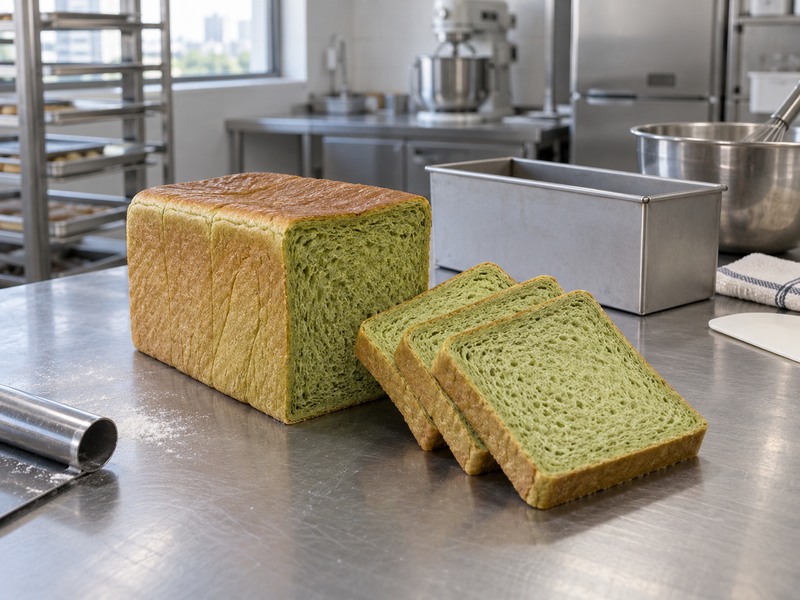
Start at the cut face. Matcha must be visible and taste present after baking, but the loaf cannot lose its plain milk-bread character. Use one approved slice beside candidate loaves to compare crumb uniformity, edge color, aroma, and flexibility. A bright unbaked dough is a weak purchasing test because baking and storage change the result. Record the actual pan, lid, and slice format before asking suppliers for samples.
The site’s general matcha bread guide covers a broader category. This brief concerns the narrower milk-bread production decision.
2. Which finished-loaf targets should the team set?
Write a specification that staff can inspect
Define loaf mass, pan dimensions, target height, crust color, crumb cell pattern, slice thickness, and the number of accepted slices. Add sensory checks at the intended eating temperature. A bakery that sells toast may accept a darker crust than a fruit-sandwich maker who removes it. Both still need a consistent green interior. Use photographs of approved slices under one lighting condition; an uncalibrated phone image is useful for communication but cannot replace the physical standard.
Separate appearance from function. A loaf can have an even color and still compress under a slicer blade. Check whether slices spring back, whether the crumb clings to a knife, and whether a filled sandwich holds without tearing. Set an allowable range only after repeated pilot runs, not after one chef-made loaf. Technical staff should also define the applicable allergen, microbiological, and shelf-life controls for the actual formula.
| Target | How to observe it | Why it matters |
|---|---|---|
| Square profile | Compare cooled loaf to pan standard | Stable pack and slice size |
| Crumb softness | Compression and handling trial | Sandwich assembly |
| Tea flavor | Blind tasting at sale condition | Dose approval |
| Slice integrity | Count accepted machine-cut slices | Saleable yield |
Keep the standard tied to a lot and method. If the flour or matcha changes, the same standard is the basis for reapproval.
3. How should matcha be screened in the dough?
Compare powder in the finished bread
Request traceable samples with an ingredient declaration, lot code, sensory description, and available analytical documents. Then test each powder in one locked dough formula. Matcha that tastes balanced in water can change after mixing with milk, fat, sugar, and flour. Baking can mute aroma and shift green toward olive. Evaluate the cooled inner crumb and a toasted slice; those are different experiences and should be scored separately.
Hold other variables still. Use the same flour lot, batch size, pan, dough temperature, proof endpoint, and oven profile. Record matcha mass as a proportion of total dough or flour, with the denominator stated. A series of trial doses can identify the lowest level that meets the approved tea target. These are local trial starting points, not a universal recipe or a supplier claim. If powder clumps, compare a dry preblend against a controlled wet dispersion without changing dose at the same time.
| Candidate check | Dry powder | Finished loaf |
|---|---|---|
| Color | Receiving comparison | Cut crumb after cooling |
| Aroma | Open-pack sniff | Slice and toast tasting |
| Dispersibility | Small mixing test | Streaks in full loaf |
| Cost | Price per kilogram | Cost at approved dose |
The matcha powder for baking guide offers a broader ingredient starting point. The loaf trial decides suitability here.
4. What does a cooked flour paste change?
Treat tangzhong as one process option
Many milk-bread formulas use a cooked flour-and-liquid paste, often called tangzhong, to manage softness and moisture. It changes the dough’s water distribution and the timing of ingredient addition. The reference Matcha Shokupan recipe places matcha in that paste; this is a useful idea to test, not proof that every commercial line should do so. A bakery may have an existing soft-bread method that needs no paste step.
Price the handling step. A paste requires heating, cooling, transfer, cleaning, and a controlled hold time. If the line already has a cooked-flour system, matcha can be compared in the paste and in the dry blend. If not, calculate whether a softer slice justifies extra labor and equipment use. Keep total water and tea dose constant during the comparison. Otherwise a wetter loaf may look like a matcha-dispersion benefit when the change came from hydration.
Judge each path after cooling, slicing, and normal storage. Texture on the day of baking alone is an incomplete result.
5. How can mixing and proofing be controlled?
Record the dough path
Enriched bread is sensitive to dough temperature, mixing energy, ingredient order, and proof endpoint. Matcha adds fine dry material and may alter how the operator judges dough development by sight. Write down batch mass, mixer speed and time, dough temperature, and rest duration. Compare the same observations with an approved plain milk-bread control. A change in loaf volume may come from mixing or yeast management rather than from the tea.
Use measurable endpoints. Track dough temperature after mixing, piece weight at the divider, seam position, and dough height in the pan before baking. Do not borrow a home recipe’s clock time for a warm bakery or a chilled production room. The King Arthur Baking milk-bread example shows another product format, but its home method is not a line setting. Have regular operators perform repeated runs so the method is not dependent on one developer’s touch.
| Stage | Record | Failure it helps diagnose |
|---|---|---|
| Mix | Time, speed, dough temperature | Tight or torn crumb |
| Divide | Piece mass | Uneven loaf height |
| Proof | Pan fill and elapsed time | Collapse or poor volume |
| Bake | Oven zone and core check | Pale side or wet crumb |
Keep any change to one stage at a time. A useful pilot sheet makes later supplier comparisons much easier.
6. Why do square loaves shrink or collapse?
Follow the geometry through cooling
A square top can leave the oven looking correct and sink as steam escapes. Possible causes include insufficient structure, underbaking, excess proof, too much dough in the pan, or rough release. A lidded pan also hides the upper surface while the loaf bakes. Compare the sidewall immediately after de-panning and after full cooling, then cut the center slice to inspect crumb set. Do not assume matcha caused a fault seen in the plain control.
Inspect the corners. If one corner is dense, check shaping and dough placement. If the entire side caves inward, compare proof height, bake completion, and cooling airflow. Record pan coating and lid fit; inconsistent release can distort the loaf before it reaches the slicer. A bakery may choose a round-top loaf if a square profile adds loss without improving the intended product. That decision belongs in the commercial brief, not as an emergency workaround after launch.
| Observed defect | First process check | Controlled comparison |
|---|---|---|
| Sidewall cave | Bake completion and proof | Hold dough, vary one endpoint |
| Dense corner | Shaping and pan loading | Compare operator technique |
| Stuck top | Lid and release | Approved pan treatment |
Use accepted cooled loaves as the yield denominator. Oven appearance is only an intermediate inspection.
7. What should a slicing trial measure?
Test with normal production equipment
Machine slicing can expose defects hidden in a hand-cut sample. Set a cooling interval and loaf core condition before slicing, then use the planned blade and speed. Count torn slices, compressed slices, irregular end pieces, and crumbs lost. A soft loaf may need a longer set time; a dried-out loaf may be neat on the blade but unpleasant to eat. Judge both slicer performance and consumer texture.
Measure the accepted unit. If a retail pack promises eight equal slices, count how many full packs each loaf produces. Include rejected ends and operator handling loss. For fruit sandwiches, assemble the slice with the real filling and hold it through the intended service period. Toast bread under the café’s normal equipment, since browning can alter tea flavor. A single fresh center slice cannot stand in for all these uses.
Use the same sliced-loaf standard when assessing future matcha lots. That protects the decision from changing with each baker’s knife technique.
8. How should the loaf be packed and held?
Validate the real route to sale
Warm bread packed too early can create condensation; long exposure before packing can dry the crumb. Choose a cooling and bagging sequence based on the bakery’s own environment and package. Compare appearance and texture after the actual distribution route, including stacking and retail display. A matched pair of loaves packed under different conditions can reveal whether the problem is moisture, mechanical damage, or tea color change.
Keep shelf life evidence separate. A pleasant tasting at one time point does not establish a safe or acceptable sale period. Qualified technical staff must validate the formula, packaging, storage conditions, and any microbiological plan. The ingredient list and allergen declaration must match the approved recipe. If the loaf is sold as a product with an origin or organic claim, the supporting supplier documents belong in the artwork file before labels are printed.
| Pack concern | Observable signal | Owner |
|---|---|---|
| Condensation | Moist bag and softened crust | Process and quality |
| Crumb drying | Stiff edge at sale | Packaging team |
| Color shift | Duller cut face | R&D and retail |
| Label accuracy | Formula-to-artwork match | Regulatory review |
Treat pack choice as part of the loaf design. It affects the product a buyer actually receives.
9. How do yield and tea cost affect sourcing?
Price the saleable slice
Powder price per kilogram is a weak final comparison. Calculate tea mass at the accepted dose, then add mixing, pan, bake, cooling, slicing, packaging, and rejected-loaf costs. Divide by saleable slices or packs, not theoretical loaf cuts. A powder with a higher purchase price may cost less per accepted pack if a lower dose reaches the flavor target or if it creates fewer streaked loaves. That outcome must be measured on the same line.
Keep the model honest. Put freight and currency assumptions in separate cells from measured production losses. Compare at least two traceable powder lots so a one-off good sample does not become the specification. If a supplier proposes a different matcha grade, run it through the existing finished-loaf test rather than choosing by grade name. Procurement can negotiate supply and change-notice terms once R&D has a repeatable target.
| Cost input | Unit to record | Why it changes the answer |
|---|---|---|
| Matcha dose | Mass per accepted loaf | Ingredient use |
| Line loss | Rejected loaves per batch | True yield |
| Slice loss | Accepted packs per loaf | Selling unit |
| Pack and labor | Cost per accepted pack | Channel margin |
Keep the cost sheet with the sensory and defect records. A cheap loaf that cannot be sold is not a saving.
10. When is the formula ready for a line trial?
Hand one method to the plant
The approved file should contain the finished-loaf standard, ingredient lots and specifications, formula by mass, mixing and proof endpoints, pan and oven settings, slicing conditions, pack, and change-control route. R&D should sign off flavor and texture; production should confirm the normal crew can repeat the method; quality should approve safety and label controls; procurement should confirm supply terms. These are linked decisions. A hand-made loaf cannot substitute for a normal shift run.
Run the handoff test. Give the written method to an operator who did not develop it. Observe several consecutive batches and record rejected loaves by defect. Recheck one replacement tea lot with the same method. If the loaf still meets the agreed target and the accepted-pack cost works, the project is ready for a controlled launch trial. For another perspective on home-scale loaf geometry, read the Sift & Simmer shokupan article.
Reference: Matcha Shokupan (Japanese Milk Bread). The recipe supplied topic context; the commercial tests here are original.
FAQ
Q1: Is matcha milk bread the same as ordinary matcha bread?
It is a narrower soft-loaf application with specific crumb, pan, and slicing requirements.
Q2: Must a bakery use tangzhong?
No. Compare it with the plant’s current soft-bread method under matched formula conditions.
Q3: Can powder color predict the loaf color?
No. Approve color on the cooled, cut loaf after the intended hold.
Q4: What is the best cost denominator?
Use the accepted slices or packs produced by a normal line run.
Q5: Can a home recipe establish commercial shelf life?
No. Qualified staff must validate the specific formula, pack, and storage route.