
Matcha powder for baking is tea selected for how it performs in a finished baked product, not for how bright it looks in the tin. Oven heat, dough color, sugar and fat all change the result. A powder that tastes refined as a whisked drink can disappear in a cookie; another can survive baking but leave a rough finish. Kirbie’s Cravings’ guide to the best matcha powder for baking argues for a vivid powder in home recipes. A bakery buyer should test candidate powders in its own product and use the outcome, rather than a grade name, to set the specification.
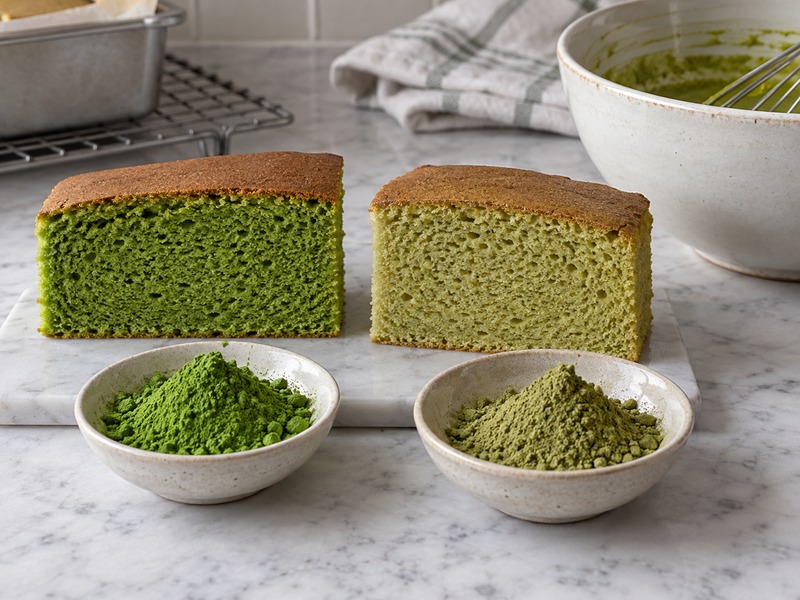
For: bakery developers, ingredient buyers, café teams and private-label brands. Decision: which tea lot delivers acceptable flavor and appearance after the full bake and sale period.
1. What does the baked product need from matcha?
Choose the lead application
A pale sponge, brown cookie, enriched bread and white-chocolate filling expose tea differently. Start with the product that matters commercially and define its intended taste, color, texture and price. A cake may need a clear green interior, while a brown cookie may succeed with a strong tea note despite a muted shade. Do not qualify one powder for every recipe after a single tea-bowl tasting. Each application has a different matrix and heat route.
Describe the accepted bite. Set a plain-language standard for tea aroma, bitterness, color at the cut face and any powdery texture. Taste at the actual sale temperature, immediately after cooling and near the proposed end of sale. A matcha claim should be perceptible in the finished item. If the tea exists only as a green spot in the batter, the product brief needs revision.
| Application | What matcha must survive | Primary check |
|---|---|---|
| Sponge cake | Heat and pale crumb | Cut-face color |
| Cookie | Browning and butter | Tea after bake |
| Bread | Long process and crust | Interior flavor |
| Filling | Sweetness and fat | Tea clarity |
2. How should powders be screened before baking?
Compare identified samples
Request food-grade matcha samples with product names and lot numbers. Inspect dry aroma, color, clumping and pack condition, then prepare an equal-dose plain tea sample to identify obvious defects. This first check can eliminate a stale or unpleasant candidate, but it should not decide the purchase. A tea that is lovely in water may be too quiet in a sweet batter. Move the plausible candidates into the same base recipe as quickly as possible.
Keep conditions equal. Weigh the powder and other ingredients; use the same mixing order, pan size and oven position. Code the samples for blind tasting. If two teas produce different dough behavior, record it rather than correcting one batch silently. The comparison should reveal a powder’s practical effect on the product, not the baker’s improvisation.
3. Are grade labels enough to choose a powder?
Treat them as supplier language
“Ceremonial,” “premium” and “culinary” can help a seller describe intended use, but they are not a universal bakery performance standard. The cited home-baking article favors a vivid tea it calls ceremonial for color retention. That is a useful trial hypothesis, not a rule for every oven and recipe. Compare powders at equal dose, then compare them again at the dose each needs to meet the finished-product target. A less expensive tea may win in a deeply flavored cookie, while a brighter tea may justify its cost in a pale cake.
Ask for measurable evidence. A supplier specification, identified lot, storage guidance, pack size and required food-safety documents matter more than a grade word alone. Keep retained samples and an approved baked reference. If a supplier changes a tea within the same marketing grade, the bakery still needs a confirmation bake.
| Supplier claim | What to verify | Baker’s decision |
|---|---|---|
| “Ceremonial” | Actual lot in the recipe | Does color survive? |
| “Culinary” | Flavor after baking | Is tea clear? |
| “Bright green” | Cut product after hold | Is appearance stable? |
4. How should matcha be mixed into batter or dough?
Prevent streaks without overmixing
Matcha can compact into clumps. A dry preblend with flour or sugar may distribute it more evenly; sifting can help where powder arrives lumpy. A liquid dispersion may suit some batters but changes water balance and may be awkward in low-moisture dough. Choose a route compatible with the recipe, and include any liquid in the formulation total. Record mixer, addition point, speed and time. Inspect the bottom of the bowl and the last filled pan.
Protect the original structure. More mixing can eliminate spots but alter gluten development or aeration. If a cake becomes dense after matcha is added, check mixing and solids balance before blaming tea quality. If a cookie shows dark islands, change preblending before increasing dose. A uniform green raw batter is useful evidence, but the finished crumb is the real standard.
5. What dose gives flavor without a rough finish?
Run a measured ladder
Set several trial levels as grams of matcha per kilogram of flour or finished batter, and state which denominator is used. Keep pan, bake and sweetener constant. Taste blind after cooling. Record when matcha first becomes recognizable, when bitterness appears, and whether the powder changes dryness or mouthfeel. A surface dusting can intensify the first bite but may fall off in the pack; evaluate it separately from tea in the product.
Cost the accepted dose. A low price per kilogram is not a saving if the formula needs substantially more powder. Calculate grams per sellable unit after trim and rejects. Consider the contribution of glazes, chocolate or fruit. A tea dose that works in plain cake may be buried once the finished product is assembled. Select the level using the sold item.
| Trial result | Question | Next step |
|---|---|---|
| Green but flavorless | Is dose too low or base masking? | Taste plain crumb |
| Bitter and dry | Is tea load high? | Compare powder or dose |
| Flavor fades under topping | Is topping dominant? | Reformulate assembly |
6. How should color be assessed after heat?
Check interior and surface
The top of a baked item can brown even when the interior stays green. Slice the product after a standard cooling interval and photograph under fixed light. Compare the crust, center and edge. Repeat after the proposed sale hold and in the planned package. A supplier’s powder photo is not a promise that cake will remain bright. Oven temperature, time, batter acidity and base color can all affect perception.
Avoid adding tea merely for color. A larger dose may deepen green but make the product bitter or expensive. First inspect the bake route, ingredient balance and tea lot. If a vivid visual is central to the product, use a recipe and pack that support it. Marketing photography should show the normal sale item rather than an unusually green pilot chosen from one pan.
7. Does matcha affect texture and yield?
Look beyond flavor
Tea powder adds dry solids. At a modest dose it may have little visible effect; at a higher dose it can change batter flow, cookie spread or crumb perception. Measure pan fill, baked height, spread, moisture impression and yield beside a control without matcha. If the product becomes dry, change one variable at a time. More liquid may help in one formula and weaken structure in another. A direct spoon-for-spoon swap between grades is not a validated bakery adjustment.
Count rejects. Dark flecks, uneven color and broken pieces add cost. Record their frequency in early, middle and late production. If one matcha needs more mixing and increases process time, include that in supplier comparison. Texture and line behavior can outweigh a small difference in dry-powder aroma.
| Product defect | First variable to inspect | Evidence |
|---|---|---|
| Streaks | Dry preblend and mixing | Cut-face photo |
| Dense crumb | Batter handling | Control comparison |
| Dry finish | Tea dose and bake | Blind tasting |
| High reject rate | Dispersion and fill | Pilot log |
8. What should be checked during holding and packaging?
Test the real sale period
Store finished products in their intended wrap, box or display case. Inspect tea aroma, color, moisture, surface and topping after realistic holding. A cookie can lose its tea note under butter oxidation; a cake can dry out and make bitterness more obvious. Test the opened product, not only the sealed pack. Different pack materials may protect moisture while increasing condensation or smearing a glaze.
Separate safety from appearance. Shelf-life decisions need the applicable product-specific food-safety work. A green crumb after several days does not prove a cake is safe to sell. Conversely, a safe product may no longer meet sensory standards. Set both requirements. If the bakery freezes stock, include freeze–thaw and display tests before approving the powder.
9. How should the supplier be compared?
Buy the baked result
Ask each candidate supplier for lot traceability, specifications, pack sizes, lead time, minimum order and change notification. Keep a controlled standard bake for incoming tea. Compare cost per accepted finished unit, including matcha dose, process waste and rejects. A smaller sealed pack may cost more per kilogram but protect quality in a bakery that uses little matcha each week. Choose a pack the business can handle according to supplier guidance.
Check claims separately. Origin, organic and other claims require suitable documents for the selling market. A high price or a “ceremonial” label does not establish those facts. Avoid attributing health effects to a sugary baked product because it contains tea. A precise description of flavor and appearance will usually serve the customer better.
| Supplier factor | Record | Consequence in the bakery |
|---|---|---|
| Lot change | Notice and new sample | Confirmation bake |
| Pack size | Usage time after opening | Aroma and waste |
| Dose | Grams per sellable item | True tea cost |
| Process loss | Failed or trimmed units | Margin |
Prepare the cost comparison from a real pilot yield. If a cake tray produces fewer saleable slices than expected, allocate the full tea cost across those slices. If a powder retains color but creates more speckled rejects, its price advantage disappears quickly. For a second supplier, request enough material to run the normal mixing and baking process rather than a tiny bowl demonstration. Purchasing should see the same held, packed product that the bakery team judged, because a supplier can meet a dry-powder specification while still missing the intended eating standard.
10. What pilot is enough for release?
Bake on the intended line
Use the final formula, tea lot, mixer, oven, pan and pack. Take samples from first and last batches or pans. Measure color, height or spread, flavor, texture, yield and rejects. Taste after cooling and after the proposed sale hold. Ask several tasters to evaluate coded samples without knowing which powder is more expensive. Document the powder and dose that meet the agreed standard.
Write the control sheet. Record matcha product and lot, mass per batch, preblend method, bake route, acceptable color and flavor, pack and retest triggers. A new flour, tea lot or oven program can change results. The next useful action is a small line pilot with two tea candidates and the actual sold product. It answers the specific buying question directly and clearly.
Reference: The Best Matcha Powder for Baking Plus 20 Matcha Recipes is a consumer baking reference. This buyer framework is independent and uses finished-product trials rather than a universal grade ranking.
FAQ
Q1: Is ceremonial matcha always best for baking? No. Compare identified powders in the specific baked product at the accepted dose and cost.
Q2: Why does a cake brown on top? Oven heat and the base recipe affect the surface; inspect the interior and the product after holding.
Q3: Can matcha be added without changing the recipe? Small trials may work, but measure changes in batter, bake, texture and yield.
Q4: How should a buyer compare price? Use cost per sellable baked unit at the dose that meets the flavor and appearance standard.
Q5: Can one approved tea cover every bakery product? It may, but each product needs its own dose and process validation.