
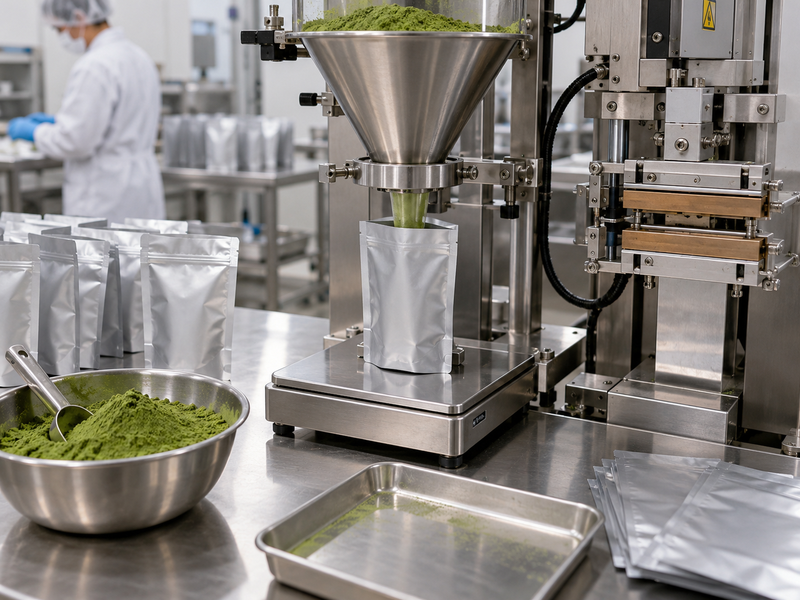
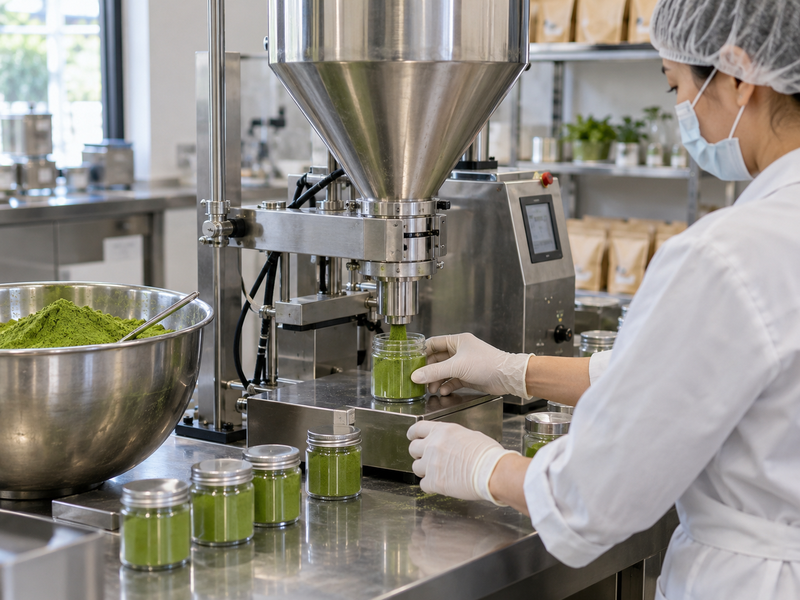
A filler that handles coarse seasoning powder may struggle with fine matcha. The auger can bridge, a pouch seal can collect dust, and the nominal speed on a quotation may disappear during cleaning. Matcha filling machine selection should begin with the powder and pack the business will actually sell. Give vendors the target fill range, packaging material, expected changeovers and acceptance checks, then run a witnessed trial. Acepack’s machine-selection article introduces equipment options; the buyer still needs data from their own product and line conditions.
Contents
- 1. What must matcha filling machine selection cover?
- 2. How does matcha powder behavior affect dosing?
- 3. Which filling method deserves a trial?
- 4. How should fill-weight performance be measured?
- 5. What can go wrong at the pouch seal?
- 6. How should the buyer test usable speed?
- 7. What cleaning and changeover work is required?
- 8. Which controls and records should the line provide?
- 9. How should a factory acceptance trial be written?
- 10. What belongs in the final purchase decision?
1. What must matcha filling machine selection cover?
Define the selling unit first
Write down every product and pack the line must handle. A single-serve stick, a 30 g tin, a 100 g pouch and a bulk bag have different dosing, handling and sealing problems. Identify the minimum and maximum declared weights, pack opening, liner material, closure and expected run length. A machine may be suitable for one format and need expensive change parts for another. Ask the vendor to quote those parts explicitly, including hopper, auger, forming set and sealing jaws where applicable.
Separate a confirmed launch product from possible future formats. The first purchase decision should be evaluated against committed volume; “it might fill every package later” is hard to verify. Obtain sample packs made from intended commercial material, not generic demonstration film. If the seller suggests a substitute film, record it as an untested change. Buyers working on the site’s powder packaging options can use those pack choices to build a machine brief. Include the space and utilities available at the actual plant. A nominally compact unit can require extra room for bag feeding, dust extraction, checkweighing and operator access.
| Requirement | Buyer entry | Trial evidence |
|---|---|---|
| Product | Exact matcha or blend lot | Same powder in vendor test |
| Fill range | Each declared net weight | Measured sample distribution |
| Pack | Material and opening size | Commercial pack samples |
| Run length | Planned units per changeover | Timed run and downtime log |
| Site | Utilities and available footprint | Layout and installation drawing |
2. How does matcha powder behavior affect dosing?
Observe the powder before choosing hardware
Fine powder can form arches above an outlet, cling to metal, become airborne at a drop point or change flow as the hopper level falls. Matcha lots and blends do not behave identically. A sweetened latte mix may contain larger particles or different moisture and bulk density than plain tea. Tell the vendor which variants the line must run, and send enough material for the full trial, including start-up and cleanout. A tiny jar of powder cannot demonstrate a long run.
Ask the technician to show the hopper at both full and low levels. Watch for rat-holing, sudden surges, powder stuck to the walls and product collecting where it cannot be recovered cleanly. Record room temperature and humidity during the test because those conditions may alter handling. Do not assume a supplier’s powder specification predicts dosing by itself; the combination of powder, hopper geometry, agitation and auger matters. If a flow aid or vibration is proposed, test whether it changes dust, segregation or appearance. Keep a sample of the accepted powder beside the trial record so later procurement knows what the machine was qualified to handle.
3. Which filling method deserves a trial?
Match the mechanism to the dose
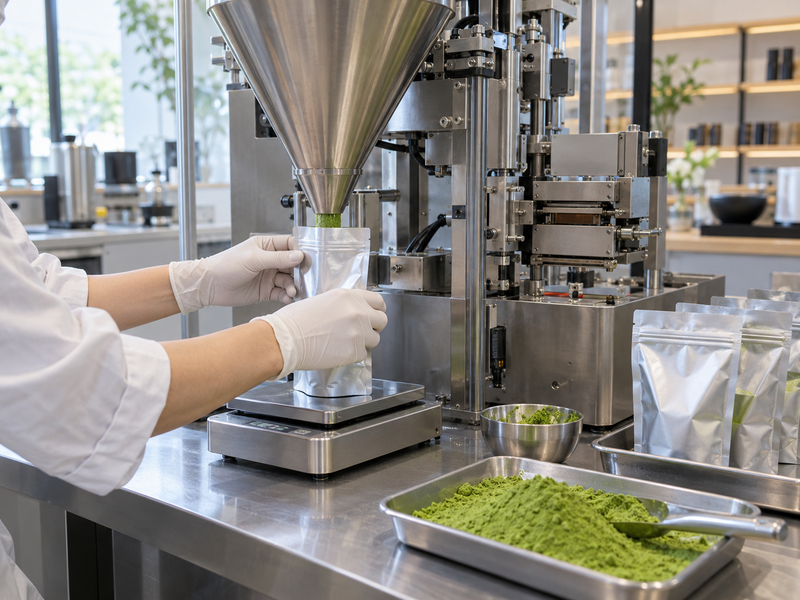
Auger fillers meter powder by screw rotation and are common in fine-powder applications. Gravimetric systems use a weight signal to control the deposit, while volumetric cup systems suit some free-flowing products. No mechanism is automatically best for every matcha format. Request a short explanation of how the proposed machine handles a partially empty hopper, powder that compacts, and a changed pack size. Ask what can be adjusted by operators and which adjustments need a trained technician.
Run at least two candidate mechanisms when capital and supplier access allow it. Use the same matcha lot and pack so the comparison is fair. Observe not only average fill weight but rejects, product left in the machine, dust and the time required to reach stable operation. If the vendor claims high precision, ask for the test conditions and raw weight series. A polished sample pouch proves that the machine can make a pouch once; it does not show its distribution across a production run. For a business selling premium small packs, loss from overfill can be material even when every unit is legal. The buyer should calculate that cost using the actual ingredient price.
| Method | Trial question | Watch for |
|---|---|---|
| Auger | Does dose shift as hopper empties? | Bridging and screw buildup |
| Gravimetric | Does feedback settle quickly? | Slow cycle or unstable readings |
| Volumetric cup | Does density vary by lot? | Weight drift at fixed cup volume |
| Manual assisted | Is operator control repeatable? | Labor and inconsistent tare |
4. How should fill-weight performance be measured?
Keep the raw series, not only the average
Define a sampling plan before the vendor trial: start-up units, steady-run units, low-hopper units and units after a stop and restart. Weigh the filled pack with a calibrated check scale, account for tare, and retain individual readings. Averages hide underfilled packs and excess giveaway. Plot the series in run order; a slow decline may reveal hopper-level drift that a single standard deviation conceals. Repeat with another matcha lot or blend when its flow differs materially.
Legal quantity requirements depend on the selling market. For U.S. packaged goods, NIST Handbook 133 explains methods for checking net contents. Use the current local rules and a qualified metrology or quality colleague to set acceptance limits; do not copy a tolerance from a vendor brochure. The trial can use an illustrative internal goal, such as a specified maximum spread or reject rate, but identify it as a buyer target rather than a universal standard. Check the scale used for verification before and after the run, and record any drift. If readings fail, preserve the data and investigate rather than adjusting the report to make the average look attractive.
5. What can go wrong at the pouch seal?
Inspect the seal as a separate operation
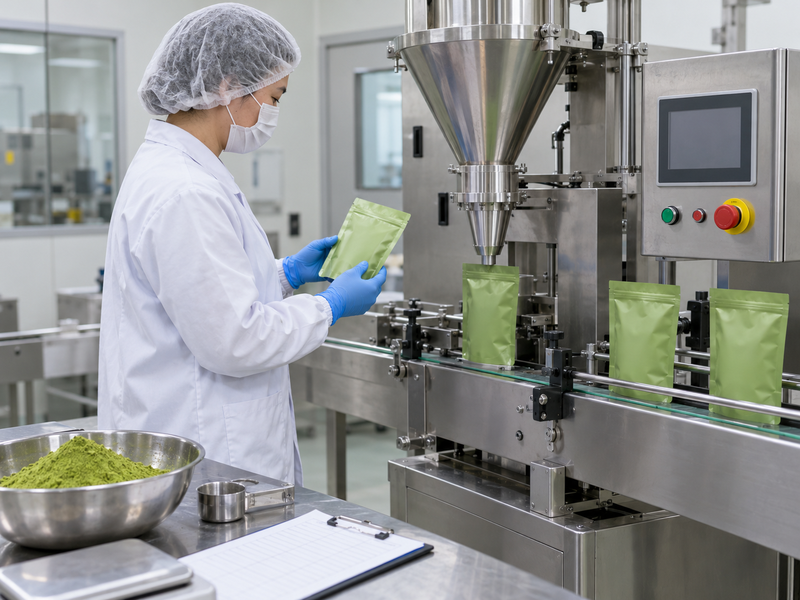
Matcha dust can settle on the inner faces of a pouch during dosing. Heat and pressure may then close the film around powder rather than creating the intended bond. A pouch may look closed while it leaks during handling or transport. Watch how far the fill nozzle enters the pack and how the machine controls dust between dose and seal. Request samples from start-up, steady operation and after a stop, when powder can collect near the jaws.
Use a packaging specialist to choose appropriate integrity tests for the material and closure. For an initial comparison, examine seal width, continuity, contamination, wrinkles and damage after a modest handling trial. Record jaw temperature, pressure, dwell time and film lot for each sample. The selected conditions need validation on the actual commercial package; a visual pass alone is insufficient for claims about shelf life or oxygen protection. Discuss the site’s nitrogen-flushed matcha packaging only if that feature is truly part of the proposed line. Gas flushing changes the test plan, utilities and pack materials; it is not a decorative option on a quotation.
| Seal observation | Possible cause to investigate | Trial record |
|---|---|---|
| Green powder in seam | Dust at fill or transfer | Nozzle position and dust control |
| Wrinkled film | Pack tracking or jaw alignment | Film lot and machine setting |
| Variable seal width | Pack presentation | Samples across run |
| Leak after handling | Incomplete bond or damage | Test method and failure location |
6. How should the buyer test usable speed?
Time the complete saleable run
Machine brochures often quote cycles per minute under favorable conditions. Buyers need saleable units per hour after start-up, weighing, rejected packs, film splices and routine stops. Define the trial window before starting. Count accepted finished packs; count rejects separately; log the reason and duration for every stop. A 20-minute demonstration may miss the problems that appear after the hopper empties or the seal jaw accumulates powder.
Run the format that is hardest for the intended business, perhaps the smallest dose or the narrowest stick pack. Include one ordinary intervention, such as replenishing powder or changing a film roll, and time it without skipping safety procedures. Calculate usable output as accepted units divided by the observed time. Then compare it with forecast demand and shift hours, allowing for cleaning and planned maintenance. This is an internal capacity exercise, not a machine’s rated maximum. If the result leaves little headroom, a slower but easier-to-clean line might still be better for short runs. Record labor too: one operator on the machine plus another feeding packs is a different cost from a truly single-operator line.
7. What cleaning and changeover work is required?
Ask to see the machine opened
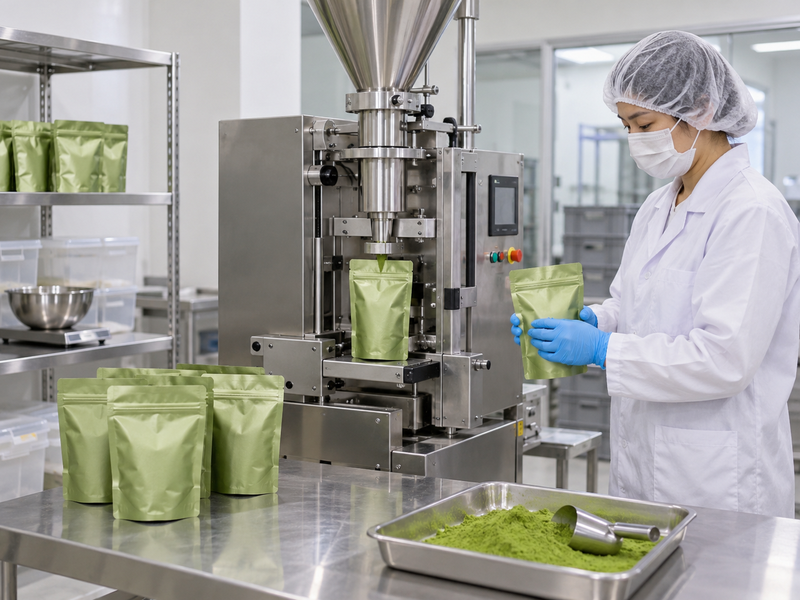
A machine quote should include a cleaning demonstration with the material used in the fill trial. Have the technician empty, disassemble, clean, inspect and reassemble the product-contact path while your team times the work. Look behind auger flights, in the hopper throat, around the nozzle and at seals or gaskets. Note which parts need tools and which are likely to be damaged or lost during frequent changeovers. Request written instructions and a spare-parts list before purchase.
If the line will handle plain matcha and dairy or nut-containing blends, involve the allergen-control lead. The FDA’s food preventive-control guidance treats documented cleaning and verification as parts of an allergen program. A vendor’s generic “easy clean” claim does not show that the site can control its own recipe sequence. Test a real changeover, with the previous product and next product identified, and document the release check. For other lines, evaluate tea-color carryover, moisture after washing and the amount of powder lost at cleanout. A clever quick-release design is valuable only if staff can use and inspect it consistently.
| Cleanout measure | What to capture | Buying consequence |
|---|---|---|
| Disassembly time | Start to exposed contact parts | Planned downtime |
| Product recovered | Grams before discard | Ingredient loss |
| Inspection access | Hidden or inaccessible points | Control burden |
| Reassembly check | Parts and settings confirmed | Restart risk |
| Spare availability | Lead time and cost | Maintenance budget |
8. Which controls and records should the line provide?
Follow a pouch back to its settings
At minimum, an operator should be able to identify the product recipe, target fill, pack format, lot and machine setting used for a run. Ask whether recipe changes are password-controlled, how alarms are stored, and whether the system records actual weight or only an auger count. Check if a downstream checkweigher can reject outliers and retain a useful log. The site must still define who reviews that log and how a rejected pack is handled.
The interface should make errors hard to miss. Test an intentional wrong-film or wrong-recipe setup during the vendor acceptance run if safe and supported. Observe what the machine displays and whether it prevents a saleable pack. A touchscreen full of features can slow a busy operator if each change requires obscure menus. Request a sample data export before signing. Confirm how backup and restore work if the controller fails. Keep the required records proportionate to the operation: a small maker may need a clear paper sheet and checked scale; a high-volume line may need electronic traceability integrated with its quality system.
9. How should a factory acceptance trial be written?
Agree on passes before the machine arrives
Write a factory acceptance test with the vendor before building or shipping the equipment. It should name the exact product lots, pack materials, fill range, number of units, sampling points, capacity measurement, seal checks, changeover task and documents to be delivered. Distinguish a demonstration from a contractual acceptance test. The buyer should be present or receive unedited run data and samples with traceable labels. If a criterion fails, document the remedy and retest condition.
Separate factory acceptance from site acceptance. The machine may run well in the vendor’s room but face different utilities, humidity, film handling and upstream feed at the buyer’s facility. A site test should repeat the critical performance checks after installation and operator training. The FDA explains that food-contact materials must comply with applicable authorizations for their intended use; request documentation for product-contact components and packaging materials relevant to the market. Do not claim broad “FDA approval” for an entire machine without a specific basis.
| Acceptance item | Pre-agreed method | Retain |
|---|---|---|
| Fill weight | Samples across run phases | Individual weights and tare |
| Saleable speed | Timed accepted output | Stop and reject log |
| Seal quality | Agreed test on actual film | Labeled samples and results |
| Changeover | Full strip-down and restart | Timing and inspection sheet |
| Documentation | Review against purchase scope | Manuals and component list |
10. What belongs in the final purchase decision?
Compare operating cost with test evidence
Put three figures beside the purchase price: saleable output at the tested settings, product lost to giveaway and cleanout, and labor time per changeover. Add the cost of spare parts, compressed air, extraction, service visits and operator training. A lower quoted price can lose its advantage if the line needs long cleaning stops or a second worker to rescue dusty seals. Use a simple annual scenario based on the company’s forecast, and show assumptions separately from measured trial data.
Confirm warranty scope, support response, spare-part location and who owns the machine settings and data. Record every accepted deviation from the original specification in the purchase order, including what will be tested at site acceptance. If one model has no successful run on the actual matcha and package, score it as unproven rather than treating the vendor’s rating as equal evidence. The best selection is the machine the team can operate, clean, verify and repair while producing compliant packs at the required rate. Preserve the trial samples and raw logs so a later expansion decision starts from observed performance.
FAQ
Q1: Is an auger filler always best for matcha? No. It is a common candidate for fine powders, but the buyer should compare fill variation, dust, cleaning and output with the actual product.
Q2: How many samples should a vendor run? Agree on a meaningful start-up, steady and low-hopper series before the trial. The number should support the buyer’s acceptance plan.
Q3: Can a fast machine compensate for overfill? Only a costed trial can answer that. Calculate saleable output and ingredient giveaway together.
Q4: What causes matcha to contaminate pouch seals? Dust at the nozzle or transfer point can settle in the seal area; inspect samples across the run and test the actual film.
Q5: Should site acceptance repeat factory tests? Yes. Repeat critical fill, seal and output checks under the buyer’s installation conditions.