
Matcha caramel combines green tea powder with a chewy cooked sugar and dairy base, then sets into pieces for cutting and wrapping. For confectionery buyers, the challenge is repeatable texture alongside recognizable tea flavor. Small, recorded candy trials help separate powder selection, cooking variation and packaging problems before a larger production order.
Contents
- 1. What should a matcha caramel candy specification describe?
- 2. How should a buyer choose the tea powder?
- 3. How can a team plan useful formula trials?
- 4. When should matcha enter the caramel mixture?
- 5. How should the cooking endpoint be controlled?
- 6. How can a producer set an even slab?
- 7. How should the slab be cut into consistent pieces?
- 8. What should an individual wrapper trial check?
- 9. How should saleable candy cost be calculated?
- 10. What belongs in a supplier development brief?
1. What should a matcha caramel candy specification describe?
Define the piece customers will unwrap
Start with shape, target weight and the intended eating temperature. A wrapped cafe counter sweet may need a different chew from a confection sold through chilled distribution. Describe how the piece should bend, bite and release from its wrapper under the proposed selling conditions. A photograph alone cannot communicate these requirements.
Set a flavor target that includes caramel, dairy and tea. Tasters should identify whether honey, vanilla or salt will be part of the formula. Those ingredients can change how they perceive the tea, so keep their quantities on the same development sheet. Avoid approving the powder in water and assuming it will perform identically after cooking.
Plan a realistic color reference. A brown caramel base containing green powder can produce muted olive tones. Approve photographs of the actual pilot candy without increasing saturation to resemble uncooked matcha. Buyers can then compare later samples against a product the factory can reproduce.
For a wider overview of formats, consult the Matcha Village candy guide. Keep the specification for these chewy, individually wrapped pieces separate from any other confection under development.
2. How should a buyer choose the tea powder?
Compare cooked samples from the same base
Ask for powders intended for confectionery evaluation and confirm whether each sample contains only matcha or includes sugar and other ingredients. Matcha caramel needs a powder that disperses acceptably and leaves a pleasant tea finish after the sweet base. Grade names help identify a supplier’s range, but they cannot replace tasting the finished piece.
| Sample check | What to record | Why the record helps |
|---|---|---|
| Product identity | Code, lot and ingredient list | Connects the trial with a purchase |
| Dispersion | Clumps or green specks in the cut face | Separates mixing from flavor problems |
| Finished flavor | Tea intensity and drying finish | Supports a specific supplier request |
| Cooked appearance | Color under consistent lighting | Avoids judging dry powder alone |
Use one base formula, one powder dose and one cooking process for the initial comparison. Cut equal pieces from the same position in each slab. Let tasters record notes before seeing product names or prices. An expensive sample should earn approval through the finished candy rather than its description.
Retain the powder information and batch sheet with the tasting result. When a later shipment changes the chew or aroma, that record gives the team a starting point for checking ingredients and production conditions.
3. How can a team plan useful formula trials?
Change tea dose before changing the whole candy
Begin with a caramel base your production team already understands, or have a qualified confectionery developer establish one. Record sugar, glucose syrup or honey, dairy, fat and any flavoring by weight. A change in syrup type or dairy composition needs its own evaluation because several formula properties may change together.
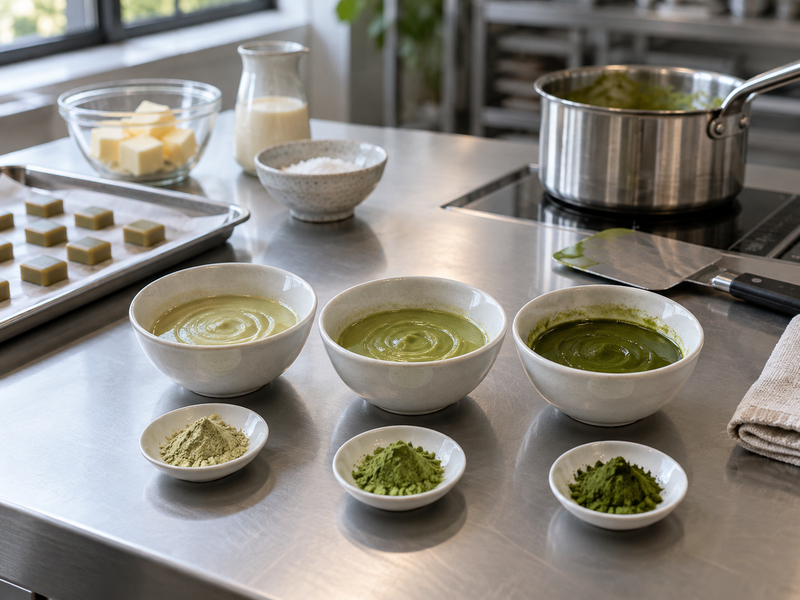
The proposed matcha caramel trial below expresses tea dose against the base’s ingredient weight before cooking. For each sample, use 1,000 g of the same base ingredients and add the listed matcha. These are development amounts, not validated recipes or recommended commercial inclusion levels.
| Trial | Base before cooking | Added matcha | Question to answer |
|---|---|---|---|
| A | 1,000 g | 5 g | Is tea recognizable after sweetness? |
| B | 1,000 g | 10 g | Does the finish remain pleasant? |
| C | 1,000 g | 15 g | Does stronger flavor introduce defects? |
Measure cooked yield for every batch. Water lost during cooking means the pre-cook dose ratio differs from the percentage in finished candy. Write both the weighed addition and final batch weight on the record. Keep honey, vanilla and salt fixed while selecting a tea range, then compare those flavor adjustments separately if needed.
4. When should matcha enter the caramel mixture?
Plan a repeatable dispersion step
In Sarah Menanix’s published recipe, the matcha is whisked into part of the cream before that mixture enters the cooked sugar base. This gives one documented approach to wetting the powder. Follow the complete recipe if using it as a reference batch. Snixy Kitchen honey matcha green tea caramels
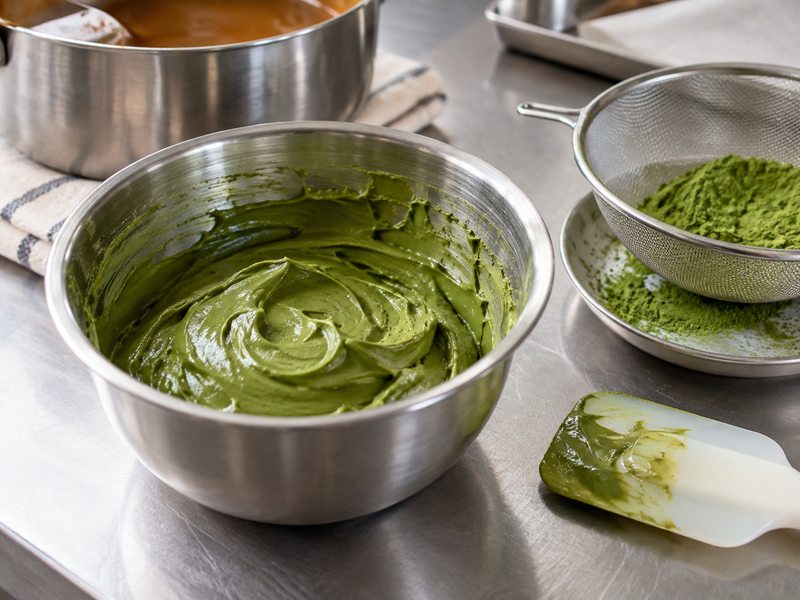
For a separate matcha caramel development trial, record the liquid reserved for dispersion as part of the total formula. Adding extra cream to fix lumps changes the batch. Sift the weighed powder, mix with the allocated liquid and inspect the mixture before continuing. Check the sides of the mixing vessel for powder that has not entered the batch.
If a developer proposes adding matcha later, evaluate that process separately. Record the addition temperature, mixing time and transfer delay, then compare finished pieces. A new timing method may change dispersion and flavor at the same powder dose.
Prepare the pouring frame and tools before cooking begins. Staff should not need to search for a sieve or weigh tea while the sugar mixture approaches its endpoint. Follow the chosen process for warm dairy additions and use appropriate protection when handling hot confectionery mixtures.
5. How should the cooking endpoint be controlled?
Use the selected recipe and checked instruments
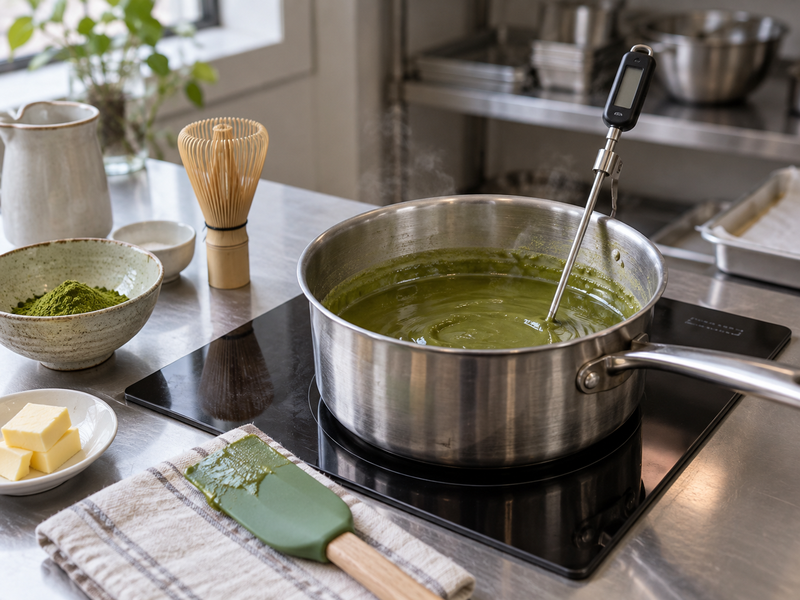
A thermometer reading needs context: the formula, probe placement, batch depth and local boiling conditions. King Arthur’s published Mom’s Caramels method targets 248 F (120 C) and describes softer results at 246 or 247 F for that formula. These are recipe-specific reference points. King Arthur caramel method
ThermoWorks also explains that altitude changes sugar-cooking targets and gives guidance for adjusting them. Use the relevant correction with a checked thermometer rather than copying a sea-level number into every factory recipe. ThermoWorks caramel temperature guide
| Endpoint control | Record for each batch | Check before accepting a difference |
|---|---|---|
| Probe position | Immersion and vessel used | Contact with pan bottom |
| Final reading | Temperature and instrument ID | Accuracy and local adjustment |
| Heat removal | Time between endpoint and pour | Delay or continued heating |
| Finished batch | Cooked weight and cooled texture | Formula or evaporation change |
For matcha caramel, approve a narrow endpoint range through your own controlled trials. Compare pieces at the same eating temperature. A colder sample can confuse the texture comparison. Set the routine from the resulting chew, cutting behavior and wrapper release, with a production record that explains how the batch reached that result.
6. How can a producer set an even slab?
Fix the mold footprint and deposited weight
Record the internal frame dimensions and the amount poured into it. Matcha caramel cut from a deep center and a thin edge will not give a fair portion or tasting comparison. Use a level work surface and a liner approved for contact with the hot mixture. Prepare enough liner overhang for the chosen removal method.
Measure the deposited weight using equipment and a procedure suitable for hot confectionery work. Keep a separate record of material left in the pan. Avoid repeatedly scraping questionable dark residues into the slab merely to improve yield. Investigate the cooking or transfer step that produced them.
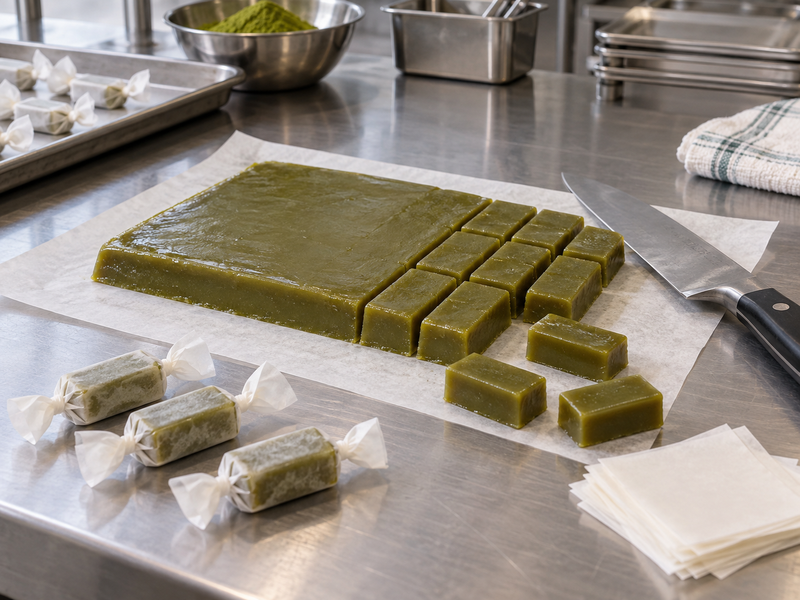
Allow the slab to reach the approved cutting condition before removing its support. Record room conditions and the interval after pouring during development. The piece should retain its intended shape during handling. Set timing from your formula, thickness and process instead of adopting a universal cooling period.
Photograph the center and edges of the cut slab under the same lighting. Uneven color, visible powder pockets or an oily surface should be investigated before the batch becomes a reference for future orders.
7. How should the slab be cut into consistent pieces?
Check weight as well as dimensions
Choose a cutting pattern that suits both the wrapper and the desired portion. A proposed 200 mm square slab could produce 100 squares measuring 20 mm across before any trimming. That geometric count does not establish piece weight. Thickness and cooked yield still determine the mass of each portion.
| Cutting check | Proposed measurement | Action if inconsistent |
|---|---|---|
| Slab thickness | Center and several edge positions | Review deposited weight and leveling |
| Portion dimensions | Length and width from a sample | Adjust cutting guide |
| Portion weight | Pieces across the slab | Review thickness and cut spacing |
| Cut-face condition | Smearing, tearing or hard fragments | Review cutting condition and endpoint |
Cut matcha caramel using suitable tools and the approved handling method. Record whether the piece stretches ahead of the blade or sticks after separation. A warm, soft slab and an overly firm slab create different cutting problems. Change the cutting condition before rewriting the tea dose to address a mechanical defect.
Separate edge trim from saleable pieces and weigh it. If the business intends to rework trim, establish a controlled formula and process for that use. Do not repeatedly return unidentified scraps to new batches and expect the same flavor or texture.
8. What should an individual wrapper trial check?
Evaluate release and appearance together
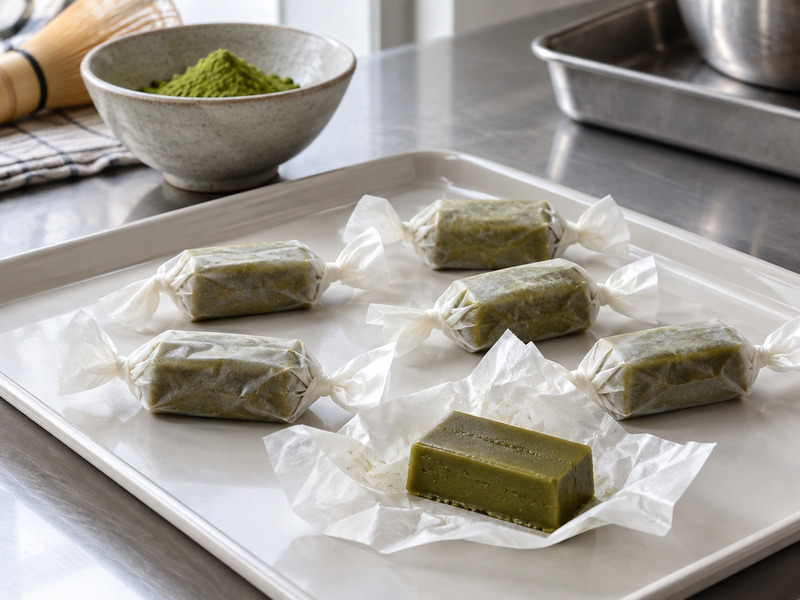
Request food-contact packaging suited to the candy and proposed distribution conditions. Wrapper trials for matcha caramel should use finished pieces from the approved formula, with their normal surface condition. A supplier’s generic paper sample cannot establish how your particular fat-containing confection will unwrap.
Check whether the candy releases cleanly, leaves oil marks or tears the wrapper. Observe folded or twisted ends and assess whether pieces keep their shape in the outer pack. Include normal handling and the temperature conditions expected in distribution. Record the conditions of each trial rather than writing an unsupported shelf-life date on the result.
Moisture and food safety questions require an assessment of the finished formula, production process and package. A chewy texture or a clean wrapper does not validate microbial stability. Agree on suitable testing with the responsible food technologist or laboratory before approving commercial storage instructions.
Have staff wrap a measured number of pieces and record labor time and rejects. A wrapper that performs well in a few samples may be awkward at the planned production rate. Keep approved material codes, dimensions and closure instructions together so purchasing does not replace the film or paper solely on appearance.
9. How should saleable candy cost be calculated?
Divide by accepted portions
Cost matcha caramel from the accepted output of the batch. Include the base ingredients, tea, individual wrappers, outer packaging and labor. Keep cooking loss, pan residue, edge trim and rejected pieces visible in the calculation. Raw ingredient weight alone can overstate the number of portions available for sale.
The example below uses invented costs and output for arithmetic. It is not a quotation, validated yield or suggested selling price. Assume a pilot batch produces 900 g of accepted candy, cut into 90 pieces weighing 10 g each.
| Cost item | Illustrative batch amount | Cost per accepted piece |
|---|---|---|
| Base ingredients | USD 8.10 | USD 0.090 |
| Matcha | USD 0.90 | USD 0.010 |
| Individual wrappers | USD 2.70 | USD 0.030 |
| Listed subtotal | USD 11.70 | USD 0.130 |
Add measured labor and the other excluded costs before judging the margin. Compare suppliers using the same accepted piece specification. If a powder needs a higher dose to meet the flavor target, calculate that dose’s cost. A lower unit price may disappear into extra tea, trimming losses or slower wrapping. Use the finished product trial to supply those numbers.
10. What belongs in a supplier development brief?
Send the formula conditions with the sample request
A useful matcha caramel brief names the base ingredients, planned tea range, addition stage and cooking method. Include the target piece weight, texture description and an unedited photograph. Explain whether the product will sell in cafe portions, gift packs or larger retail bags so packaging discussions have a clear starting point.
For Matcha Village enquiries, identify the need for bulk tea, a custom blend or private label support. Ask which samples and documents are available for the specific project and destination market. Confirm product identity, packaging specifications and claim support directly before approving commercial artwork.
The bulk matcha supplier guide can support the purchasing checklist. Add the candy trial record so a supplier can see the application behind a request for stronger tea flavor or less drying finish. Include the cost target per accepted piece rather than only a powder price ceiling.
Before increasing batch size, repeat the approved pilot with the intended operator and equipment. Keep the recipe revision, instrument checks, cooked yield, cutting results and packaging observations together. Issue that agreed record to production and purchasing before placing the larger ingredient order.
FAQ
Q1: Can matcha caramel be made as cut candies?
Yes. Develop a chewy caramel base that sets for cutting, then evaluate the tea addition, portion size and individual wrapper under the planned selling conditions.
Q2: Should tea powder be added dry at the end?
That needs a separate dispersion trial. A documented reference method mixes matcha into part of the cream. Record any changed timing and all added liquid.
Q3: Is 248 F the correct endpoint for every batch?
No. It is a reference target in specific published formulas. Your recipe, instrument, altitude and intended chew require a controlled production setting.
Q4: Why is the candy olive rather than bright green?
The finished color includes both the cooked caramel base and tea. Approve the actual pilot appearance and avoid using saturated powder photographs as the product standard.
Q5: How long can individually wrapped pieces be stored?
Establish a storage period through appropriate finished-product evaluation. Formula, process, package and distribution conditions all need to be included before making a commercial shelf-life claim.