
Matcha cake is a cake flavored and colored with powdered green tea. For a bakery, success means more than a green slice: the tea should be recognizable, the crumb should stay tender, and the color should survive the oven and display case. Those outcomes depend on powder choice, dose, batter chemistry, bake conditions, and packaging. This guide offers a measured development process for bakery teams, food manufacturers, and ingredient buyers. A home-style matcha cake recipe shows the appeal of the format; a commercial product also needs batch yield, sensory limits, and shelf-life verification.
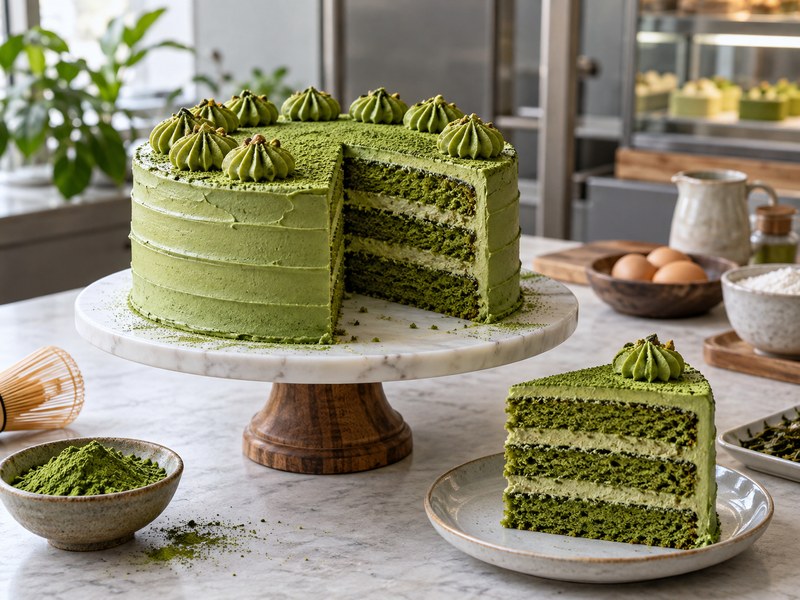
1. What makes a cake a matcha cake?
Matcha should be part of the cake’s flavor, not merely a garnish or a label on green sponge. Pure matcha contributes tea aroma, bitterness, a little savory depth, and color. The result changes with sugar, fat, dairy, eggs, flour, and heat. A high-sugar white chocolate frosting can make a modest tea dose seem faint; a lightly sweet cream can leave it clear. Decide whether the product is a plain loaf, sponge layer, butter cake, or filled slice before selecting powder. Each format gives matcha a different amount of competition from other ingredients.
How should the development team describe its target?
Begin with the cut slice. Define desired crumb color under the actual case lighting, tea aroma at room temperature, sweetness, moisture, and portion size. Keep an approved reference slice or photographs and sensory notes. “Bright green” alone is a poor target because some colors shift in a day. Taste both cake and finished decorated portion. If frosting hides the tea, changing powder may be less effective than reducing frosting sweetness. Set a realistic price per slice before trials so the recipe can be assessed commercially, not only as a tasting sample.
| Product choice | Main matcha test | Common risk |
|---|---|---|
| Plain loaf | Tea flavor in crumb | Dryness over display life |
| Layer cake | Flavor with filling | Sweet frosting masks tea |
| Sponge roll | Color and flexibility | Cracking or pale surface |
| Packaged slice | Color through shelf life | Light and oxygen exposure |
2. Which matcha powder works in baked batter?
Request powder samples meant for baking and test them at equal dose in the same base batter. A fine, vivid powder may look impressive dry yet turn olive during baking. A stronger-flavored culinary powder may retain taste better, although an aggressive bitterness needs control. Grade names are not universal specifications. Compare current lots for aroma, particle texture, color, and flavor after baking. Ask suppliers for ingredient declarations, origin, lot identification, shelf-life guidance, and available testing appropriate for your market. Make the purchase decision from the finished cake, not the powder photo.
What should a fair powder trial hold constant?
Keep flour, sugar, fat, egg, liquid, leavening, pan, batter weight, oven profile, and cooling method unchanged. Sift each powder into the dry mix or make a controlled slurry if the method calls for one. Blind-code samples so a high-priced label does not influence tasting. Evaluate at bake day and at the intended sale day. A cake that looks good from the oven may taste flatter after packaging. For sourcing context, compare our matcha plant guide and ask for a lot sample tied to the quoted product.
| Powder check | Bench method | Record |
|---|---|---|
| Dry aroma | Open coded samples together | Fresh or stale notes |
| Dispersion | Use same batter method | Specks and clumps |
| Baked color | Photograph under fixed light | Crumb and crust |
| Baked flavor | Blind tasting | Tea clarity and bitterness |
3. How much matcha should a baker add?
Use baker’s percentages so the recipe can scale. A sensible first test series might use matcha at 2%, 3%, and 4% of flour weight, then narrow the range around the preferred cake. These are experimental starting points, not standards. A rich butter cake and a light sponge may need different doses. At 500 g flour, 2% means 10 g matcha. Record matcha separately from flour even if it is mixed into the dry ingredients. If powder rises sharply in cost, the tasting panel should decide whether the extra flavor earns that increase.
How should a small trial matrix be built?
Change one variable at a time. Make three matcha doses with the same batter and bake profile. Score tea aroma, bitterness, crumb color, volume, and texture after cooling. Choose a dose, then test sugar or frosting changes. Do not alter powder, sugar, oven temperature, and pan simultaneously; a better cake would teach the team little. Weigh every batch before and after baking to estimate yield. Keep rejected units in the cost calculation. A small, disciplined trial is faster than a large batch whose cause of failure is unclear.
| Flour in test | Matcha rate | Matcha weight | Trial purpose |
|---|---|---|---|
| 500 g | 2% | 10 g | Light tea profile |
| 500 g | 3% | 15 g | Middle reference |
| 500 g | 4% | 20 g | Stronger profile |
4. How should matcha enter the batter?
Matcha absorbs liquid and can form dark specks if dumped into wet batter. Sifting it with flour helps distribute powder in many cake methods. A small slurry can work in other formulas, but added water must be counted in the total hydration. Butter cakes, sponges, and oil cakes use different mixing sequences; follow the structure of the chosen base formula. Avoid overmixing after flour enters, especially where gluten development would toughen the crumb. Scrape the bowl and check for powder trapped at the bottom before portioning.
What tells the team that mixing is inconsistent?
Slice samples from the first and last pans filled. Dark streaks, uneven green patches, or different volumes suggest poor incorporation or batter holding. Time the mixing stages and specify equipment speed, bowl load, ingredient temperature, and scrape points. A hand mixer test does not automatically transfer to a production planetary mixer. If matcha is preblended with dry ingredients, verify that the blend does not segregate during storage or transfer. Train staff on the actual visual endpoint of the batter rather than a vague direction such as “mix until smooth.”
5. Why does matcha cake lose its green color?
Heat, oxidation, batter pH, and light can alter green pigments. Browning on exposed surfaces is also normal in a cake, so judge the cut crumb separately from the crust. A lower oven setting with a longer bake is not automatically better; the center still needs to set without drying the edge. Trial pan depth, batter mass, oven loading, and cooling. Photograph cooled slices under consistent light and again after the intended display period. A powder that starts bright is useful only if its color fits the finished product’s conditions.
Should a bakery add food color?
Color may be an option if the brand’s product brief permits it and labeling rules are met. It cannot replace tea flavor. Run a no-color control and taste both versions blind. If added color makes the cake look like matcha while the tea flavor is absent, the formula still needs work. Avoid promising “naturally green from matcha” when color is added. For a clean-label brief, concentrate on powder choice, exposure to heat and light, packaging, and realistic shelf life. A visible difference between day one and day three should be documented before selling a multi-day display claim.
| Symptom | Likely area to investigate | Controlled next test |
|---|---|---|
| Brown crust, green center | Normal surface browning | Judge cut slice separately |
| Dull crumb after storage | Light or oxygen exposure | Compare packaging |
| Dark specks | Powder dispersion | Sift or change mixing stage |
| Bitter finish | Powder or dose | Blind dose trial |
6. How can the crumb stay tender?
Matcha is a dry powder, so dose changes can alter a cake’s water balance. At low percentages the effect may be modest, but a development team should still compare volume and softness as it increases the dose. Weigh liquid and fat rather than making casual adjustments by eye. Let cakes cool fully before wrapping; trapped steam can wet the surface, while long uncovered cooling can dry a slice. Frosting, syrup, and fillings change eating quality, so evaluate the assembled product after its planned hold time.
Which measurements are useful without a laboratory?
Measure batter weight per pan, baked weight, cake height, and portion weight. Use a consistent hand-pressure or fork test for crumb softness, supported by dated photographs. A larger manufacturer may use water activity and texture instruments, but those results need a sampling plan. Look for differences between center and edge slices. If one tray dries while another stays soft, oven airflow or pan position may matter more than the matcha. Record the production sequence before changing the formula. Recipe development becomes expensive when process faults are mistaken for ingredient faults.
7. Which fillings and frostings suit matcha cake?
Lightly sweet whipped cream, cream cheese frosting, white chocolate, red bean, and citrus are possible partners, but each shifts the balance. The finished slice should still taste of tea. Match sweetness at the portion level, not in isolated spoonfuls of frosting. A filling with high moisture can migrate into sponge; a firm frosting can make a tender cake seem dry by contrast. Test assembled slices at the planned service temperature. A refrigerated cake may release less aroma than one brought briefly toward room temperature under a safe service procedure.
What should be checked before choosing a topping?
Taste through the whole forkful. Weigh cake, filling, and frosting in one saleable portion. Then taste from edge and center, where filling ratios differ. Record allergens and any market-specific labeling requirements. A plant-based frosting may use nut ingredients; white chocolate contributes milk and sugar. A dusting of dry matcha can intensify aroma at first but may absorb moisture and darken. If the product is displayed, test its appearance after the normal case time rather than approving the decoration immediately after assembly.
8. What shelf-life and safety work does a bakery need?
Shelf life belongs to the finished recipe, packaging, and storage conditions. A dry loaf and a cream-filled layer cake have different risks. Set an initial hold period through your food-safety plan, then verify sensory quality and relevant microbiological controls for the actual product. Keep refrigerated fillings under local temperature requirements. FoodSafety.gov gives a general cold-food reference of 40°F/4°C or below, but commercial rules and a validated product plan govern the operation. Matcha itself does not make a dairy filling shelf stable.
What should the sale-day check include?
Assess crumb color, off-aroma, frosting condition, moisture, package condensation, and portion weight at each planned sale day. Track the difference between cakes made at the beginning and end of a production run. If a packaged slice travels, add a transport trial with actual temperature and handling. Do not infer shelf life from another bakery’s recipe. Keep ingredient and lot records for traceability, especially when a new matcha batch arrives. A shelf-life statement should be revised when packaging, filling, or process changes materially.
9. How should the recipe scale and be costed?
Scale from baker’s percentages and verify at production batch size. Large mixers, deeper pans, and full oven loads change aeration, bake time, and cooling. Run a pilot with enough pans to expose those differences. Cost per saleable slice includes matcha, all other ingredients, labor, packaging, trimming, and unsold pieces. If 20 g matcha enters a test batch that yields ten slices, the theoretical powder dose is 2 g per slice before waste. Compare that figure with actual powder use over several batches.
What data should travel from test kitchen to factory?
Keep formula version, ingredient brands and lots, mixer settings, batter temperature, pan mass, oven profile, cooling time, slice dimensions, and rejection count. Decide the minimum acceptable tea flavor through a reference tasting. If a lower-cost powder produces more rejected cakes, its kilogram price is misleading. For another baked format, compare the matcha cookies guide and its approach to color and bake loss.
| Cost component | Measure | Common hidden loss |
|---|---|---|
| Matcha | Grams per saleable slice | Trial and bowl residue |
| Base batter | Batch yield | Edge trimming |
| Filling | Grams per slice | Over-portioning |
| Packaging | Unit cost | Damaged slices |
| Labor | Minutes per batch | Rework |
10. What should a bakery request from a supplier?
Ask for current lot samples across appropriate baking grades, a specification, ingredient and origin declarations, shelf-life and storage advice, and available tests required by the purchase market. Confirm pack size, lead time, and whether future lots can be compared with an approved standard. Matcha Village can discuss bulk powder for baking, but the bakery should validate a real production cake before committing to a grade. Reject a sample if it works only in dry powder photography and fails in the finished slice.
What completes the approval file?
Retain the chosen lot sample, baked reference, trial matrix, ingredient documents, production recipe, sensory notes, and cost calculation. Set a process for checking a replacement lot before it reaches every oven. The immediate next step is a three-dose trial in your existing cake base, followed by a full-size pilot with the filling and packaging you plan to sell. That sequence turns an appealing green sponge into a product a buyer, baker, and retailer can describe consistently.
| Approval item | Required evidence |
|---|---|
| Powder | Sample and lot specification |
| Cake | Formula and baked sensory record |
| Process | Mixing, bake, cooling, packing |
| Shelf life | Product-specific hold study |
| Claims | Reviewed ingredient and origin wording |
FAQs
Q1. Can culinary matcha make a good cake? Yes. Judge its baked color and flavor in your recipe rather than its grade label.
Q2. Why did my cake turn brown? Investigate normal crust browning, powder choice, heat exposure, pH, and storage light before changing the recipe.
Q3. How much matcha should I use? Start with a controlled dose series, such as 2–4% of flour weight, and choose through tasting.
Q4. Can I add matcha directly to wet batter? You can, but pre-dispersing or sifting often reduces clumps; account for any added liquid.
Q5. Does matcha extend cake shelf life? Do not assume so. Validate the finished cake, filling, packaging, and storage conditions.