
Matcha cookies are baked cookies flavored and colored with powdered green tea. For a bakery, the hard part is retaining a recognizable tea taste and appealing green crumb after the oven, then making that result repeatable across dough batches. Sugar, fat, flour, leavening, and bake profile all influence the outcome. The brown-butter and white-chocolate version at Cooking Therapy shows one consumer style. This guide helps commercial bakers set a formula, compare matcha powders, run useful trials, and price the finished cookie without relying on a photograph of raw dough.
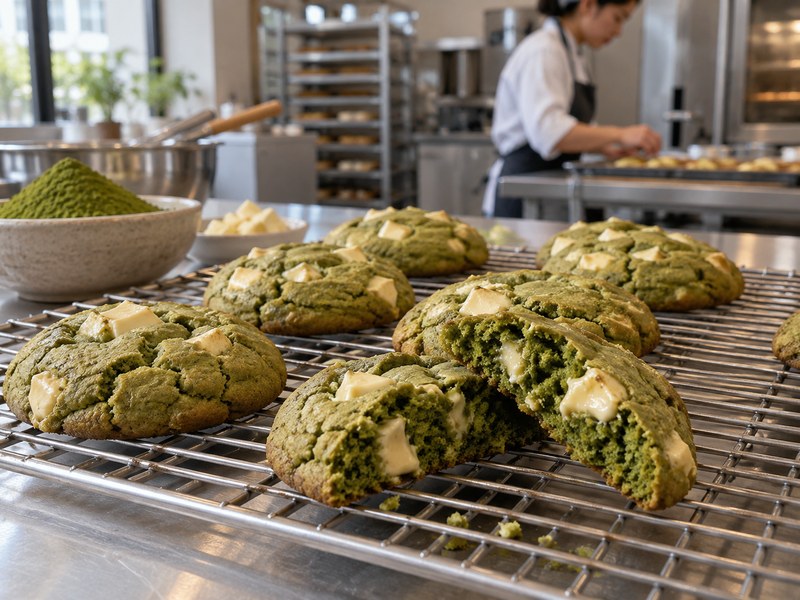
1. What are matcha cookies?
Matcha belongs in the dough at a level that contributes discernible tea flavor, not merely a green tint. It can be the dominant note in a plain butter cookie or a supporting note beside white chocolate, nuts, or citrus. The word “matcha” should match the ingredient used. A product containing green coloring and generic green-tea flavor but little actual matcha needs a different description. For packaged goods, the ingredient statement and front label must agree under the applicable market rules.
What should the product brief decide?
Define the cookie’s texture, size, tea intensity, sweetness, and color after baking. Decide whether it is a fresh café cookie, a frozen dough product, or a packaged shelf-stable item. Those routes have different production and shelf-life needs. A bakery selling a soft-centered cookie should evaluate it after the normal display period, while a manufacturer may need a longer distribution test. Set a target weight and acceptable spread range before choosing a powder. Otherwise, a flavor change can be confused with a dough geometry change caused by a different flour or oven load.
| Product choice | Development effect | Buyer question |
|---|---|---|
| Soft café cookie | Short display window | How does it eat after cooling? |
| Crisp packaged cookie | Moisture control | What shelf-life evidence exists? |
| Frozen dough | Storage and bake tolerance | Does color survive frozen handling? |
2. Which matcha powder should a bakery test?
Select matcha for flavor after heat, color in the finished crumb, and cost at the working dose. A powder that tastes beautiful whisked in water may lose its nuance in a butter-rich dough. Conversely, a stronger culinary powder can perform well when supported by sugar and fat. Supplier grade names do not define the result. Start with at least three coded powders and bake them in the same base formula. Keep powder mass, dough temperature, cookie weight, oven load, and bake time constant.
How should a tasting panel score samples?
Taste cooled cookies blind and record tea intensity, bitterness, sweetness balance, aroma, crumb color, and aftertaste. Cut each cookie to compare interior color; surface browning can hide a good crumb. Taste again after one and several days under the intended packaging or display conditions. Ask for lot-linked ingredient and origin information plus relevant testing from each supplier. Matcha Village’s matcha portfolio can be screened this way. Do not approve a powder because its loose dust is the brightest green on a sample tray.
| Powder score | Test location | Why it matters |
|---|---|---|
| Tea aroma | Cooled cookie | Oven can mute it |
| Bitterness | Final bite | High dose may become harsh |
| Color | Cut crumb | Surface browns differently |
| Cost | At approved dose | Price per kilogram misleads |
3. How much matcha should go into the dough?
Use baker’s percentages or a fixed powder-to-flour ratio for early trials. A practical exploration might compare 2%, 4%, and 6% matcha against flour weight, with all other ingredients held constant. These are trial points, not promises about the best formula. As matcha rises, dry solids, bitterness, color, and ingredient cost rise too. A very high dose can make the cookie taste grassy or dry. A lower dose may be sufficient when the cookie is small and lightly sweetened.
How do you prevent a false comparison?
Weigh every ingredient. Do not change white chocolate amount or bake time while comparing matcha dose. Make doughs to the same final temperature and rest them for the same duration. Label trays with codes so the tasting panel does not know which sample contains the most powder. After choosing a dose, run a second test to fine-tune sweetness or fat. If your product uses cocoa butter, browned butter, or a strong nut, test tea intensity again because these flavors can compete. Record dough yield and cookie count so powder cost can be calculated per sellable unit.
4. How do flour, sugar, and fat affect matcha flavor?
Cookie structure shapes how matcha is perceived. Brown sugar and browned butter add deep caramel notes that may complement tea but can also hide it. White sugar and a lighter fat base often let green color and tea aroma show more clearly. Flour type changes spread and chew. Baking soda or powder can alter both texture and color, depending on the formula. Do not assume a matcha cookie is simply a vanilla cookie with tea added; the base recipe may need deliberate adjustment once a powder and dose are selected.
What is a controlled base-recipe test?
Take one matcha powder and dose, then compare two sugar systems or two fat systems, changing only that variable. Bake on the same pans in the same oven zone. Measure diameter, height, weight loss, and crumb appearance. Taste both warm and fully cooled. A warm cookie may conceal bitterness that appears the next day. If white chocolate is present, evaluate a bite with and without a chip. The tea should remain identifiable in the dough itself, even if chocolate softens its edges.
| Ingredient variable | Likely effect | Trial measurement |
|---|---|---|
| Brown sugar | Darker flavor and color | Tea clarity after cooling |
| Browned butter | Nutty aroma | Does tea remain distinct? |
| Flour | Spread and chew | Diameter and height |
| Leavening | Rise and browning | Crumb color and texture |
5. Why does the oven change color and taste?
Heat browns sugars and proteins, dries the cookie, and changes the tea’s aroma. The green surface seen in raw dough rarely survives unchanged. A pale center with browned edges may be a better target than an evenly green exterior if the cookie still tastes good. Oven temperature, loading pattern, pan material, and cookie size all affect the result. Resist lowering temperature solely for color if that leaves the center underbaked or produces a poor texture. Food quality comes before a promotional photograph.
How should bake profiles be compared?
Run a small matrix of two oven settings and two bake times using the same dough. Record actual oven temperature with a calibrated probe, not just the dial value. Weigh cookies before and after baking to estimate moisture loss. Photograph cut surfaces under consistent light and taste after cooling. Repeat the preferred condition on a full tray; a single test cookie may bake differently from a loaded oven. If the recipe will move to another site, repeat the trial in its equipment. Matcha cannot rescue a process that produces different cookies each shift.
6. Which inclusions pair well with matcha?
White chocolate adds sweetness and fat that can soften tea bitterness. Dark chocolate creates stronger contrast but may dominate the dough. Nuts bring texture and a roasted note, while citrus zest can sharpen a sweet formula. Each inclusion changes cost, allergens, dough flow, and visual appearance. Choose additions around the target customer rather than stacking every popular flavor into one cookie. A bakery may be better served by one plain matcha item and one indulgent version, each with a clear identity.
What should an inclusion test record?
Measure grams of inclusion per cookie and distribution across a tray. Taste dough-only sections as well as bites containing an inclusion. Check whether pieces burn or bleed color at the chosen bake profile. Review allergen labeling and cross-contact procedures before commercial sale. A substitution from one white chocolate brand to another can change sweetness and melting, so treat it as a formula change. If the product photograph shows large pieces on top, define whether staff add them by hand; that step has a labor and yield cost.
| Inclusion | Benefit | Production risk |
|---|---|---|
| White chocolate | Sweet contrast | Tea may disappear |
| Dark chocolate | Bitter contrast | Can dominate flavor |
| Nuts | Crunch | Allergen and uneven spread |
| Citrus zest | Aromatic lift | Variable intensity |
7. How can production keep cookies consistent?
Weigh matcha into each dough batch and disperse it with other dry ingredients before mixing. Lumps can leave dark green spots and bitter pockets. Keep the mixing order, dough temperature, rest time, scoop weight, and bake load fixed. Matcha powder is sensitive to exposure, so reseal opened packs and follow the supplier’s storage directions. A production record should identify the powder lot used in each dough batch. That link matters if a later shipment looks or tastes different.
What should a scale-up run prove?
The scaled mixer should distribute powder evenly without overworking the dough. Compare cookies from the beginning, middle, and end of a depositor run. Measure unit weight, diameter, bake loss, and sensory quality. Watch for powder left on the bowl wall or trapped in dry pockets. A pilot made in a tabletop mixer may not predict a production mixer with a different shear pattern. Train operators on an acceptable dough appearance, but give them objective limits too. “Mix until green” is not a sufficient control for a high-volume line.
8. How should shelf life and packaging be tested?
A cookie’s shelf life depends on water activity, formula, packaging, handling, and storage. Color fading is only one concern. Texture may harden or soften, inclusions may change, and aroma may weaken. A fresh café cookie and a sealed retail pack need different validation. Set a proposed period, sample at planned intervals, and use appropriate microbial and physical testing through your food safety process. Do not infer a safe shelf life from the shelf life of the matcha powder itself.
What should the package trial include?
Use the actual film, bag, or tray planned for sale, then test after normal shipping and storage exposure. Observe breakage, moisture change, color, off-aromas, and customer opening experience. If a display case exposes cookies to light for hours, include that condition in sensory tests. A gift box may protect appearance yet trap moisture if the inner pack is wrong. For frozen dough, evaluate color and baking behavior after the intended frozen storage period. Keep documented results for the specific formula and package, not just a general promise that matcha stays green.
| Shelf-life check | Sample point | Failure signal |
|---|---|---|
| Texture | Day 0 and later intervals | Staling or softening |
| Color | Controlled light comparison | Dull crumb |
| Aroma | Sealed and opened pack | Stale notes |
| Safety | Approved test plan | Out-of-spec result |
9. What does the matcha dose cost per cookie?
Calculate matcha cost as grams per cookie multiplied by landed price per gram, then account for dough and bake yield. If a 60 g cookie contains 1.2 g matcha, one kilogram of powder supplies roughly 833 theoretical cookies before waste. The real figure falls with dough left in equipment and rejected units. Compare powders at the dose needed to deliver the target flavor. A lower-priced matcha that requires twice the dose may not save money, especially if it also darkens the crumb or raises bitterness.
Which costs should sit beside powder cost?
Include inclusions, labor, packaging, rejected pieces, and shelf-life loss. For a bakery chain, compare store-level variance in cookie weight and baked yield. A dough batch that produces fewer oversized cookies raises cost even if ingredient prices are unchanged. Use a pilot cost sheet linked to the signed recipe and current supplier quotes. When the formula changes, update the margin before changing menu copy or price. For private-label production, request quotes for the actual pack size and expected order frequency, not an unspecified bulk price.
10. How can a bakery approve a supplier and recipe?
Approve the cookie as a finished product. Keep the powder lot and documents, formula, process settings, sensory reference, shelf-life plan, and cost sheet together. Ask suppliers for a specification, origin and ingredient information, market-relevant tests, packaging details, and repeat-lot process. If a certification claim appears on the cookie pack, verify it covers the relevant powder and finished-product chain. A supplier can offer bulk matcha or OEM support, but the bakery’s own validation still decides the claim and shelf life.
What should trigger a new test?
Retest after a change in powder lot, flour, fat, inclusion, mixer, oven, package, or cookie weight. Some changes need only a focused sensory check; others affect allergens or safety and require formal review. Keep an approved reference cookie or a dated sensory record so a new team knows what “good” meant at launch. Ask staff to log repeated pale or bitter batches rather than covering them with extra chocolate. The commercial aim is a cookie whose tea character remains clear after baking and whose margin survives ordinary production losses.
| Approval item | Record |
|---|---|
| Powder | Lot-linked spec and sample |
| Formula | Weights and batch yield |
| Process | Mix, rest, bake settings |
| Finished cookie | Sensory and shelf-life results |
FAQs
Q1. Can culinary matcha work in cookies? Yes. Judge it in a baked trial for flavor, color, texture, and cost.
Q2. Why do matcha cookies turn brown? Baking reactions and heat affect the surface. Compare the cut crumb and eating quality too.
Q3. How much matcha should a bakery start with? Test a measured range such as 2%, 4%, and 6% of flour weight, then select by finished-cookie taste.
Q4. Does white chocolate improve every formula? No. It can balance bitterness but may hide tea and adds sweetness, cost, and allergens.
Q5. Does powder shelf life determine cookie shelf life? No. Validate the finished cookie in its actual package and storage conditions.