
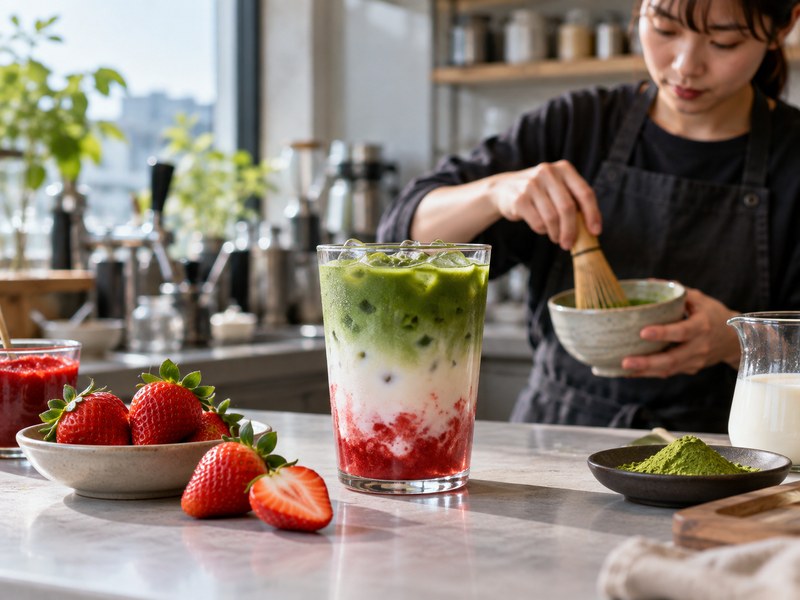
A strawberry matcha latte combines a strawberry base, milk or a plant drink, and prepared matcha, often in visible red, white, and green layers. Its appeal is easy to see; its service problem is less photogenic. Fruit varies, purée settles, and careless pouring turns the cup muddy before handoff. A café needs measured components and a way to test them together. Just One Cookbook’s home recipe illustrates the layered format. This guide develops a commercial specification that can be trained, costed, and adjusted without pretending one home recipe fits every bar.
1. What belongs in a strawberry matcha latte?
The drink has three working parts: a strawberry component, a milk component, and a matcha component. The fruit may be fresh purée, cooked sauce, or a prepared ingredient. Each option brings a different sweetness, water content, color, and handling requirement. The milk can be dairy or a plant drink, but its flavor and viscosity affect both separation and taste. Matcha should be prepared as a smooth concentrate rather than sprinkled over ice. A garnish is optional; it should earn its cost and preparation time.
What should the menu promise?
Name the fruit form accurately. “Fresh strawberry” should describe what is actually used, while “strawberry flavor” is more appropriate for a flavored syrup. If the drink uses sweetened matcha powder, staff need to know that before offering a less-sweet version. Do not assume a red color means fruit is the main ingredient. For a business, the drink name, ingredient declaration, allergen details, and bar recipe must tell the same story. A simple menu description can still be precise: strawberry purée, oat milk, and whisked matcha over ice.
| Component | Role in cup | Purchase check |
|---|---|---|
| Strawberry base | Flavor, sweetness, red layer | Fruit content and storage |
| Milk or plant drink | Body and white layer | Allergen and separation |
| Matcha concentrate | Tea flavor and green layer | Lot taste and dispersibility |
2. Which strawberry base should a café choose?
Fresh berries give a recognizable flavor, but their ripeness and yield change with season and supplier. A prepared purée can reduce prep time if its ingredients, sweetness, and texture suit the recipe. A cooked sauce may be more consistent for layering yet can taste closer to jam. A flavored syrup is easy to pump, though it does not replace real fruit when your menu says the drink contains strawberries. Choose on the basis of the promised cup and operational capacity, then measure the differences in a side-by-side test.
How should fruit options be tested?
Use the same matcha and milk, then swap only the fruit base. Taste for genuine strawberry aroma, excessive acidity, cooked notes, and sweetness after the whole drink is stirred. Examine seeds and pulp in the intended straw diameter. Calculate usable yield rather than the price of a fruit carton: trimming, spoilage, and prep labor count. For a prepared base, request the ingredient list, storage direction, shelf-life information, and relevant food safety documents. A product that looks excellent in a clear glass may clog a narrow service spout or separate during a lunch rush.
| Base | Likely advantage | Pilot question |
|---|---|---|
| Fresh purée | Seasonal fruit character | Can prep match demand? |
| Prepared purée | Faster assembly | Is sweetness consistent? |
| Cooked sauce | Strong visible layer | Does it taste too jammy? |
| Flavored syrup | Simple dosing | Does the menu describe it honestly? |
3. What matcha stands up to strawberry and milk?
Strawberry brings acid and sweetness; milk softens the tea. A powder selected for plain water may be too subtle here, while an aggressively bitter powder can make the final sip unpleasant. Taste candidate lots in the finished drink and as a plain control. Look for a recognizable tea note after the cup has been stirred, not only a bright green top layer in a photograph. The desired balance depends on your customer: a dessert café may accept a sweeter cup than a tea specialist.
How can a buyer compare matcha samples?
Code samples, keep fruit and milk fixed, and prepare each with the same measured powder mass. Have tasters score tea presence, bitterness, color at handoff, color after mixing, and finish. Record the cost at the dose needed for an acceptable cup. Ask for lot-linked specifications and compare reorder samples against the approved material. Matcha Village’s bulk matcha is one sourcing route; assess any proposed grade in your own strawberry formula. A supplier’s “latte grade” description is a starting category, not evidence that the specific lot works in your recipe.
4. How do you build clean layers without slowing service?
Layering depends on density, viscosity, temperature, ice placement, and pour speed. A thick fruit base usually goes into the cup first. Add ice and milk gently, then pour the prepared matcha over the ice or along a suitable spoon. The exact order should be tested with the cup and ice used in service. Some recipes make dramatic bands for a minute and then blend as the guest moves the cup. That is fine if the drink tastes good after mixing; a layered appearance alone is not a quality standard.
What should the bar procedure specify?
State the fruit mass, ice mass, milk volume, matcha concentrate volume, and pour order. Include a photo of an acceptable handoff cup and a maximum assembly time. Run ten consecutive drinks with two staff members. If only the developer can maintain neat layers, simplify the method. Test lidded cups as well as open glasses; a lid can disturb the top layer. Give customers a stirrer or explain that the layers are meant to be mixed before drinking. The tasting panel should assess the mixed drink, because that is where the ingredients must work together.
| Step | Working control | Common failure |
|---|---|---|
| Fruit | Weighed base at cup bottom | Inconsistent sweetness |
| Ice | Fixed mass and cube type | Fast dilution |
| Milk | Measured pour | Uneven bands |
| Matcha | Smooth concentrate, gentle pour | Clumps or muddy top |
5. What is a useful starting formula?
For a 350 mL service cup, a development trial might use 45 g strawberry purée, 140 mL milk, 2 g matcha dispersed in 40 mL water, and roughly 100 g ice. These are trial values, not a finished commercial recipe. Real purée may be sweeter or looser than another supplier’s product. Cup displacement also changes with ice geometry. Prepare three versions that vary fruit mass while holding everything else still. Then adjust matcha only after the preferred fruit level is clear.
How should sweetness be tuned?
Taste the assembled drink after a full stir and at normal drinking temperature. A sweet fruit base can hide matcha’s bitter edge at the first sip, but dilution may expose it later. If the cup tastes flat, adding more syrup may make it heavier rather than better; compare tea strength and fruit acidity. Keep a separate sugar-free or reduced-sugar concept only if it has its own stable recipe and truthful label. Use measured units for every ingredient, including optional syrup. “One pump” becomes unreliable when a pump head or bottle changes.
6. How do milk choices affect flavor and appearance?
Dairy milk generally offers a familiar creamy base. Oat, soy, and other plant drinks differ in sweetness, protein, viscosity, and how they interact with acidic fruit. Some separate or form flecks after mixing. Do not assume the bar’s standard milk swap works in this recipe. A coconut drink may dominate strawberry; an unsweetened soy drink may expose tea bitterness. Taste the whole cup and watch it for the same time customers usually carry it. Each milk option may need a separate fruit or matcha adjustment.
What should be checked before adding variants?
Run the formula with the exact retail or foodservice carton intended for use. Compare color at handoff, texture after stirring, separation after ten minutes, and flavor at the final sip. Review allergen statements and cross-contact procedures with your food safety team. “Dairy-free” requires more than substituting oat milk if the strawberry component or topping contains milk. Document each approved variation in the point-of-sale menu and recipe card. Too many casual substitutions create remakes, especially when staff are trying to protect the visual layers at speed.
| Milk option | Sensory question | Operations question |
|---|---|---|
| Dairy | Does fruit acidity affect texture? | Cold holding and allergens |
| Oat | Is added sweetness excessive? | Brand-to-brand variation |
| Soy | Does tea flavor remain clear? | Allergen control |
| Coconut | Does coconut dominate? | Separation in cold cup |
7. Can a strawberry matcha latte be prepared ahead?
Dry matcha can be portioned and fruit base can be prepared under an appropriate food safety plan. The fully mixed drink is a poor candidate for long standing: layers move, ice melts, matcha settles, and fruit texture changes. A prepared fruit base also has a different handling profile from a sealed commercial syrup. Set its use period from validated supplier directions or your own controlled process, rather than guessing from color or smell. For high-volume service, stage components separately and assemble each cup to order.
How do you plan a busy service window?
Forecast likely drink count and prep fruit in clearly labeled containers sized for the shift. Keep matcha powder sealed until use or preportion it in protected units. Place utensils and a scale where the line can reach them without cross-contact. If you make a matcha concentrate ahead, define its time, temperature, agitation, and discard rule with your food safety lead. Train staff to reject fruit with unexpected off-odors or texture. A two-minute assembly target means little if the team spends ten minutes finding a clean squeeze bottle during a rush.
8. How should a buyer cost and price the drink?
Calculate ingredient cost at the approved dose, then add cup, lid, ice, garnish, waste, and labor. Fresh berries require a yield calculation after trimming and spoilage; a purée quote usually specifies a ready-to-use mass. Track remakes caused by poor layering or inconsistent sweetness. Visual appeal may support a premium price, but the margin should survive the drink’s busiest hour. A stable formula can also travel across stores if every location has the same ingredient specification and training.
Which pilot data are worth keeping?
Record preparation time, cost per served cup, fruit waste, matcha dose, and customer requests for sweetness changes. Note whether customers stir the drink before tasting, because a complaint about a strong top layer may be a service instruction problem. Repeat the pilot with a second fruit lot or delivery. If the drink only works with a single unusually ripe batch, it is not ready for a multi-store launch. A small panel can score both appearance and mixed flavor without turning every opinion into an unmeasurable marketing claim.
| Cost line | Unit to record | Why it changes |
|---|---|---|
| Strawberry | Grams served and usable yield | Season and trimming |
| Matcha | Grams per cup | Powder strength |
| Milk | Milliliters per cup | Variant choice |
| Packaging | Unit per sale | Dine-in versus takeaway |
9. What documents should an ingredient supplier provide?
For matcha, request origin, ingredient declaration, lot code, product specification, and market-relevant testing. For fruit, request its ingredient list, handling and storage directions, shelf-life basis, and allergen information. For milk and toppings, keep current labels for the exact purchased products. If a supplier says an ingredient is organic, halal, kosher, or otherwise certified, verify current scope for that product and market. A certificate for the company is not automatically a certificate for every item.
What belongs in an approved ingredient file?
Keep the signed recipe, supplier and item codes, current documents, approved samples, alternate-item rule, and customer-facing description. An alternate strawberry purée should be retested for sweetness and viscosity before it is silently substituted. A new matcha lot should be tasted in the complete drink, not merely compared by dry color. Private-label or chain buyers may also need packaging and shipping specifications. Matcha Village describes OEM and private-label services; ask for an offer against the exact application, destination, and label claims you intend to make.
10. How can a chain scale the recipe without losing the cup?
Start with a pilot in one store, then ask another team to make the drink from the written card without developer coaching. If the second team cannot reproduce it, the procedure needs work. Fix the unit measures, cup, ice, and pour order before rolling out across locations. Train staff on the reason for each control: a smooth concentrate prevents clumps; fixed fruit mass controls sweetness; lidded-cup testing protects takeaway appearance. Audit a few drinks during peak hours rather than only at opening.
What is a practical launch sign-off?
Approve taste after stirring, appearance at handoff, cost, assembly time, allergen information, and ingredient traceability. Keep photos of acceptable and unacceptable separation, but use sensory language alongside the images. Define which changes require retesting: a new fruit base, milk carton, ice machine, matcha lot, or cup size. When the recipe is stable, request supplier quotes against its measured demand. The best strawberry matcha latte for a business is one customers enjoy after the pretty layers have mixed and every trained barista can make again.
| Sign-off | Evidence |
|---|---|
| Sensory | Mixed-cup panel notes |
| Visual | Handoff and carry-time photos |
| Operations | Timed multi-barista trial |
| Supply | Approved lots and substitute rule |
FAQs
Q1. Does a strawberry matcha latte need fresh strawberries? No. Purée or a prepared base can work if the menu describes it accurately and the full drink passes tasting.
Q2. Why do the layers disappear? Movement, pouring, and differences in density mix the components. Judge flavor after stirring as well as appearance at handoff.
Q3. Can oat milk replace dairy milk? It can, but test the exact carton with the fruit base for sweetness, texture, and separation.
Q4. How much matcha should a café use? Start with a measured trial such as 2 g per 350 mL cup and adjust through blind tasting of the finished drink.
Q5. Can the completed drink be batched? Assemble cups to order where possible. Separate prepared components need defined food handling and holding rules.