
Matcha tea garden pest monitoring is the repeated search for insects and disease signs, followed by a documented decision about whether to act. A buyer may receive a pesticide test report yet still know little about what happened in the garden before harvest. Scouting records fill part of that gap. Japan’s NARO Tea Pest Control Group studies pest ecology, forecasting, and integrated management for tea; a commercial supplier should show how its local field team watches its own blocks.
Ask for the decision trail. A dated observation, identification, response, and follow-up tell a buyer more than a broad “pest-free” claim.
Contents
- What does matcha tea garden pest monitoring cover?
- Which blocks and plant parts should scouts inspect?
- How should a scout identify a problem?
- What can traps and other tools contribute?
- How are scouting results turned into decisions?
- Which nonchemical measures deserve a record?
- How should any treatment be documented?
- Where does residue testing fit?
- How can buyers connect scouting with a powder lot?
- What makes a supplier review credible?
1. What does matcha tea garden pest monitoring cover?
A repeated field observation
Monitoring means looking at defined locations often enough to notice change, recording what was found, and following up. It covers insects, diseases, damage, and the conditions in which they appear. A spray log is a treatment record; it cannot replace scouting notes. Equally, a trap photograph alone cannot establish that the whole garden was checked.
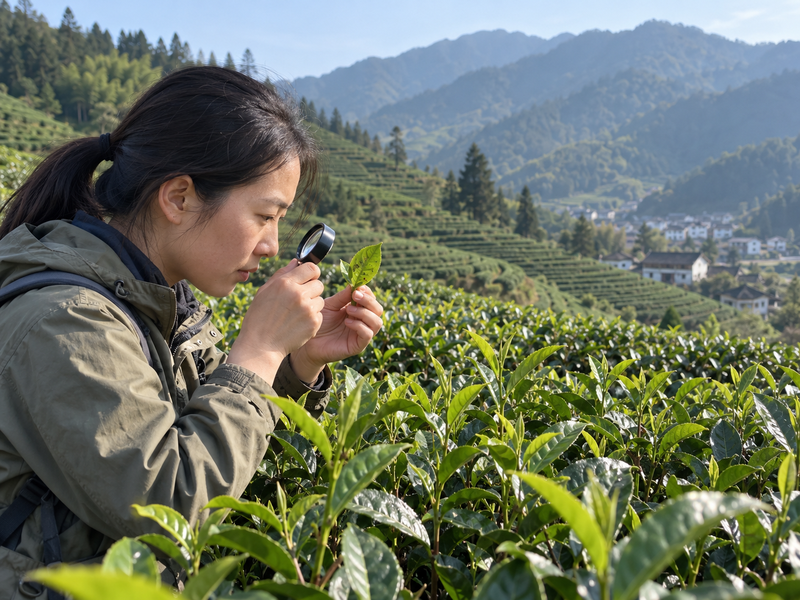
Map the route. Request a block plan, scouting frequency, and instructions for checking leaf surfaces and nearby growth. The plan should distinguish production blocks from boundaries or unusually wet, shaded, or exposed spots. Changes to the route should be recorded, especially when a new problem appears.
NARO’s tea pest research description names tea green leafhopper and anthracnose among Japanese research subjects. A mainland Chinese garden may face a different local mix. Buyers should not paste a Japanese pest list into a Chinese purchase specification; they should ask the supplier to identify locally relevant issues and show the evidence behind that identification.
2. Which blocks and plant parts should scouts inspect?
Representative and risk-based checks
A scouting route should include representative rows and places where problems are more likely to appear. Edges, dense canopy pockets, low ground, or blocks with prior damage may warrant closer attention. A supplier can explain its route without revealing every commercial detail of the estate map.
Look under the leaf. Some insects and early symptoms are easier to see on undersides or young shoots than from a path. Ask whether scouts record plant part, growth stage, and severity. A vague note such as “pests seen” does not show whether damage threatened harvestable leaf or appeared on older growth outside the picking standard.
The route also needs consistency. A trend is hard to interpret if one week covers five blocks and the next covers one. If rain or harvest prevents a scheduled check, record the omission and the make-up visit. That small discipline helps buyers judge whether a quiet period reflects low pressure or simply missing observations.
| Scouting area | Why include it | Note to keep |
|---|---|---|
| Routine production rows | Establishes a comparable trend | Block, date, plant part |
| Garden edges | May reveal incoming pressure | Edge location and direction |
| Prior problem spot | Tests whether response worked | Repeat count or symptom note |
3. How should a scout identify a problem?
Separate signs from conclusions
Leaf damage can have several causes. A scout should record the observed sign, its location, and a tentative identification when confident. Photographs, hand lenses, sample bags, or a local specialist can support a difficult diagnosis. The record should distinguish “small feeding marks on young leaves” from a confirmed pest species.
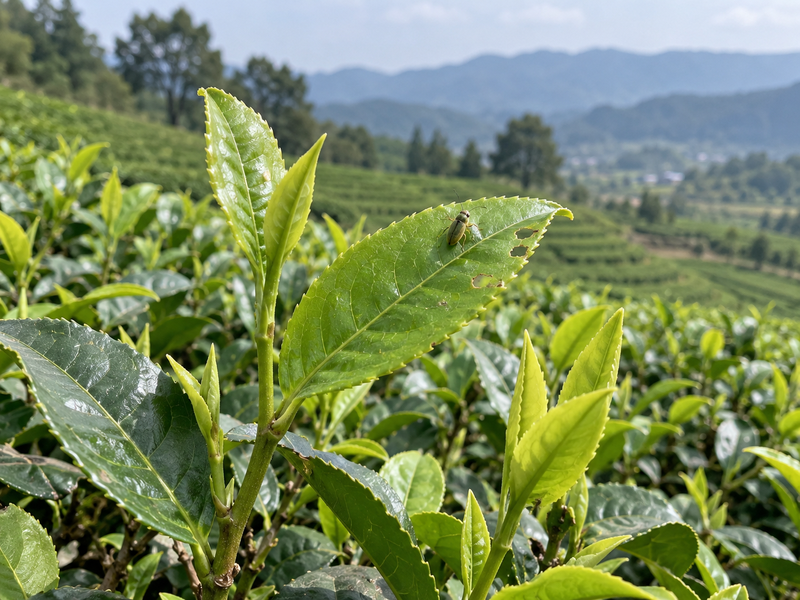
Keep the uncertainty. Misidentification can lead to an unnecessary or ineffective response. If a symptom might be disease, weather injury, or mechanical damage, the supplier should show how it checked. A later corrected identification is a sign of a functioning process, provided the decision trail remains visible.
NARO’s tea pest control research includes work on ecology and forecasting. That research supports asking suppliers for observation and identification before action. It does not make any single image a diagnosis for an unrelated garden. A buyer can review the structure of the supplier’s process without pretending to diagnose tea pests remotely.
4. What can traps and other tools contribute?
One signal among several
Traps can show activity patterns when placed and checked consistently. Their readings depend on trap type, location, maintenance, and the pest being targeted. A count from one trap is not a direct measure of every insect on harvestable shoots. Ask how the supplier combines trap information with plant inspection.
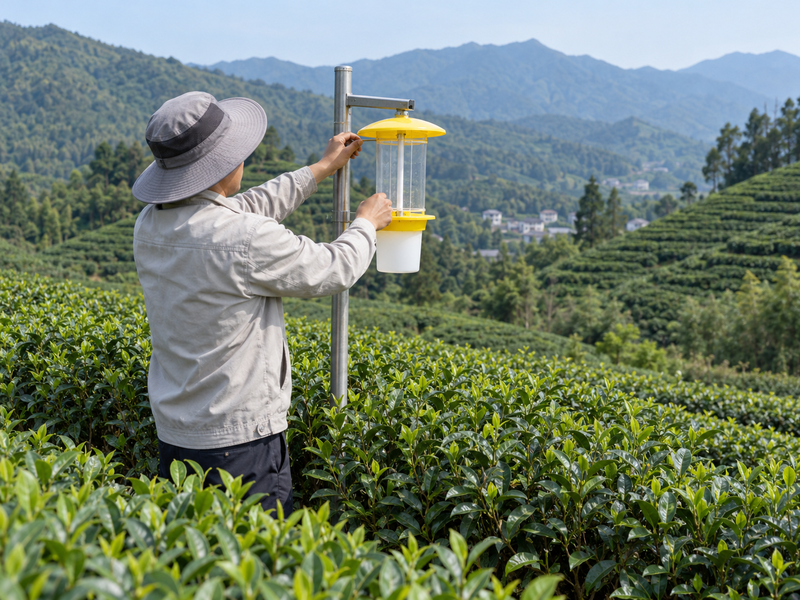
Track the same point. A trap record should name its block, installation date, check date, target organism, and any replacement. If a trap moved, the trend should not silently continue as if nothing changed. The NARO research page shows monitoring with a light trap among its tea pest work; it does not imply that this tool fits every species or site.
Digital images and field apps can help, but they need the same discipline as paper. A timestamped photograph with no block code may be hard to use months later. A buyer can ask for a sample report that places tools inside a scouting method rather than accepting a dashboard screenshot as the whole program.
| Tool | Useful contribution | Limit |
|---|---|---|
| Hand lens | Closer look at leaf surface | Small sampled area |
| Trap | Trend at a fixed point | Species and placement dependent |
| Photograph | Reviewable symptom evidence | Needs date, block, and scale |
5. How are scouting results turned into decisions?
Record why staff acted or waited
The decision might be to keep watching, adjust a cultural practice, isolate a block, seek diagnosis, or use a locally permitted treatment. A low observation does not always require action; a fast-changing problem may require a prompt response. The supplier should explain its decision criteria using local agronomy and applicable rules.
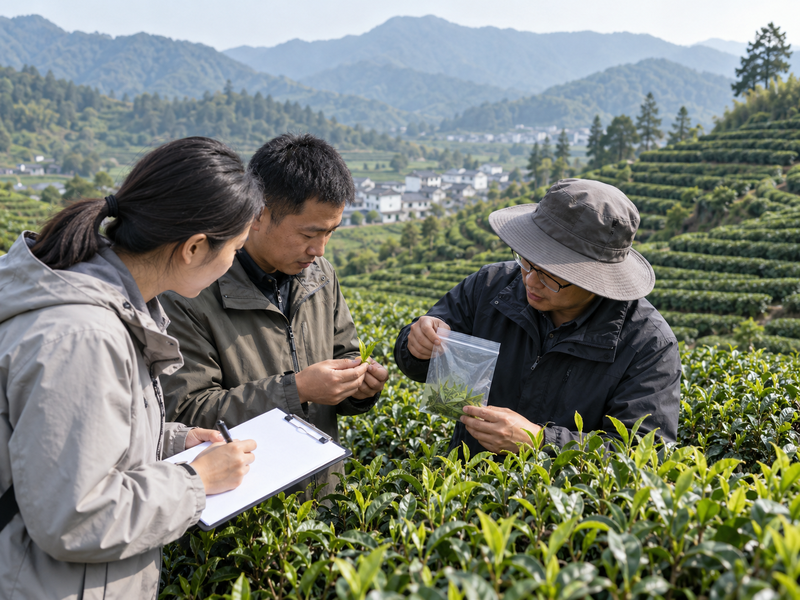
Find the hinge point. Ask for an example where a scout observed a problem, who reviewed it, and why the team chose its next step. Then ask for the follow-up check. A treatment without a prior observation may still have a documented reason, but the buyer should see it. “We spray on a schedule” is a policy statement, not evidence that each intervention matched field conditions.
NARO describes work toward integrated pest management for tea, including cultural and physical approaches and natural enemies. A buyer can use that framework to ask about choices. It should not require one control method for every garden or claim that a nonchemical step alone solves all pressure.
6. Which nonchemical measures deserve a record?
Management still needs evidence
Pruning choices, sanitation, canopy management, and attention to affected plant material can change pest or disease conditions. Their value depends on the problem and the site. If a supplier cites these measures as part of its program, ask for dates, affected blocks, and the observations that followed.
Don’t accept a label. “Integrated” sounds reassuring but does not say what happened. A record of a damaged shoot inspection, a localized removal, or a changed field practice is testable. The supplier should also record when an intended measure could not be completed and what was done instead.
Some measures may affect leaf availability or harvest timing. That link matters to buyers planning repeated shipments. The supplier can connect its pest records to the production forecast without promising that every risk is eliminated. NARO’s description of cultural and physical controls offers research context, while any particular measure needs local justification.
| Measure recorded | Buyer asks | Follow-up |
|---|---|---|
| Canopy or pruning work | Which blocks and why? | Did symptoms change? |
| Removal of affected material | What was removed? | How was it handled? |
| Physical monitoring or control | Which target and location? | Was performance checked? |
7. How should any treatment be documented?
A complete application trail
If a supplier uses a plant protection product, records should identify the target, block, date, product, legal authorization for that use, operator, actual application, and relevant harvest interval. Buyers should also know who checks market requirements for the destination of the powder. This article cannot prescribe a product or rate: rules vary by country, crop registration, and market.
Match the lot. A treatment record should connect with later harvest and tencha intake. If a treated block entered a blended lot, the genealogy needs to show that contribution. A buyer can then assess the documentation and any required analytical testing for its market.
Request the current local compliance procedure rather than a generic “pesticide-free” promise. The Matcha Village discussion of pesticides in matcha gives buyers additional context, but the purchase decision needs lot-specific records and the applicable legal limits. A test result below a reporting limit is a laboratory finding under defined methods, not proof that no product was ever used.
8. Where does residue testing fit?
A check on a defined sample
Residue analysis can verify a selected lot against a specified method and destination-market requirements. It cannot replace scouting, application records, or a traceability system. A certificate of analysis needs sample identity, sampling date, laboratory details, analyte scope, reporting limits, and the standard used for interpretation.
Read the scope. “Passed testing” says little if the report covers only a narrow panel or a different lot. Ask who chose the analytes and whether the panel reflects products used in the garden, relevant regional risks, and buyer-market rules. An independent laboratory can add confidence, but sample selection still determines what the result represents.
Do not convert a non-detect into a universal residue-free claim. Analytical methods have detection and quantification limits. If a buyer needs a particular market threshold, write it into the specification and confirm that the method can assess it. The laboratory result and field history then support each other.
| Report element | Why it matters | Buyer check |
|---|---|---|
| Lot and sample ID | Connects result to material | Match receiving record |
| Analyte panel | Defines what was tested | Compare with risk plan |
| Reporting limit | Sets meaning of non-detect | Compare with market limit |
| Date and laboratory | Establishes chain and method | Check report authenticity |
9. How can buyers connect scouting with a powder lot?
Trace backward from finished material
Choose a finished matcha lot and identify every source block. Review scouting entries during the relevant leaf growth and harvest period, any treatments, harvest dates, fresh-leaf intake, tencha runs, and final powder packaging. If several blocks were blended, a site-wide statement is too coarse.

Test both directions. Start from the powder and work back to plots. Then choose a plot with a recorded pest issue and work forward to every lot that used its leaf. The Matcha Village traceability overview can orient a buyer to the chain, but the supplier must supply records for the actual product offered.
An investigation may show that the affected plot did not enter the shipment. That is a useful result. If it did, the buyer can inspect the response, timing, and laboratory evidence. This is why a stable block code matters. Without it, even a detailed scouting notebook may be detached from the commercial lot.
10. What makes a supplier review credible?
A compact document set
Request the scouting procedure, current block map, sample field logs, one decision-and-follow-up example, treatment records where relevant, and a lot-linked laboratory report. Ask who is responsible for identification and who can stop harvest from a block. A supplier should be able to explain exceptions without rewriting them as success stories.
Choose a real week. Review a routine week and one week with weather or pest pressure. Check whether scheduled visits occurred, whether findings were specific, and whether later checks closed the issue. A spotless report with identical wording every week deserves a closer look, especially if traps or photographs tell a different story.
Matcha tea garden pest monitoring works for a buyer when it makes field decisions visible and connects them with the powder being purchased. Ask for one complete lot trail and agree on the records needed for the next shipment. That request creates a practical basis for quality discussion without assuming one treatment, one pest threshold, or one testing panel fits every origin.
| Review item | Strong evidence | Follow-up |
|---|---|---|
| Scouting route | Dated block-specific visits | Ask about missed checks |
| Identification | Observations and supporting images | Seek local expert review |
| Decision | Reason and authorized action | Request follow-up check |
| Lot connection | Block-to-powder genealogy | Reconcile mixed runs |
FAQ
Q1: Is residue testing enough to prove pest management? No. It measures selected substances in a defined sample and does not explain garden decisions.
Q2: Must every insect sighting trigger treatment? No. The supplier should document identification, severity, context, and its reason for acting or waiting.
Q3: Can a trap count replace leaf scouting? No. A trap is one signal and needs placement and target context.
Q4: Should buyers specify one pesticide program? No. Legal use and local pest pressure differ; request a documented, compliant decision process.
Q5: What is the most useful audit sample? One finished lot traced backward through garden blocks, scouting, any treatment, harvest, and laboratory records.