
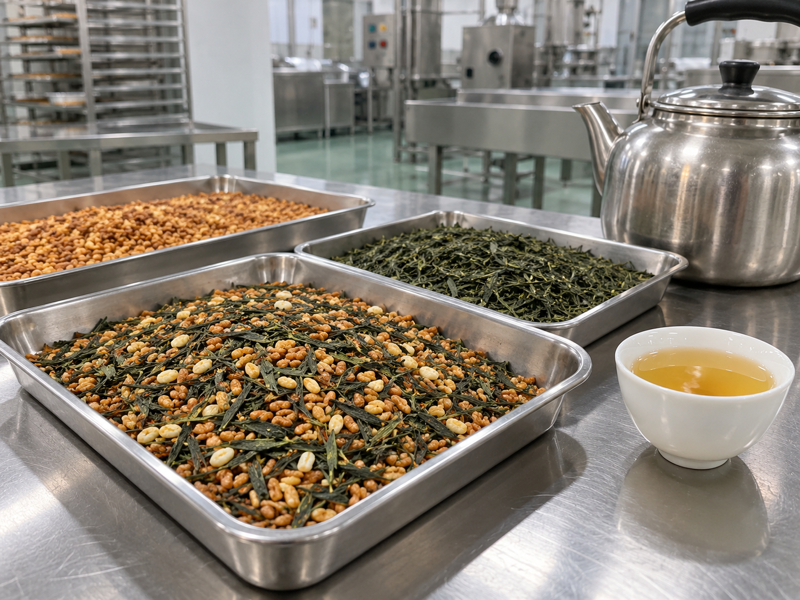
Learning how to make genmaicha tea starts with one practical point: the roasted-rice aroma arrives quickly, while green-tea bitterness can grow if the leaves sit too long. A reliable cup depends on measured tea, water temperature, contact time, and complete straining. This guide begins with a hot cup, then covers iced service, repeated brews, powder formats, and larger-batch controls. Use the numbers as a starting trial and adjust them for the blend and equipment in hand.
Contents
- 1. What is genmaicha made from?
- 2. What equipment is needed for a cup?
- 3. How to make genmaicha tea for one cup?
- 4. What temperature and time should be tested?
- 5. How should the cup be poured and tasted?
- 6. Can the same leaves be brewed again?
- 7. How can genmaicha be made iced?
- 8. How do powders change the method?
- 9. What causes common brewing problems?
- 10. How can a café repeat the result?
1. What is genmaicha made from?
Genmaicha blends green tea and roasted rice. The tea may be bancha, sencha, or another style. Japan's Ministry of Agriculture, Forestry and Fisheries describes several possible tea bases and notes that some genmaicha uses roasted cooked white rice. A bag labeled “brown rice tea” therefore does not tell you everything about its composition. Some versions also contain matcha. The visible mix and the supplier's specification reveal more than a generic name.
The rice gives a toasted cereal aroma; the tea contributes its own leaf character and caffeine. Differences in roast level, leaf size, and blending ratio can change the ideal brew. Taste a new lot before applying an old recipe without adjustment. For a commercial buyer, ask whether the material is a loose blend, a powdered whole blend, an extract, or a sweetened mix. Those formats require different handling and may produce a different cup even if all carry the same tea name.
| Ingredient format | What it contains in the cup | Preparation implication |
|---|---|---|
| Loose blend | Extracted tea and rice flavor | Strain solids |
| Tea bag | Extracted flavor | Confirm bag fill weight |
| Whole powder | Suspended solids | Mix thoroughly |
| Soluble extract | Dissolved extract | Follow product-specific dose |
2. What equipment is needed for a cup?
Use a scale that reads small gram amounts, a kettle or hot-water source, a thermometer if the kettle is not calibrated, a timer, and a teapot or filter that lets the blend contact water evenly. A small white cup helps assess color, but taste should decide the brew. Clean the vessel before testing; old tea residue can add stale notes. When comparing ingredients, use the same vessel and filter for every sample.
A teaspoon may be convenient at home, yet it is a weak commercial measure because rice and leaf can settle differently in a bag. A weighed dose is much easier to teach and audit. If a café chooses preportioned sachets, weigh several from a production run and confirm their cup performance. Keep water source consistent. A filtered-water change may alter flavor even when the tea and timer do not. Equipment accuracy matters most when a team wants a repeatable menu drink rather than a pleasant one-off cup.
3. How to make genmaicha tea for one cup?
A useful trial begins around 2–3 g of loose genmaicha per 100 mL of water. This is a starting range, not a fixed rule for every grade. A larger mug, a smaller cup, and an iced concentrate have different targets. Weigh tea and water for the first few trials. Once the preferred ratio is established, record it on a card and only then translate it into an operational scoop or sachet if needed.
Keep the dry mix representative. Rice grains may collect in one part of a pack while lighter leaves collect elsewhere. Follow supplier handling guidance and avoid taking only the top fraction for a comparison. If a 300 mL service cup is planned, calculate the tea amount from the desired brew volume rather than from the cup's nominal capacity; ice, milk, or headspace may occupy part of that cup. At scale, also record usable liquid yield after straining because tea and rice retain some water.
| Brew target | Loose tea trial | Water input | Use |
|---|---|---|---|
| Small tasting cup | 2–3 g | 100 mL | Supplier comparison |
| Two tasting cups | 4–6 g | 200 mL | Repeat sensory check |
| Larger hot serving | 6–9 g | 300 mL | Service development |
| Iced base | Separate trial | Separate trial | Allow for ice dilution |
4. What temperature and time should be tested?
Japan's 2024 agriculture ministry tea guidance gives approximately 90–100°C and 30 seconds to one minute as a genmaicha hot-brew starting point. Begin in that neighborhood, then taste your particular blend. Measure temperature where water meets the tea if possible; a kettle setpoint and a small cold pot can differ. Start timing when the water contacts the blend, not when someone remembers to look at the clock.
Run two or three controlled comparisons. Keep tea mass and water fixed while changing time, then hold time fixed and test temperature. A stronger roast aroma does not always require a longer extraction. If bitterness rises before the cup gains useful aroma, try more tea with a shorter steep or ask for a different blend. Do not leave the leaves in the pot after the chosen endpoint. That turns a one-minute recipe into a changing brew as service continues.
| Test | Water temperature | Contact time | What to assess |
|---|---|---|---|
| A | 90°C | 30 seconds | Softness and aroma |
| B | 95°C | 45 seconds | Balance |
| C | 100°C | 60 seconds | Roast strength and bitterness |
The table provides controlled trial points. It does not claim that one condition is optimal for every supplier or customer.
5. How should the cup be poured and tasted?
Strain the full batch promptly at the selected time. If brewing several small cups, pour in an even sequence or decant into a clean vessel before portioning so the last cup is not stronger than the first. Note usable yield. Let tea cool briefly to a safe tasting temperature, then assess aroma, toasted-rice note, green-tea character, bitterness, astringency, and finish. Taste it unsweetened before adding anything else.
Use simple descriptive notes rather than “good” or “bad.” “Roasted aroma disappears after cooling” tells a product team what to investigate. “Bitter aftertaste at one minute” suggests a shorter steep or different dose. A clear cup can help show suspended particles, but color alone cannot prove strength. For a buyer comparison, blind-code samples and keep water, vessel, dose, and time identical. That gives the actual tea blend a fair test instead of rewarding whichever sample received the most favorable brew.
6. Can the same leaves be brewed again?
A second infusion is possible, but it should be assessed as a separate drink. Much of the immediate roasted-rice aroma may have left with the first brew, while tea extraction continues. Try a measured second contact time and taste the result rather than assuming the original recipe can simply be repeated. Record both cup quality and combined yield if the second infusion affects ingredient cost or menu promises.
For a café, a second steep may complicate service and create variation if staff lose track of which leaves have already been used. A hospitality tea service may value the changing cup as part of the experience. Those are different models. Follow your site's rules for handling wet spent leaves; they are a perishable preparation, not an ingredient to leave out indefinitely. If a second brew does not meet the menu's sensory target, discard the leaves according to the operation's waste procedure.
7. How can genmaicha be made iced?
The simplest iced trial is a measured hot brew poured over a specified ice weight. Brew stronger or in less water than the hot version so the final melted and unmelted ice does not wash out flavor. Record actual liquid volume after brewing and final cup weight. Taste immediately and after a realistic customer wait. A cold cup can mute aroma, so evaluate roasted-rice character at serving temperature rather than judging only the hot concentrate.
Another approach is brewing, chilling under approved food-safety controls, and serving over ice. Cold extraction is a third option with its own time and safety plan. These methods can taste different even when they use the same dry tea mass. Select the one that fits equipment and service pace, then write its own recipe. If a drink will be delivered, test the cup and lid after transport time. A recipe that succeeds at the counter may be weak by the time it reaches a customer.
| Iced route | Practical benefit | Control needed |
|---|---|---|
| Hot brew over ice | Quick service | Ice weight and dilution |
| Chilled batch | Fast assembly | Cooling and hold rule |
| Cold extraction | Different flavor | Time and safety validation |
8. How do powders change the method?
Whole genmaicha powder is often dispersed into liquid and consumed rather than strained. Start with the supplier's specific dose recommendation, then test texture, sediment, and flavor in the intended cup. A small amount of warm water can help disperse powder before adding cold milk or ice, but the required mixing energy depends on particle size. A soluble extract behaves differently; do not use a whole-powder method as proof that an extract will have the same color or mouthfeel.
Ask whether the powder contains only tea and rice, includes matcha, or is a sweetened latte premix. The answer affects formula development, nutrition calculation, and label language. Avoid treating a cloudy drink as a brewing defect if the product was designed as a suspension, but specify whether customers should stir or shake it. In a packaged beverage, settling and processing need a formal product-development study. A countertop mix test cannot establish shelf stability.
9. What causes common brewing problems?
Weak aroma may come from an old or poorly stored ingredient, low dose, excessive dilution, or a blend with a mild roast profile. Bitterness may come from stronger leaf, too much time, or a high dose. A flat iced drink may simply have too much ice melt. Investigate one variable at a time. Keep the previous version as a control so a change can be judged against the symptom it was meant to fix.
If the dry ingredient smells stale, check its storage and lot before adjusting brew time. If a powder drink feels gritty, review particle size and mixing rather than heating it longer by default. If one store's cup differs from another, check scales, water, timing, and hold practice. Escalate damaged packs or suspect contamination through quality procedures. A good troubleshooting process begins with observed facts and ends with a revised, tested instruction.
| Symptom | Likely check | Controlled next step |
|---|---|---|
| Weak roast note | Ingredient age and dose | Compare a fresh lot |
| Bitter cup | Time, temperature, leaf base | Shorter steep trial |
| Watery iced tea | Ice mass and concentrate | Adjust measured dilution |
| Variable cup | Weighing and pour sequence | Standardize card |
10. How can a café repeat the result?
Turn the successful trial into a card with ingredient SKU, lot handling, grams of tea, water amount and temperature, brew time, straining method, final yield, and serving size. Add a separate card for iced service. Test the instructions with a new staff member who did not join the development session. Watch for hidden steps such as warming the pot or pre-dispersing powder. If those steps affect flavor, write them down. If they do not, simplify the method.
Approve the cup against a retained sensory reference, preparation time, and cost per serving. Review it after an ingredient change or new equipment rollout. For the source definition, read Japan MAFF's genmaicha overview; for the hot-brew starting range, see its 2024 tea guidance. A team ready to buy should request representative samples and specifications for the intended format, then brew them using the same controlled method before choosing a supplier.
For a related roasted-tea comparison, read our genmaicha vs hojicha guide.
FAQ
Q1: How do I make genmaicha tea for one cup? Weigh roughly 2–3 g loose blend per 100 mL water and test a short hot infusion near 90–100°C, then strain and adjust by taste.
Q2: Should the water be boiling? Hot water near boiling is a common starting point for this tea, but test the exact blend and vessel for bitterness and aroma.
Q3: Can I leave the tea in the pot while serving? Strain at the selected endpoint if consistent flavor matters; continued contact changes the brew.
Q4: Can I use the same method for iced genmaicha? Make a separate dilution trial with a measured ice weight and taste after a normal hold.
Q5: Does genmaicha powder need steeping? A whole powder is usually mixed and consumed, while an extract follows its own directions. Confirm the product type with the supplier.