
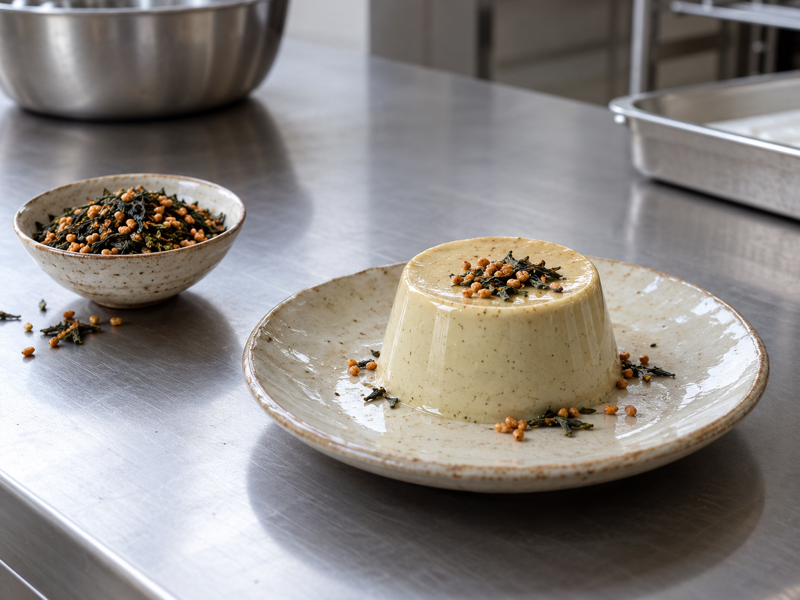
Panna cotta gives genmaicha a quiet base: cream, sugar, and a set texture that can let roasted rice show. It can also fail quietly. A weak infusion disappears after chilling, and loose tea particles can make a dessert meant to be smooth feel gritty. For a restaurant or packaged dessert line, the recipe must set reliably and keep its tea character through storage and service. This guide focuses on the development decisions that determine that outcome, from infusion to portioning.
Contents
- 1. What should genmaicha panna cotta taste like?
- 2. How should the tea be infused?
- 3. Should the dessert use powder instead?
- 4. How can a kitchen set the right tea strength?
- 5. What controls the set and mouthfeel?
- 6. Which toppings support the tea?
- 7. How should portions be filled and unmolded?
- 8. What changes during chilled storage?
- 9. Which food-safety and label checks are needed?
- 10. How can a chain repeat the dessert?
1. What should genmaicha panna cotta taste like?
The first spoonful should register as a creamy dessert with a distinct toasted-rice tea note, not simply vanilla cream colored tan. Decide how much green-tea character the brand wants and whether the roast should lead. A clean finish matters because astringency can seem sharper after the cream melts. Taste the proposed tea as a brewed cup before using it in dairy; a weak or stale blend is unlikely to become convincing in a cold dessert. Write a sensory target that the kitchen can use during trials.
Compare a plain control with genmaicha versions at the same serving temperature. Ask tasters to identify aroma, sweetness, tea, rice, and aftertaste separately. A dessert tasted straight from the fridge may feel muted; a spoonful left warm on the bench may flatter the infusion. Set the service temperature and time in the test. The existing genmaicha ice cream article covers a frozen matrix; panna cotta has a different set and release problem that deserves its own trials.
| Attribute | Target | Failure |
|---|---|---|
| Roast aroma | Clear, gentle | Lost in cream |
| Tea note | Recognizable | Bitter or absent |
| Set | Soft but stable | Rubbery or loose |
| Finish | Clean | Stale rice note |
2. How should the tea be infused?
Use a measured tea mass, liquid volume, temperature, and contact time. Infuse the genmaicha in the liquid chosen for the formula, then strain consistently. A hot water brew and a warm cream infusion extract differently; cream contains fat and can pull or hold aromas in another way. Test the actual method rather than assuming a café tea recipe can be poured into panna cotta without changing the set. Account for evaporation and liquid absorbed by leaves and rice during straining.
A fine filter can improve texture, but over-filtering or squeezing the spent blend may bring unwanted bitterness or particles. Record the yield after straining and make up the formula deliberately if the yield varies. Taste the infused liquid before adding all sugar and stabilizer, then taste the final dessert. A good pre-set infusion does not guarantee a strong cold portion. Use a reference batch and keep sample notes, especially if the tea supplier changes leaf grade or rice roast.
3. Should the dessert use powder instead?
Powder can provide a stronger tea color and flavor without infusion loss. It also adds insoluble leaf and rice solids that may settle or feel sandy in a smooth gel. Ask for the ingredient composition and particle-size information, then test dispersion in the actual cream system. A fine-looking dry powder can still leave a rough finish after chilling. A powdered route may suit a layered or intentionally textured dessert, while a filtered infusion can give a cleaner classic panna cotta.
If the kitchen tries powder, add it with a documented mixing sequence and check the top and bottom of filled cups. Long holding before filling can let particles settle. An extract is another option but may change the label and flavor profile. Compare forms through blind tasting after the planned chill. The choice should follow the finished spoonful, fill consistency, and cost per portion, not the convenience of skipping a strainer.
| Tea form | Strength | Risk |
|---|---|---|
| Warm infusion | Smooth texture | Aroma loss |
| Fine powder | Direct solids | Grit and settling |
| Extract | Easy dose | Narrower profile |
| Surface garnish | First aroma | Soggy topping |
4. How can a kitchen set the right tea strength?
Run a small controlled series with one base formula. Change tea dose or infusion strength, but not both at the same time. Hold cream, sugar, gelatin or other setting system, portion size, and chilling time constant. Record the infused-liquid yield so a stronger tea is not accidentally also a lower-liquid formula. Taste blind after the portions have fully set and reached service temperature. Note whether roast and green tea are both present, and whether a stronger version introduces bitterness.
Once a dose is chosen, repeat it with another lot and a larger batch. A short tasting at the bench can miss batch variation during filling. If the tea note fades after a day, consider the infusion method, package, and storage before increasing dose. A high-dose sample may cost more and taste harsher without solving aroma loss. The aim is a repeatable portion at the last planned service time, not the most intense first spoonful on day one.
5. What controls the set and mouthfeel?
A panna cotta needs enough structure to be served or unmolded without turning rubbery. The setting system depends on the recipe and market: gelatin, agar, or another hydrocolloid will behave differently. Tea infusion can change liquid balance, and some powdered ingredients alter the perception of firmness. Follow a qualified formula development process for the chosen system. Do not transfer a setting dose from a plain dessert without checking the tea variant at the final portion size.
Measure practical outcomes: clean release from the mold, spoon resistance, water separation, and smoothness. If the dessert is sold in a cup, unmolding may not matter; a soft set may be preferable. If it travels in a carton, vibration and temperature variation matter. Test portions from the beginning and end of a filling run. A stable dessert should not have dense tea sediment at the bottom and a pale top. The finished texture should match what the menu photograph suggests.
| Texture issue | Possible cause | Trial response |
|---|---|---|
| Too loose | Liquid or set mismatch | Rebalance formula |
| Rubbery | Excess setting agent | Adjust target |
| Sandy | Coarse powder | Infuse or mill finer |
| Water release | Formula/storage | Stability test |
6. Which toppings support the tea?
Roasted rice, citrus, honey, black sesame, and fruit can work, but each makes a different dessert. Begin with the plain panna cotta and prove the genmaicha flavor first. A crisp rice garnish may echo the blend but soften in a chilled cup. Citrus can lift cream yet pull attention away from the tea. Honey can make the roast feel warm; too much can make the dessert read as honey panna cotta. Add one topping at a time and taste a normal serving.
Consider allergen and service consequences. Sesame changes allergen information; fruit sauce changes moisture and shelf-life behavior. A garnish applied at service may preserve crunch but adds a step for staff. A prepacked retail cup needs the topping to survive its whole distribution period. The kitchen should record whether the topping is packed separately, added on the line, or applied at the counter. The simplest version that tastes clearly of genmaicha is often the strongest menu item.
7. How should portions be filled and unmolded?
Set a fill weight and inspect several cups or molds from each part of a batch. If tea particles or foam accumulate, late portions can differ from early ones. Stirring or filtering controls should be written into the procedure. For an unmolded dessert, test release after the normal chill and after a longer hold. A panna cotta that releases beautifully for the pastry chef but tears for service staff is not ready for a chain. Use the actual plate or container in trials.
If the dessert is sold in a cup, check lid clearance, condensation, and visual separation. A pale tea dessert may look plain; an honest garnish can help, but do not use a dense tea layer only for photographs. The product should remain appetizing under display lighting. Keep a photograph of the approved fill and surface. Train staff to reject cracked, weeping, or poorly set portions rather than covering them with sauce.
| Service format | Main check | Record |
|---|---|---|
| Unmolded plate | Release and shape | Breakage rate |
| Retail cup | Seal and surface | Fill weight |
| Café cup | Speed and topping | Hold time |
| Catering tray | Transport | Vibration trial |
8. What changes during chilled storage?
Cold suppresses aroma and can alter texture. A tea note that was clear in warm infused cream may be faint in a chilled portion. Storage can also bring water separation, surface drying, odor pickup, or a softened garnish. Taste at planned intervals in the final container, including near the intended end of life. Compare with a fresh control. The tea supplier’s date covers the tea ingredient, not a dairy dessert made from it.
Run the study under the real cold-chain plan. A portion may leave production, ride in a vehicle, sit in a café refrigerator, and spend time on a service counter. Temperature excursions and handling need a qualified food-safety assessment. For quality, record flavor, set, appearance, and package integrity at each step. Do not stretch a shelf-life date because the cup still looks smooth. Genmaicha aroma can fail before visible texture does.
9. Which food-safety and label checks are needed?
Dairy, gelatin, and other ingredients bring their own safety, allergen, and labeling requirements. A vegan version using another setting system is a separate formula and needs its own validation. The finished dessert should follow a qualified process for heat treatment where applicable, cooling, filling, storage, and distribution. The tea supplier can provide raw-material records; it cannot certify the safety of the restaurant’s assembled cup. Link ingredient lots to finished batches.
Review the product name and ingredient list against the actual formula. If the dessert contains genmaicha tea, it may contain caffeine; do not describe it as caffeine-free without evidence. Declare dairy and other allergens according to the selling market. If the menu mentions organic tea or a named origin, keep documentation. A label review after the last recipe change is more useful than an early approval of a formula that has since been revised.
| Record | Purpose | Owner |
|---|---|---|
| Tea spec | Composition and lot | Buyer |
| Formula | Exact finished recipe | Pastry team |
| Safety plan | Process and cold chain | QA |
| Artwork | Consumer wording | Regulatory |
10. How can a chain repeat the dessert?
Write the recipe in weights and include infusion yield, straining method, mixing temperature, setting-agent procedure, fill weight, chill time, and serving instructions. Train a second team with the written method and compare its portions blind with the approved reference. If results differ, fix the instruction or equipment assumption. A vague “steep until fragrant” leaves too much room for variation between kitchens and shifts.
Cost the full system: tea input, infusion loss, cream, setting agent, cups, garnish, labor, chilled distribution, and rejected portions. Test a production-equivalent batch before rolling out to several sites. The final check is a normal customer portion near the end of the planned service window. It should still taste of roasted rice and green tea, hold its shape, and match the menu description.
FAQ
Q1. Is infusion better than powder? Infusion tends to be smoother; powder can be stronger but may add grit. Test the actual dessert.
Q2. Why is the tea weak after chilling? Cold service reduces aroma perception. Judge at serving temperature.
Q3. Can roasted rice be used as a garnish? Yes, but check hardness and whether it softens in a chilled cup.
Q4. Is a tea panna cotta caffeine-free? Not by default. Standard genmaicha contains green tea.
Q5. What should be validated before sale? The set, flavor, food-safety process, cold storage, and finished-product shelf life.
Approve the dessert as it reaches the customer: cold, portioned, and inside its real service container.