
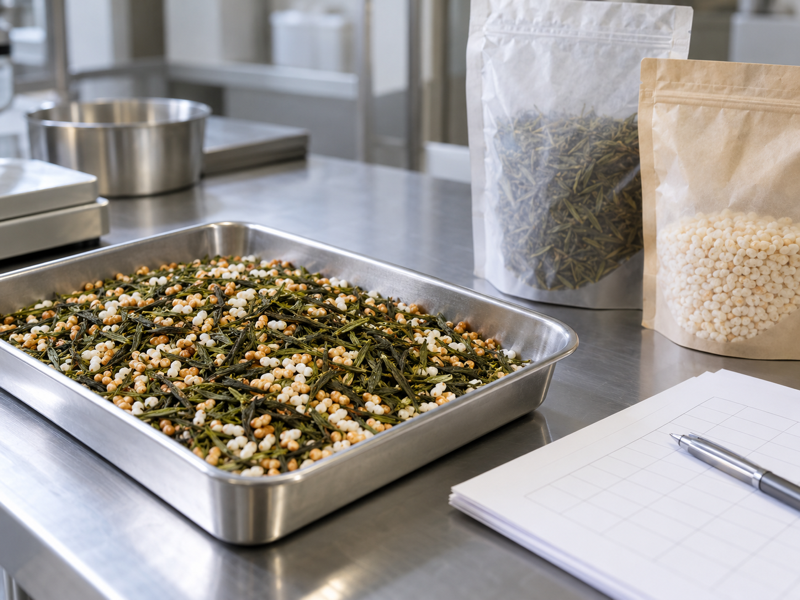
A basic genmaicha blend uses green tea and roasted rice. Those ingredients can make the product look straightforward for a gluten-free range, but an ingredient impression is not a finished-product claim. Flavorings, shared equipment, cross-contact, and market labeling rules still need review. This article gives tea buyers and private-label teams a practical way to assess a genmaicha SKU before printing “gluten free” on a pouch or answering a customer with celiac disease. It does not certify any supplier’s product.
Contents
- 1. Is plain genmaicha gluten free by ingredient?
- 2. Why is an ingredient list only the first step?
- 3. What does the US gluten-free claim require?
- 4. Where can cross-contact happen?
- 5. How should a supplier assess roasted rice?
- 6. What changes in flavored or matcha blends?
- 7. Which tests and records help support a claim?
- 8. How should a café answer a celiac question?
- 9. What should a buyer put in the specification?
- 10. When should the claim be reviewed again?
1. Is plain genmaicha gluten free by ingredient?
A conventional genmaicha is green tea blended with roasted rice. Rice is not wheat, rye, or barley, and the tea plant is not a gluten grain. Japan’s MAFF tea reference describes genmaicha as roasted brown rice mixed with a green tea base. That composition suggests a simple ingredient starting point. It does not prove what is in every commercial SKU or what happened during processing and packing. Read the actual ingredient declaration before making any claim.
A product labeled “genmaicha” may add matcha, flavoring, sweeteners, or other ingredients. The supplier may also pack it on shared equipment. If the buyer wants a gluten-free claim, it needs a product-specific review of ingredients and controls. A customer asking whether a plain cup is suitable is asking about the cup sold at that café, not about an abstract tea category. The answer must follow the finished product and the relevant jurisdiction, including anything added during preparation.
| Product | Initial ingredient question | Further check |
|---|---|---|
| Plain loose blend | Tea and rice only? | Cross-contact |
| Matcha-iri blend | Added matcha? | Full spec |
| Flavored blend | Carrier ingredients? | Supplier disclosure |
| Latte | Milk or mix added? | Finished recipe |
2. Why is an ingredient list only the first step?
Ingredient lists tell buyers what was intentionally added. They may not reveal unintended cross-contact from receiving, storage, roasting, blending, milling, or packing. A facility handling barley tea or wheat-containing snacks may need segregation and cleaning controls before a genmaicha SKU can support a gluten-free claim. The presence of shared equipment is not, by itself, proof of contamination; it is a risk to assess. Ask how the supplier maps those flows and verifies its controls.
Trace the product from rice and tea suppliers to the final sealed pack. Identify where open material moves, which tools touch it, and whether rework is used. Review labels and work orders for the exact SKU, because an otherwise suitable blend can be mispacked or misidentified. A defensible claim depends on a controlled process, not a single “no gluten ingredients” checkbox. The buyer’s quality team should decide what supplier evidence and finished-product testing are appropriate to the risk.
3. What does the US gluten-free claim require?
The US Food and Drug Administration explains that a food labeled “gluten-free” must meet its defined criteria, including less than 20 parts per million gluten from unavoidable presence and restrictions on gluten-containing grain ingredients. The FDA’s questions and answers also explain that rice can be labeled gluten-free if any unavoidable gluten from cross-contact remains below that limit. The manufacturer is responsible for the claim.
That US rule is not a global template. Importers should check the law and claim wording in every destination market. A supplier certificate may support review, but the brand using the claim needs to verify that the certificate covers the correct product, lot, method, and jurisdiction. Do not copy “gluten-free” from a competitor’s online listing. A cup brewed in a café may also involve added ingredients or shared utensils that require a separate service assessment.
| Claim element | US reference | Buyer action |
|---|---|---|
| Ingredient restrictions | FDA rule | Review formulation |
| Unavoidable gluten | Under 20 ppm | Assess test evidence |
| Cross-contact | Manufacturer control | Audit process |
| Final label | Accurate claim | Regulatory approval |
4. Where can cross-contact happen?
The rice supply may use transport, storage, or handling equipment that also sees gluten-containing grains. A tea facility may pack multiple products on shared lines. Dry powders and crumbs can move through air or remain in bins if cleaning is weak. The buyer should ask for the supplier’s allergen or gluten risk assessment, site map, line schedule, cleaning procedures, and verification records. The detail matters more than a blanket “we use separate lines” statement that no one can connect to the actual SKU.
At a café, the tea itself may be controlled while the preparation station introduces a separate risk. Scoops, grinders, syrup pumps, pastry crumbs, or shared milk-frothing equipment can affect the finished drink. Train staff to distinguish sealed packaged tea from a prepared beverage. If the café cannot verify its controls for customers with celiac disease, it should say so plainly. A reliable “cannot guarantee” response is better than a confident answer based only on rice being an ingredient.
5. How should a supplier assess roasted rice?
Ask where the rice is sourced, how it is roasted, what other grains are handled nearby, and how lots are identified. The roast process can change flavor and moisture but should not be assumed to remove gluten introduced by cross-contact. The supplier should document incoming checks, storage segregation, equipment cleaning, and release criteria suitable to its facility. If the rice is blended with tea at another site, review that site too. A single upstream declaration does not cover the full chain.
Roast profile and rice particle size matter to product quality, but a gluten claim needs a different evidence path. Keep quality and claim records linked by lot. If a buyer changes rice supplier to fix price or flavor, revisit the gluten assessment before continuing an existing label. The new material may have a different handling route even if both suppliers call it roasted brown rice. The purchase specification should require notification before this kind of change.
6. What changes in flavored or matcha blends?
Matcha is tea powder, but a matcha-iri blend can have different manufacturing and packing steps from loose-leaf genmaicha. A flavored SKU may include carriers or processing aids that deserve closer ingredient review. A dessert or beverage using genmaicha can add flour, malt, cookie crumbs, or other gluten sources. The question “is genmaicha gluten free?” must be answered at the level of the exact finished product. A component can be suitable while the final menu item is not.
For private-label programs, request full sub-ingredient information where the supplier can provide it and check label declarations. Keep the base tea SKU separate from premixes and café recipes in the product database. The genmaicha matcha-iri guide explains why that blend has a different composition. A gluten-free claim may still be possible for a specific SKU, but it needs evidence for every intentional ingredient and for cross-contact through its own production route.
| Format | Added risk question | Review owner |
|---|---|---|
| Plain loose tea | Shared grain handling? | Supplier QA |
| Tea powder | Shared milling? | Quality team |
| Flavored blend | Carrier composition? | Regulatory |
| Café dessert | Flour and utensils? | Kitchen lead |
7. Which tests and records help support a claim?
The FDA does not require one universal test plan for every food. It lists several tools manufacturers may use, including ingredient testing, finished-product testing, supplier certificates, and third-party certification. The right plan depends on material and process risk. A buyer should ask what method is used, its detection limit, which lot it covers, and how often verification occurs. A test result on one development sample does not automatically cover future production from a changed supplier or line.
Document the decision. Keep the ingredient review, facility assessment, cleaning evidence, test reports where used, product specification, artwork approval, and change-control record together. For a high-risk claim, a third-party audit or certification may add confidence, but a logo alone should not replace the underlying scope. Check whether certification covers the exact product and site. If the evidence is incomplete, hold the claim rather than inventing a threshold or printing a reassuring phrase that the business cannot defend.
8. How should a café answer a celiac question?
Staff should retrieve the approved ingredient and allergen information for the exact tea or menu item. They can say what the product contains and what the café knows about cross-contact controls. They should not diagnose celiac disease or promise that any drink is medically safe for an individual. If the product carries a substantiated gluten-free claim, staff can point to it and still explain any preparation risks at the café. If the claim has not been approved, do not infer one from rice and tea alone.
A practical training script might be: “Our plain genmaicha ingredients are green tea and roasted rice. I need to check our current supplier and preparation information before I can answer about gluten cross-contact.” That response is slower than a confident guess but far safer. It also shows management whether the information system works. If staff cannot find the current spec, the next task is to improve records and training, not to give them a smoother sentence.
9. What should a buyer put in the specification?
Record the full ingredient list, rice and tea suppliers, manufacturing site, any relevant allergen and gluten controls, pack format, approved claim wording, lot codes, test requirements, and change-notification triggers. Specify whether the buyer expects a gluten-free claim or only a composition statement. Those are different purchase requirements. The supplier should understand which documents must accompany shipment and how a deviation will be handled. Link the spec to artwork and the finished SKU.
For a food manufacturer buying genmaicha as an ingredient, the finished product needs its own assessment. Tea documentation helps but does not certify a cookie or ice cream. The buyer should consider the whole formula and production line. If a restaurant uses the tea as a beverage and a broth, the kitchen needs separate handling instructions. A clear specification prevents sales, quality, and operations from each making a different assumption about the same ingredient.
| Spec field | Why it matters | Change trigger |
|---|---|---|
| Ingredient list | Intentional gluten source review | Formula change |
| Site and line | Cross-contact assessment | Site move |
| Test/COA scope | Claim support | New method |
| Artwork version | Public wording | Label change |
10. When should the claim be reviewed again?
Review it when ingredients, suppliers, processing sites, shared equipment, cleaning controls, packers, or destination rules change. Also review it after a test failure, a complaint, or a packaging error. Claims can become stale quietly when procurement solves a supply shortage with a “like-for-like” substitute that has a different handling history. Make the change process require quality and regulatory sign-off before the next lot is packed under the old label.
Routine review should include a current supplier declaration and a check that lot records match the approved spec. For a café chain, update recipe cards and staff answers whenever the tea or added ingredients change. If evidence no longer supports the claim, remove or suspend it while the problem is investigated. A specific, documented answer to customers is more valuable than a broad promise based on how genmaicha is traditionally made.
| Review trigger | Immediate action | Record to retain |
|---|---|---|
| New rice supplier | Reassess handling | Supplier declaration |
| New packing line | Check cross-contact controls | Line approval |
| Test failure | Hold affected lot | Investigation |
| Label revision | Reapprove claim | Artwork sign-off |
FAQ
Q1. Are rice and green tea naturally gluten grains? No. Rice and tea are not wheat, rye, or barley, but that does not certify a finished blend.
Q2. Can a US brand print “gluten-free” on genmaicha? It can if the specific product meets the FDA definition and the manufacturer can support the claim.
Q3. Does roasting rice remove gluten from cross-contact? Do not assume it does. Control and test the material and process as needed.
Q4. Is a genmaicha latte gluten-free if the tea is? Not automatically. Review milk alternatives, syrups, toppings, and café handling.
Q5. What should a buyer request first? A current ingredient statement and the supplier’s gluten and cross-contact assessment for the exact SKU.
Before using the claim, trace the sealed pack from its rice supplier through the final line. The answer must hold for that route, not only for the recipe on paper.