
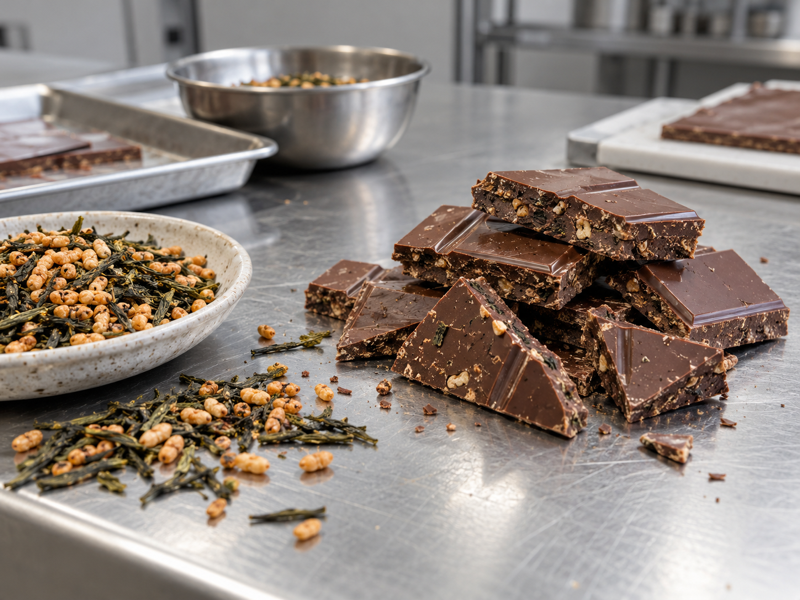
Chocolate can carry genmaicha’s roasted-rice note beautifully, but cocoa fat and sweetness can hide the green tea. A bar that smells good at the mixing bowl may taste like ordinary white chocolate after it sets. Confectionery teams need to decide whether the tea belongs in the chocolate mass, a filling, or a surface layer, then test texture and shelf performance. This guide lays out that development work for brands and ingredient buyers. It avoids a fixed recipe because cocoa type, fat level, and particle size change the result.
Contents
- 1. What should genmaicha chocolate taste like?
- 2. Which chocolate base reveals the tea?
- 3. Should the tea be powder, infusion, or filling?
- 4. How should a dose trial be structured?
- 5. What texture problems can tea particles cause?
- 6. How can rice aroma survive processing?
- 7. Which quality checks matter after setting?
- 8. What changes during storage and shipping?
- 9. How should the label describe the tea?
- 10. What should a supplier hand over for scale-up?
1. What should genmaicha chocolate taste like?
A finished piece should give a clear reason for the word “genmaicha” on the pack. Decide whether the first impression should be toasted rice, green tea, cocoa, or a balance. White chocolate can provide a pale, creamy background for the rice note; milk chocolate may make it taste like cereal milk; dark chocolate can cover delicate tea but support a stronger roast. None is automatically correct. The chosen base should reflect the consumer experience the brand wants to sell.
Taste plain chocolate controls beside trial pieces. Ask panelists to describe aroma before biting, flavor as the chocolate melts, and aftertaste. A tea note that appears only in the dry powder but not the finished piece has no commercial value. Watch for bitterness at higher doses and for a dusty finish. The existing genmaicha taste guide can help define a tea reference, but a confectionery sensory target must be built from the actual chocolate.
| Chocolate base | Likely advantage | Watch point |
|---|---|---|
| White | Tea and rice can stand out | High sweetness |
| Milk | Familiar cereal profile | Roast may blur |
| Dark | Strong cocoa pairing | Tea may vanish |
| Compound coating | Process flexibility | Flavor/fat quality |
2. Which chocolate base reveals the tea?
Start with the simplest base that fits the price and label brief. Use the same tea dose across two or three chocolate bases, then taste blind after full crystallization. The cocoa and dairy components affect how quickly aromas reach the nose. White chocolate often shows subtle flavors, but its sugar can flatten tea. Dark chocolate may need a more distinct roasted-rice ingredient. A buyer should test the base before optimizing a premium genmaicha powder around an unsuitable matrix.
Also check melting behavior and color. Tea solids can make a pale base tan or greenish; a dark base hides that visual cue. If the product is a filled bonbon, the shell and center should be tasted together at the serving temperature. A tea-rich center can look successful alone yet disappear behind a thick shell. Adjust shell-to-filling ratio only after the tea ingredient itself performs. The cost model should use grams per finished piece and expected rejects, not powder price alone.
3. Should the tea be powder, infusion, or filling?
A fine genmaicha powder can be mixed into a fat-based mass, but tea and rice solids may make the texture sandy if particles are too coarse. A water-based infusion is difficult in a conventional chocolate mass because water can cause seizing; it may be better suited to a controlled ganache or other formulated filling. A flavor extract may deliver aroma at a lower solids load, but it needs an honest label and a sensory comparison with the whole-tea target. Ask the supplier exactly what the “genmaicha” ingredient contains.
Plan process trials with the confectioner’s equipment. A tabletop bowl may disperse a powder that clumps in a larger melter. A filling adds moisture and microbiological considerations that a solid bar may not have. The tea buyer should provide a current specification, particle-size information if available, allergen and contaminant documents, and a traceable sample lot. The chocolate team decides whether the material belongs in the mass, center, or garnish after tasting and stability work.
| Tea form | Useful application | Main risk |
|---|---|---|
| Fine powder | Bar or coating | Grit and viscosity |
| Brewed infusion | Ganache or syrup | Water control |
| Extract | Aroma adjustment | Different profile |
| Whole rice garnish | Visual cue | Hard bite |
4. How should a dose trial be structured?
Choose one chocolate base and one tea form for the first round. Make a plain control and several tea levels within a sensible range from supplier guidance. Hold batch size, melt temperature, mixing time, tempering method, mold, and cooling constant. Record viscosity and how the material behaves during deposit. If higher doses make the mass too thick, that is a process result, not a reason to quietly add fat before tasting. Change one variable at a time so the team can tell what improved the product.
Taste the pieces after they have set and equilibrated, then repeat after storage. Blind panelists should score roasted-rice aroma, green tea, cocoa balance, texture, and lingering bitterness. A high-dose sample may win on aroma but lose on mouthfeel and cost. Repeat the winning condition with another tea lot. If the sensory result changes materially, tighten the ingredient specification or broaden the accepted target with evidence. Avoid choosing a formula from the first attractive sample photograph.
5. What texture problems can tea particles cause?
Chocolate is sensitive to particle size. Coarse leaf or rice can feel gritty against an otherwise smooth melt. A powder that looks fine in a dry spoon may still leave a sandy finish once dispersed in cocoa butter. Ask for particle-size data and run a mouthfeel panel at the intended serving temperature. If the product deliberately includes crunch, distinguish pleasant toasted-rice pieces from accidental coarse powder. The packaging photo and product name should prepare consumers for that texture.
Solids can also raise viscosity and interfere with molding or enrobing. Track deposit weight, shell thickness, air bubbles, and surface finish as the tea dose changes. Do not assume a longer mixing time will fix a coarse ingredient; it may only heat the mass or damage aroma. If fine milling is needed, test it with the supplier and check whether the new powder changes color or flavor. A smooth bar and a crunchy inclusion are different product concepts and should be specified separately.
| Defect | Possible source | Next action |
|---|---|---|
| Sandy melt | Coarse tea/rice | Finer grade trial |
| Thick mass | High solids load | Rebalance formula |
| Pale streaks | Poor dispersion | Mixing check |
| Hard inclusions | Large rice pieces | Size specification |
6. How can rice aroma survive processing?
Roasted-rice aroma can weaken during warm holding, extended mixing, or storage. Keep a timed record of when the tea enters the process and how long the mass stays warm. Compare a shorter and longer holding condition while keeping the formula fixed. If the difference is obvious, the process needs a limit or the ingredient needs a different form. Do not simply overdose the tea to compensate for an avoidable loss; that can raise grit and bitterness without restoring the right aroma.
The cocoa base can also mask the roast. Before changing the tea, taste it in a lighter chocolate or a thinner shell. A separate tea filling may give a clearer first impression, though it changes shelf-life and safety work. Use the actual finished piece as the acceptance standard. When a supplier proposes a “high-aroma” grade, test it under the factory’s normal heat history. The claim matters only if the difference survives to the consumer.
7. Which quality checks matter after setting?
Check temper or coating stability, appearance, snap or bite, melt, tea flavor, and piece weight. Tea solids can affect the way a mass flows and crystallizes, so production specialists should validate the final process rather than carrying over settings from plain chocolate. Sample from the start, middle, and end of a run. If the tea settles in a holding tank, later pieces may taste stronger and look darker. Record mixing or agitation controls that prevent that drift.
A sensory reference should be a finished piece from an approved production-equivalent lot. Dry tea aroma is useful for incoming inspection but cannot replace the chocolate reference. Check that packaging protects the pieces from heat and odor pickup. Train quality staff to distinguish normal tea flecks from bloom, poor dispersion, or contamination. Small appearance changes can matter strongly in premium confectionery, especially when the pack has a clear window.
| QA check | Sample point | Decision |
|---|---|---|
| Flavor | Set piece | Tea recognizable? |
| Texture | Melt and bite | Grit acceptable? |
| Flow | During deposit | Line stable? |
| Surface | After storage | Bloom or streaks? |
8. What changes during storage and shipping?
Chocolate can bloom, absorb odors, or melt and reset under poor temperature control. Genmaicha aroma may also fade, and a filling may introduce moisture-related shelf-life limits. Study the finished piece in the final wrapper and shipping carton under realistic conditions. A tea powder’s own shelf-life date does not validate the chocolate. Set separate acceptance criteria for flavor, surface, texture, pack integrity, and microbiological safety where relevant to the formula.
Taste near the intended end of life beside a fresh control. A bar that still looks attractive may have lost its roasted-rice signature. If shipping crosses hot regions, test the route or a justified simulation. When a defect appears, keep lot and process records for both tea and chocolate. A common error is blaming a “weak tea batch” when the true change was longer warm holding or a thinner package film. Evidence from the whole system identifies the cause.
9. How should the label describe the tea?
The front label should name a flavor customers can find. “Genmaicha chocolate” needs a real genmaicha ingredient or a clearly disclosed flavor system consistent with market rules. The ingredient list should reflect tea, rice, chocolate components, and any flavoring, with allergens reviewed for milk, soy, nuts, or shared lines. Avoid claiming caffeine-free when green tea is present. A small tea dose may contribute little caffeine, but a zero claim requires evidence.
If the brand uses a premium leaf or origin story, obtain documentation for it. The nutrition panel and serving size belong to the finished confection, not the tea powder. Link approved artwork to the formula revision; a late change from powder to extract or from white to milk chocolate may require a label update. The copy can be concise: “white chocolate with green tea and roasted rice” tells customers more than a vague promise of Japanese calm.
| Label field | Verify against | Change trigger |
|---|---|---|
| Product name | Finished flavor | Formula trial |
| Ingredient list | Full recipe | New tea form |
| Allergens | Materials/site | Line change |
| Shelf date | Finished-product study | New pack |
10. What should a supplier hand over for scale-up?
A tea supplier should provide a specification with composition, physical form, lot code, storage guidance, relevant quality records, and a change-notification process. A chocolate maker should keep the approved tea lot, test formula, process parameters, sensory reference, finished-product stability results, and artwork revision together. If the buyer wants a larger order, ask whether the supplier can repeat the same roast and particle profile over the planned period. A one-off sample is a starting point, not a supply plan.
Scale up in steps. Run a production-equivalent batch, monitor dispersion through the full tank, and package it on the actual line. Taste pieces from different times in the run after storage. Then compare cost per piece, expected rejects, and margin. If the product only works with a fragile process or an inconsistent powder, revise the concept while it is still a pilot. A successful genmaicha chocolate is the same recognizable piece at the first and last carton.
FAQ
Q1. Is white chocolate always best for genmaicha? No. It often reveals tea, but sweetness may mask the finish. Test bases blind.
Q2. Can brewed tea be poured into melted chocolate? Water can cause seizing. A formulated filling is usually a separate development route.
Q3. Why does genmaicha powder feel gritty? Tea and rice particles may be too coarse for the chosen chocolate system.
Q4. Does chocolate preserve the tea aroma automatically? No. Warm processing, packaging, and storage need testing.
Q5. What should be approved first? The finished piece’s flavor and texture, followed by process and shelf stability.
Keep one approved finished piece as the reference. The tea powder is an ingredient; the chocolate is the product.