
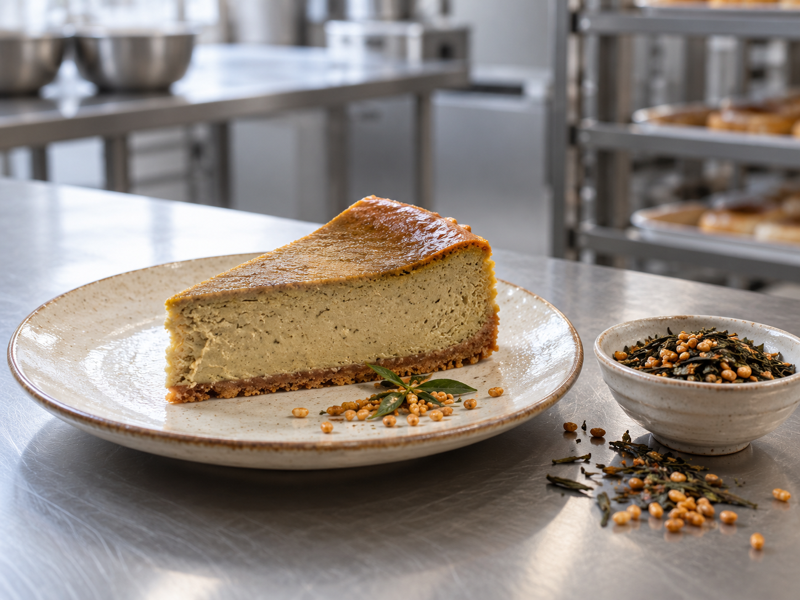
Cheesecake makes genmaicha tempting: cream can soften green-tea edges while toasted rice adds a cereal finish. It also creates a hard flavor problem. Cheese, sugar, and a browned top can bury the tea until the slice tastes like a normal cheesecake with a fashionable name. A bakery needs to decide where the tea enters, how it survives baking or chilling, and how the slice holds in service. This guide is a development plan for commercial pastry teams, with tests to run before a menu or packaged launch.
Contents
- 1. What should genmaicha cheesecake taste like?
- 2. Which cheesecake style suits the tea?
- 3. What tea form works in a cream-cheese base?
- 4. How should a bakery set the tea dose?
- 5. What does heat do to the roasted-rice aroma?
- 6. How can texture remain smooth?
- 7. What belongs in the crust or topping?
- 8. How should chilled service be tested?
- 9. What safety and label checks are needed?
- 10. How can the bakery scale the recipe?
1. What should genmaicha cheesecake taste like?
Define a slice that customers can recognize without reading the menu. The cream-cheese tang should remain pleasant, while roasted rice and green tea should appear before the finish. Decide whether the tea is the main flavor or a quiet note behind citrus, caramel, or chocolate. A “tea-flavored” target is too loose for a production team. Write separate sensory markers for aroma, first bite, mid-palate, and aftertaste, then taste the cheesecake plain before evaluating garnish.
Compare a control cheesecake with tea trials at the same serving temperature. If tasters name only caramelized top and cream cheese, the tea claim is not earning its place. If they find a coarse rice texture or an astringent finish, more sugar may hide rather than solve the issue. The existing genmaicha yuzu cake takes a citrus-led direction; this cheesecake guide keeps the question on how a creamy base carries tea. The product brief should be written before the supplier sends powders.
| Flavor layer | Target | Warning sign |
|---|---|---|
| Cream cheese | Clean tang | Sourness hides tea |
| Toasted rice | Recognizable roast | Burnt or absent |
| Green tea | Gentle finish | Harsh bitterness |
| Sweetness | Supports both | Flattens flavor |
2. Which cheesecake style suits the tea?
A baked cheesecake, a Basque-style browned cake, and a no-bake chilled cake expose genmaicha to different conditions. A strongly browned top can echo the roasted-rice note but also mask it. A no-bake system may keep more tea aroma yet rely on a different stabilizing system and tighter chilled handling. A classic baked cake can offer a cleaner tea expression if the bake avoids heavy caramelization. Choose the style by a side-by-side tasting, not by the popularity of one recipe online.
Make small pilot batches of the same tea ingredient in two styles. Keep the slice size and serving temperature comparable. Record yield, handling time, visible cracks, water release, and customer-facing appearance. A café chain may favor a preportioned chilled format for service; a bakery counter may value the drama of a Basque top. The commercial winner balances flavor with a process the kitchen can repeat. A slice that works only when the pastry chef stands beside the oven is not ready for several stores.
3. What tea form works in a cream-cheese base?
A fine genmaicha powder can be mixed into the batter or filling, but it may add specks and grit. A brewed infusion or concentrated tea can give a smoother result, though its water must be accounted for in the formula. A supplier extract can be easy to dose but may not match the breadth of real leaf and roasted rice. Ask for composition, particle size, and sensory samples of each candidate. A powder made from only leaf with a separate rice flavor is not the same ingredient as milled whole genmaicha.
Trial dispersion before baking a whole cake. Mix the tea into a small portion of the cream base and check for lumps, color, and flavor after chilling. Some powders wet poorly in a cold, fatty mix. An infusion may thin a no-bake filling or change the set. Adjust the formula deliberately and record every change. A smooth test spoonful is useful, but the finished slice and its crust must be tasted together. The ingredient form should be selected for the finished product, not for convenience at the bench.
| Tea form | Advantage | Development risk |
|---|---|---|
| Fine powder | Direct tea solids | Grit and specks |
| Infusion | Smooth mouthfeel | Added water |
| Extract | Compact dose | Narrow flavor |
| Surface dust | Strong first aroma | Mess and moisture |
4. How should a bakery set the tea dose?
Use a plain control and several tea levels in one stable cheesecake base. Hold cream-cheese brand, sugar, egg or stabilizer, pan size, bake or chill schedule, and serving temperature constant. Record the ingredient weight as a percentage of the full batter. If the tea form changes water or solids, note that effect instead of hiding it with an unrecorded adjustment. Taste blind once the cake has reached its normal service condition, not when it is still warm from production.
A high dose can increase bitterness, darken the filling, or create a dry texture. A low dose can disappear after refrigeration. Pick the lowest dose that meets the flavor target, then repeat it with another tea lot and a production-equivalent batch. Cost per slice matters, especially if the bakery uses a premium tea powder. Include scrap from cracked or poorly set cakes in the cost model. A fixed internet percentage is less useful than a documented range for the bakery’s own base.
5. What does heat do to the roasted-rice aroma?
Baking can drive off delicate rice volatiles while adding browned flavor from the cake. The result may taste “toasty” without tasting specifically of genmaicha. Compare raw batter aroma, cooled cake, and chilled slice. If the tea is lost during baking, test another tea form, a shorter heat exposure within the validated process, or a controlled tea layer added after baking. Do not compromise the cake’s safety or set just to keep aroma. The food technologist and pastry chef need to approve any process change together.
A Basque top is a special case. Its caramelized edge can make the overall dessert attractive even if the tea is faint. Ask tasters to evaluate a bite with top and a bite from the center. If only the center carries tea, decide whether that is acceptable in a normal slice. If the top overwhelms it, reduce browning or make the tea component more distinct. Document the oven endpoint with temperature, time, and visual standard rather than “bake until done.”
| Stage | Flavor risk | Check |
|---|---|---|
| Mixing | Powder lumps | Batter sample |
| Baking | Aroma loss | Cooled cake |
| Chilling | Aroma muted | Service slice |
| Display | Drying/odor pickup | End-of-day sample |
6. How can texture remain smooth?
Cheesecake should not feel sandy. Fine tea leaf and rice particles can still be noticeable in a creamy matrix, especially after the slice is cold. Test mouthfeel across several bites, including the edge and center. If powder settles during a long hold before baking, one cake may be darker or stronger at the bottom. Stirring controls and prompt filling may help, but a coarse material may need replacement. Request a finer grade or test an infusion rather than accepting grit as “authentic.”
The tea can also change moisture balance. A dry powder can absorb water and make a no-bake filling thicker; an infusion can soften the set. Measure cut quality, weeping, cracking, and firmness after the planned storage period. A dessert that slices cleanly on day one may leak on day three. Use the full plated item in the evaluation because sauces and fruit can hide a texture fault during tastings. A stable base needs a sensory target and a physical release standard.
7. What belongs in the crust or topping?
A plain biscuit crust lets the filling carry the tea. A toasted-rice or sesame crust can reinforce the cereal note but may crowd it. A citrus topping can brighten a heavy slice; too much acid can make the tea feel thin. Begin with the simplest version, then add one element at a time. Taste with a standard plated portion rather than an oversized development slice. The customer will experience a ratio of filling, crust, and topping, not three separate components.
If the bakery uses actual roasted-rice pieces in a crust, check their bite and moisture behavior after refrigeration. Hard grains are unpleasant, and a crisp crust can soften under a wet filling. A tea dusting can look good at plating but may clump in a packaged slice. Decide whether the garnish is made at service or at central production. The operational choice affects labor, waste, allergen review, and whether every store can reproduce the photograph.
| Component | Possible benefit | Check |
|---|---|---|
| Plain crust | Clean tea signal | Moisture migration |
| Rice crust | More roast | Hard pieces |
| Citrus topping | Lifts cream | Tea masking |
| Tea dust | First aroma | Clumping |
8. How should chilled service be tested?
Taste the cheesecake at the temperature and age at which it will be sold. A cold slice releases less aroma than a warm spoonful of filling. A café display may hold portions for hours after cutting, while a packaged retail slice may travel for days. Test both the protected whole cake and exposed service slice. Record edge drying, weeping, surface color, and flavor. The kitchen should define a practical display period from evidence rather than treating the printed shelf-life date as permission to hold an open slice indefinitely.
For a chain, run a service simulation: remove the cake from storage, cut normal portions, plate or pack them, and sample through a busy shift. If a garnish is applied on demand, measure the extra time. Staff may skip a fussy step when the queue grows. A good recipe can be served accurately by someone who was not present at the development tasting. Write a short station card and train with the actual product.
9. What safety and label checks are needed?
Cheesecake commonly contains dairy and may contain egg, wheat, soy, or nuts depending on the formula. The finished product needs a qualified food-safety process and a shelf-life study for its own packaging and distribution. Tea supplier documents support raw-material review, but they do not validate a chilled dairy dessert. Review ingredient declarations, allergens, nutrition, claims, storage instructions, and lot traceability. A café version and a packaged retail version may need different controls.
Avoid suggesting that genmaicha makes cheesecake healthy or caffeine-free. It is still a dessert with tea ingredients. If the brand calls out a premium tea grade or origin, keep supplier evidence. Link approved artwork to the production formula, and require review when tea form or topping changes. If the product moves from a small bakery to a central plant, revisit the process and safety plan. A familiar recipe name does not make the scaled process automatically safe.
| Record | Owner | Purpose |
|---|---|---|
| Tea specification | Procurement | Ingredient identity |
| Finished formula | Bakery | Repeatability |
| Allergen review | Regulatory | Accurate label |
| Shelf study | Quality | Storage date |
10. How can the bakery scale the recipe?
Translate every ingredient to weight and define a mixing sequence, batter temperature, fill weight, pan size, bake or chill endpoint, cooling method, and portion size. Keep a retained reference slice and a photograph of its normal appearance. Test multiple positions in the oven or depositor; a powder can disperse unevenly in a large mixer. If the winning pilot used a small batch, run a production-equivalent trial before finalizing pricing and artwork.
The supply plan matters too. Ask whether the tea ingredient can be repeated across lots and whether rice roast changes are controlled. Compare two lots in the finished cake. Track yield, rejected slices, topping labor, and cold-chain costs per serving. A cheesecake that looks attractive in a single social post may be costly or unstable on a real line. Approve the menu item when the slice still tastes of genmaicha after the normal production, storage, and service sequence.
FAQ
Q1. Is powder or brewed tea better for genmaicha cheesecake? Powder can be stronger but gritty; infusion is smoother but adds water. Test both in the chosen base.
Q2. Does a browned Basque top help? It can echo roast, but it can also hide the tea. Taste center and top together.
Q3. Why does the tea taste weak after chilling? Cold service suppresses aroma. Evaluate at the actual serving temperature before setting dose.
Q4. Can the product be labeled caffeine-free? Not from the name alone. Standard green tea contains caffeine.
Q5. What is the first commercial test? A blind comparison with a plain cheesecake, using a normal slice after the planned chill period.
Keep the approved reference as a ready-to-serve slice. That is the standard the bakery needs to repeat.