
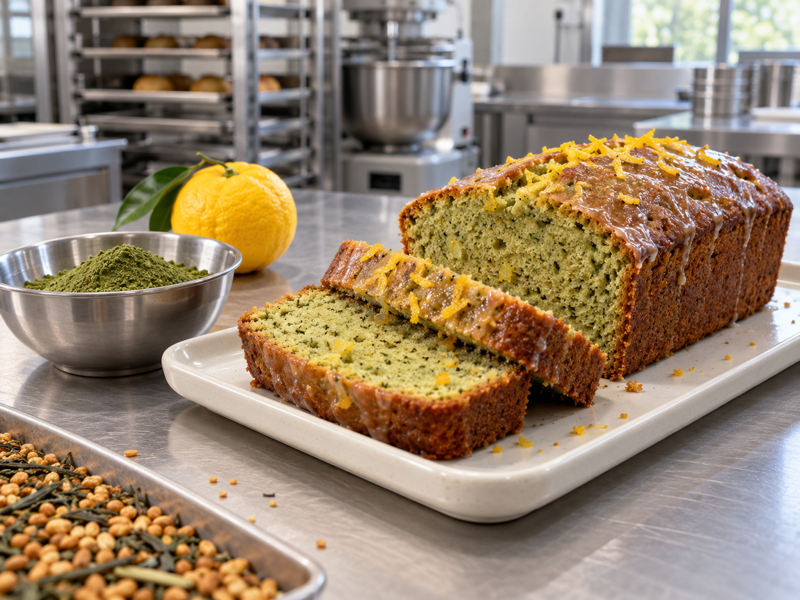
Genmaicha yuzu cake brings roasted-rice tea aroma and bright citrus into a bakery format. The difficult part for a commercial team is keeping both notes recognizable after baking, glazing, packing, and several days on a shelf. This guide sets out a practical development route: define the sensory target, select tea and citrus formats, run controlled pilots, and document what survives the process. Its quantities are starting points for trials, not a validated production formula.
Contents
- 1. What should a genmaicha yuzu cake taste like?
- 2. Which genmaicha format suits cake production?
- 3. Which yuzu ingredient should a bakery use?
- 4. How can a pilot formula be structured?
- 5. How should the batter and bake be controlled?
- 6. Where should citrus and tea flavor be added?
- 7. How can teams evaluate shelf life?
- 8. What should a bakery ask ingredient suppliers?
- 9. How should a sensory trial be organized?
- 10. When is the concept ready for scale-up?
1. What should a genmaicha yuzu cake taste like?
A useful target describes an eating experience rather than a fashionable ingredient list. For a genmaicha yuzu cake, try a moist, moderately sweet crumb; a gentle green-tea backbone; a recognizable toasted-rice aroma; and a clean citrus finish. Decide whether the cake should feel like a tea cake with citrus or a citrus cake with tea. Those two briefs lead to different ingredient levels and different glazes. A buyer can then compare samples against a common target instead of choosing whichever cake smells strongest in the test kitchen.
Roasted notes can read as nutty, cereal-like, or even slightly smoky depending on the tea blend. Yuzu can read as peel, juice, or confectionery citrus depending on its form. Record the intended descriptors and the defects you want to avoid. In a retail loaf, bitterness after swallowing may matter more than the immediate aroma. In a foodservice slice, the first bite may carry more weight because the cake is served fresh. Neither priority should be assumed for both channels.
| Sensory point | Target for a pilot | Warning sign |
|---|---|---|
| Aroma | Distinct toasted rice and light citrus | Burnt or perfumed note |
| Crumb | Moist and even | Dense base or wet streak |
| Taste | Tea present without harshness | Bitter finish |
| Citrus | Clear after the swallow | Sour glaze masks tea |
2. Which genmaicha format suits cake production?
Traditional genmaicha combines green tea with roasted rice. Japan's Ministry of Agriculture, Forestry and Fisheries describes blends made with bancha, gyokuro, or sencha and notes that some production uses roasted cooked white rice. That range matters: one supplier's blend will not behave exactly like another's. In baking, a finely milled powder usually disperses more evenly than loose leaves. Whole rice pieces can bring texture, but they may soften inside batter or create hard points if added without a controlled preparation step.
Ask whether the supplied material is a milled whole blend, tea powder plus roasted-rice powder, an extract, or a premix with sweetener. Those are different ingredients. Screen powder for visible specks, aroma after heating, particle size appropriate for the batter, and behavior in fat-rich systems. A small sieve test and a baked control tell more than color in the bag. If an ingredient is sold as “genmaicha powder,” request its composition and specification before declaring it equivalent to a loose tea blend.
| Format | Likely advantage | Development check |
|---|---|---|
| Fine whole-blend powder | Both tea and rice notes in one input | Grit, dispersion, variability |
| Separate tea and rice powders | Flexible flavor balance | Two inventory items, blending accuracy |
| Tea infusion | Smooth flavor, fewer specks | Extra water, weaker roast note |
| Extract or flavor | Strong aroma at low use rate | Label fit and baked flavor authenticity |
3. Which yuzu ingredient should a bakery use?
Yuzu juice brings acidity and a sharp top note. Peel or zest brings aromatic oils and some bitterness. A paste may contribute sugar and solids as well as fruit. A flavor can be more process-stable but raises separate labeling and customer-brief questions. Choose by the job each ingredient must do. For example, juice in batter can alter pH and leavening; peel in a glaze can remain aromatic after baking; a concentrated preparation may offer easier dosing in a large plant.
Specify the ingredient as purchased, not merely “yuzu.” Record whether it contains added sugar, preservatives, other citrus, or carriers. Get a supplier specification and check the finished ingredient declaration with regulatory staff in each target market. Keep allergen and cross-contact review separate from flavor evaluation. A good citrus note in a bench sample does not settle a retail claim or an import document. If yuzu supply varies by season, set a sensory reference and compare replacement lots before changing the bakery schedule.
4. How can a pilot formula be structured?
Start with an existing plain cake that already runs reliably on the line. Change one flavor variable at a time. A three-point trial might hold the base cake constant while varying genmaicha powder at low, middle, and high pilot doses. Then select a tea level and test two yuzu placements: batter only and glaze plus batter. This design reveals whether tea bitterness, citrus acidity, or a process issue caused a poor result. It also protects the team from attributing every difference to the featured ingredients.
The table below is a trial map, not a universal recipe. Your actual grams depend on flour, fat, mixing method, cake size, and ingredient strength. Record all ingredients by weight and express flavor additions as a percentage of total batter or flour weight consistently. Bake a no-flavor control in the same session. Commercial decisions need comparison against a repeatable baseline, not memory of last week's cake.
| Trial | Tea input | Yuzu input | Question answered |
|---|---|---|---|
| Control | None | None | Does the base process still work? |
| A | Low powder level | Fixed glaze | Is the roast note detectable? |
| B | Medium powder level | Fixed glaze | Is flavor balanced? |
| C | High powder level | Fixed glaze | Where does bitterness begin? |
| D | Chosen powder level | Batter plus glaze | Does citrus survive baking? |
5. How should the batter and bake be controlled?
Tea powder absorbs water and can darken during baking. It can also form visible clusters if added directly to a wet mixing bowl. For a typical cake batter, disperse a small powder addition with dry ingredients, then follow the established mixing sequence. If the powder is coarse, test it separately before changing mixer speed. Overmixing can damage cake texture while failing to remove coarse particles. Measure batter temperature and deposited weight as carefully as flavor dosage.
Use identical pans, fill weights, oven settings, and cooling conditions across the pilot. Record the core temperature or another established bake-completion measure used by your quality team. A darker tea batter may mislead a visual bake check, so compare texture and moisture as well. Test how the cake cuts after cooling; wet streaks and tearing can emerge only at slicing. At scale, powder feeding, dust control, and batch order may affect consistency more than a small adjustment in tea percentage.
6. Where should citrus and tea flavor be added?
Split additions according to heat sensitivity. A tea powder in batter may provide persistent flavor and color, while yuzu in a post-bake glaze can preserve brighter aroma. A syrup applied to a warm cake may add moisture and citrus, but it changes water activity and must be part of a shelf-life review. Another option is yuzu peel in batter and a small juice component in icing. Test those placements rather than assuming a larger single dose will fix weak aroma.
Keep a mass balance: weigh batter additions, toppings, and expected glaze pickup per cake. Foodservice and packaged retail versions may need different solutions. A glossy glaze that works in a café display can stick to a film wrapper. A dry icing that ships well may obscure the tea aroma. Include the package in tasting trials and taste at room temperature, since cold samples can mute both tea and citrus. The customer buys the packaged or served cake, not the warm cake on a cooling rack.
| Addition point | Useful for | Main control |
|---|---|---|
| Batter | Persistent tea flavor and color | Dispersion and bake loss |
| Warm-cake syrup | Moisture and citrus impact | Pickup weight and shelf life |
| Glaze | Bright yuzu aroma | Adhesion and package contact |
| Surface garnish | Visible cue | Distribution and stability |
7. How can teams evaluate shelf life?
Set the intended storage condition and sale period before declaring success. A cake held under refrigeration, an ambient wrapped loaf, and a frozen foodservice slab face different risks. Follow your site's established microbiological, water-activity, and packaging protocols. Genmaicha powder and yuzu components do not make a cake shelf-stable by themselves. Color may dull, citrus aroma may fade, and roasted notes may become flat while the cake remains otherwise acceptable. These sensory changes deserve a place in the study.
Pull samples at planned intervals from at least the proposed packaging configuration. Assess aroma immediately after opening, crumb moisture, surface condition, and flavor after swallowing. Photograph slices under consistent light if color is part of the sales promise. A real-time study should govern the final date; an accelerated screen can help reject weak candidates but cannot automatically establish commercial shelf life. If the format uses a glaze or syrup, compare finished cakes with and without it to isolate its effect.
8. What should a bakery ask ingredient suppliers?
Request a current specification for each tea ingredient: composition, particle size or sieve information, sensory description, storage advice, lot identification, and available test documents. Ask for samples from more than one lot if the launch will require repeat purchases. For yuzu, request composition, soluble solids or concentration where relevant, processing method, and details needed for an ingredient statement. These requests are more useful than a generic promise of “premium grade.”
For cross-border procurement, tell the supplier the destination country, finished-product category, and anticipated volume. Ask what documentation can be supplied for the specific lot and market. Never place a certification icon on a cake because a supplier's wider portfolio mentions it; verify certificate scope, validity, and ingredient identity. Matcha Village offers genmaicha powder within a broader tea-ingredient portfolio, but a bakery should confirm the offered lot's composition and documents during qualification rather than infer them from company-level descriptions.
| Supplier question | Why procurement needs it | Evidence to retain |
|---|---|---|
| What exactly is in this powder? | Formula and label accuracy | Current specification |
| Which lot will ship? | Traceability | Lot code and COA if available |
| How is it packed? | Line handling and storage | Pack specification |
| What market documents exist? | Import and claim review | Current, in-scope documents |
9. How should a sensory trial be organized?
Blind-code the samples and present them in an order that reduces position bias. Let panelists score separate attributes rather than selecting a single winner. A cake can earn high overall liking because it is sweeter while failing the brief for genmaicha identity. Ask at least about roasted-rice aroma, green-tea flavor, yuzu aroma, bitterness, sweetness, crumb texture, and purchase fit. Keep water and plain crackers available between samples, and avoid strong kitchen odors during evaluation.
Include people who represent the decision chain: R&D, quality, procurement, commercial, and, if possible, the customer's application team. Their jobs differ. Procurement may notice a dosage that strains cost; quality may flag an unstable glaze; sales may hear that the cake sounds unfamiliar on a menu. Capture comments verbatim, then decide what change is worth another pilot. A measured “too bitter after one day” note points to an actionable test. “Needs more excitement” does not tell the baker what to adjust.
10. When is the concept ready for scale-up?
Scale-up is reasonable when the flavor target survives at least a repeat pilot, the ingredient identity is documented, and the manufacturing team can reproduce appearance and weight within its normal controls. Verify the cost at commercial dosage and expected yield. Check whether tea powder can be fed safely and accurately at line speed, whether glaze pickup stays consistent, and whether the package preserves the planned presentation. If one of those questions remains open, a larger run should be treated as another experiment.
Write a one-page handover showing approved ingredient codes, formula revision, mixing order, critical process observations, sensory reference, package, and unresolved risks. This document keeps a successful sample from turning into six slightly different production versions. For a supplier discussion, share the required tea profile, target application, likely volume, target market, and sample evaluation method. The next useful step is a controlled pilot with a clear pass criterion, followed by documented repeat testing.
| Gate | Evidence before release | Owner |
|---|---|---|
| Sensory | Approved reference and repeat result | R&D / customer |
| Quality | Ingredient and process records | Quality team |
| Operations | Trial yield and line observations | Production |
| Commercial | Cost and pack fit | Procurement / sales |
A buyer comparing other roasted-tea concepts can also review our genmaicha vs hojicha guide.
Further reading
- Japan MAFF description of genmaicha.
- FDA guide to the Nutrition Facts label for teams developing a packaged product for the United States.
FAQ
Q1: Can loose genmaicha leaves go straight into cake batter? They can be tested, but coarse leaves and rice pieces may create uneven texture. A fine powder or controlled infusion is often easier to dose consistently.
Q2: Does yuzu juice replace all lemon juice in an existing formula? Treat substitution as a new trial. Acidity, flavor concentration, and added solids vary by ingredient and can change batter behavior.
Q3: Will a darker green cake mean stronger tea flavor? No. Color responds to ingredient grade, dose, batter chemistry, and heat; sensory testing must confirm flavor.
Q4: Can a bakery claim the cake is low calorie because it contains tea? No. The full recipe and serving size determine nutrition; calculate and verify the finished product under applicable market rules.
Q5: What should go in a sample request to a tea supplier? State cake format, target roast and tea notes, proposed powder use, destination market, trial volume, and documentation needs.