
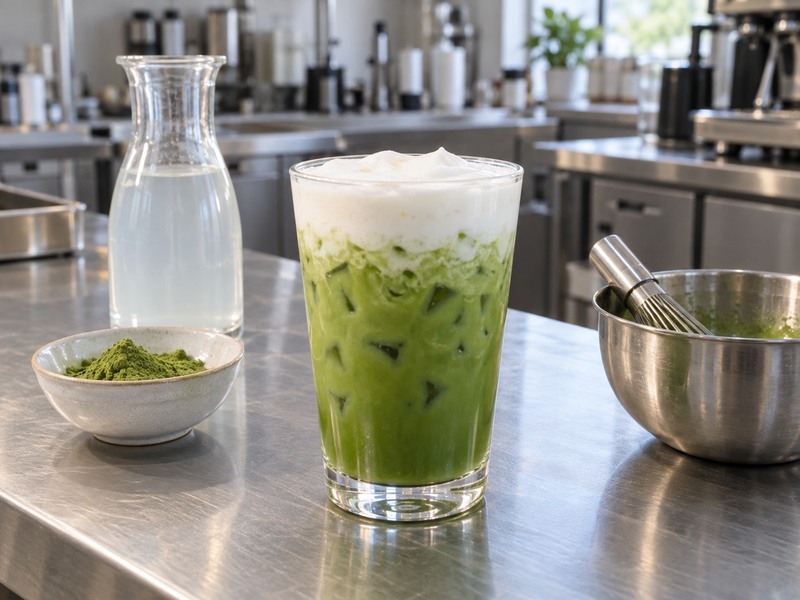
Coconut cloud matcha is a layered drink built around matcha and a light coconut-flavored foam, often over a chilled base. A single attractive glass is easy to make; a menu item must survive normal service. Foam can drain, the green layer can streak, and one operator’s coconut dose can change sweetness by the next shift. A café team should define the served drink, lock ingredient forms, and test the complete assembly at peak-hour pace. The goal is a repeatable product, not a copied home recipe.
Contents: 1 · 2 · 3 · 4 · 5 · 6 · 7 · 8 · 9 · 10
1. What exactly is the cafe selling?
Set the served-glass standard
The name coconut cloud matcha can describe several recipes. One uses coconut water as the green layer’s base; another places coconut foam over a matcha latte. A buyer must choose one architecture before ordering powder or foam ingredients. Specify cup volume, ice amount, base liquid, tea intensity, foam height, drinking temperature, and the visual boundary between layers. Decide whether a customer is expected to stir before drinking. That choice affects how sweetness and tea reach the first sip.
Judge the whole drink. Compare first sip, mixed sip, and the final diluted portion. A layered photo may be attractive while the tea settles into a weak lower half. Test the drink with the actual cup, lid, straw, and service route. A counter-service café, delivery kitchen, and bottled-drink producer have different time windows; one glass cannot be approved for all three without further work.
The site’s matcha coconut water guide covers the simpler drink. This brief addresses the extra foam and assembly step.
2. Which matcha works under a coconut foam?
Taste through the complete build
Coconut aroma and sweetness can make a mild tea seem absent. A powder that tastes balanced in plain water may need a different dose in this drink. Screen two or three traceable lots at one fixed formulation and service temperature. Whisk or disperse each by the same method; clumps are an operator problem as well as a sensory defect. Evaluate color under normal counter lighting rather than a studio lamp.
Do a matched-dose trial. Record tea mass per finished serving and keep the denominator clear. A second trial can adjust dose until each lot reaches the same sensory target. The lower-priced powder may require more mass or create a darker, bitter finish. Compare those outcomes before approving a supplier. Request ingredient declaration, lot ID, pack format, storage advice, and a process for notifying the café of material changes. None of those documents proves the drink will work without a glass trial.
| Tea check | Fixed-dose comparison | Target-matched comparison |
|---|---|---|
| Presence | Does coconut mask it? | Mass needed for approved tea note |
| Color | Green in prepared base | Green after ice and foam |
| Texture | Visible clumps or sediment | Mouthfeel at serving end |
| Cost | Price of equal tea mass | Cost of the approved glass |
Keep the serving method fixed when showing samples to buyers. Otherwise a better whisk can be mistaken for a better powder.
3. How should coconut water be chosen?
Treat it as a variable ingredient
Coconut water differs in sweetness, acidity, aroma, and dissolved solids. Those differences affect the tea layer and may change how a foam tastes against it. Compare candidate waters at the same weight and temperature, with the same matcha lot and ice. Blind tasting can separate a coconut preference from a brand label preference. Record whether the product is single-ingredient coconut water or a sweetened beverage blend; the final menu name and ingredient statement must reflect the actual material.
Check supply as well as taste. Ask for pack size, opened-container handling instructions, shelf-life documentation, lot identification, and availability through the planned distribution route. If the café uses a concentrate, define its dilution by mass and control the water source. A small change in dilution can shift every glass. For a seasonal menu item, test an approved alternative before the preferred product is unavailable, not while the line is busy.
| Water attribute | Bench observation | Buying consequence |
|---|---|---|
| Sweetness | Taste beside tea | May require less added sweetener |
| Acidity | Flavor after mixing | Can sharpen or dull tea |
| Cloudiness | Appearance under foam | May change visual standard |
| Pack size | Opened-pack use | Waste and handling cost |
Do not judge a coconut water from the unopened label alone. The served drink is the relevant evidence.
4. What makes a foam serviceable?
Define the cap as a component
A foam needs enough structure to sit above the base at handoff, yet it should remain pleasant when the customer drinks through it. Different systems can use coconut cream, coconut-flavored milk alternatives, or a dairy-containing base. They will behave differently under temperature, sugar, and whipping conditions. Choose the ingredient system with the café’s allergen and menu promise in mind. Then specify foam deposit mass, height, appearance, and drainage tolerance.
Watch the clock. Record the time from whipping to dispensing and from assembly to sale. A foam that passes a one-minute photo test may flatten during a normal queue. Compare preparation in a full pitcher and near-empty pitcher. Check whether the nozzle or ladle delivers the same cap after repeated servings. If the recipe needs a stabilizer, the technical team must assess its declaration, usage, and sensory effect within the relevant market.
The Paper & Tea coconut cloud article is a consumer reference for the format. It does not establish a café’s service specification.
5. How can the layers stay distinct?
Control temperature, order, and pouring
A clean boundary depends on how dense and cold each component is, the ice geometry, and the pour. Standardize whether matcha is dispersed in a small amount of water before it reaches the serving cup. Then define the order of ice, coconut base, tea, and foam. Record pour position and rate with the actual cup. A method that works in a wide glass may streak inside a narrow takeaway cup.
Test under ordinary light. Photograph the drink at handoff and after the normal queue interval, using the same background and camera position. This is a process record, not a promise of identical color in every store. Taste both the visible layers and the stirred drink. A drink that looks clean but has a concentrated powder pocket at the bottom needs a dispersion fix. Try one change at a time, such as lower pour height or a different ice size, so the team can identify the cause.
| Defect | Likely first check | One-variable trial |
|---|---|---|
| Green streak through foam | Pour height | Lower tea pour |
| Powder pocket | Premix dispersion | Change preblend method |
| Fast boundary loss | Ice and temperature | Hold components colder |
| Uneven cap | Deposit tool | Compare measured scoop |
Do not add color merely to repair a weak tea process. Any added ingredient creates a different formula and claim file.
6. What should a station prep method control?
Make the recipe work during a rush
A commercial method needs weighed ingredients, defined component temperatures, a cleaning route, and a build sequence a trained employee can repeat. Decide whether tea is prepared per order or as a controlled batch. Batch preparation may shorten service time but introduces hold and sediment questions. Foam may be made to order or held in equipment; each choice has a different labor profile. Technical staff should set safe handling for the actual ingredients and equipment.
Run a timed queue. Ask several normal operators to prepare consecutive orders while another person records component weight, assembly time, appearance, and rework. Include the moment when an ingredient container runs low. A method that depends on one expert making a perfect swirl is not ready for a multi-store rollout. Write the acceptance rules in station language: how full the cup is, what the foam looks like, and when a drink must be remade.
| Prep decision | Speed effect | Control needed |
|---|---|---|
| Tea per order | More steps | Dose and dispersion |
| Tea batch | Faster pour | Hold, settling, lot trace |
| Foam per order | Fresh cap | Mixer and operator time |
| Foam batch | Faster service | Drainage and safe hold |
Equipment maintenance belongs in the method. Residue in a whisk or foam tool can change both appearance and sanitation.
7. How does the drink change during a hold?
Measure the route a customer sees
Hold testing should mirror counter pickup, takeaway, or delivery. Put the actual lid on the cup, handle it as staff would, and inspect at meaningful points. Record foam height, drainage, ice melt, separation, tea sediment, and flavor. A single number called “stability” hides useful differences. Foam may remain tall while diluted tea becomes weak, or tea may stay strong while the cap smears on the lid.
Separate quality from safety. A visual and sensory trial tells the team whether the menu promise survives. It does not validate microbiological safety or a legal holding period. The applicable foodservice team must set temperature and time controls for the finished recipe. The FDA Food Code is a model for retail food protection in the United States; local requirements and the exact ingredients still determine the operating procedure.
Use the same cup and fill line during each candidate trial. Changing packaging can conceal a formula problem.
8. Which label and allergen questions need review?
Verify the formula behind the name
“Coconut” on a menu can refer to coconut water, coconut cream, a flavored syrup, or a blend. The ingredients and allergen review must follow the actual components, including any milk, oat, soy, or other base used for foam. A café should not call a drink dairy-free merely because the tea layer contains no dairy. Likewise, a prepared blend may carry sweeteners or additives that the menu team did not expect from its shorthand name.
Keep claims close to evidence. If a brand wants a low-sugar, vegan, organic, or origin statement, route it to its regulatory reviewer with supplier documents and the final formula. A powder’s marketing sheet is not a substitute for an approved product file. Record ingredient substitutions at store level, since an emergency foam replacement can change allergen status and the customer’s experience at once. The site’s matcha labeling guide gives a wider view of this approval process.
| Menu statement | Evidence needed | Common gap |
|---|---|---|
| Contains coconut water | Final recipe and supplier label | Coconut only in flavoring |
| Dairy-free | Every foam component | Dairy stabilizer or cream |
| No added sugar | Ingredient and recipe review | Sweetened coconut base |
| Origin statement | Traceable ingredient records | Packing place confused with origin |
The final artwork and store recipe should be versions of the same approved product.
9. What does a sold glass actually cost?
Include labor and remake rate
Tea and coconut water are only part of a drink’s cost. Count foam ingredient, ice, cup, lid, labor, equipment cleaning, and rejected drinks. Divide by accepted glasses sold in the intended channel. A tall foam cap can improve appearance but increase cup size or lid clearance needs. A cheaper coconut base may lose its advantage if it drains quickly and forces remakes during a queue.
Use measured loss. In a hypothetical pilot, compare two foam systems at one cup size and matcha dose. Record actual ingredient drawdown per shift and the number of saleable glasses. Put supplier prices and freight assumptions beside, rather than inside, measured production loss. If the café operates several stores, check whether the same ingredients can be sourced and handled in all of them. A single-store special may still be valid, but it should be costed as such.
| Cost driver | Measurement | Decision use |
|---|---|---|
| Matcha dose | Mass per accepted glass | Tea procurement |
| Foam yield | Accepted caps per batch | Labor and waste |
| Cup and lid | Unit price and clearance | Takeaway margin |
| Remakes | Glasses discarded per shift | True service cost |
A cost sheet should follow the approved sensory target. Reducing tea until the drink no longer tastes like matcha does not solve a margin problem.
10. When should the menu item go live?
Sign off one repeatable build
The launch file should contain component specifications, exact build weights, temperatures, prep order, holding rules, cup and lid, allergen review, cost model, and a supplier substitution process. R&D should approve taste and visual standard; operations should show that trained staff can execute it under a real queue; quality should approve handling and labels. Procurement should confirm normal supply rather than a one-time sample.
Make the next test concrete. Run a short menu pilot with the intended staff, cup, and equipment. Record rework, customer questions, purchase repeat, and the point where the drink’s quality fails. Adjust one variable and rerun the same check before scaling to other stores. For a home-scale view of the layered style, read the Paper & Tea coconut cloud article; keep the commercial method grounded in your own tests.
Reference: How to Make a Coconut Matcha Cloud | Trendy Matcha Recipe. The reference supplied format context; the service trials here are original.
FAQ
Q1: Does coconut cloud matcha require coconut water?
Not always, but the chosen base must be defined in the product brief and described accurately.
Q2: Can the foam be prepared hours before service?
Only after the team validates quality and safe handling for its exact formula and equipment.
Q3: Why does the green layer streak into the foam?
Pour height, component temperature, ice, and density can all contribute. Test one at a time.
Q4: Is a dairy-free tea layer enough for a dairy-free menu claim?
No. The complete foam and base formula must be reviewed.
Q5: What is the best cost denominator?
Use accepted glasses served during a normal operating trial, including remake loss.