
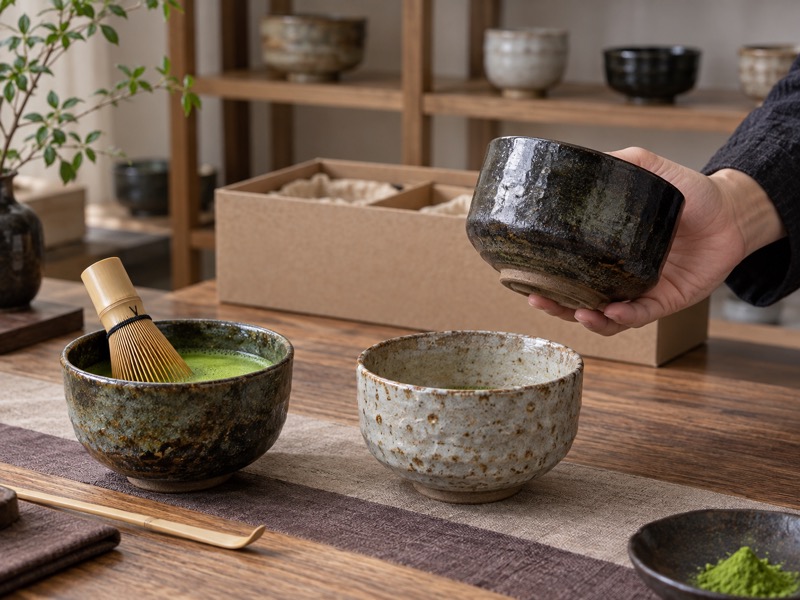
A Japanese matcha bowl, or chawan, is the vessel used to prepare and serve matcha. For a tea program, its value is practical as well as visual: the whisk needs room, staff need a stable grip, and the glazed interior must be suitable for repeated food contact and washing. A bowl that looks striking on a shelf may splash during service or chip after a week of stacking.
This buyer’s guide treats the bowl as working equipment. It covers bowl shape, staff handling, supplier evidence, and a sample trial. It also keeps Japanese tea culture in view without suggesting that one commercial specification represents every tea-school practice.
Contents
- What makes a bowl useful for matcha service?
- Which chawan shapes fit the intended preparation?
- How do diameter and depth change whisking?
- Which ceramic properties affect handling?
- When does a pouring lip make sense?
- How should bowls be cleaned and dried?
- What breakage and replacement rates should be tracked?
- How should a buyer assess glaze and food-contact claims?
- What belongs in a supplier sample review?
- When should a tea program approve a bowl?
1. What makes a bowl useful for matcha service?
A working bowl gives the whisk enough room, holds the intended liquid without sloshing, rests steadily, and feels comfortable when served. For a café, a durable piece also has to survive a fast wash cycle and be available for replacement. For a tea ceremony program, form and handling may follow a particular tradition that deserves its own expert advice. Define the use case first. A bowl used to whisk and drink a small serving is not automatically the right vessel for preparing a concentrated base to pour into many lattes.
Ask staff to make their usual matcha in each candidate bowl. Observe splashing, whisk contact with the sides, comfort lifting it, and whether the rim drips. Repeat with several staff members, since a piece can fit one person’s hand and frustrate another. Test the intended fill level. A generous-looking bowl may have a narrow usable floor, while a modest one may provide excellent whisk movement. Record the outcome instead of buying by photo or nominal capacity alone.
| Use | Priority | Trial observation |
|---|---|---|
| Direct matcha service | Comfortable hold and presentation | Grip, lip feel, heat |
| Café prep station | Whisk room and quick handling | Splash, pour, wash |
| Retail gift set | Appearance plus clear use instructions | Customer preparation trial |
2. Which chawan shapes fit the intended preparation?
Chawan vary in profile. Wider, lower forms can offer working space, while taller forms may contain liquid differently and feel warmer to hold. The relationship between bowl shape, seasonal use, and tea practice is more nuanced than a simple “summer versus winter” sales label. The Global Japanese Tea Association’s teaware overview notes variation in shape and appearance according to intended preparation. Use tradition as context, then test the task. A commercial buyer should not claim ceremonial authenticity from a silhouette alone.
Select two or three profiles that suit the program and prepare the same measured tea in each. Staff should use the actual bamboo whisk or mixer specified for service. Note whether the bowl’s internal curve allows full motion without striking a sharp corner. Consider storage as well: a broad rim may look elegant but take more shelf space. If multiple bowls are planned for a tasting flight, keep presentation coherent without forcing the same shape on every preparation. The best profile is the one operators can use consistently and guests can handle with confidence.
3. How do diameter and depth change whisking?
Outside diameter is a poor stand-in for usable whisking room. Measure internal diameter near the working liquid level, bottom contour, and depth. Place the intended volume of water in the bowl, then whisk with the exact chasen. Watch the tips and the liquid. The whisk should move freely without repeated contact with the side or a narrow central hollow. A very shallow bowl can splash at a vigorous pace; a deep, narrow bowl can constrain the whisk even if its total capacity is large.
Record a small set of dimensions on the sample sheet and pair them with an operator score. Do not invent a universal ideal diameter; match the bowl to the whisk, method, and serving volume. Include left- and right-handed staff if the bowl has a directional lip or decorative front that changes handling. If the program uses a mechanical frother, test that tool too, but do not market the result as traditional whisk preparation. The vessel should be evaluated in the service it will actually perform.
| Measurement | Why it matters | Simple check |
|---|---|---|
| Internal working width | Whisk movement | Make a full-speed test cup |
| Depth at fill | Splash and capacity | Use actual service volume |
| Bottom contour | Powder collection | Inspect residue after pouring |
| Rim thickness | Drinking and grip | Staff and guest handling test |
4. Which ceramic properties affect handling?
Weight, wall thickness, glaze texture, base finish, and fired shape affect daily use. A heavy bowl can feel reassuring yet slow a high-volume station; a very light one may feel fragile. A rough foot can scratch shelving, while an uneven base can rock. Handle every sample wet and dry. Tea service involves warm liquid, damp hands, and a towel, not just a clean studio photograph. Ask staff whether they can lift and rotate the bowl confidently without gripping the rim awkwardly.
Look closely at glaze inside the working area. Food-contact suitability needs supplier evidence; visual smoothness alone proves little. A textured interior may hold pigment or powder and take longer to clean. Check whether decorative elements are compatible with repeated washing and the temperature range used in service. A handmade appearance can include intentional variation, but the buyer still needs tolerances for cracks, sharp points, and rocking. Agree those criteria with the supplier before a bulk order, and use a signed sample as the reference.
5. When does a pouring lip make sense?
A pouring lip can help when a bowl is used to make a matcha base that is then transferred into a latte glass. It is less important for a bowl served directly to a guest, and a pronounced spout may change the visual character or stackability. Test the actual transfer. Pour the usual liquid amount into the intended receiving cup at normal staff speed. Record drips down the outside, splashes, and residual powder left in the bowl. A lip that performs well with water might behave differently with a foamy matcha suspension.
If staff prepare many drinks per hour, compare a lipped bowl with a small dedicated mixing vessel. The specialist vessel may be easier to clean and less costly to replace. Do not force one object to serve both ceremonial presentation and production convenience if neither use becomes satisfactory. If a lip is selected, define its orientation and any right-hand bias in training. The purchasing decision should include whether the supplier can reproduce that geometry across batches rather than only on one attractive prototype.
| Service route | Advantage to test | Possible drawback |
|---|---|---|
| Lipped chawan | One vessel for whisk and pour | Drip, orientation, wash time |
| Plain chawan | Direct presentation | Less controlled transfer |
| Separate mixing vessel | High-volume efficiency | Extra equipment and cleaning |
6. How should bowls be cleaned and dried?
Cleaning starts with the actual tea residue and service pace. After preparing a standard cup, rinse and wash according to the facility’s approved procedure and the supplier’s care instructions. Inspect the interior curve, foot ring, decorative recesses, and rim. Dry the bowl completely before stacking or packing. Trapped moisture can make storage unpleasant and obscure chips or glaze defects. A porous unglazed area may need different care from a fully glazed interior; ask the supplier rather than applying a generic rule to every piece.
Do not assume a bowl is dishwasher safe because it is ceramic. Confirm the maker’s instruction, then run a controlled repeated-wash trial if the operation relies on a machine. Check color change, abrasion, rim chips, and loss of decorative finish. If handwashing is required, include labor time in the cost. Keep the bamboo whisk’s care routine separate from the bowl’s; the two materials have different handling needs. Put the approved cleaning method on the station sheet so staff are not left to infer it from the object’s appearance.
7. What breakage and replacement rates should be tracked?
Breakage is a cost and service continuity issue, especially when a handmade bowl cannot be reordered identically. Start with a small pilot lot and log chips, cracks, rocking bases, and glaze wear by date and station. Count replacements per 100 service uses or another consistent unit rather than comparing raw incident totals across stores with different volumes. Separate damage on arrival from damage during washing or guest service. That distinction tells the buyer whether to improve packaging, choose a stronger form, or retrain staff.
Inspect shipping cartons and protective inserts during the sample review. Ask the supplier how long it can provide the same form and what variation is normal. Hold a small replacement stock if the bowl is central to the guest experience. The cheapest unit may be costly if it chips quickly or becomes unavailable mid-season. Conversely, an expensive handmade bowl may be appropriate for a low-volume guided tasting and unsuitable for fast café service. Buy for the operating context, not a single price per piece.
| Incident | Record | Likely response |
|---|---|---|
| Arrival chip | Carton, position, lot | Review pack design |
| Wash damage | Method and cycle count | Revise care or select another bowl |
| Service crack | Use conditions | Review form and handling |
| Unstable base | Sample dimensions | Tighten acceptance tolerance |
8. How should a buyer assess glaze and food-contact claims?
Ask the supplier to identify the manufacturing site, materials, intended food use, and test reports applicable to the destination market. Glaze color or a “natural” description does not demonstrate safety. The FDA notes that some ceramic foodware can release lead from food-contact surfaces. Request product-specific evidence for the finished glaze and decoration, using a qualified laboratory and the correct test method for the market. Have the importer’s compliance team interpret the report rather than relying on a supplier badge.
Check that the report names the exact product family, sample, date, and test conditions. A report for a different glaze or older factory lot may not support the proposed bowl. Ask how changes in clay, glaze, kiln, or decorative materials are controlled. Decorative pieces marked unsuitable for food are not substitutes for tested service bowls. This is a procurement and regulatory question; a visual inspection cannot replace the evidence. If the seller cannot establish food-contact suitability, keep that piece out of the beverage program.
9. What belongs in a supplier sample review?
Give each candidate a numbered sheet covering dimensions, weight, usable volume, glaze finish, base stability, whisking, pouring, washing, packaging, and landed cost. Include at least several samples from the expected production method, not only a showroom master. Compare variation within a lot. Handmade variation can be welcome, but chips, sharp points, and a rocking base are not aesthetic features. Photograph the sample against a scale and keep one signed reference in purchasing records.
Ask for minimum order quantity, lead time, packing specification, replacement policy, and notice if the manufacturing process changes. Confirm whether the supplier can support the anticipated reorder schedule. If the program uses a chawan in a gift kit, test whether the bowl, whisk, and insert survive transport together. If it is used in café service, run the bowl through the actual storage and washing route. A sample approval should identify the intended use; it should not be a blanket approval for every channel.
| Sample item | Evidence to keep | Owner |
|---|---|---|
| Signed bowl | Physical reference | Purchasing |
| Food-contact report | Exact product and test | Compliance |
| Whisking and wash results | Operator record | Operations |
| Carton trial | Damage count | Logistics |
10. When should a tea program approve a bowl?
Approval is reasonable when the chosen bowl works with the intended whisk and serving volume, handles safely, cleans within the station routine, carries suitable food-contact evidence, and can be supplied at the required pace. Run the final test in service conditions. Let ordinary staff prepare and wash multiple bowls across shifts, then record defects and time. Show a guest-facing sample to the team responsible for presentation, but let functional failures override a beautiful glaze.
Write a purchase specification with measurements and tolerances, defect examples, pack method, documents, and replacement terms. If the bowl serves a Japanese tea practice, review its cultural and procedural fit with a qualified practitioner. A café using it as a practical mixing and serving vessel can state that more modestly. The next supplier request should be a production-lot sample set and matching food-contact evidence for the exact glaze and decoration the brand plans to buy.
Sources: Omakase Forest’s The Complete Guide to Japanese Matcha Bowls appeared in the archived US SERP; Global Japanese Tea Association teaware overview; FDA ceramic foodware guidance.
FAQ
Is every wide ceramic bowl a Japanese matcha bowl?
No. Chawan has a cultural context as well as a working shape. For a commercial program, assess the claimed origin and intended use separately from the bowl’s ability to whisk tea.
Should a café choose a bowl by diameter alone?
No. Internal contour, depth, rim, weight, and stability all affect service. Make tea in the candidate with the actual whisk and serving volume.
Is a handmade bowl automatically food safe?
No. Ask for product-specific food-contact evidence for its glaze and decoration in the destination market. Handmade appearance does not substitute for testing.
Can a chawan go in a dishwasher?
Follow the maker’s care guidance and validate the actual wash process. Ceramic construction alone does not prove repeated machine washing is suitable.
What should be signed off before a bulk order?
Keep a physical reference sample, acceptance tolerances, food-contact documents, service and wash trial results, and the packing and replacement agreement.