
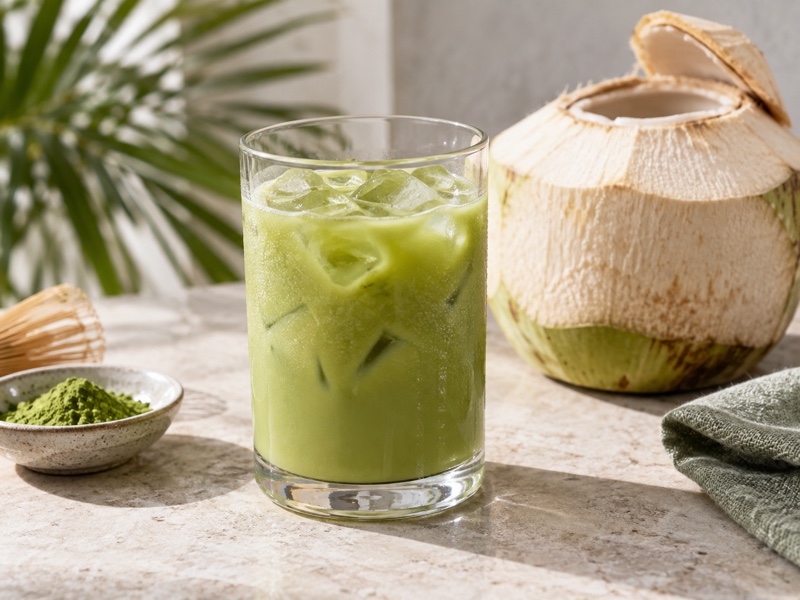
Matcha coconut water pairs powdered green tea with a naturally sweet liquid, yet the two ingredients vary more than a quick café trial suggests. Coconut water can change in sweetness and aroma between suppliers, while matcha settles and can taste sharper after dilution. For a repeatable menu drink or packaged concept, test the specific lots and service conditions you intend to buy. The iced matcha coconut water example from Sift & Simmer shows the consumer idea; this guide focuses on sourcing, balance, handling, and commercial release.
1. What finished drink does the buyer want?
Define a clear target: a lightly sweet tea drink, a coconut-forward refreshment, or a fruit-flavored beverage with coconut water as its base. Those options can share ingredients yet taste very different. Specify cup size, matcha role, sweetness position, whether ice is included, and the point at which the guest will drink it. A made-to-order glass can tolerate a little settling if it is mixed just before service. A ready-to-drink bottle needs a tested solution for uniformity, safety, and shelf life.
Write a sensory brief
Ask the panel to identify tea and coconut separately. If the tea disappears, the product may be a costly coconut-water beverage with a green color. If coconut vanishes, plain water might serve the recipe at lower cost. Record aroma, sweetness, tea strength, aftertaste, color, and texture in the same order for every sample. A test sheet with those fields prevents the loudest taster from reducing a complex decision to “I like this one.”
| Product choice | Decide before trials | Why it matters |
|---|---|---|
| Service format | Glass, takeaway, or package | Holding and processing |
| Flavor lead | Tea or coconut | Dose and supplier selection |
| Sweetness | Coconut only or adjusted | Label and taste |
| Appearance | Uniform cloud or visible layer | Mixing and presentation |
2. How variable is the coconut water supply?
Taste coconut water from several candidate suppliers at the same temperature. Some products are sweeter, more mineral, or more cooked-tasting than others. Ingredient declarations also differ: a plain coconut water, a concentrate-based product, and a flavored blend are not equivalent. Ask for specifications and compare actual lots, not only marketing descriptions. Record soluble solids if your team has a refractometer, but use taste and supplier documentation as well. One number cannot describe aroma or aftertaste.
Test substitution now
A seasonal or regional supply change can alter the finished beverage. Make the approved formula with two candidate coconut waters and note whether a small change in sweetness or tea dose would be required. If the company plans multi-country sourcing, define an acceptable incoming range and a procedure for rebalancing. Do not promise a fixed “no added sugar” position until every chosen ingredient and the final label have been reviewed for the intended market. Coconut water naturally contains sugars; “no added sugar” does not mean sugar-free.
3. Which matcha stands up to coconut notes?
Coconut water can make vegetal tea seem either fresh or oddly savory. Compare tea grades in the actual coconut base. Keep the coconut lot, dose, mixing method, and ice fixed. Evaluate the first sip, the warming middle, and the final sip where particles may collect. A bright powder can look attractive in the cup while leaving a coarse finish. A lower-cost powder may taste acceptable in sweet coconut water but become dull after a short hold. Choose with the complete experience in view.
Buy against an application test
Matcha Village’s pure matcha page is a relevant starting point for sample discussions. Ask for the proposed grade’s specification, lot identity, and documents needed for import. Test any new lot beside the approved control. Do not infer that a premium label guarantees a better coconut-water drink, and do not assume a generic certification applies to a shipment without checking its documents. Keep the finished-drink acceptance standard with the purchase order.
| Tea sample | Evaluate in dry powder | Evaluate in finished drink |
|---|---|---|
| Candidate A | Aroma and color | Coconut balance, grain |
| Candidate B | Aroma and color | Tea recognition, sediment |
| Control lot | Known benchmark | Change after timed hold |
4. How should the powder be dispersed?
Matcha remains suspended rather than dissolving. Whisk a measured dose into a small amount of suitable liquid before adding the full coconut-water volume. Test water and coconut water as wetting liquids; they can change mixing speed and foam. A bottle-shaking method may be fast for one café drink but produce inconsistent results when different staff use different force or time. Specify a tool and mixing period that can be repeated during a rush. Inspect for specks against the side of a clear glass.
Check held concentrate separately
A prebatched tea concentrate can reduce ticket time, but it may settle between orders. Prepare a batch, hold it under the proposed safe-handling plan, and dispense early, middle, and late portions. Measure their color and tea intensity. If the last portion carries most of the powder, the base needs an agitation rule or a shorter batch size. A premix with coconut water may also require more careful refrigeration than a dry powder station. Have the food-safety lead define the actual holding practice rather than borrowing one from another drink.
5. How much sweetening is necessary?
Taste the coconut water alone, then taste it with matcha before reaching for syrup. Natural sweetness may be enough. If the tea adds a rough edge, a small sweetener adjustment may help, but it can also obscure coconut flavor. Run a three-point sweetness series and record the chosen recipe by weight. Include a no-added-sweetener control in every round. This makes the cost and label implications visible. A flavored syrup should be evaluated as a separate product version, not slipped into a formula described as only tea and coconut water.
Separate nutrition language from flavor language
The US FDA explains how nutrient-content claims are regulated. Terms such as “low sugar” or “no added sugar” require a review of the complete formulation and applicable labeling rules. For export, ask the destination-market reviewer. A café can describe the beverage’s ingredients accurately without making an unverified nutrition promise. Even a simple menu phrase can become misleading if the supplier changes from plain coconut water to a sweetened blend.
| Sweetness trial | Change | What to score |
|---|---|---|
| Control | Coconut water and tea only | Natural balance |
| Light adjustment | Small measured sweetener | Tea clarity and finish |
| Higher adjustment | Increment above light | Whether coconut or tea disappears |
6. What does ice do to the formula?
Ice chills and dilutes the beverage. Use a fixed mass or fill line for testing. Make one version poured over ice and another pre-chilled with less ice. Taste immediately and after a typical customer wait. If the tea disappears after melting, changing powder may be less useful than reducing extra mixing water. Large cubes, small cubes, and crushed ice create different rates of dilution and different visual effects. Choose the ice that the actual stores can stock consistently.
A layered photograph can create a menu promise that is hard to meet. Matcha concentrate poured over coconut water may float briefly, then mix as the cup moves. Decide whether the product should be served layered or fully blended. If layered, test whether the first sip is mostly tea or mostly coconut water and whether a stir instruction solves it. For takeaway, test a lid and a short walk. A cup that looks good at the counter may be streaked and weak by the time the customer opens it.
7. What changes during a short refrigerated hold?
A drink held for a few minutes can show a ring of powder, uneven cloudiness, or a flat aroma. Prepare identical cups and observe them at a fixed temperature at pour, after a normal queue delay, and after a longer pickup delay. Photograph against a neutral background. Taste the upper and lower liquid separately. If the last sip tastes much stronger, adjust mixing or decide on a made-to-order limit. Do not hide a settling problem by stirring once for the development team when staff will not do that during service.
Use the real cup
A clear glass shows sediment differently from an opaque cup. A narrow bottle can make resuspension difficult. Test every package the product will use. Record whether coconut solids or tea powder cling to the wall. If a finished drink contains perishable ingredients, use the café’s documented refrigeration and time controls. The FDA Food Code provides a US model for retail handling, while local requirements govern a particular operation. A good sensory score is not a substitute for safe holding.
8. Can the concept become a packaged drink?
A packaged version requires separate processing, microbiological, and shelf-life work. Coconut water is not a neutral water substitute. Its composition and the final beverage’s pH, solids, and processing all affect the control plan. Work with a qualified beverage processor or process authority for the intended distribution temperature and package. Do not assume a bottled drink is shelf-stable because its ingredients were safe before opening. Mixing them creates a new product with its own validation needs.
Follow the filled product
Inspect start, middle, and end of a pilot fill for tea distribution. Evaluate green color, coconut aroma, sediment, package integrity, and taste throughout real-time storage. Include shipping vibration and the lighting the product will see in retail. If the label asks consumers to shake, validate that action with the actual container. For a carbonated variation, test pressure and opening behavior separately. A successful café recipe remains a useful flavor reference, but it cannot determine a commercial shelf life.
| Package trial | Record | Release question |
|---|---|---|
| Pilot fill | Dose uniformity | Same tea in every unit? |
| Storage | Flavor, color, microbes | Quality and safety through date? |
| Transit | Sediment and damage | Acceptable on arrival? |
| Opening | Aroma and pour | Matches marketing image? |
9. How should buyers calculate the commercial case?
Calculate cost per saleable drink with coconut water, matcha, sweetener if any, ice, cup, labor, and waste. Coconut water price can move with source and package. If a café opens a large carton for small batches, count leftover spoilage. For retail, add processing, packaging, freight, testing, and returns. Compare the margin with alternative tea drinks that use plain water or milk. Coconut water must earn its place through flavor, positioning, or customer demand.
Procurement should agree on approved alternatives before a shortage. A replacement coconut water can shift sweetness and mineral notes enough to require a new formula check. A new tea lot can alter dispersion and color. Keep both ingredients in change control. If the drink’s selling point depends on a short, simple ingredient list, factor that constraint into supplier negotiation rather than accepting an additive-heavy substitute at the last minute.
| Cost driver | Measure | Recheck when |
|---|---|---|
| Coconut water | Volume and opened-carton loss | Supplier or pack changes |
| Matcha | Weighed dose per cup | Grade or lot changes |
| Service | Mixing and handoff time | Cup format changes |
| Retail pack | Fill and testing loss | Co-packer changes |
10. What belongs on the final build card?
List exact ingredient names and weights, ice quantity, mixing tool, order, cup, garnish if used, and a visible fill line. Include a photograph of the correct color and a note about acceptable natural settling. Specify whether staff should stir before handoff and whether the customer should do anything before drinking. For a packaged product, replace a café build card with a controlled formula and process record approved by QA and regulatory staff.
The launch gate should contain an incoming coconut-water specification, an approved matcha lot or comparison standard, timed sensory results, a cost sheet, and signed label wording. Retest if either main ingredient changes. If the formula is only appealing for a few minutes, sell it fresh; if packaged distribution is the goal, continue the technical work until the drink remains safe and pleasant at its proposed date.
FAQ
Q1: Can coconut water replace all added water? It can in a fresh trial, but test dispersion and flavor. A small wetting portion may still improve mixing.
Q2: Does coconut water make the drink sugar-free? No. Coconut water contains natural sugars; any claim needs a full-formula and market review.
Q3: Why does matcha settle? Ground tea remains suspended, so particle behavior and mixing method affect the last sip.
Q4: Can a café recipe be bottled directly? No. Processing, safety, shelf life, and package compatibility need separate validation.
Q5: What should buyers sample? Compare multiple lots of both coconut water and matcha in the exact finished recipe.
A reliable matcha coconut water begins with a defined tea and coconut taste. Approve both ingredients in the finished drink, then verify mixing, dilution, and holding in the actual cup or package. That work tells the buyer whether the combination is ready for sale or still only a promising bench sample.