
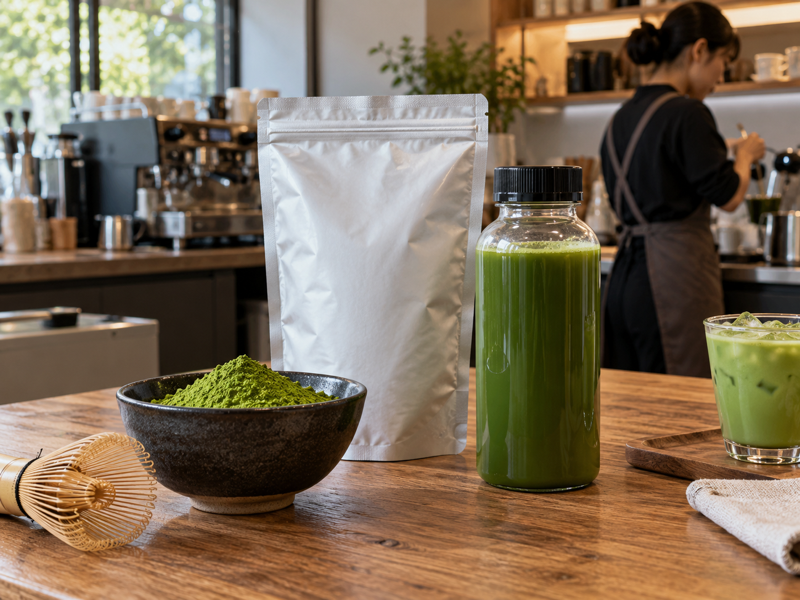
What matcha do cafes use? The answer changes with the drink, prep method, and service volume. Cafes use several matcha formats, and the word on the menu does not tell a buyer which one is in the cup. One shop whisks unsweetened powder to order. Another uses a sweetened latte blend. A high-volume bar may prepare a controlled liquid base. These approaches create different flavor, cost, ingredient, and service obligations. This guide explains what matcha cafes use and how an operator can identify a format that fits its menu without confusing customers.
Contents
- 1. What counts as matcha in a cafe drink?
- 2. Why do some cafes use pure powder?
- 3. When is a sweetened latte blend used?
- 4. How do cafes use prepared matcha bases?
- 5. Do cafes use different matcha for different drinks?
- 6. What about origin and grade claims?
- 7. How should formats be compared on cost?
- 8. Which format works best at high volume?
- 9. What should staff know about the chosen matcha?
- 10. How should a cafe choose its final format?
1. What counts as matcha in a cafe drink?
Matcha is a finely ground tea powder used as the tea ingredient. In a café, that powder may be used on its own, mixed into a latte blend, or prepared into a liquid base before service. The drink may also contain milk, syrups, fruit, or coffee. A green cup does not reveal the ingredient composition. Operators should keep the supplier's product description and recipe record close to the menu language.
Ask what the powder itself contains. Pure matcha differs from a mix with sugar, milk solids, flavors, or other tea ingredients. These distinctions affect sweetness, allergen review, dose, and claims. A customer ordering unsweetened matcha should be able to receive it if the menu promises it. Staff need a clear answer rather than a general statement that “all matcha is the same.”
| Format | What enters the recipe | Main review |
|---|---|---|
| Pure powder | Ground tea powder | Flavor and dose |
| Sweetened blend | Matcha plus other ingredients | Composition and sugar |
| Prepared base | Powder mixed with liquid | Hold and settling |
| Flavored mix | Tea plus flavor components | Claims and allergens |
2. Why do some cafes use pure powder?
Pure powder gives the café control over sweetness, milk, and tea strength. It can support a straight tea and a plain latte from the same ingredient if it performs well in both. Staff must measure and disperse it correctly. A poor mixing method leaves clumps; damp storage can make the problem worse. The café also needs a suitable supplier specification and lot check.
Taste pure powder in water and in the intended milk. A delicate straight cup may disappear in a large flavored latte, while a stronger powder may taste rough without milk. One powder can work across the menu, but that should be shown by a trial. If the shop uses two products, label and store them so baristas do not switch them by mistake.
3. When is a sweetened latte blend used?
A blend can reduce preparation decisions and provide a consistent default sweetness. It may suit a quick-service menu built around sweet milk drinks. But the café loses some control: changing sweetness without changing matcha dose can become difficult. A blend also needs a full ingredient and allergen review. Buyers should know how much of the product is matcha and how the other ingredients affect the finished cup.
Run a direct comparison against pure powder plus measured syrup. Use the same finished drink size and target sweetness. Compare flavor, cost, speed, cleaning, and customer feedback. The faster method is useful only if it meets the menu's taste and ingredient promise. Do not describe a sweetened blend as plain unsweetened matcha. A clear menu can make either format a reasonable business choice.
| Blend question | Why it matters | Test |
|---|---|---|
| Sugar amount | Default sweetness | Taste and ingredient sheet |
| Matcha content | Tea strength | Finished cup |
| Milk components | Allergen and texture | Full declaration |
| Dose | Cost per cup | Weigh actual portion |
| Flexibility | Less-sweet orders | Trial alternate recipe |
4. How do cafes use prepared matcha bases?
Some cafés mix matcha with water ahead of service to shorten ticket time. The base may be made in small batches and portioned into drinks. This can help during a rush, but powder can settle and color or flavor can change during holding. The operator needs a written recipe, batch size, mixing method, storage condition, lot record, and discard time based on appropriate food safety guidance.
Test the first, middle, and last portions from a batch. Measure concentration and taste them in the same latte. If the last pour is stronger or gritty, the base is not yet controlled. Include waste from discarded base in cost calculations. For a low-volume shop, fresh single-cup preparation may be simpler. For a busy bar, a validated base can save time. The decision comes from timed service and quality checks.
5. Do cafes use different matcha for different drinks?
They may. A tea-forward straight drink and a sweet fruit latte make different demands on powder. A café could choose a delicate product for straight service and a stronger one for milk. That adds purchasing, storage, labeling, and training complexity. Use a second product only when the sensory and financial gain is clear.
Run side-by-side tests across the whole menu. If one product can make an acceptable straight tea and latte at practical doses, simplicity may be worth more than a slight preference in one test. If two products are approved, assign distinct codes, containers, and recipe cards. Tell staff which product each drink uses. A silent switch can change both flavor and the cost sheet.
| Menu item | Powder job | Format decision |
|---|---|---|
| Straight tea | Smooth tea flavor | Test pure powder |
| Plain latte | Tea through milk | Test dose and blend |
| Fruit latte | Remain present with flavor | Test stronger base |
| Dessert | Survive sugar or heat | Separate baking trial |
| Retail pouch | Match label promise | Packaging review |
6. What about origin and grade claims?
Origin and grade words should be backed by the actual supplier record for the product used. A menu claim about a region cannot be inferred from the café's visual style or a supplier's general marketing page. Ask for current documentation and lot traceability. Grade labels may be applied differently across suppliers; they do not replace tasting and composition checks.
If a shop changes sources during a shortage, review whether menu descriptions and staff answers must change. A backup powder may require a different dose or mixing method. It should be approved in the cup before it enters service. Clear language helps customers choose: “unsweetened matcha whisked to order” is more informative than a vague promise of the “highest grade.”
7. How should formats be compared on cost?
Calculate the cost of an acceptable finished cup for each format. Pure powder may have a higher price per bag but offer flexible sweetness and a lower dose. A blend may contain cheaper components but require a larger serving. A prepared base may save service time while creating hold waste. Include milk, syrup, packaging, normal remakes, and labor in the comparison.
Ask whether the format changes menu price or customer demand. A specialty straight tea may command a different price from a sweet iced latte. Do not assume customers will pay more because the supplier uses a prestigious word. Test paid orders and repeat interest. Cost per kilogram is a procurement number; cost per consistent, sellable cup is the operating number.
| Cost line | Pure powder | Blend or base |
|---|---|---|
| Tea dose | Weighed grams | Portion and tea content |
| Added sweetness | Separate syrup | May be included |
| Labor | Mix to order | May be shorter |
| Waste | Spills and stale powder | Batch discard |
| Documents | Powder spec | Full composition |
8. Which format works best at high volume?
High volume favors repeatable steps and enough station capacity. A powder that disperses quickly can be made to order. A controlled batch base may reduce mixing during peak periods. A premix may shorten a recipe but limit flavor control. Test the methods with real staff and mixed orders, including cleaning and replenishment. The fastest one-cup demonstration is not the same as the fastest shift.
Set a capacity target from observed demand. Time ticket to handoff and count remakes. Watch whether staff skip weighing or under-mix when the queue grows. If batching is chosen, validate safe holding and concentration. If fresh preparation is chosen, place water, scale, and mixing tools where they do not collide with the coffee bar. Format choice and station design belong in the same decision.
9. What should staff know about the chosen matcha?
Train staff on the exact product used, its ingredients, storage, dose, mixing method, and which drinks contain added sweetener or milk components. Give them plain answers to customer questions. They need not recite a long origin story, but they should know whether a drink is unsweetened and when to check a supplier sheet. Recipe cards should use product codes so a similar-looking bag does not substitute silently.
Review new lots and supplier changes with the team. If color or taste shifts, investigate powder, water, milk, and preparation before blaming one cause. A retained sample helps. Record remakes for clumps and weak flavor. Those failures are valuable feedback about the chosen format and how it performs under ordinary service.
| Staff question | Required answer source | Training check |
|---|---|---|
| Is it sweetened? | Composition and recipe | Explain default |
| Is there dairy? | Full ingredient list | Handle allergen query |
| How much powder? | Recipe card | Weigh dose |
| What if it clumps? | Remake rule | Demonstrate |
| Which bag? | Product code | Identify stock |
10. How should a cafe choose its final format?
Define the menu promise, then test formats in the intended drinks at normal service temperature. Compare taste, color, sediment, cost per cup, preparation time, supplier documents, and availability. Use a small paid pilot to see whether customers reorder. Record the format decision and its reason, including any tradeoff the team accepted.
Revisit the decision when volume, menu, supplier, or equipment changes. A shop may start with one pure powder and later add a validated batch process for a busy location. Another may simplify a sweet blend menu after customers ask for unsweetened tea. The format is a tool for serving the chosen cup; keep it aligned with the customer promise and the operation.
A format trial can be run as a service comparison. Ask the regular team to make the same intended drink using pure powder, a blend, and a validated prepared base, if each format is available and fits the menu brief. Hold cup size and target sweetness constant. Record taste after a normal wait, ingredient composition, ticket time, cleaning time, and stock waste.
The result may show that a slower method makes a markedly better cup, or that a faster format performs similarly at peak. Neither outcome should be assumed. Review what the menu would have to say about each option and whether customers can still order the advertised unsweetened drink. Put the chosen format, product code, and preparation method in the recipe and staff training record. That is more precise than telling workers to use “the café matcha.”
FAQ
Q1: Do all cafes use pure matcha powder?
No. Some use pure powder, blends, or a prepared base. Ask about composition and recipe.
Q2: Is a sweetened blend lower quality?
It is a different product. Judge it against the drink, ingredient promise, and customer need.
Q3: Can a prepared base be held all day?
Only under a validated safe process with documented quality and discard rules; do not assume a universal hold time.
Q4: Does “ceremonial grade” tell me what a cafe uses?
No. Ask for the exact product specification and taste the finished drink.
Q5: Why might a cafe stock two powders?
Straight tea and milk drinks can demand different flavor profiles, though two products add operational complexity.
Related reading: matcha powder for cafes and Best Matcha Powders for Smooth Lattes.