
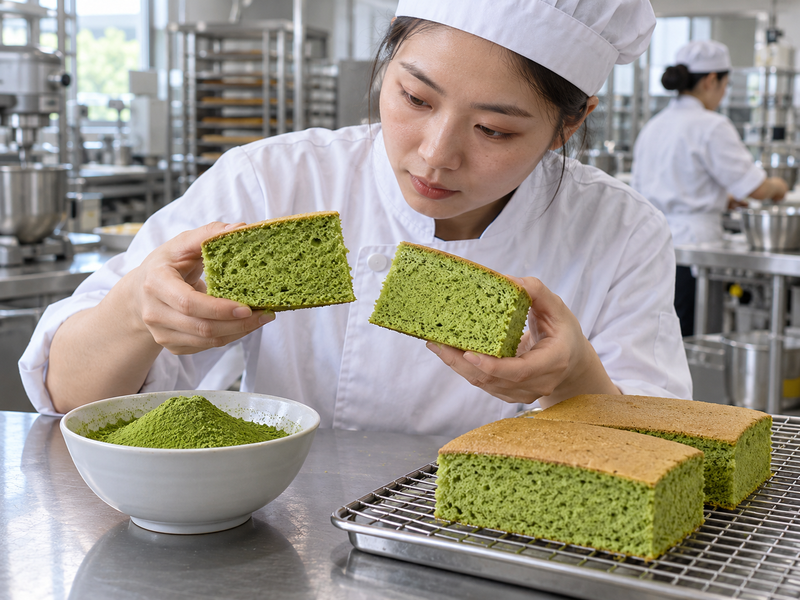
A cake developer can select a vivid matcha powder for cake and still cut an olive-colored sponge after baking. Another powder may hold color but disappear under sweet frosting. For a commercial cake, the useful question is which matcha powder survives the complete formula, oven, filling, display, and production schedule. A bakery needs a controlled ingredient trial before buying by grade name or dry-powder appearance. This guide treats cake as a manufacturing application, with decisions a purchasing and R&D team can reproduce across lots and sites.
Contents
- 1. What job should matcha powder perform in this cake?
- 2. Which powder candidates belong in the first trial?
- 3. How should a bakery compare color after baking?
- 4. How does powder selection change flavor in the finished slice?
- 5. What dose trial reveals the useful range?
- 6. How should matcha enter different cake batters?
- 7. What process variables can be mistaken for a powder problem?
- 8. How do filling and shelf life affect powder approval?
- 9. How should a cake line scale and cost the selected powder?
- 10. What should appear in the supplier and factory approval file?
1. What job should matcha powder perform in this cake?
Define the saleable slice before requesting samples. A plain sponge relies on matcha for most of its character; a chocolate-filled layer cake gives the tea far more competition. Decide whether matcha must provide recognizable flavor, natural green color, both, or a supporting note. Specify the cake format, portion size, filling, serving temperature, display conditions, and target selling price. A powder can be suitable for one format and poor for another without being inherently low quality.
Write a product brief in sensory language. “Clear tea aroma after cooling” is easier to test than “premium matcha taste.” Describe acceptable bitterness, crumb shade, visible specks, and flavor after the intended sale period. Taste the whole portion, not a bare sponge sample, because frosting can change sweetness and perceived tea strength. Choose a reference cake and photograph its cut surface under fixed light. Purchasing should receive the same brief R&D uses so a quoted replacement grade is judged on the finished product, not on a supplier's marketing category.
| Product format | Matcha job | Trial priority |
|---|---|---|
| Plain sponge | Main flavor and crumb color | Aroma after cooling |
| Layer cake | Remain clear under filling | Whole-slice tasting |
| Packaged slice | Hold appearance through storage | Color and flavor stability |
| Frozen cake | Remain perceptible when cold | Serving-temperature test |
2. Which powder candidates belong in the first trial?
Request samples intended for bakery use alongside a higher-priced drinking grade if the brand story warrants comparison. Grade labels are not uniform across suppliers, so ask for the exact product code, specification, pack size, and batch sample. Choose candidates with a plausible supply volume and landed cost. A powder that wins a small tasting but cannot support weekly production creates a reformulation problem. Do not choose on dry color alone; fine green powder can behave very differently after heat and mixing.
Keep the shortlist tight. Three or four candidates are usually enough for an initial screen. Give each a blind code. Prepare one base cake formula, weigh ingredients, and run candidates in a consistent oven load. Ask the supplier whether each sample represents normal commercial production or a special development lot. If a sample is too small for a full pilot, flag that limitation before declaring a winner. Record age and storage condition of samples because a newly opened pouch compared with an older one is not a fair ingredient trial. Repeat the leading candidate with a second lot if supply permits.
3. How should a bakery compare color after baking?
The cut crumb matters more than the dry powder. Heat, cake pH, mixing, oven exposure, and cooling can shift green color. Brown crust is normal and should be judged separately. Bake equal batter weights in the same pans and compare slices only after full cooling. Photograph cut surfaces under the same neutral light with identical camera settings. A bakery display case can change the perceived shade, so inspect samples there as well as in the test kitchen.
Measure the color you sell. Compare a center slice and an edge slice from each trial. Look for uneven patches, dark specks, and loss of green during the planned display period. A powder that looks vivid at noon may appear dull after two days in a clear pack. If the commercial recipe includes food color, test both with and without it and make claims accordingly. Do not assume that adding color solves weak tea flavor. Keep photographs tied to lot code and formula version; free-floating images become useless when a later team tries to approve a replacement lot.
| Observation | Possible source | Controlled follow-up |
|---|---|---|
| Dull center crumb | Powder, pH, or heat | Compare equal-dose powders |
| Dark specks | Poor dispersion | Change incorporation method |
| Green center, brown edge | Surface heat exposure | Review pan and oven profile |
| Rapid display fade | Light or pack exposure | Test alternate packaging |
4. How does powder selection change flavor in the finished slice?
Taste after baking, not only in water. Sugar, egg, butter, and filling can suppress tea aroma or accentuate bitterness. A stronger culinary powder may deliver a clearer cake flavor than a delicate drinking powder at the same inclusion. The selected powder should still taste balanced at a viable dose. Run blind tasting with plain crumb first, then with the complete decorated portion. Taste at the temperature customers will encounter, whether chilled from a display case or served near room temperature under a safe procedure.
Use a small vocabulary. Ask testers to score tea aroma, bitterness, sweetness balance, stale notes, and aftertaste. Give the team reference samples so “strong” means approximately the same thing across sessions. A white chocolate frosting may bury a powder that works in plain sponge; a lightly sweet cream may expose its bitterness. Adjust the frosting ratio before doubling matcha dose, because more powder can raise cost and dry the crumb. If a supplier recommends a grade for cakes, ask what matrix and dose supported that recommendation. The bakery's own formula remains the deciding test.
5. What dose trial reveals the useful range?
A single matcha dose cannot show whether a candidate has room for adjustment. Build a modest trial ladder around the bakery's current target, expressed as matcha mass relative to flour or total batter mass. Those are different bases, so label the calculation clearly. Hold flour, sugar, fat, liquid, leavening, pan fill, and bake profile fixed while changing only powder dose. Record baked yield, taste, color, volume, and cost per saleable slice. These are development settings, not universal recipe recommendations.
Look for the plateau. At some point extra powder contributes more bitterness or dryness than useful tea flavor. A lower dose may have acceptable color but weak taste. Taste samples blind and calculate the incremental ingredient cost between steps. Then refine around the best range. If a candidate needs substantially more powder than another to reach the same flavor, its cheaper kilogram price may be misleading. Repeat the chosen dose in a full decorated slice, because the filling can shift the preferred level. Keep powder measurement in grams, not spoonfuls, for production transfer.
| Trial step | Fixed items | Decision measure |
|---|---|---|
| Low dose | Base formula and process | Is tea detectable? |
| Target dose | Base formula and process | Is balance acceptable? |
| High dose | Base formula and process | Do bitterness and cost rise? |
| Confirmation | Full cake assembly | Does whole slice work? |
6. How should matcha enter different cake batters?
In many batters, sifting matcha with dry ingredients helps distribute it. A controlled slurry can work in other formulas, but its liquid belongs in the formula total. Foam-based sponge, butter cake, and oil cake tolerate different mixing sequences. Extra mixing after flour enters can toughen a crumb; poor mixing leaves dark pockets. The team should choose an incorporation method that fits its base cake and can be repeated by ordinary operators during a full production run.
Check both ends of the bowl. In a pilot, sample batter from the top and bottom of the mixer and cut cakes filled early and late. Compare color, specks, volume, and texture. If powder collects on the bowl wall, specify scrape points and mixer speed. If a premix is prepared ahead of time, check whether it stays uniform during transfer. A small bench mixer may disperse powder well while a larger planetary mixer leaves pockets because the fill level changes. Write the visual endpoint and timing into the process sheet after the pilot, then train staff with actual reference batter.
7. What process variables can be mistaken for a powder problem?
Oven loading, pan depth, batter temperature, leavening, cooling time, and ingredient substitutions can all change matcha cake. A dull crumb does not automatically indict the supplier. Compare a new powder with an approved control in the same production window. If both shift, examine the process. If only one shifts, review its batch data and handling. Use a fault log that records what changed before changing multiple ingredients at once.
Trace the run. A full oven may have hot spots unseen in a two-pan bench test. Batter waiting too long can affect lift and color. A new milk powder or fat can change flavor release. Even different slice thickness can alter how dark a green crumb looks. Record pan position, oven profile, cooling time, and finished weights. Ask production staff where they notice differences; they often see a mixing or deposit problem before a tasting panel does. A cause-and-effect check saves the bakery from paying for a “better” powder to compensate for an unstable process.
| Symptom | Check before changing powder | Evidence |
|---|---|---|
| Uneven green across pans | Oven position and batter order | Pan map |
| Tough crumb | Mixing time and hydration | Batch sheet |
| Weak tea only after filling | Filling ratio | Portion weights |
| Flavor drift by day | Storage and packaging | Hold samples |
8. How do filling and shelf life affect powder approval?
A cake is sold with its filling, frosting, and packaging. Test matcha flavor through the whole forkful and after the intended hold. Chilled cream can mute aroma; a sweet glaze can dominate. Moist fillings can migrate into sponge, while uncovered display can dry the cut surface. Separate sensory shelf life from food-safety shelf life. Dairy or other perishable components require a validated safety plan and local storage controls. Matcha does not make a cream cake shelf stable.
Test the sale day. Assemble pilot cakes at production scale and sample at release and at each planned sale point. Photograph the cut surface, weigh portions, inspect condensation, and taste for tea clarity and off-notes. Packaged slices need transport and light-exposure trials. If a supplier's powder performs on day zero but fades rapidly in the chosen pack, test pack protection before switching ingredients. A frozen line should be evaluated after freezing, thawing, and serving. Keep the shelf-life protocol tied to the exact finished formula; a different frosting or pack can invalidate the earlier result.
9. How should a cake line scale and cost the selected powder?
Move from bench cakes to a pilot large enough to expose mixer fill, depositor accuracy, oven load, cooling space, and trimming loss. Track powder mass per batch and saleable portions rather than relying on theoretical recipe yield. The purchasing comparison should include rejected cakes, bowl residue, over-portioning, packaging, and labor. A powder with a higher price per kilogram can cost less per accepted slice if it needs a lower dose or creates fewer rejects.
Use a release-ready calculation. Weigh total batter, baked output, trim, and finished portions. Calculate actual powder used per saleable slice and compare it with the planned figure. Examine whether the chosen powder arrives in a pack size the line can consume before quality declines after opening. If a factory runs several cake flavors, design lot changeovers and storage so matcha is traceable. Train staff on the approved code and substitution rule. A new lot should be trialed against the baked reference before it enters every production site.
| Cost element | Measure | Hidden loss to watch |
|---|---|---|
| Matcha | Grams per accepted slice | Bowl and transfer residue |
| Batter | Yield after baking | Pan and trim loss |
| Decoration | Weight per portion | Over-application |
| Labor | Minutes per batch | Rework and cleaning |
10. What should appear in the supplier and factory approval file?
Keep the chosen sample code, supplier specification, ingredient declaration, relevant test reports, storage guidance, pack format, lead time, and commercial terms. Add the bakery's own blind tasting notes, color photographs, dose trial, pilot batch sheet, cost calculation, and finished-cake reference. Agree with the supplier on batch variation and notification of changes that could affect color or flavor. Set a receiving method for new lots and a complaint route if production cakes miss the agreed benchmark.
Close with a production cake. A supplier's powder photo and water tasting can narrow candidates, but only the saleable cake can approve one. Run the final formula at operating scale with its planned filling and packaging. If the result passes taste, appearance, safety, yield, and cost requirements, freeze the formula version and train production. When a future lot differs, compare it with the retained reference in the same recipe before reformulating. That method gives a bakery a purchasing decision that survives beyond one pastry chef's first successful batch.
Choose matcha powder for cake through controlled baking and whole-slice tasting. Hold the formula and process steady while comparing candidate powders, then confirm the winner at production scale and through its intended sale period. Request commercial-lot samples and specifications from suppliers before committing packaging or launch volume.
FAQ
Q1: Is ceremonial-grade matcha necessary for commercial cake?
No. Compare suitable grades in the finished cake and choose by flavor, appearance, supply, and cost.
Q2: Why is the baked crumb duller than dry powder?
Heat, batter conditions, and storage can change color. Compare cooled slices under fixed light.
Q3: Should a bakery increase matcha when frosting masks flavor?
Test the frosting ratio and sweetness as well as powder dose before changing the ingredient cost.
Q4: Can a bench cake approve powder for a full factory run?
No. Pilot the actual mixer, pan load, oven, cooling, and packaging process.
Q5: What should buyers request with a powder sample?
Ask for the product code, specification, lot, pack size, storage advice, relevant tests, and supply terms.
A small-scale sponge example appears in this matcha cake recipe. For commercial sourcing context, see our matcha grade guide.