
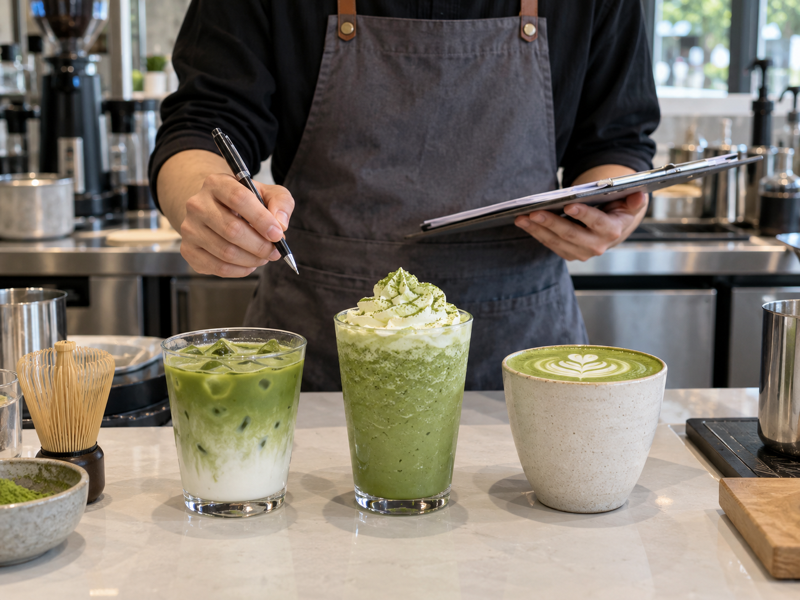
A matcha cafe franchise offers a brand, a menu, and an operating system in exchange for fees and obligations. The attractive part is visible during a tasting; the harder part sits in the contract, supply rules, store economics, and support after opening. A prospective buyer should compare the franchisor's claims with actual unit records and speak with operators who have run through slow months. This guide is a due diligence checklist, not legal or investment advice. Qualified advisers should review the agreement and disclosure documents in the relevant jurisdiction.
Contents
- 1. What exactly does the franchise provide?
- 2. Which fees and obligations affect the economics?
- 3. How should a buyer test unit economics?
- 4. What should the supply agreement say about matcha?
- 5. Does the brand have a defendable customer promise?
- 6. How much control does the local operator keep?
- 7. What training and quality system is needed?
- 8. How should the site and lease be evaluated?
- 9. What do current franchisees say?
- 10. When is a franchise decision ready?
1. What exactly does the franchise provide?
List every item the franchisor promises: brand use, site selection, layout plans, initial training, opening support, recipes, purchasing terms, marketing, technology, and ongoing field visits. Ask which services are included in the initial fee and which carry separate charges. A glossy presentation may describe “support” without saying how many training days or what happens when a key barista leaves.
Request the operations manual table of contents and a demonstration of routine systems, subject to confidentiality rules. Watch a normal store shift if permitted. Can staff use the recipes under pressure? Does the point-of-sale system record modifiers and waste? How quickly does the field team answer an ingredient issue? A franchise is most valuable when its system reduces avoidable decisions and errors after the launch team goes home.
| Promise | Evidence to request | Follow-up |
|---|---|---|
| Training | Agenda and duration | Who pays travel and retraining? |
| Site help | Selection criteria | Who makes final approval? |
| Recipes | Cards and update process | Can local milk be used? |
| Marketing | Spend and deliverables | What is local vs national? |
| Field support | Visit cadence | What happens after complaints? |
2. Which fees and obligations affect the economics?
Identify the initial fee, royalty, marketing contribution, technology charges, required purchases, renewal fee, transfer fee, and any remodel obligation. Some costs are based on gross sales rather than profit. Put each term into a monthly model and check the exact contract language. Ask whether a fee can change during the term and what services the buyer receives for it.
Obtain written equipment and buildout estimates for the proposed market. Required fixtures can be more expensive than a buyer expects from visiting a finished store. Check whether the franchisor earns rebates from suppliers and how those are disclosed. Model a low-volume month with all fixed fees still due. A concept that works only at the top of the sales range needs more evidence before a buyer invests.
3. How should a buyer test unit economics?
Ask for permitted financial performance information and the basis for any sales claim. Compare mature stores with newer units and note differences in location, size, hours, and whether the owner works shifts. Speak with current and former franchisees if the disclosure process allows it. Ask about actual ingredient cost, labor, royalties, rent, remakes, and seasonal dips rather than only revenue.
Build your own model for the proposed site. Use local rent, wages, permits, taxes, and supplier delivery costs. Time the service capacity of the bar layout. If the plan requires a certain number of cups per hour, confirm that stores with similar staffing have reached that level. A franchise name does not remove a physical bottleneck at the matcha station or a weak location.
| Unit input | Evidence | Why it varies |
|---|---|---|
| Sales mix | POS or disclosed examples | Local taste and daypart |
| Powder cost | Required supplier quote | Freight and dose |
| Labor | Actual roster | Wages and volume |
| Rent | Proposed lease | Street and size |
| Fees | Agreement | Sales-based charges |
4. What should the supply agreement say about matcha?
Matcha is central to the product promise. Ask whether the franchise requires a specific powder, blend, or private-label source. Review the product specification, ingredient statement, lot traceability, shelf life, storage, and the process for approving substitutes. If a required supplier has a delay, who may authorize a backup, and how quickly? A franchisee should not learn the rule during a shortage.
Test the actual product in the required recipes and local milk. Regional water and milk choices can change the cup, even when the powder is stable. Confirm freight, minimum order, pack size, and any price-change mechanism. Ask how a quality concern is reported and who pays for affected stock or remakes. A franchisor's tight control can protect consistency, but the operating rules need enough detail to work in a real store.
5. Does the brand have a defendable customer promise?
Visit several stores as a customer. Order the same plain and flavored matcha drinks, note prices, queue times, sweetness, and consistency. Compare what the brand promises online with what a regular shift delivers. A strong identity is useful only if the cup and service support it. Check customer reviews for repeated issues rather than isolated extremes.
Look at menu breadth. A long menu may attract trial but create waste and training burden. Ask how items are tested before rollout and whether franchisees can give feedback. If the brand relies on a particular origin or grade claim, request documentation that supports it. Marketing language must match the ingredient specification and local labeling rules. A brand that changes claims faster than it updates recipes puts store operators in a difficult position.
| Brand test | What to observe | Question for franchisor |
|---|---|---|
| Plain latte | Tea flavor and clumps | What is the standard? |
| Iced drink | Dilution after wait | Is ice weight specified? |
| Queue | Ticket time | What peak capacity is proven? |
| Menu copy | Ingredient accuracy | Who approves changes? |
| Reviews | Repeating complaints | What corrective action followed? |
6. How much control does the local operator keep?
Read the rules on pricing, promotions, hours, menu changes, local suppliers, delivery apps, and marketing. Some standardization protects a customer who visits different stores; some restrictions may make a local site harder to run. Ask how exceptions are requested and how long approval takes. Get examples of approved changes, not a verbal assurance that the franchisor is “flexible.”
Check territory terms carefully. An exclusive area may have performance conditions or exclusions for airports, grocery stores, delivery, or online retail. Understand who can sell packaged matcha in your area. If the café later wants to add desserts or corporate catering, the agreement may restrict it. A buyer should align the contract with the business they actually plan to operate, not a vague idea of future freedom.
7. What training and quality system is needed?
Ask how the franchisor trains new hires after the initial opening. Staff turnover is normal; the system should not depend on the founding team being present. Request sample recipe cards, food safety procedures, opening checks, equipment maintenance instructions, and how updates reach stores. A digital manual that nobody uses during a rush is weak support.
Watch training in a live store if possible. Can a new barista measure matcha accurately, mix without clumps, handle a milk substitution, and remake a faulty cup? How is the final drink checked? Ask whether the franchisor audits taste, ingredient use, service time, and sanitation, and how it helps a struggling store improve. A quality system should catch drift before customer complaints become the main signal.
8. How should the site and lease be evaluated?
Use the franchisor's site criteria but test them against local evidence. Count relevant foot traffic by daypart, compare nearby beverage prices, and check access for takeaway, delivery, and repeat visits. Confirm utilities, drainage, refrigeration space, ventilation, waste handling, and signage rights. A store layout copied from another city may not fit the new site's dimensions or regulations.
Model the lease beside conservative sales. Rent increases, fit-out periods, and landlord work can change cash needs before opening. Ask whether the franchisor approves the lease and whether its approval shifts any liability. Have a local professional review the lease. Store economics are local even when the menu and brand are standardized.
| Site question | Evidence | Risk |
|---|---|---|
| Daypart traffic | Repeated counts | One busy hour misleads |
| Buildout | Contractor quote | Hidden utility work |
| Access | Customer and delivery walk | Poor pickup flow |
| Rent terms | Executed lease draft | Escalations |
| Regulations | Local authority advice | Delayed opening |
9. What do current franchisees say?
Prepare a consistent question list and speak with more than one operator. Ask why they bought, how opening support compared with promises, whether powder and packaging arrive on time, what they spend on labor, and what they would do differently. Ask what a bad month looks like and whether the brand helped solve it. Listen for concrete examples, not only enthusiasm or frustration.
If former operators are available, ask why they left. A closure can have many causes, including a poor site, weak execution, or a flawed system. Compare accounts with documents and your own model. Do not treat one operator's result as a forecast for your site. Use their experience to identify questions the contract and financial statements need to answer.
10. When is a franchise decision ready?
The decision is ready for serious consideration when the buyer has reviewed disclosure documents, tested the drinks, modeled local economics, checked supply and territory rules, and spoken with operators. Have an independent franchise lawyer and accountant review terms and assumptions. The buyer should know the cash needed beyond opening day and what happens if sales take longer to build.
Write a decision memo with the strongest evidence, unresolved risks, and conditions that must be met before signing. If the agreement, site, or supply system fails a critical test, negotiate or walk away. A matcha cafe franchise can shorten some learning curves, but only if its operating system holds up under the buyer's actual market conditions.
One final comparison can separate the brand's value from the location's value. Build a version of the site model using the franchise's fees and required purchases, then a version using a plausible independent operation with its own training and marketing costs. Do not assume the independent version would perform equally well; instead, identify what the franchise must deliver to justify the difference. That may be lower recipe development risk, better supply, faster opening, stronger customer recognition, or field support. Ask for evidence of those benefits at comparable units. Discuss the comparison with an independent adviser and test the downside case in both models. This exercise does not decide the deal by itself, but it makes the contract's economic tradeoff visible and gives the buyer precise questions for the franchisor before signing.
Ask each adviser to write down unresolved contract points and assign a deadline for answers. Do the same for site and supplier questions. If a seller presses for a deposit before the material answers arrive, the buyer should treat that timing itself as a decision risk and record it in the memo.
| Final gate | Evidence | Decision owner |
|---|---|---|
| Contract | Adviser-reviewed terms | Buyer |
| Unit model | Local low-case cash plan | Accountant |
| Supply | Required product and backup | Operations |
| Site | Lease and service capacity | Buyer and operator |
FAQ
Q1: Does a franchise guarantee customers?
No. The brand may help recognition, but local demand, site, execution, and price still determine sales.
Q2: Can a franchisee buy matcha from any supplier?
The agreement controls purchasing. Review required suppliers and substitute rules before signing.
Q3: Which fee is easiest to overlook?
Ongoing technology, marketing, and required purchasing costs can be missed when attention stays on the initial fee.
Q4: Should a buyer visit existing stores?
Yes. Taste the drinks and observe normal service at more than one site if possible.
Q5: Who should review the documents?
An independent lawyer familiar with the jurisdiction and an accountant should review legal and financial terms.
Related reading: bulk matcha supplier guide and Matcha Magic Looks to Break Out in Specialty Beverage Space.