
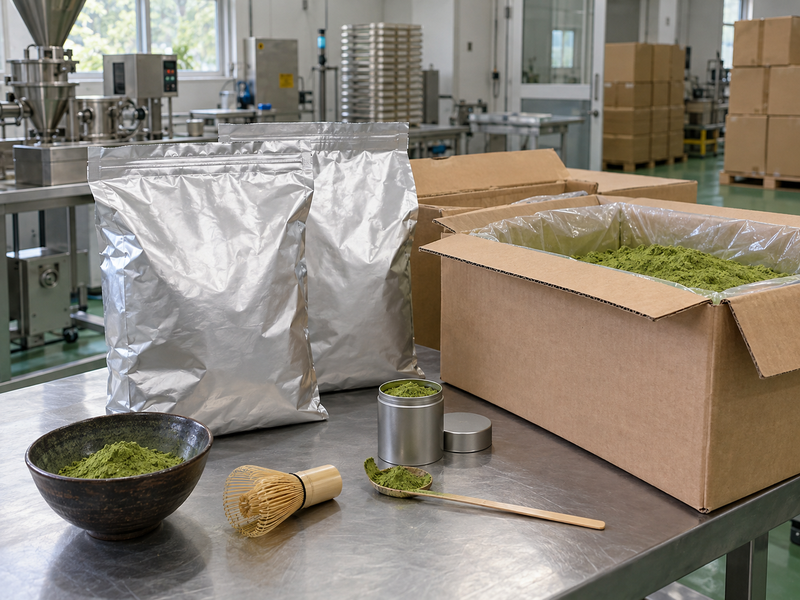
What is bulk matcha? In purchasing, it usually means matcha powder supplied in commercial quantities or wholesale packs rather than small consumer tins. That answer is only a starting point. A one-kilogram foil bag for a café, a pallet of sealed cartons for a food plant and a private-label retail run can all be called bulk. Their risk, documentation and price structures differ. Buyers get better quotes when they describe the product and the job it must do, not merely the word “bulk.”
This guide helps café chains, brands, manufacturers and distributors turn a loose category name into a purchase specification. Matcha Village supplies matcha and related tea powders for B2B applications, so the discussion follows the questions a real supplier needs answered: recipe, volume, pack, quality evidence, and delivery. It does not assume that the cheapest powder or the brightest green product photo is the right choice.
1. What does “bulk” describe in a matcha quotation?
Ask whether the term refers to pack size, order volume, price tier or a channel reserved for business buyers. A supplier might advertise a 1 kg pack as bulk while another offers 10 kg inner bags and pallet quantities. A wholesale quotation may include packaging, customs documents and minimum order requirements that a retail product page does not show. Start by naming the net weight per inner unit, units per case and total quantity per order. Those three numbers are more useful than a single “bulk price.”
Pure matcha powder should also be distinguished from a formulated matcha latte powder or a blended tea product. A sweetened mix can contain a much smaller fraction of matcha than a pure powder and therefore cost less per bag while costing more per gram of matcha. Ask for the ingredient statement before comparing offers. If the seller uses the word bulk for a repacked consumer product, check who packed it, how the original lot is traced and whether the pack is suited to your workplace.
| Offer | Question to ask | Why it changes the quote |
|---|---|---|
| Commercial ingredient bag | Net weight and barrier pack? | Handling and after-opening use |
| Wholesale carton | How many sealed inner units? | Inventory flexibility |
| Latte blend | What is the full formula? | Matcha dose and finished cost |
| Private-label product | Who owns pack and label approval? | Setup and compliance work |
2. Is bulk matcha always a different grade?
No. Bulk describes the supply format, while grade language tries to describe quality or intended use. A café can buy a high-quality powder in a large bag; a manufacturer can buy an economical powder for a strongly flavored food. Grade labels such as ceremonial, premium and culinary are not a universal numerical standard. A buyer should ask what the supplier means by the label and test the offered lot in the actual product. The same powder can appear delicate in water and muted in sweet milk.
Compare color under fixed light, aroma, taste, texture and performance after the process the powder will face. A fine, expensive tea is not automatically the best ingredient for a high-heat bake. Conversely, a low-cost powder that gives a weak or bitter latte can force a higher dose and spoil the apparent saving. Use a written target for the cup or food, then let that target select the product tier. Matcha Village’s bulk ceremonial guide looks at one specific positioning claim; it should not substitute for an application trial.
3. How do foodservice and factory needs differ?
A café buys for drink quality and service repeatability. The team may open a bag many times, use a small scoop, mix powder in cold liquid and need a quick backup when stock runs low. Pack size, clumping and staff instructions can matter as much as laboratory fineness. A food manufacturer buys for controlled batches. It may empty a bag into a hopper, blend with dry ingredients, heat the mixture and require formal release documents. The same supplier can serve both, but the specification and acceptance test should be different.
Describe the process in the request for quotation. A dairy plant needs to know whether powder disperses before or after homogenization and how color behaves in its formula. A bakery needs a small bake test. A distributor needs lot separation and pack durability through multiple warehouses. If a supplier cannot discuss the end use, the quote is likely a price for powder rather than a solution to the buyer’s operating problem.
| Buyer | Primary trial | Likely pack concern |
|---|---|---|
| Café chain | Finished hot and iced drinks | Working bag size |
| Bakery | Standard bake and color | Weighing and line waste |
| Ice cream maker | Frozen sensory and color | Batch dosing |
| Distributor | Lot and seal inspection | Transit durability |
4. What information should a buyer send first?
A concise brief saves both sides a round of unsuitable samples. State the product type, destination market, intended application, target flavor and color, estimated monthly use, first-order quantity, preferred inner-pack weight and any required certifications or tests. Separate firm requirements from preferences. If the business has no sales history, say that the volume is a launch estimate. Suppliers can then suggest a pilot pack and a scalable option without treating a speculative annual forecast as a committed purchase.
Attach a recipe or a description of the finished product when possible. “Matcha for lattes” still leaves unanswered questions about sweetness, milk, serving temperature and dose. If a buyer has an existing approved powder, ask whether the supplier can test a blinded benchmark sample. Do not send a competitor’s confidential formulation without permission. The best initial brief gives enough detail to choose a useful sample, then leaves room for a technical conversation.
5. Which pack formats are common for a bulk program?
Suppliers may offer sealed foil pouches, lined larger bags, cartons containing smaller inner packs, or retail-ready tins and sachets through a separate OEM project. The appropriate pack depends on how quickly the buyer opens and consumes each unit. A small café can waste less with several sealed units than with one large bag that stays open. A factory using an entire bag in one batch may prefer fewer inner packs and simpler line handling. Compare total accepted product, not only packaging cost.
Ask whether the pack protects the powder from light, moisture and oxygen under the specified distribution route. Check seal design, net weight tolerance, carton strength and label details. A change in pack material is a product change for many buyers because it may affect storage behavior. If you plan to repack, map the original supplier lot to each finished code. The bulk packaging guide covers that conversion in more detail.
| Pack option | Good fit | Buyer check |
|---|---|---|
| Small sealed foil units | Slow or variable café use | Labor and waste per opened unit |
| Larger lined ingredient bag | Fast factory throughput | Hopper and handling fit |
| Retail-ready tin or sachet | Private-label sale | Label, artwork and shelf test |
| Mixed-size case | Multi-site pilot | Lot and inventory tracking |
6. What documents should travel with a bulk lot?
At minimum, the buyer needs enough information to identify the powder, lot, pack and seller. The exact file set depends on product, destination market and customer contract. It may include a specification, ingredient declaration, lot-specific certificate of analysis, origin or traceability information, relevant certificates, invoice and shipping documents. Ask the supplier to show the format before the first shipment, so the import or quality team can flag missing fields early. A certificate logo on a website is not the same as a current document covering the shipped product.
Match product and lot codes across the commercial and quality records. A result from a pre-sale sample is useful for evaluating a supplier but does not release a later manufacturing lot. Destination requirements should be set with qualified regulatory advice; do not borrow another market’s limit simply because it appears in a competing supplier’s brochure. The supplier certification article explains how to request evidence without treating every badge as interchangeable.
7. How should samples be compared?
Ask for samples that represent the production product and identify their lot codes. Test more than one option when the menu or formula has distinct use cases. Keep the recipe, equipment, water, milk and serving time fixed. Blind-code samples so testers judge the cup rather than the supplier’s description. For a baked or frozen product, use a small controlled production trial; tasting dry powder is not enough. Record both accepted performance and the dose needed to achieve it.
Compare at least one production-scale lot before a large contract if continuity matters. A perfect 30 g pouch does not reveal how a later 500 kg order will be packed, documented or shipped. Ask how reference samples are retained and how changes in raw material or blend will be communicated. A sample decision should become a written specification, not remain in one buyer’s memory. If two powders taste similar, the pack, documentation and replenishment reliability may decide the purchase.
| Test | Keep constant | Record |
|---|---|---|
| Hot tea | Powder, water and temperature | Aroma, bitterness, texture |
| Iced latte | Milk, ice, dose and mixing | Color, clumps, separation |
| Bakery trial | Base formula and bake | Color and flavor after heat |
| Pack review | Storage and handling test | Seal and lot traceability |
8. Why can the lowest price per kilogram mislead?
A quote may exclude freight, duties, tests, repacking, handling and unusable stock. More important, powders can require different doses to reach the same finished sensory target. Calculate cost per accepted cup or kilogram of finished food using a common recipe. If a cheaper powder needs substantially more to show through milk, the ingredient cost gap can narrow or reverse. Include rejected cups, cleaning and packaging waste when those are material in a pilot.
Compare quotes on the same delivery basis and currency. Ask whether the price covers the required documents and whether the quoted pack is the one approved in trials. A buyer planning a subscription or seasonal menu should also price the next reorder, not only an introductory sample lot. The bulk matcha wholesale article at Matcha Village expands the purchasing calculation. Do not treat a volume discount as savings until turnover can support the order.
| Cost item | Common omission | Better comparison |
|---|---|---|
| Ingredient price | Different pack or formulation | Same product basis |
| Freight and import | Different delivery terms | Delivered usable stock |
| Powder dose | Supplier serving suggestion | Tested accepted recipe |
| Waste | Open-pack aging and remakes | Cost per accepted unit |
9. What should a first order prove?
Use the first commercial order to test the whole chain. It should confirm that the approved product arrives in the agreed pack with matching documents, survives transport, passes incoming checks and performs in service or production. Choose a quantity large enough to exercise normal logistics but small enough to manage if the process needs adjustment. Set acceptance criteria before shipment and keep a retained sample. Record time from purchase order to usable stock, including customs and quality release, not just factory production time.
Run an ordinary shift or production batch with the powder. A pilot run by a supplier representative may look excellent while routine staff struggle with dosing or clumps. Note complaints, waste and stock usage. If the first order differs from the pre-sale sample, investigate lot and handling records rather than immediately adjusting the recipe. Only after the commercial process works should the buyer consider a larger volume commitment.
10. How does a buyer turn a bulk purchase into a stable program?
Agree on forecast cadence, lead-time assumptions, change notification, reference quality, lot documents and a clear route for complaints. Define the point at which the buyer reorders and who checks remaining shelf life. If a brand has several products, map which powder and grade belong to each. That prevents a well-meaning purchasing substitute from moving a bakery powder into a premium drink. Review performance periodically: accepted lots, rejected cases, service results and total cost.
The phrase bulk matcha should become a specific product, process and relationship. Matcha Village can discuss ingredient samples, application tests, pack options and OEM work with businesses that share a target product and expected demand. Use its contact page to provide those details. A clear brief and a controlled first order make the next quote easier to compare, whether the chosen supplier is Matcha Village or another qualified producer.
FAQ
Q1. Is bulk matcha the same as wholesale matcha?
The terms overlap, but “bulk” often refers to quantity or pack size while “wholesale” also describes a business sales channel and its terms.
Q2. Does bulk mean lower quality?
No. Quality depends on the powder and its intended use. A high-quality tea can be packed commercially.
Q3. What is the smallest useful bulk order?
That depends on the supplier’s pack and minimum order, as well as how quickly the buyer can use an opened unit.
Q4. Can a retail tin be used as a production sample?
It can inform early taste work, but confirm that the commercial lot and pack represent the product the buyer will receive.
Q5. Which number is better than price per kilogram?
Cost per accepted finished cup or food unit, calculated with the actual dose and avoidable waste, is more useful.