
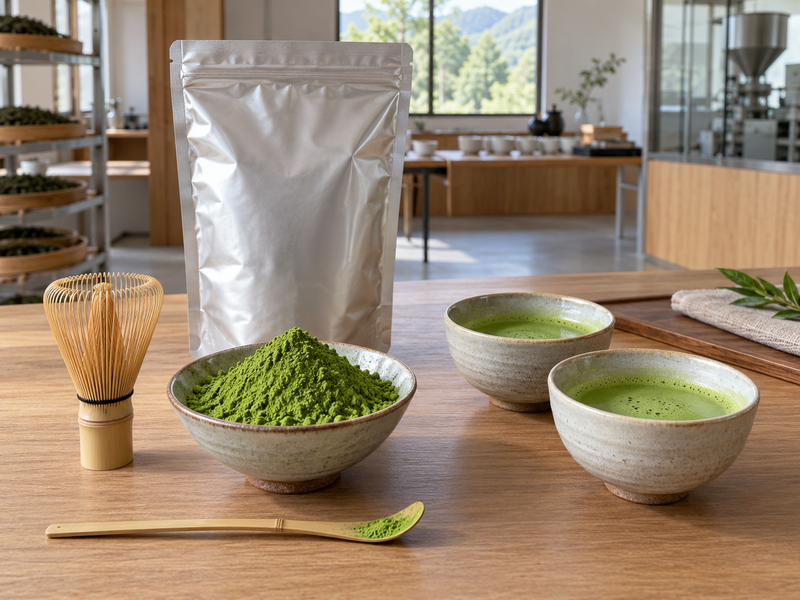
Bulk matcha ceremonial is easy to request and hard to buy consistently. One supplier’s “ceremonial” sample may be smooth in water; another may use the word for a bright powder intended mainly for milk. A brand buying kilograms rather than tins needs a sensory target, an approved lot, and a cost per sellable cup. This guide gives purchasing and product teams a practical way to define the grade, compare samples, and plan supply without treating the marketing term as a formal quality standard.
1. What does bulk matcha ceremonial mean on a quote?
“Ceremonial” is widely used in matcha sales, but the word alone does not tell a buyer which leaves were used, how a powder was processed, or how it will taste. A bulk quote should identify the actual product code and an agreed specification. The useful distinction is sensory: a powder sold for plain-water preparation should taste balanced at the intended dose, without a harsh finish or distracting grit. Color matters, but a bright photograph cannot substitute for a cup test.
Ask the supplier how its ceremonial tier differs from its other grades in application and release criteria. That answer may refer to leaf selection, flavor profile, appearance, or batch controls. Keep the answer tied to the quoted lot. A company may legitimately offer several premium powders, yet they are not interchangeable just because each is called ceremonial. If your retail pack promises a delicate straight matcha, test that promise in water. If you sell mostly lattes, a different grade may provide stronger tea character at a better finished-cup cost.
2. Which sensory brief should a buyer write first?
Define the drinking experience before asking for samples. State the preparation dose, water temperature used in your own service, target color, aroma, perceived sweetness, bitterness, texture, and finish. Describe your customer and format: a plain matcha tin, a café bowl, or a premium instant mix. Avoid demanding “the greenest, sweetest, smoothest” powder without ranking those goals. A brand may prefer a gentle cup with moderate color; a café may need greater intensity because ice and milk dilute the taste.
Set a pass range rather than one perfect adjective. For example, a panel can agree that a sample must remain pleasant after a normal sipping interval, disperse without obvious grit, and show no stale or foreign aroma. A measurable color target can help if your team has consistent equipment and lighting. The brief should include pack size and forecast volume, because the chosen grade must be available in the quantities you intend to buy. Put the target on paper before the sales team sees supplier names.
| Attribute | How to test | Buyer decision |
|---|---|---|
| Tea aroma | Blind prepared-cup comparison | Fits brand profile? |
| Bitterness and finish | Taste at fixed dose and time | Pleasant without sweetener? |
| Texture | Whisk with the standard method | Acceptable mouthfeel? |
| Appearance | Same light and serving vessel | Matches product promise? |
3. How should bulk samples be requested and controlled?
Request enough material to run repeated cup tests and the intended packaging or café application. Each sample should carry a product code, batch or lot number, packing date where available, and the specification that would govern a commercial order. Ask whether the quoted commercial lot is the same as the sample lot. A free sample from an exceptional batch is not useful if replenishment will come from another product with different flavor.
Store the samples under the supplier’s guidance and test them at similar age after opening. Use identical containers or blind codes so a famous origin or high price does not influence panel notes. Keep one sealed retain sample. If the product team rejects a candidate, record the reason rather than a general “not premium enough.” Precise feedback such as “good aroma, gritty finish at our dose” lets a supplier propose an appropriate alternative. A controlled sample trail also helps purchasing compare later lots without relying on memory.
4. What does a useful blind tasting look like?
Prepare every candidate with the same weighed dose, water volume, temperature, whisking method, and vessel. Give tasters coded cups in a rotating order. Include your current approved powder if you have one; a familiar control anchors the discussion. Record separate scores for aroma, tea taste, bitterness, texture, color, and finish rather than one combined number. A panel can then explain why it prefers a sample and whether that difference matters to customers.
Repeat the tasting on another day. Powder age, panel fatigue, and preparation errors can affect a single session. Taste again after the expected service interval, because a cup may open well and finish harshly. When possible, compare two production lots of the preferred product. This is more useful than asking a supplier to send ten unrelated “ceremonial” samples. The aim is an accepted sensory range that future deliveries can meet, not a competition for the most impressive first sip.
| Field | Record | Why it helps |
|---|---|---|
| Code and lot | Hidden during tasting | Reduces brand bias |
| Preparation | Dose, water, time | Makes cups comparable |
| Sensory notes | Specific aroma and finish words | Guides next sample |
| Decision | Pass, retest, reject | Prevents vague approval |
5. Does the ceremonial grade suit every application?
A powder selected for plain-water drinking may be too subtle in a sweet latte or baked product. Test the candidate in the application that pays for it. In a plain matcha tin, customers can notice texture and finish directly. In a premium iced latte, milk and ice can mute delicate aromas. In chocolate, sugar and fat can hide both flavor and color. A brand can use different matcha grades for these products without compromising honesty, provided each is described accurately.
Make a small application matrix. Keep the dose and base recipe fixed when comparing grades, then adjust only after identifying the strongest candidate. If an expensive grade needs the same grams as a lower-priced alternative but customers cannot detect the difference in the final product, the cost needs justification beyond taste. Conversely, a powder that performs well at a lower dose may offer good value despite a higher kilogram quote. The grade name should follow the product decision, not dictate it.
6. What documents should accompany the chosen lot?
Ask for a current product specification, ingredient identity, lot-specific certificate of analysis, storage instructions, and the test documents required by your destination market and customer channel. Quality and regulatory staff should set the relevant microbiological and contaminant criteria; a generic certificate on a website is not a substitute for evidence attached to the actual lot. If organic status or another certification is part of your product claim, check its scope and current validity separately from the ceremonial label.
Review traceability from the incoming tea material through milling and packing. The level of detail a supplier can share varies, but the batch should be identifiable and recallable. Ask how changes in source material, processing, or grade are communicated. A buyer should not discover a substitute lot after retail tins have been filled. Retain the approved sample, specification revision, and quality documents under one product code so marketing, purchasing, and warehouse teams use the same reference.
| Document | Check | Use |
|---|---|---|
| Specification | Product code and revision | Purchase acceptance |
| Lot analysis | Matches the shipped batch | Quality release |
| Traceability record | Lot and pack link | Issue investigation |
| Claim support | Scope covers product | Label review |
7. Which bulk pack protects a premium powder?
Matcha quality can change when powder is exposed to moisture, odors, heat, light, and air. Ask for a packaging format that fits your actual throughput. A large bag can lower packaging cost but may stay open too long at a small packing line or café. Smaller sealed units can reduce exposure, though they add material and handling cost. Compare total usable powder rather than package price alone.
Inspect seal integrity, inner liner, lot marking, and the ease of clean transfer into your process. If a brand repacks bulk matcha into retail tins, validate the repacking environment and timing. Keep open-pack rules in the standard operating procedure and train staff to use dry, clean utensils. A beautiful sample can lose the traits that justified its premium cost if the bulk bag sits beside heat or strong-smelling ingredients. Ask the supplier for handling guidance specific to the selected powder and pack.
8. How should buyers calculate a usable cup cost?
Begin with the quoted price per kilogram and the approved grams per cup. Then add freight, duty where applicable, packaging, preparation waste, and any powder left unusable after an open pack exceeds your internal quality window. The result is a cost per sellable serving. A higher-priced powder may be economical if it delivers the target flavor at a lower dose. A lower-priced sample may require more grams, more sweetener, or more staff attention.
Use a sensitivity table for dose and waste rather than a single optimistic number. A chain should test whether baristas consistently portion the powder, because small overuse multiplies across stores. For a retail tin, calculate filled units per bulk pack after expected process loss. Ask for quote validity, volume tiers, and minimum order by the tested product code. Do not invent a market benchmark; use actual supplier quotes and your own yield data.
| Input | Calculation | Risk to test |
|---|---|---|
| Powder | Price/kg × grams/1,000 | Dose creep |
| Freight and import | Landed cost by shipment | Small-order premium |
| Process loss | Purchased less sellable grams | Dust and residue |
| Pack exposure | Discarded open-pack grams | Slow turnover |
9. How can a brand keep the grade consistent at volume?
Forecast by finished units and approved dose, then discuss supply capacity and allocation with the supplier. An attractive sample does not guarantee that a large order can be filled from the same or equivalent lots. Ask how the supplier handles harvest changes, milling schedules, and a lot that falls outside the accepted sensory range. Build a reapproval step before the current inventory runs out. That gives the product team time to compare a new lot in a controlled tasting.
Consider a second approved source only if the brand can manage different profiles and label claims honestly. A backup product should be tested and documented, not chosen during a stockout. Review lead time to your receiving dock and the time needed for incoming inspection. Matcha Village describes bulk supply and application support in its company materials; the practical question for any buyer is whether the specific powder, pack, and volume in the quote match the approved sample and order plan.
10. What should go into the first purchase order?
Reference the approved product code, specification revision, accepted sensory sample, pack format, quantity, delivery terms, documentation, and change-notice rule. Name the receiving checks and what happens if the delivered lot differs from the sample. Purchasing should confirm the minimum order and lead time before marketing commits to a launch date. Quality should approve the lot documents before the powder enters production.
Begin with a commercial pilot if the brand has only run bench cups. Pack or serve a small batch, then review returns, staff feedback, and customer comments. If the pilot passes, reserve volume and set a re-order point based on real use. Bulk matcha ceremonial buying works when the term points to a repeatable product that tastes right in the intended cup and arrives with records that let the business keep selling it.
| Line | Required reference | Owner |
|---|---|---|
| Product | Code, grade, specification | Purchasing |
| Quality | Approved lot documents | Quality |
| Commercial | Pack, quantity, price, lead time | Purchasing |
| Change control | Notice and reapproval rule | Product / quality |
Frequently asked questions
Q1: Is “ceremonial” a complete specification?
No. Agree on a product code, sensory target, application, and lot documents.
Q2: Should ceremonial matcha be tasted with milk?
Yes if milk is the planned application; also taste it plain to understand the tea itself.
Q3: Can a high price prove better cup quality?
No. Use blind tasting and cost per accepted serving.
Q4: How many lots should a buyer test?
Test more than one where possible and set a process for approving future lots.
Q5: Does a ceremonial label prove organic status?
No. Organic claims require separate product-specific evidence.
Share your cup target, pack format, and forecast with Matcha Village to request a documented sample. Treat bulk matcha ceremonial as a tested purchasing specification, not a label on a sample bag.
For a published comparison of ceremonial-grade pricing and volume, see the Ujicha Matcha guide.