
Matcha bulk packaging is the set of inner bags, closures, cases, and pallet controls that moves commercial tea powder from a packing line to a buyer’s production floor. A buyer can approve the tea and still receive torn liners, unreadable lot codes, or bags too large for operators to handle cleanly. This guide treats the pack as a production specification: define fill weight, barrier, seal, case, handling, transport, and receiving checks before the purchase order. It is written for importers, beverage plants, bakery manufacturers, and foodservice distributors. Matcha Village offers bulk formats, but the correct configuration depends on the buyer’s line and distribution route.
1. What belongs in a matcha bulk packaging system?
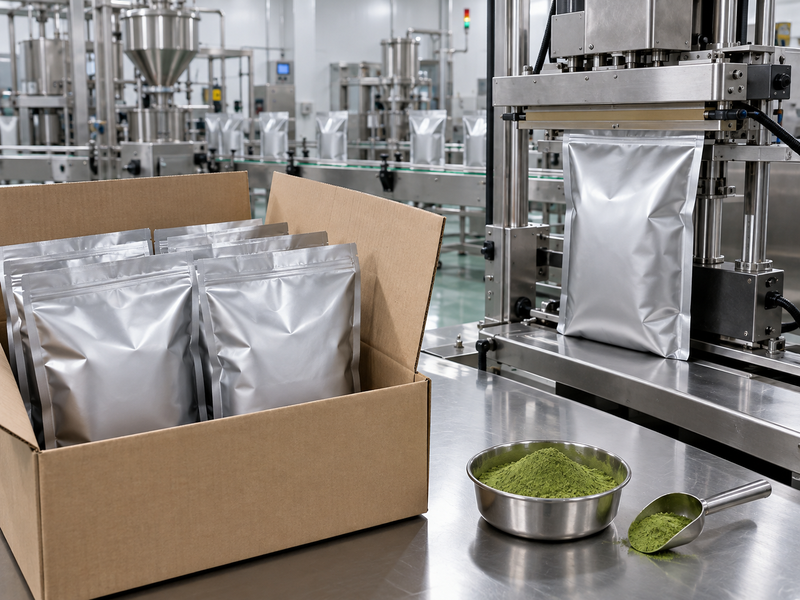
Start with all layers that touch or protect the product. The primary pack may be an opaque multilayer pouch, a liner inside a rigid container, or another food-grade bag. Secondary packaging groups those units in a case. Tertiary packaging holds cases on a pallet for transport. Each layer has a separate job. A strong outer carton cannot compensate for a poorly sealed inner bag, and an excellent inner bag can still be punctured by careless case packing.
Write the configuration in a single bill of materials and pack drawing. Include nominal fill weight, bag dimensions, closure, case count, case dimensions, pallet pattern, total gross weight, and any liner or corner protection. Ask for a photograph of a filled production pack rather than an empty sample. For a buyer’s automated receiving system, barcode placement and readable codes may matter as much as bag material. The supplier and buyer should approve the same pack version so a reorder does not arrive in a “similar” but operationally different carton.
| Layer | Main job | Approval evidence |
|---|---|---|
| Primary bag | Protect powder and contain fill | Material and seal specification |
| Shipping case | Guard bags in handling | Filled-case transit trial |
| Pallet unit | Move stable load | Pattern and wrap record |
2. Which inner-bag properties should buyers specify?
Ask for food-contact suitability for the destination market, the material structure, barrier properties relevant to the product, bag dimensions, and compatibility with the proposed sealing equipment. Matcha’s fine powder can settle into folds and seal areas, so the bag needs a filling method that keeps its mouth clean. An opaque structure usually protects the powder from display light better than a clear bag, but the buyer should evaluate the full filled pack under its own storage plan.
Look beyond a generic claim that the bag is “foil.” Different constructions, gauges, and coatings perform differently. Request the vendor’s transmission data with test conditions and note whether the figures apply to the completed pack or only the film. Ask how the supplier controls bag changes. A switch to a new pouch supplier may leave the tea specification untouched while changing seal strength or dimensions. Put packaging material and supplier change notification in the quality agreement. The pack is part of the approved commercial product.
3. How should bulk fill weight be chosen?
The best unit weight is one operators can empty within a sensible production window without excessive open-pack exposure or awkward lifting. A beverage plant that uses matcha daily may handle a larger bag efficiently; a bakery making a weekly green-tea product may prefer smaller sealed units. Ask the receiving and production teams how the bag will be moved, opened, poured, and closed if it is not emptied at once. A fill weight that minimizes bags per pallet can still cause spills or manual-handling problems on the plant floor.
Compare pack size using landed cost per usable kilogram, not just packaging cost per kilogram. Smaller bags add material and filling work but may reduce stale or contaminated partial packs. Larger bags can improve transport efficiency while raising open-stock loss. Run a pilot with the actual operators and note residual powder left in the liner. If the buyer needs multiple sites, a mixed pack strategy may be better than forcing every site into the same unit size. State any site-specific format in the order code.
| Pack-size factor | Small unit | Large unit |
|---|---|---|
| Opening frequency | More sealed units | Longer open period |
| Handling | Easier manual pour | May need lift aid |
| Packaging spend | More material per kilogram | Less material per kilogram |
| Residual waste | Usually less per opening | Requires pilot measurement |
4. How should seals and closures be checked?
A barrier film only helps if the finished bag stays closed. Define the seal type, minimum acceptable seal integrity, and visual defects that trigger rejection. Fine powder in the heat-seal zone can weaken a seam. Ask how the packing line prevents powder contamination at the mouth and how operators inspect finished seals. Test bags after realistic transport and handling, not only immediately after sealing. A bag that passes a gentle bench squeeze may fail at a case corner after vibration.
Resealable zippers are useful for partial use but should not be treated as equivalent to an unopened factory seal. If a foodservice buyer will reopen the bag, assess closure after repeated cycles with powder dust around the tracks. In industrial production, an open bag may be better transferred to a controlled working container rather than repeatedly folded and clipped. Document the procedure. Any oxygen-management step at packing should also be verified with the exact filled and sealed format, then assessed separately after opening.
5. What should cases and pallets protect against?
Cases must support stacking, guard bags from abrasion, and show identification at receiving. Check board strength for the planned load and route, not a generic carton grade. Bags should fit without sharp folds or pressure points. Ask for the approved case count and maximum gross weight. A pallet pattern should keep cases within the pallet footprint, with stretch wrap or other restraint suited to the journey. Overhang invites crushing and torn cartons during forklift moves.
Run a shipment-style trial where practical. Inspect a pallet after vibration, handling, and any temperature or humidity conditions expected in transit. Photograph damage and mark its position in the stack. If failures cluster at bottom corners, the issue may be stacking or pallet construction rather than bag material. For an importer, confirm whether wood packaging or pallet requirements apply to the route with the forwarder. The packaging plan should arrive with a logistics plan, because the tea’s quality depends on both.
| Outer-pack control | Failure it addresses | Receiving signal |
|---|---|---|
| Case fit | Bag abrasion or puncture | Damage inside otherwise sound case |
| Pallet pattern | Stack instability | Leaning or crushed corners |
| Wrap and edge protection | Shift during transit | Loose cases at delivery |
6. Which labels and codes belong on bulk packs?
Inner bags and outer cases should carry enough identification to connect the delivered tea to the purchase order and quality records. Agree the product name or code, lot number, net weight, packing date where needed, storage instruction, and any market-required information. Keep codes legible after handling and away from seams or folds that make them hard to scan. If the buyer uses a warehouse system, agree barcode content and placement before the first shipment.
A case label does not replace inner-bag identification when cases are opened and bags move through a factory. Every production line needs to know which lot it has. Verify that the lot on the bag matches the certificate of analysis, packing list, and invoice. If multiple lots share one pallet, define separation and labeling clearly. A perfectly sealed but untraceable bag can stop production while the quality team investigates. This is an avoidable packaging failure, not a problem with matcha taste.
7. How should transport conditions be reflected?
Specify the route, expected transit time, temperature exposure, humidity risk, and handling points. A short domestic truck route and a long international shipment do not put the same pressure on cases and seals. Use the transport scenario to choose test conditions for filled packs. A buyer may ask for desiccant or a particular container loading pattern, but those decisions should be made with logistics and quality teams. Do not assume an extra sachet can rescue weak packaging.
Ask the supplier for pack-out photographs and loading records on the first commercial order. At arrival, inspect the pallet before cutting wrap, then sample cases from different positions. Compare the condition with the approved trial. If damage occurs, preserve photographs, lot codes, and carrier documents before moving product into stock. Good evidence helps identify whether the problem arose at filling, palletizing, or transit. It also gives both parties a concrete fix for the next shipment.
8. How should operators use the bulk pack?
Test the bag at the point of use. Can staff open it without cutting into the product? Does fine powder puff out when the top is pulled apart? Can the entire contents pour into a hopper without material trapped in folds? If the bag is only partly used, where will the remainder go and how will its lot identity follow it? These are production questions. A pack designed without observing the receiving line can create contamination and waste despite passing laboratory barrier tests.
Run a timed trial with ordinary operators, not only a packaging engineer. Record opening time, transfer loss, residual powder, and any need for extra tools. Compare two candidate formats under the same conditions. If an inner liner is difficult to separate from the case, employees may improvise a risky method. Change the design or write a safer standard procedure. The packaging specification should state how the pack is intended to be opened and whether it is suitable for partial use.
| Operator test | Measure | Possible design response |
|---|---|---|
| Opening | Time and spills | Tear location or tool instruction |
| Transfer | Powder left in bag | Bag shape or pour spout |
| Partial use | Closure and label retention | Smaller pack or working vessel |
9. What should receiving inspect before release?
Check pallet and case condition, unit count, gross and net weights as specified, inner-bag seals, legible lot codes, and document matches. The quality team should define a sampling plan and what happens when damage appears. Do not mix suspect bags into production while the issue is being resolved. Keep a sealed retain sample and link the inspection to the shipment. A damaged outer carton may be cosmetic, while a punctured primary bag threatens product integrity; the procedure should distinguish them.
Compare delivered packaging with the approved version. A different case count, bag dimension, or closure may signal an unannounced substitution. Ask the supplier before accepting the change as equivalent. Record the location and frequency of defects, not just a pass/fail count. Patterns reveal whether a seal problem is isolated to one production shift or a pallet corner. A concise receiving checklist saves time because inspectors know what evidence to capture before product is moved.
| Receiving finding | Immediate treatment | Record |
|---|---|---|
| Crushed outer case, sealed inner bag | Inspect under quality procedure | Position and photograph |
| Punctured primary bag | Segregate affected unit | Lot and damage detail |
| Code mismatch | Hold until reconciled | Documents and pack codes |
10. What belongs in a bulk packaging RFQ?
Send a pack drawing or functional brief that names fill weight, acceptable material structure or barrier target, seal, case count, pallet requirements, lot coding, destination market, route, and intended operator use. Ask for material and food-contact documents relevant to the destination, filled sample packs, quality checks, minimum order quantity, lead time, and change-notice rules. If the supplier proposes an alternative pack, request a side-by-side explanation and a pilot rather than a simple “equivalent” statement.
Matcha Village discusses bulk matcha supply through its website. A buyer can share the packaging brief alongside the matcha specification so the quote reflects both. Matcha bulk packaging should be approved when the filled pack survives the route, reaches receiving with readable codes, and works on the production floor. A sealed pouch in a photograph is only the start of that decision.
Frequently asked questions
Q1: Is a foil pouch enough for bulk matcha? Check the exact structure, seal, filled-pack performance, and transport route.
Q2: Should inner bags carry lot codes? Yes when bags can be separated from cases; traceability must remain at point of use.
Q3: Are larger packs always cheaper? They can reduce packaging spend but may raise handling and open-stock loss.
Q4: Can a zipper replace a factory heat seal? Judge unopened seal and repeated-use closure separately in the approved design.
Q5: What is the first shipment check? Inspect pallet condition before unpacking and reconcile codes and counts with the documents.
Approve matcha bulk packaging in the buyer’s hands as well as on the supplier’s line. A fill, transit, receiving, and operator trial can expose expensive surprises before regular orders begin.