
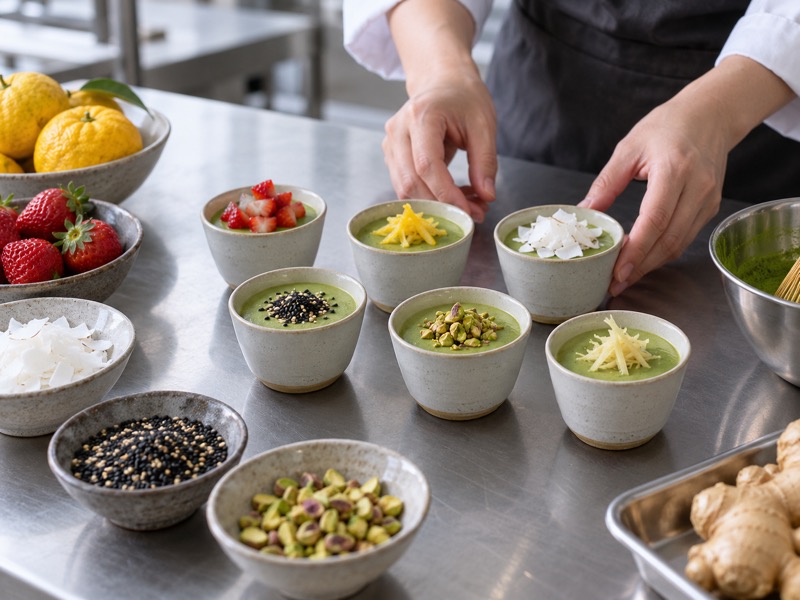
What flavors go well with matcha depends on the tea, the format, and the job of the second ingredient. Strawberry can brighten an iced latte, black sesame can make a dessert feel deeper, and coconut can soften bitterness. None is automatically a good pairing if it hides the tea or destabilizes the drink. A product team needs to taste the same base under controlled conditions and decide what each addition contributes.
This guide is for café menu teams and food brands building a repeatable drink or dessert, not a list of fashionable flavors to pour together. It turns pairing ideas into a short sensory and sourcing program.
Contents
- What should a good matcha pairing achieve?
- How should the reference matcha be tasted first?
- Which fruits complement matcha in drinks?
- When do dairy and plant milks help or hide the tea?
- Which nut and roasted notes work in desserts?
- How do acidity and sweetness change the pairing?
- What can floral or spice notes add?
- How should a team run a small sensory matrix?
- Which ingredients and costs constrain a menu?
- What should the final pilot approve?
1. What should a good matcha pairing achieve?
A pairing should make a particular cup better without making the matcha unrecognizable. Decide whether the partner ingredient will provide contrast, bridge a note already in the tea, or fix a format problem. Citrus can cut a creamy base; toasted sesame can link to roasted notes in a bakery item; vanilla can reduce the perception of rough edges in an economical latte. Name the job before choosing the flavor. That prevents a development session from rewarding the sweetest sample merely because sweetness is easy to like.
Write a target consumer and format beside each concept. A takeaway iced drink needs stability after several minutes, whereas a plated dessert can tolerate a sharp top note that disappears quickly. Pairing success should be judged against tea identity, customer liking, texture, appearance, and the desired price point. A concept that tastes striking in a tiny tasting cup can become exhausting at a full serving. Test both sizes before deciding.
| Pairing job | Candidate | What to verify |
|---|---|---|
| Brighten a creamy drink | Strawberry or yuzu | Tea remains apparent after dilution |
| Add depth to dessert | Black sesame or roasted nut | No burnt aftertaste |
| Soften bitterness | Vanilla or milk | Sweetness does not dominate |
2. How should the reference matcha be tasted first?
Prepare the matcha alone with a weighed powder dose, measured water, and a fixed temperature. Taste it immediately and after a short, consistent hold. Record aroma, vegetal notes, umami, bitterness, astringency, color, and texture in plain words. Keep a control cup on the table throughout development. Otherwise the team may gradually increase fruit or sugar until it forgets what the tea contributes. Use the same matcha lot for the first pairing matrix, then retest finalists with another lot.
The supplier specification matters because different powders make different pairings succeed. A deeply vegetal tea may work with creamy coconut; a softer powder may disappear under coconut and need a lighter partner. Do not assume a marketing grade name predicts the sensory outcome. Ask the supplier for sample consistency, storage instructions, and any relevant safety and traceability records. Compare the proposed commercial lot, not only a premium tasting sample. The formulation must be affordable and available at the intended scale.
3. Which fruits complement matcha in drinks?
Fruit can bring acidity, aroma, color, and sweetness. Strawberry is familiar and visually legible in layered drinks, but purée solids may settle and its red color can muddy the green if blended completely. Citrus such as yuzu or lemon gives a clean top note; high acidity can change milk texture and push the drink toward sourness. Mango and peach offer round sweetness but may cover delicate tea. Test the fruit in the final matrix, including the intended milk, ice, syrup, and serving time.
Start with two fruit types and several modest inclusion levels. Evaluate the aroma of the fruit separately, then the drink immediately and after the expected takeaway hold. Record whether the fruit tastes like a fresh ingredient or a generic candy note. If fruit is supplied as concentrate or purée, request brix, acidity, microbiological and storage information appropriate to the product. A café may tolerate fresh-fruit variation that a packaged beverage cannot. The viable ingredient is the one whose sensory effect can be repeated and costed, not the one with the best sample photograph.
| Fruit route | Useful role | Common trial problem |
|---|---|---|
| Strawberry purée | Familiar berry contrast | Sediment, color mixing |
| Citrus juice or syrup | Bright top note | Milk curdling or sharpness |
| Mango purée | Body and sweetness | Matcha becomes hard to detect |
4. When do dairy and plant milks help or hide the tea?
Milk changes flavor, opacity, body, and perceived bitterness. Whole dairy milk can round a strong powder, while low-fat milk may expose astringency. Oat drinks may add cereal sweetness; soy can bring a beany note; coconut can contribute its own aroma even at low use. Fix the milk before adjusting tea dose. If every tasting uses a different base, the team cannot tell whether an improvement came from the matcha or the milk.
For each shortlisted milk, prepare identical finished volumes with the same tea powder and sugar. Compare hot and iced versions if both will be sold. Check foam, separation, and the appearance of the drink after normal service time. Review allergens and ingredient statements if the concept moves into a packaged format. Milk choice also affects unit cost and procurement: a premium plant drink may turn an appealing concept into an unworkable menu item. The goal is a milk that supports the chosen tea profile and stays available across stores.
5. Which nut and roasted notes work in desserts?
Roasted flavors can complement matcha’s earthy side. Black sesame offers deep toast and a strong visual contrast in ice cream, cookies, or a plated sauce. Pistachio and almond can add rich nut notes, but sweet pastes may bring more sugar than expected. White chocolate contributes fat and sweetness rather than a distinct nut flavor. Taste the matcha after baking or freezing, because heat and cold change aroma and bitterness. A combination that works in a warm ganache may feel flat in frozen cream.
Use ingredient forms that suit the process. A coarse nut paste can make a beverage gritty; a fine paste may still separate. For bakery products, compare added matcha before and after the heating step with a no-matcha control. Record allergen implications prominently. Do not advertise a pairing as “nut free” because a flavor sounds nutty; inspect the actual ingredient and shared equipment. A distributor should request the specification and shelf-life plan for both the matcha and roasted component before offering a finished formulation to clients.
| Dessert format | Pairing candidate | Process check |
|---|---|---|
| Ice cream | Black sesame | Flavor after freezing |
| Cookie | White chocolate | Tea color after baking |
| Cream filling | Pistachio | Smoothness and allergen control |
6. How do acidity and sweetness change the pairing?
Acidity can sharpen fruit and make matcha seem less heavy, but too much may amplify astringency or destabilize dairy. Sweetness can calm bitterness, yet it quickly masks a modest tea dose. Change one variable at a time: compare a base recipe, a slightly sweeter version, and a slightly more acidic version before adjusting both. Record the addition by weight rather than “one pump” unless the pump has been calibrated.
For ready-to-drink products, measure pH and soluble solids with suitable instruments, then have the food-safety and formulation team assess the whole process. Those readings do not by themselves establish shelf life or safety. For café drinks, a simpler tasting grid may be enough, but staff still need a standardized syrup dose. Evaluate the full serving, not only a spoonful. The finish can become cloying after several sips even when the first impression is pleasant. If a recipe needs a large sugar addition to conceal rough tea, compare a different matcha lot before locking the formula.
7. What can floral or spice notes add?
Floral and spice notes work best when they have a narrow purpose. Jasmine can add a fragrant lift, ginger can make a cold fruit drink feel more pointed, and vanilla can bridge matcha with milk. Strong lavender or cinnamon can make the tea seem absent. Dose by aroma threshold, not trend. A short two-level trial is usually more informative than adding several botanical extracts at once. Smell each finished drink before tasting; a dominant top note may signal imbalance even when sweetness makes the flavor acceptable.
Check whether the ingredient is a real botanical, extract, flavor preparation, or syrup, because the label and sourcing documents differ. Some spices create visible flecks or settling. Essential oils require food-use suitability and careful handling; do not improvise with a non-food fragrance. If a concept is intended for multiple countries, have the regulatory team review permitted ingredients and claims in each market. A small, reproducible addition that clarifies the tea is better than an elaborate blend whose supply chain is hard to control.
8. How should a team run a small sensory matrix?
Limit the first matrix to manageable choices: one matcha, one format, three pairing candidates, and two doses of each. Prepare coded cups in random order, using identical finished volume, ice, milk, and service time. Include a no-pairing control. Ask a focused question: which sample makes the tea more appealing while keeping the tea identifiable? Panelists can rate both attributes separately. Invite the people who will sell or manufacture the item, not only the developer who created it.
Record defects as well as preference. A strawberry sample may score highly but separate after ten minutes. A sesame concept may taste excellent while producing an allergen-handling problem in a shared facility. Repeat finalists on a second day and with a second matcha lot. This is not a statistical consumer test; it is an inexpensive screen that prevents obvious failures. If the product is a major launch, follow with a structured consumer study and a documented shelf-life or service-life check.
| Matrix entry | Tea dose | Pairing dose | Observation |
|---|---|---|---|
| Control | Fixed | None | Baseline tea identity |
| A1 / A2 | Fixed | Low / high | Flavor effect and defects |
| B1 / B2 | Fixed | Low / high | Compare against A |
| C1 / C2 | Fixed | Low / high | Compare against A and B |
9. Which ingredients and costs constrain a menu?
Availability can defeat a flavor concept. Fresh fruit prices change by season, imported purées can have long lead times, and a specialty milk may be stocked in only some stores. Calculate cost per finished serving using measured yields, waste, labor, and packaging. Price the operational recipe, including the time to build a layered drink or clean a blender. A concept that needs five separate components during a rush may not survive a busy café shift.
The purchasing brief should specify acceptable alternates and the sensory limits they must meet. Ask suppliers for ingredient identity, allergen status, shelf life, lot traceability, and a change-notification process. For matcha itself, sample the commercial grade and the packaging that will actually ship. If a seasonal fruit must be replaced, test the revised recipe rather than assuming a similar label means a similar flavor. The menu team should know which part of the profile is essential and which can flex without disappointing repeat customers.
| Constraint | Question for buyer | Pilot evidence |
|---|---|---|
| Ingredient seasonality | Is a second source available? | Side-by-side tasting |
| Yield and waste | What reaches the cup? | Measured batch record |
| Service time | Can staff repeat the build? | Timed shift trial |
| Allergen handling | Can the line segregate it? | Approved operating procedure |
10. What should the final pilot approve?
Approve a recipe only after the sensory winner survives a normal service or production run. The final sheet should state ingredient names and weights, matcha lot, water and milk amounts, mixing order, cup size, temperature, appearance, acceptable hold time, allergen declaration, and cost. Run it with ordinary staff and equipment. Expert developers often compensate silently for a recipe’s weak points. Watch whether a new operator can create the same color and tea flavor without verbal coaching.
Keep a photograph of an acceptable cup under standard light, but do not use color alone as quality control. Compare taste and texture after the intended customer wait. Log waste and prep time. If the concept is destined for retail, hand it to the food-safety and regulatory team for packaging and shelf-life work before making launch promises. The best next supplier request is a sample of the exact commercial matcha and pairing ingredient lots, with specifications and a schedule for a second, production-scale trial.
Sources: Matcha Flavor Pairings: Best Combinations for Drinks & Desserts appeared in the archived US SERP for this query. The trial framework above is an original product-development method, not a reproduction of that article. For a related formulation decision, see our matcha latte ratio guide.
FAQ
What is the easiest matcha pairing to test first?
Choose one familiar ingredient already used by the operation, such as strawberry in an iced drink or vanilla in a latte. Compare two measured doses with a plain matcha control.
Does fruit always make matcha taste better?
No. Fruit can improve contrast, but acidity, sweetness, and solids may hide tea or change texture. Taste the complete drink after a realistic hold.
Are nut flavors suitable for every matcha menu?
Only if the sensory result and allergen controls work. Review the actual paste or flavor ingredient, shared equipment, labeling, and the intended customer channel.
How many pairings should a small team screen?
Three candidates at two doses each, plus a control, is a practical first screen. Repeat the finalists rather than expanding to dozens of one-off cups.
When should a brand change the matcha instead of adding more flavor?
If the recipe needs heavy sugar or aroma to conceal harshness, compare another commercially available matcha lot. A different tea can simplify the ingredient list and service process.