
A matcha latte ratio is the measured relationship among matcha powder, preparation water, milk, and, for an iced drink, ice. A café needs that relationship written for a specific cup and serving method. Otherwise one barista pours a green tea drink while another serves mostly milk. This guide shows how to adjust a trial card without losing track of cost or guest experience. A home latte ratio guide can show consumer variations; a café still has to approve its own cup, milk and service method. Matcha Village can provide identified powder samples; the café must approve the finished drink against its own equipment, menu and market.
Table of contents
- What should a matcha latte ratio describe?
- Which measurements belong on a recipe card?
- How can a hot latte baseline be built?
- How should ice change the iced latte calculation?
- What changes when the café uses another milk?
- How should syrup and flavor additions be counted?
- How should matcha samples be compared in a latte?
- How can staff keep the ratio consistent across shifts?
- What should a weak or gritty latte tell the team?
- What should procurement approve before rollout?
1. What should a matcha latte ratio describe?
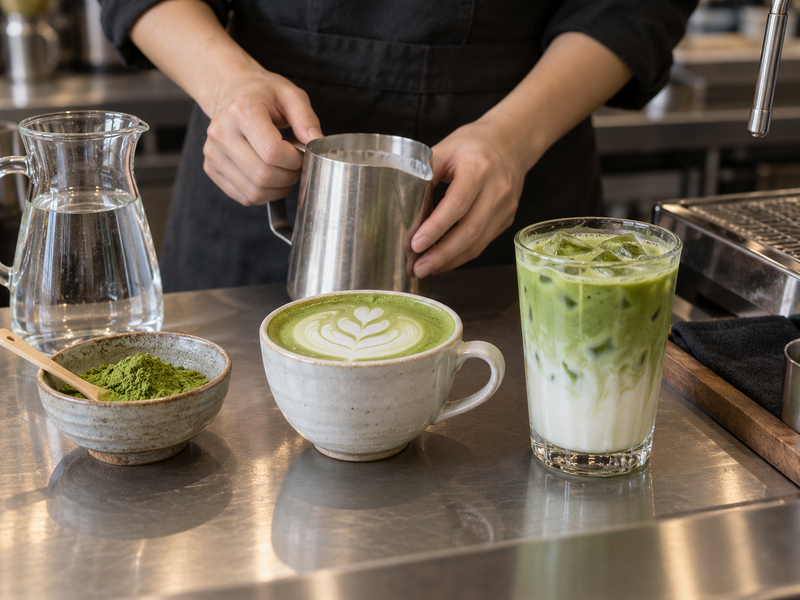
Define the finished drink, not only the whisking step
The water-to-matcha relationship matters for smooth dispersion, but it does not describe what a customer receives. The site’s matcha-to-water ratio guide covers that preparation step. The final latte also contains milk, perhaps syrup, and possibly a substantial ice load. A café recipe must name all of them, plus the intended cup. Two drinks can share the same 3 g of matcha and taste different when one carries 150 ml of milk and the other 240 ml. The target is an identifiable tea note at service, not a pleasing color in the mixing bowl.
Decide what kind of drink the menu promises. A tea-forward 8 oz hot latte may need less milk than a mild 12 oz drink; simply enlarging the cup without changing powder reduces concentration. An iced version changes again as ice occupies cup space and melts. State whether the ratio describes ingredients loaded, liquid delivered, or finished cup volume. A recipe card that specifies only “one scoop matcha” cannot hold the same taste across shifts or sites.
2. Which measurements belong on a recipe card?
Use weights where variation matters
Record matcha in grams. Powder density and a scoop’s fill level vary, while a scale gives a clearer trial comparison. Record water and milk in milliliters or grams, using the same convention across the chain. Note whether milk quantity means cold liquid poured into a pitcher or finished steamed milk with foam. A cup marked “12 oz” may have less usable capacity once the barista leaves headroom, and an iced cup loses space to ice.
Include the powder code, preparation water, milk type, milk amount, syrup amount, ice weight if relevant, target fill level and assembly sequence. The mixing method belongs on the same card because a lumpy base can taste uneven even when measured correctly. Use a short acceptance note such as “tea visible in flavor after three sips, no dry specks, consistent fill.” If a café allows guest adjustments, document how a stronger or less sweet option changes the standard recipe.
| Recipe-card field | Record as | Why staff need it |
|---|---|---|
| Matcha | Grams plus product code | Controls dose and traceability |
| Preparation water | Measured liquid amount | Makes the base repeatable |
| Milk and syrup | Type and measured amount | Controls finished flavor and fill |
| Ice and cup | Ice weight, cup and fill line | Separates liquid volume from cup size |
3. How can a hot latte baseline be built?
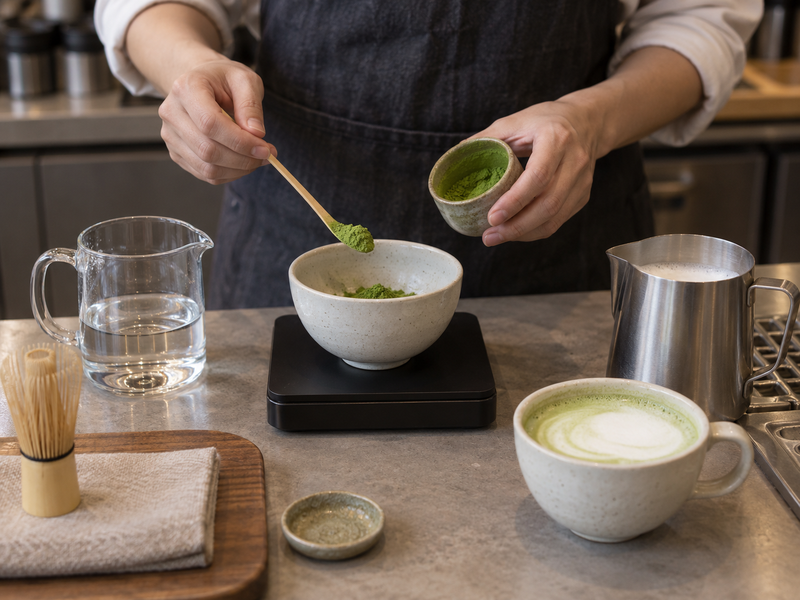
Pilot one cup size before scaling the menu
Begin with the cup the café sells most often. As a trial, an 8 oz service might use 3 g matcha, 35 ml water for dispersion, and enough steamed milk to reach the chosen fill line. That is a development starting point; actual milk volume depends on cup capacity and foam. Wet the weighed matcha thoroughly, then add steamed milk with a repeatable pouring method. If the tea note is lost, adjust powder dose or milk volume in a paired test, not both at once.
When moving to a larger cup, decide whether the menu promises the same tea intensity or a milder drink. Keeping 3 g of matcha while adding more milk changes the ratio, even if staff use the same whisked base. Make a measured trial for each size. Compare powder used, liquid delivered and actual fill, then ask blind tasters which cup tastes balanced. Milk temperature and foam depth should stay consistent, while the operator sets equipment limits and food-handling rules.
| Illustrative hot trial | Matcha | Preparation water | Milk decision |
|---|---|---|---|
| 8 oz baseline | 3 g | 35 ml | Add measured steamed milk to tested fill line |
| 12 oz, same intensity | Re-test dose | Keep dispersion workable | Measure extra milk, then taste blind |
| 12 oz, gentler profile | Hold baseline dose | Keep preparation method | Document weaker tea target on menu card |
4. How should ice change the iced latte calculation?
Count the space ice takes and the water it adds
An iced cup’s printed volume is not its liquid volume. A 16 oz cup filled with ice can accept much less beverage than an empty 16 oz cup. The ice also melts during queueing, delivery and drinking. Set an ice weight or a tested scoop, then measure how much cold milk and matcha base the cup accepts to a defined fill line. Taste the iced drink immediately and after the normal pickup interval.
A useful pilot makes three cups with the same matcha dose and different controlled ice weights. The lightest ice load may leave a warmer drink; the heaviest may displace too much tea and milk. The best option balances temperature, dilution and actual saleable liquid. If the café plans delivery, test the lidded package at the expected handoff time. Ice melt varies with environment, so the card should specify an ice portion and a service condition, not promise an exact dilution.
| Iced trial check | How to measure | Decision |
|---|---|---|
| Ice loading | Weigh the filled scoop | Fix cup displacement |
| Liquid capacity | Measure base plus milk at fill line | Avoid overflow and weak cups |
| Pickup taste | Sample after normal wait | Judge melted-ice dilution |
| Delivery route | Test the lidded packed cup | Decide if a separate recipe is needed |
5. What changes when the cafe uses another milk?
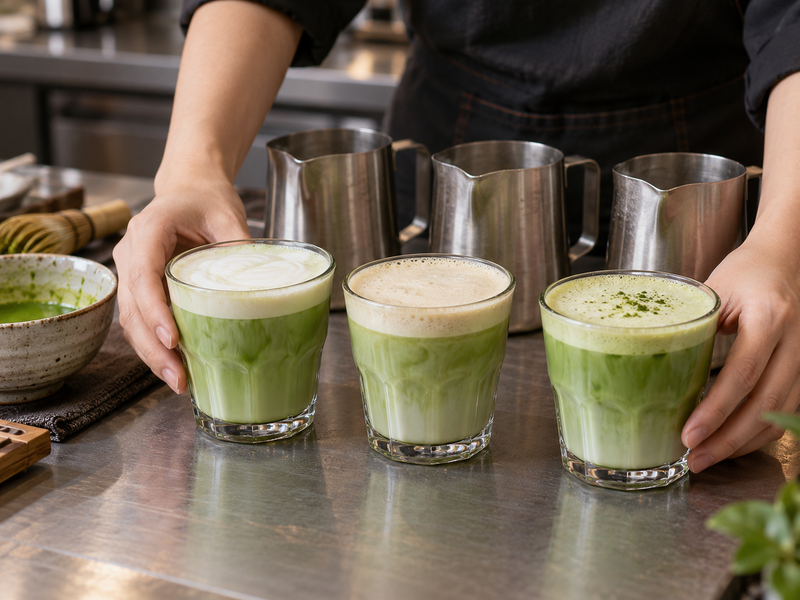
Hold the tea dose steady for the first comparison
Whole dairy milk, oat milk, soy milk and almond milk do not taste or foam the same. One may carry more natural sweetness; another may make matcha seem sharper or thinner. Compare milk choices with the same matcha sample, water amount, cup and serving temperature. Then adjust milk quantity or powder dose only if the finished drink needs it. A plant milk that foams high can make a cup look full with less liquid, so measure what reaches the guest.
Use the café’s real brands or purchasing candidates in the test. Different commercial formulations within one milk category may behave differently during steaming or over ice. Taste each latte at handoff. Record tea flavor, texture, and any separation during normal service. If a non-dairy option needs a distinct recipe, put it on a separate card instead of telling staff to “substitute milk.” Ingredient and allergen information for the finished menu item remains the operator’s responsibility.
6. How should syrup and flavor additions be counted?
Give every liquid a place in the cup
Syrup is both a flavor decision and a volume contribution. A sweetener added without reducing other liquid may raise the fill level or dilute the tea impression. A strawberry purée or thick sauce brings more body and can change the matcha layer. For each flavored drink, record the extra ingredient as a measured addition. Decide whether milk decreases to preserve total liquid volume or whether the menu offers a larger finished drink.
Start with the plain matcha latte as a control. Test one flavored version at a time with the same powder and milk. Ask whether the matcha note remains or the syrup has become the main product. That result may justify a stronger base or a different powder, but changing both together hides the reason. A chain should specify the syrup pump or measured mass. If a topping replaces drink volume, note that on the card too.
7. How should matcha samples be compared in a latte?
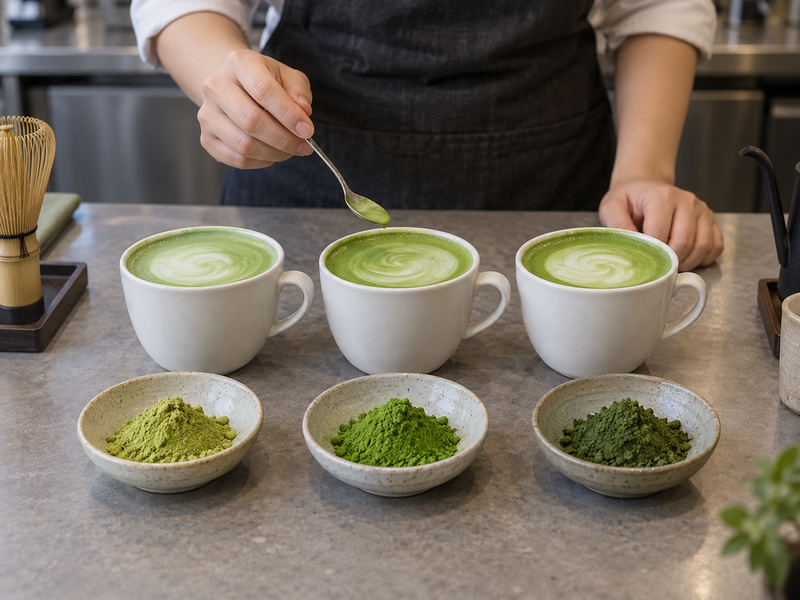
Test candidates in the same finished matrix
Matcha Village lists several matcha ranges and blends for different applications. A grade name can help select samples, but it does not determine the best latte. Ask for two or three identified powders and prepare each with the same measured water, milk and powder weight. Keep sweetness out of the first comparison unless the menu requires it. Judge the completed latte for tea character, bitterness, smoothness, and color after normal service. A powder that looks brilliant dry may be muted by milk; another may need less mass for a clear tea note.
If a formulated latte powder is compared with pure matcha, do not apply the same gram dose without reading its composition. Sugar or milk ingredients in a blend change sweetness, labeling and cost calculations. Evaluate each product on an equivalent finished serving and record the exact material code. Ask for current specifications, pack options and destination-market documents before approval. The café owns the final formula and menu claim.
8. How can staff keep the ratio consistent across shifts?
Turn the trial into a short operating card
Give staff one card per cup size and milk variant. It should show powder grams, water amount, milk amount, ice portion if applicable, assembly sequence, and an accepted photo. A barista should be able to reproduce the recipe without interpreting “strong” or “a splash.” Preweighed portions may help a high-volume line, but they need the same lot identity and storage discipline as bulk powder. If using a scoop, check its average filled weight against the scale during training.
Test the card on a busy shift with several staff. Watch where variation enters: spooning powder, estimating milk, inconsistent ice, or a cup swap. Correct the largest source before rewriting the recipe. A calibration tasting at shift change can catch drift after a new powder lot or milk brand arrives. For chains, record approved ingredient codes and substitution authority.
| Control point | Simple staff method | Manager check |
|---|---|---|
| Powder dose | Weigh or use verified portion | Spot-check grams |
| Water and milk | Marked vessel or programmed measure | Check fill and taste |
| Ice | Defined scoop plus periodic weighing | Compare cup liquid level |
| Product change | Use approved code and card revision | Retest before substitution |
9. What should a weak or gritty latte tell the team?
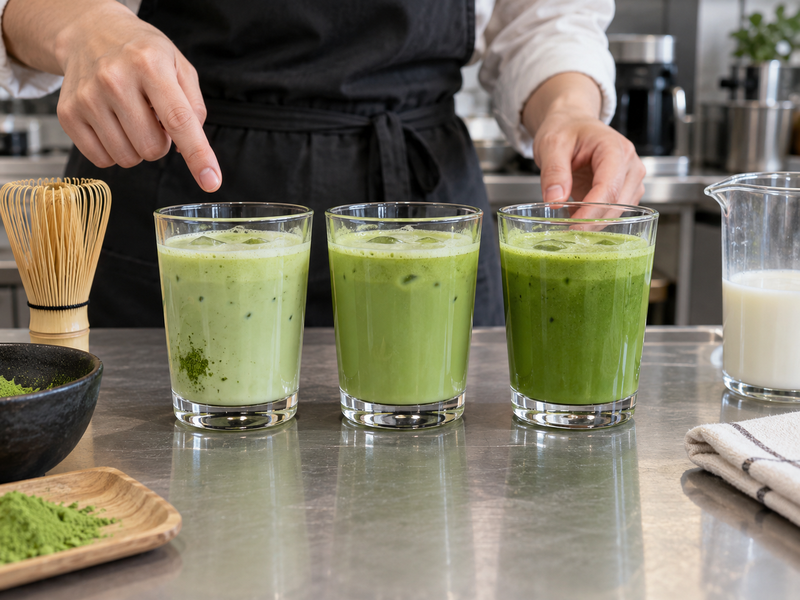
Diagnose the cup before changing the powder
A weak latte may contain too much milk, melted ice, too little matcha, or a powder whose tea character does not carry through the base. A gritty latte may point to clumps, poor wetting, a coarse sample or settling during service. Those problems need different fixes. Recreate the failure with the written recipe and measure every addition. Do not automatically increase matcha; that can raise cost and bitterness while leaving clumps untouched.
Taste the matcha base before milk and the final cup afterward. If the base is smooth but the latte looks patchy, review assembly and milk compatibility. If only large iced cups taste weak, inspect ice load and delivered liquid. If a new batch changes flavor, compare a retained sample with the incoming lot under the same recipe. Record the outcome rather than adjusting by eye at each outlet.
| Cup symptom | Check first | Controlled next trial |
|---|---|---|
| Tea note too faint | Powder grams, milk and ice | Hold cup size, change one dose |
| Dry specks or grit | Wetting and mixing | Compare dispersion method |
| Uneven color | Assembly and hold time | Sample fresh and handoff cups |
| Bitter finish | Dose and powder sample | Taste equal-dose alternatives |
10. What should procurement approve before rollout?
Buy the material that passed the cup test
The purchasing brief should name the approved powder code, its tested dose per hot and iced serving, milk variants, pack size, forecast volume, and destination market. Add the current specification and required quality documents, then request a quotation for that material. Matcha Village’s supplied company information describes matcha grades, blends and application support, but the buyer must confirm product-specific terms. A low price per kilogram can mislead if the powder needs a larger dose in milk. Calculate ingredient cost per saleable cup.
Before rollout, run a repeat test with a new lot and more than one barista. Record acceptable differences in color and flavor, escalation steps, and who can approve a substitution. For larger chains, test both quiet service and a rush. Send Matcha Village target cup sizes and milk choices, request traceable samples, and run a paired latte trial. That makes the ratio a buying and training decision rather than a number borrowed from a home recipe.
FAQ
Q1: Is a matcha-to-water ratio the same as a matcha latte ratio? No. Preparation water is one part of a latte; the finished recipe also needs milk, cup size and possibly ice.
Q2: Should a larger latte always use more matcha? If the café promises similar tea strength, retest the dose when milk volume rises. Document a deliberately milder larger cup separately.
Q3: Can hot and iced drinks use one recipe card? They can share a powder and base method, but ice displacement and melt usually require an iced card.
Q4: Does changing from dairy to oat milk change the ratio? It may. Keep powder constant for the first paired test, then adjust from finished-cup taste and fill.
Q5: What should a buyer request from Matcha Village? Ask for identified samples, current specifications, available packs and a quote tied to the tested latte formula.